
Journal of Shanghai Jiao Tong University (Medical Science) ›› 2025, Vol. 45 ›› Issue (10): 1271-1278.doi: 10.3969/j.issn.1674-8115.2025.10.002
• Frontier review • Previous Articles Next Articles
SONG Yijie1, CHEN Tianzhen1, ZHONG Na1, ZHAO Min1,2( )
)
Received:2025-01-15
Accepted:2025-04-07
Online:2025-10-28
Published:2025-10-14
Contact:
ZHAO Min
E-mail:drminzhao@smhc.org.cn
Supported by:CLC Number:
SONG Yijie, CHEN Tianzhen, ZHONG Na, ZHAO Min. Applications and challenges of generative artificial intelligence in psychiatry[J]. Journal of Shanghai Jiao Tong University (Medical Science), 2025, 45(10): 1271-1278.
Add to citation manager EndNote|Ris|BibTeX
URL: https://xuebao.shsmu.edu.cn/EN/10.3969/j.issn.1674-8115.2025.10.002
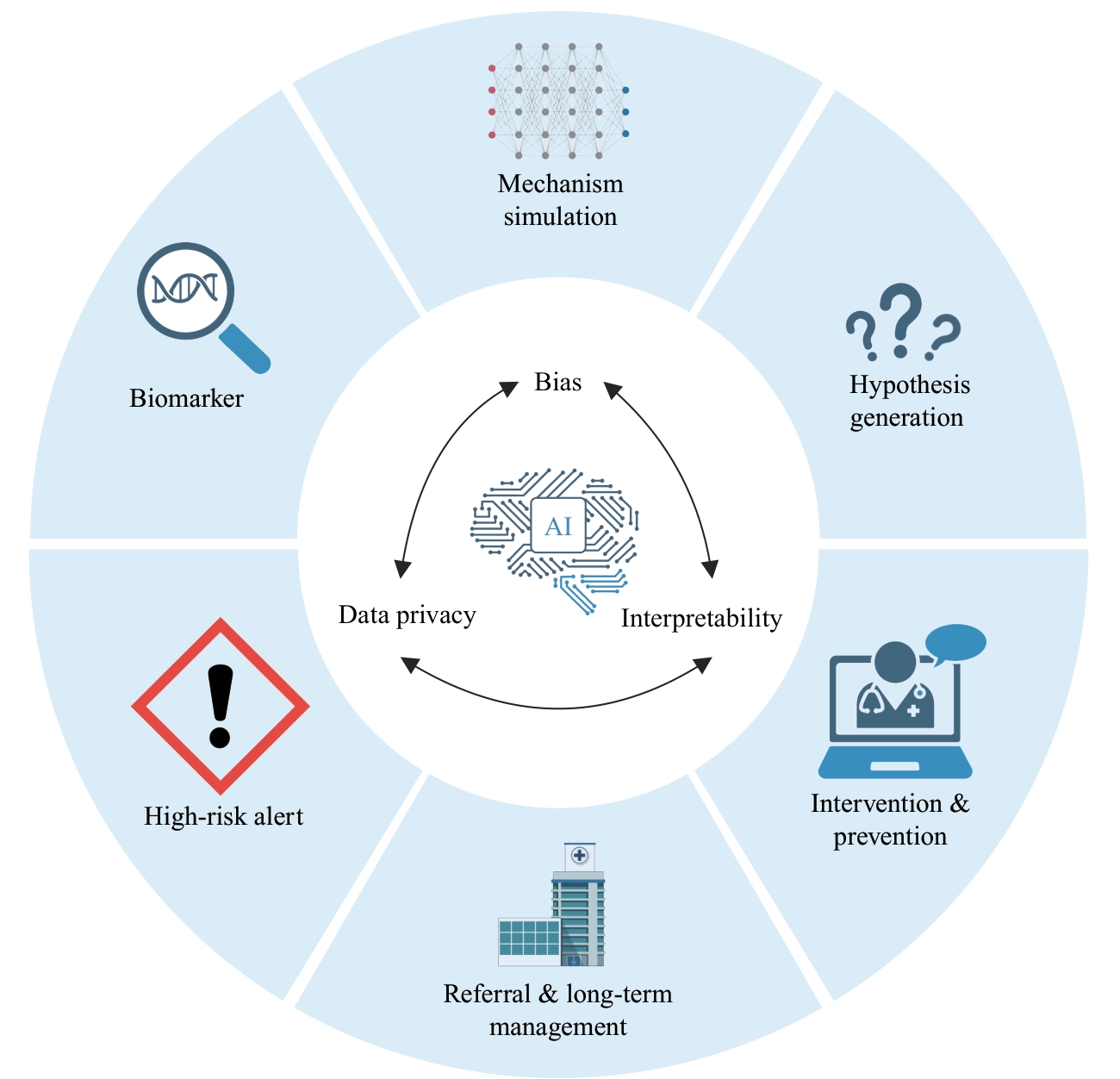
Fig 1 Applications and challenges of generative AI in psychiatry
| [1] | GBD 2019 Diseases and Injuries Collaborators. Global burden of 369 diseases and injuries in 204 countries and territories, 1990‒2019: a systematic analysis for the Global Burden of Disease Study 2019[J]. Lancet, 2020, 396(10258): 1204-1222. |
| [2] | GBD 2019 Diseases and Injuries Collaborators. Global, regional, and national burden of 12 mental disorders in 204 countries and territories, 1990‒2019: a systematic analysis for the Global Burden of Disease Study 2019[J]. Lancet Psychiatry, 2022, 9(2): 137-150. |
| [3] | INSEL T R, LANDIS S C. Twenty-five years of progress: the view from NIMH and NINDS[J]. Neuron, 2013, 80(3): 561-567. |
| [4] | KRYSTAL J H, STATE M W. Psychiatric disorders: diagnosis to therapy[J]. Cell, 2014, 157(1): 201-214. |
| [5] | KEYNEJAD R C, DUA T R, BARBUI C, et al. WHO Mental Health Gap Action Programme (mhGAP) Intervention Guide: a systematic review of evidence from low and middle-income countries[J]. Evid Based Ment Health, 2018, 21(1): 30-34. |
| [6] | KIRKBRIDE J B, ANGLIN D M, COLMAN I, et al. The social determinants of mental health and disorder: evidence, prevention and recommendations[J]. World Psychiatry, 2024, 23(1): 58-90. |
| [7] | PATHARE S, BRAZINOVA A, LEVAV I. Care gap: a comprehensive measure to quantify unmet needs in mental health[J]. Epidemiol Psychiatr Sci, 2018, 27(5): 463-467. |
| [8] | YENDURI G, RAMALINGAM M, SELVI G C, et al. GPT (generative pre-trained transformer): a comprehensive review on enabling technologies, potential applications, emerging challenges, and future directions[J]. IEEE Access, 2024, 12: 54608-54649. |
| [9] | CHEN L, WU P H, CHITTA K, et al. End-to-end autonomous driving: challenges and frontiers[J]. IEEE Trans Pattern Anal Mach Intell, 2024, 46(12): 10164-10183. |
| [10] | BARKE S, JAMES M B, POLIKARPOVA N. Grounded copilot: how programmers interact with code-generating models[J]. Proc ACM Program Lang, 2023, 7(OOPSLA1): 85-111. |
| [11] | SINGHAL K, TU T, GOTTWEIS J, et al. Toward expert-level medical question answering with large language models[J]. Nat Med, 2025, 31(3): 943-950. |
| [12] | REDDY S. Generative AI in healthcare: an implementation science informed translational path on application, integration and governance[J]. Implement Sci, 2024, 19(1): 27. |
| [13] | FEUERRIEGEL S, HARTMANN J, JANIESCH C, et al. Generative AI[J]. Bus Inf Syst Eng, 2024, 66(1): 111-126. |
| [14] | BALLARD J L, WANG Z, LI W, et al. Deep learning-based approaches for multi-omics data integration and analysis[J]. BioData Min, 2024, 17(1): 38. |
| [15] | PUGLISI L, ALEXANDER D C, RAVÌ D. Enhancing spatiotemporal disease progression models via latent diffusion and prior knowledge[C]//LINGURARU M G, DOU Q, FERAGEN A, et al. Medical image computing and computer assisted intervention—MICCAI 2024. Cham: Springer, 2024: 173-183. |
| [16] | JUNG E, LUNA M, PARK S H. Conditional GAN with 3D discriminator for MRI generation of Alzheimer's disease progression[J]. Pattern Recognit, 2023, 133: 109061. |
| [17] | STRACK C, POMYKALA K L, SCHLEMMER H P, et al. "A net for everyone": fully personalized and unsupervised neural networks trained with longitudinal data from a single patient[J]. BMC Med Imaging, 2023, 23(1): 174. |
| [18] | ELAZAB A, WANG C M, GARDEZI S J S, et al. GP-GAN: brain tumor growth prediction using stacked 3D generative adversarial networks from longitudinal MR Images[J]. Neural Netw, 2020, 132: 321-332. |
| [19] | XIA T, CHARTSIAS A, WANG C J, et al. Learning to synthesise the ageing brain without longitudinal data[J]. Med Image Anal, 2021, 73: 102169. |
| [20] | ZHANG K, CHEN G, HUANG S J, et al. Development-driven diffusion model for longitudinal prediction of fetal brain MRI with unpaired data[J]. IEEE Trans Med Imaging, 2025, 44(9): 3641-3653. |
| [21] | SEILER M, RITTER K. Pioneering new paths: the role of generative modelling in neurological disease research[J]. Pflugers Arch, 2025, 477(4): 571-589. |
| [22] | WEI W, POIRION E, BODINI B, et al. Predicting PET-derived myelin content from multisequence MRI for individual longitudinal analysis in multiple sclerosis[J]. Neuroimage, 2020, 223: 117308. |
| [23] | HUANG Q, QIAO C, JING K L, et al. Biomarkers identification for schizophrenia via VAE and GSDAE-based data augmentation[J]. Comput Biol Med, 2022, 146: 105603. |
| [24] | SOKOLOV A V, SCHIÖTH H B. Decoding depression: a comprehensive multi-cohort exploration of blood DNA methylation using machine learning and deep learning approaches[J]. Transl Psychiatry, 2024, 14(1): 287. |
| [25] | ALLESØE R L, NUDEL R, THOMPSON W K, et al. Deep learning-based integration of genetics with registry data for stratification of schizophrenia and depression[J]. Sci Adv, 2022, 8(26): eabi7293. |
| [26] | ZHAO J L, HUANG J J, ZHI D M, et al. Functional network connectivity (FNC)-based generative adversarial network (GAN) and its applications in classification of mental disorders[J]. J Neurosci Methods, 2020, 341: 108756. |
| [27] | FAN J T, FANG L, WU J M, et al. From brain science to artificial intelligence[J]. Engineering, 2020, 6(3): 248-252. |
| [28] | CUSHING C A, DAWES A J, HOFMANN S G, et al. A generative adversarial model of intrusive imagery in the human brain[J]. PNAS Nexus, 2023, 2(1): pgac265. |
| [29] | YAMAGUCHI H, SUGIHARA G, SHIMIZU M, et al. Generative artificial intelligence model for simulating structural brain changes in schizophrenia[J]. Front Psychiatry, 2024, 15: 1437075. |
| [30] | OQUENDO M A, BACA-GARCIA E, ARTÉS-RODRÍGUEZ A, et al. Machine learning and data mining: strategies for hypothesis generation[J]. Mol Psychiatry, 2012, 17(10): 956-959. |
| [31] | TONG S, MAO K, HUANG Z, et al. Automating psychological hypothesis generation with AI: when large language models meet causal graph[DB/OL]. (2024-07-16)[2024-12-30]. https://arxiv.org/abs/2402.14424. |
| [32] | BRIGANTI G, KORNREICH C, LINKOWSKI P. A network structure of manic symptoms[J]. Brain Behav, 2021, 11(3): e02010. |
| [33] | BRIGANTI G, FRIED E I, LINKOWSKI P. Network analysis of contingencies of Self-Worth Scale in 680 university students[J]. Psychiatry Res, 2019, 272: 252-257. |
| [34] | TLACHAC M, GERYCH W, AGRAWAL K, et al. Text generation to aid depression detection: a comparative study of conditional sequence generative adversarial networks[C]//2022 IEEE International Conference on Big Data (Big Data). Osaka: IEEE, 2022: 2804-2813. |
| [35] | KANCHARAPU R, AYYAGARI S N. Suicidal ideation prediction based on social media posts using a GAN-infused deep learning framework with genetic optimization and word embedding fusion[J]. Int J Inf Technol, 2024, 16(4): 2577-2593. |
| [36] | HASSANTABAR S, ZHANG J, YIN H X, et al. MHDeep: mental health disorder detection system based on wearable sensors and artificial neural networks[J]. ACM Trans Embed Comput Syst, 2022, 21(6): 1-22. |
| [37] | DAI R X, KANNAMPALLIL T, KIM S, et al. Detecting mental disorders with wearables: a large cohort study[C]//Proceedings of the 8th ACM/IEEE conference on internet of things design and implementation. New York: Association for Computing Machinery, 2023: 39-51. |
| [38] | WANG W, CHEN J, HU Y Z, et al. Integration of artificial intelligence and wearable Internet of Things for mental health detection[J]. Int J Cogn Comput Eng, 2024, 5: 307-315. |
| [39] | TANG J W, SHANG Y. Advancing mental health pre-screening: a new custom GPT for psychological distress assessment[C]//2024 IEEE 6th international conference on cognitive machine intelligence (CogMI). Washington, D.C.: IEEE, 2024: 162-171. |
| [40] | FU Y J, RAMACHANDRAN G K, DOBBINS N J, et al. Extracting social determinants of health from pediatric patient notes using large language models: novel corpus and methods[DB/OL]. (2024-04-04)[2024-12-30]. https://arxiv.org/abs/2404.00826. |
| [41] | HABICHT J, VISWANATHAN S, CARRINGTON B, et al. Closing the accessibility gap to mental health treatment with a personalized self-referral chatbot[J]. Nat Med, 2024, 30(2): 595-602. |
| [42] | ROLLWAGE M, HABICHT J, JUECHEMS K, et al. Using conversational AI to facilitate mental health assessments and improve clinical efficiency within psychotherapy services: real-world observational study[J]. JMIR AI, 2023, 2: e44358. |
| [43] | HABER Y, LEVKOVICH I, HADAR-SHOVAL D, et al. The artificial third: a broad view of the effects of introducing generative artificial intelligence on psychotherapy[J]. JMIR Ment Health, 2024, 11: e54781. |
| [44] | XIAO M X, XIE Q Q, KUANG Z Y, et al. HealMe: harnessing cognitive reframing in large language models for psychotherapy[DB/OL]. (2024-07-29)[2024-12-30]. https://arxiv.org/abs/2403.05574. |
| [45] | NIE J P, SHAO H Y, FAN Y A, et al. LLM-based conversational AI therapist for daily functioning screening and psychotherapeutic intervention via everyday smart devices[DB/OL]. (2024-03-16)[2024-12-30]. https://arxiv.org/abs/2403.10779. |
| [46] | NA H B. CBT-LLM: a Chinese large language model for cognitive behavioral therapy-based mental health question answering[DB/OL]. (2024-03-24)[2024-12-30]. https://arxiv.org/abs/2403.16008. |
| [47] | KIM T, BAE S, KIM H A, et al. MindfulDiary: harnessing large language model to support psychiatric patients' journaling[C]//Proceedings of the 2024 CHI conference on human factors in computing systems. New York: Association for Computing Machinery, 2024: 1-20. |
| [48] | HEINZ M V, BHATTACHARYA S, TRUDEAU B, et al. Testing domain knowledge and risk of bias of a large-scale general artificial intelligence model in mental health[J]. Digit Health, 2023, 9: 20552076231170499. |
| [49] | KING D R, NANDA G, STODDARD J, et al. An introduction to generative artificial intelligence in mental health care: considerations and guidance[J]. Curr Psychiatry Rep, 2023, 25(12): 839-846. |
| [50] | BLEASE C, TOROUS J. ChatGPT and mental healthcare: balancing benefits with risks of harms[J]. BMJ Ment Health, 2023, 26(1): e300884. |
| [51] | RAMACHANDRANPILLAI R, SIKDER M F, BERGSTRÖM D, et al. Bt-GAN: generating fair synthetic healthdata via bias-transforming generative adversarial networks[J]. J Artif Intell Res, 2024, 79: 1313-1341. |
| [52] | KTENA I, WILES O, ALBUQUERQUE I, et al. Generative models improve fairness of medical classifiers under distribution shifts[J]. Nat Med, 2024, 30(4): 1166-1173. |
| [53] | GOLDEN A, ABOUJAOUDE E. Describing the framework for AI tool assessment in mental health and applying it to a generative AI obsessive-compulsive disorder platform: tutorial[J]. JMIR Form Res, 2024, 8: e62963. |
| [54] | TORTORA L. Beyond discrimination: generative AI applications and ethical challenges in forensic psychiatry[J]. Front Psychiatry, 2024, 15: 1346059. |
| [55] | BAIRD A, XIA Y S. Applying analytics to sociodemographic disparities in mental health[J]. Nat Ment Health, 2025, 3: 124-138. |
| [56] | TOROUS J, BLEASE C. Generative artificial intelligence in mental health care: potential benefits and current challenges[J]. World Psychiatry, 2024, 23(1): 1-2. |
| [57] | DE FREITAS J, COHEN I G. The health risks of generative AI-based wellness apps[J]. Nat Med, 2024, 30(5): 1269-1275. |
| [58] | NGUYEN N B, CHANDRASEGARAN K, ABDOLLAHZADEH M, et al. Re-thinking model inversion attacks against deep neural networks[C]//2023 IEEE/CVF conference on computer vision and pattern recognition (CVPR). Vancouver: IEEE, 2023: 16384-16393. |
| [59] | HU H S, SALCIC Z, SUN L C, et al. Membership inference attacks on machine learning: a survey[J]. ACM Comput Surv, 2022, 54(11s): 1-37. |
| [60] | OROOJI M, RABBANIAN S S, KNAPP G M. Flexible adversary disclosure risk measure for identity and attribute disclosure attacks[J]. Int J Inf Secur, 2023, 22(3): 631-645. |
| [61] | BENOUIS M, ANDRE E, CAN Y S. Balancing between privacy and utility for affect recognition using multitask learning in differential privacy-added federated learning settings: quantitative study[J]. JMIR Ment Health, 2024, 11: e60003. |
| [62] | LI N, ZHOU C Y, GAO Y S, et al. Machine unlearning: taxonomy, metrics, applications, challenges, and prospects[J]. IEEE Trans Neural Netw Learn Syst, 2025, 36(8): 13709-13729. |
| [63] | HUANG K, GOERTZEL B, WU D, et al. GenAI model security[M]//HUANG K, WANG Y, GOERTZEL B, et al. Generative AI Security:Theories and Practices. Cham: Springer, 2024: 163-198. |
| [64] | WANG S Y, DU Y Q, GUO X J, et al. Controllable data generation by deep learning: a review[J]. ACM Comput Surv, 2024, 56(9): 1-38. |
| [65] | SHELAR H, KAUR G, HEDA N, et al. Named entity recognition approaches and their comparison for custom NER model[J]. Sci Technol Libr, 2020, 39(3): 324-337. |
| [66] | TURGAY S, İLTER İ. Perturbation methods for protecting data privacy: a review of techniques and applications[J]. Autom Mach Learn, 2023, 4(2): 31-41. |
| [67] | FAN T, KANG Y, CHEN W J, et al. PDSS: a privacy-preserving framework for step-by-step distillation of large language models[DB/OL]. (2024-06-18)[2025-02-20]. https://arxiv.org/abs/2406.12403. |
| [68] | MANDAL A, CHAKRABORTY T, GUREVYCH I. Towards privacy-aware mental health AI models: advances, challenges, and opportunities[DB/OL]. (2025-02-01)[2025-02-20]. https://arxiv.org/abs/2502.00451. |
| [69] | GAID M L, SALLOUM S A. Homomorphic encryption[C]//HASSANIEN A E, HAQIQ A, TONELLATO P J, et al. Proceedings of the international conference on artificial intelligence and computer vision (AICV2021). Cham: Springer, 2021: 634-642. |
| [70] | LETAFATI M, OTOUM S. On the privacy and security for e-health services in the metaverse: an overview[J]. Ad Hoc Netw, 2023, 150: 103262. |
| [71] | EBRAHIMI M, SAHAY R, HOSSEINALIPOUR S, et al. The transition from centralized machine learning to federated learning for mental health in education: a survey of current methods and future directions[DB/OL]. (2025-01-20)[2025-02-20]. https://arxiv.org/abs/2501.11714. |
| [72] | CHADDAD A, WU Y H, DESROSIERS C. Federated learning for healthcare applications[J]. IEEE Internet Things J, 2024, 11(5): 7339-7358. |
| [73] | GUJARATHI P, MENON K, PATEL J, et al. NeuroSafe-advancing mental health using AI, ML and blockchain[C]//2024 3rd international conference for innovation in technology (INOCON). Bangalore: IEEE, 2024: 1-5. |
| [74] | GAMI B, AGRAWAL M, MISHRA D K, et al. Artificial intelligence-based blockchain solutions for intelligent healthcare: a comprehensive review on privacy preserving techniques[J]. Trans Emerging Tel Tech, 2023, 34(9): e4824. |
| [75] | RASHEED K, QAYYUM A, GHALY M, et al. Explainable, trustworthy, and ethical machine learning for healthcare: a survey[J]. Comput Biol Med, 2022, 149: 106043. |
| [76] | BLEASE C, WORTHEN A, TOROUS J. Psychiatrists' experiences and opinions of generative artificial intelligence in mental healthcare: an online mixed methods survey[J]. Psychiatry Res, 2024, 333: 115724. |
| [77] | YANG K L, ZHANG T L, KUANG Z Y, et al. MentaLLaMA: interpretable mental health analysis on social media with large language models[C]//Proceedings of the ACM web conference 2024. New York: Association for Computing Machinery, 2024: 4489-4500. |
| [78] | ZHENG X W, ZHANG L F, XU C Y, et al. An attribution graph-based interpretable method for CNNs[J]. Neural Netw, 2024, 179: 106597. |
| [79] | CHEFER H, GUR S, WOLF L. Generic attention-model explainability for interpreting bi-modal and encoder-decoder transformers[C]//2021 IEEE/CVF international conference on computer vision (ICCV). Montreal: IEEE, 2021: 387-396. |
| [80] | PAREKH J, KHAYATAN P, SHUKOR M, et al. A concept-based explainability framework for large multimodal models[C]//Proceedings of the 38th international conference on neural information processing systems. New York: Curran Associates Inc., 2025: 135783-135818. |
| [81] | STAN G B M, AFLALO E, ROHEKAR R Y, et al. LVLM-interpret: an interpretability tool for large vision-language models[DB/OL]. (2024-06-24)[2025-02-20]. https://arxiv.org/abs/2404.03118. |
| [82] | LIU Y, YAO Y S, TON J-F, et al., Trustworthy LLMs: a survey and guideline for evaluating large language models' alignment[DB/OL]. (2024-03-21)[2025-02-20]. https://arxiv.org/abs/2308.05374. |
| [83] | SIROCCHI C, BOGLIOLO A, MONTAGNA S. Medical-informed machine learning: integrating prior knowledge into medical decision systems[J]. BMC Med Inform Decis Mak, 2024, 24(Suppl 4): 186. |
| [84] | SHNEIDERMAN B. Bridging the gap between ethics and practice: guidelines for reliable, safe, and trustworthy human-centered AI systems[J]. ACM Trans Interact Intell Syst, 2020, 10(4): 1-31. |
| [85] | MORLEY J, MACHADO C C V, BURR C, et al. The ethics of AI in health care: a mapping review[J]. Soc Sci Med, 2020, 260: 113172. |
| [86] | MONTEITH S, GLENN T, GEDDES J R, et al. Artificial intelligence and increasing misinformation[J]. Br J Psychiatry, 2024, 224(2): 33-35. |
| [87] | WANG C Y, LIU S R, YANG H, et al. Ethical considerations of using ChatGPT in health care[J]. J Med Internet Res, 2023, 25: e48009. |
| [1] | SHI Zhong-ying, ZHANG Shu-ying, GAO Qi, et al. Effects of e-learning based international cooperative training on developing core competence of psychiatric nurses [J]. , 2015, 35(8): 1213-. |
| Viewed | ||||||
|
Full text |
|
|||||
|
Abstract |
|
|||||
