
Journal of Shanghai Jiao Tong University (Medical Science) ›› 2025, Vol. 45 ›› Issue (7): 807-814.doi: 10.3969/j.issn.1674-8115.2025.07.001
• Column of multiple myeloma • Next Articles
YAN Zhi, WU Xingyue, YAO Weiqin, YAN Lingzhi, JIN Song, SHANG Jingjing, SHI Xiaolan, WU Depei, FU Chengcheng( )
)
Received:2025-02-13
Accepted:2025-05-07
Online:2025-07-28
Published:2025-07-28
Contact:
FU Chengcheng
E-mail:fuchengchengsz@163.com
Supported by:CLC Number:
YAN Zhi, WU Xingyue, YAO Weiqin, YAN Lingzhi, JIN Song, SHANG Jingjing, SHI Xiaolan, WU Depei, FU Chengcheng. Dynamic changes and prognostic significance of immunoparesis in newly diagnosed multiple myeloma patients[J]. Journal of Shanghai Jiao Tong University (Medical Science), 2025,(7): 807-814.
Add to citation manager EndNote|Ris|BibTeX
URL: https://xuebao.shsmu.edu.cn/EN/10.3969/j.issn.1674-8115.2025.07.001
| Characteristic | Overall (n=142) | Less than severe (n=34) | Severe (n=49) | Extremely severe (n=59) | P value |
|---|---|---|---|---|---|
| Age/year | 58.0 (53.0, 63.0) | 60.5 (55.3, 64.0) | 56.0 (51.0, 62.0) | 56.0 (53.0, 62.0) | 0.085 |
| Male/n(%) | 80 (56.3) | 16 (47.1) | 28 (57.1) | 36 (61.0) | 0.421 |
| Ccr<40 mL·min-1/n(%) | 40 (28.2) | 11 (32.4) | 11 (22.4) | 18 (30.5) | 0.536 |
| High risk/n(%) | 35 (24.6) | 9 (26.5) | 13 (26.5) | 13 (22.0) | 0.831 |
| R-ISS stage/n(%) | 0.008 | ||||
| Ⅰ | 17 (12.1) | 9 (26.5) | 7 (14.6) | 1 (1.7) | |
| Ⅱ | 102 (72.3) | 19 (55.9) | 34 (70.8) | 49 (83.1) | |
| Ⅲ | 22 (15.6) | 6 (17.6) | 7 (14.6) | 9 (15.3) | |
| Type/n(%) | 0.010 | ||||
| IgG | 72 (50.7) | 15 (44.1) | 21 (42.9) | 36 (61.0) | |
| IgA | 30 (21.1) | 13 (38.2) | 12 (24.5) | 5 (8.5) | |
| Others | 40 (28.2) | 6 (17.6) | 16 (32.7) | 18 (30.5) |
Tab 1 Factors influencing the degree of immunoparesis in 142 MM patients
| Characteristic | Overall (n=142) | Less than severe (n=34) | Severe (n=49) | Extremely severe (n=59) | P value |
|---|---|---|---|---|---|
| Age/year | 58.0 (53.0, 63.0) | 60.5 (55.3, 64.0) | 56.0 (51.0, 62.0) | 56.0 (53.0, 62.0) | 0.085 |
| Male/n(%) | 80 (56.3) | 16 (47.1) | 28 (57.1) | 36 (61.0) | 0.421 |
| Ccr<40 mL·min-1/n(%) | 40 (28.2) | 11 (32.4) | 11 (22.4) | 18 (30.5) | 0.536 |
| High risk/n(%) | 35 (24.6) | 9 (26.5) | 13 (26.5) | 13 (22.0) | 0.831 |
| R-ISS stage/n(%) | 0.008 | ||||
| Ⅰ | 17 (12.1) | 9 (26.5) | 7 (14.6) | 1 (1.7) | |
| Ⅱ | 102 (72.3) | 19 (55.9) | 34 (70.8) | 49 (83.1) | |
| Ⅲ | 22 (15.6) | 6 (17.6) | 7 (14.6) | 9 (15.3) | |
| Type/n(%) | 0.010 | ||||
| IgG | 72 (50.7) | 15 (44.1) | 21 (42.9) | 36 (61.0) | |
| IgA | 30 (21.1) | 13 (38.2) | 12 (24.5) | 5 (8.5) | |
| Others | 40 (28.2) | 6 (17.6) | 16 (32.7) | 18 (30.5) |
| Characteristic | Non-involved IgG | Non-involved IgM | Non-involved IgA | |||
|---|---|---|---|---|---|---|
| r value | P value | r value | P value | r value | P value | |
| IgG-involved Ig | - | - | -0.248 4 | 0.035 | -0.336 4 | 0.004 |
| IgA-involved Ig | -0.450 9 | 0.012 | -0.562 4 | 0.003 | - | - |
| Light chain type-involved light chain | -0.446 0 | 0.004 | -0.511 9 | <0.001 | -0.481 8 | 0.002 |
Tab 2 Correlation between involved immunoglobulin/light chain and non-involved immunoglobulin levels in IgG, IgA and light chain type MM patients
| Characteristic | Non-involved IgG | Non-involved IgM | Non-involved IgA | |||
|---|---|---|---|---|---|---|
| r value | P value | r value | P value | r value | P value | |
| IgG-involved Ig | - | - | -0.248 4 | 0.035 | -0.336 4 | 0.004 |
| IgA-involved Ig | -0.450 9 | 0.012 | -0.562 4 | 0.003 | - | - |
| Light chain type-involved light chain | -0.446 0 | 0.004 | -0.511 9 | <0.001 | -0.481 8 | 0.002 |
| Type | Immunoglobulin | Initial diagnosis/(g·L-1) | After induction therapy/(g·L-1) | P value |
|---|---|---|---|---|
| IgG | IgM | 0.21 (0.14‒0.37) | 0.41 (0.26‒0.59) | <0.001 |
| IgA | 0.18 (0.11‒0.36) | 0.45 (0.44‒0.88) | <0.001 | |
| Light chain/IgD | IgG | 5.73 (4.45‒7.47) | 6.50 (5.31‒7.91) | 0.223 |
| IgM | 0.18 (0.10‒0.30) | 0.34 (0.29‒0.58) | 0.004 | |
| IgA | 0.28 (0.13‒0.45) | 0.50 (0.30‒1.01) | <0.001 | |
| IgA | IgG | 4.44 (3.11‒6.55) | 6.17 (4.58‒9.00) | 0.012 |
| IgM | 0.28 (0.15‒0.44) | 0.44 (0.23‒0.62) | 0.004 |
Tab 3 Quantitative analysis of humoral immune improvement in patients with different types of MM
| Type | Immunoglobulin | Initial diagnosis/(g·L-1) | After induction therapy/(g·L-1) | P value |
|---|---|---|---|---|
| IgG | IgM | 0.21 (0.14‒0.37) | 0.41 (0.26‒0.59) | <0.001 |
| IgA | 0.18 (0.11‒0.36) | 0.45 (0.44‒0.88) | <0.001 | |
| Light chain/IgD | IgG | 5.73 (4.45‒7.47) | 6.50 (5.31‒7.91) | 0.223 |
| IgM | 0.18 (0.10‒0.30) | 0.34 (0.29‒0.58) | 0.004 | |
| IgA | 0.28 (0.13‒0.45) | 0.50 (0.30‒1.01) | <0.001 | |
| IgA | IgG | 4.44 (3.11‒6.55) | 6.17 (4.58‒9.00) | 0.012 |
| IgM | 0.28 (0.15‒0.44) | 0.44 (0.23‒0.62) | 0.004 |
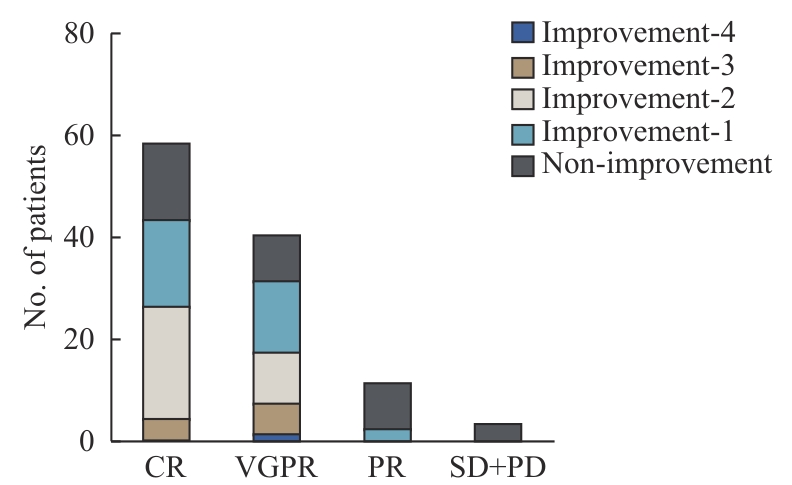
Fig 1 Correlation analysis of the degree of improvement in immunoparesis grouped by induction efficacy
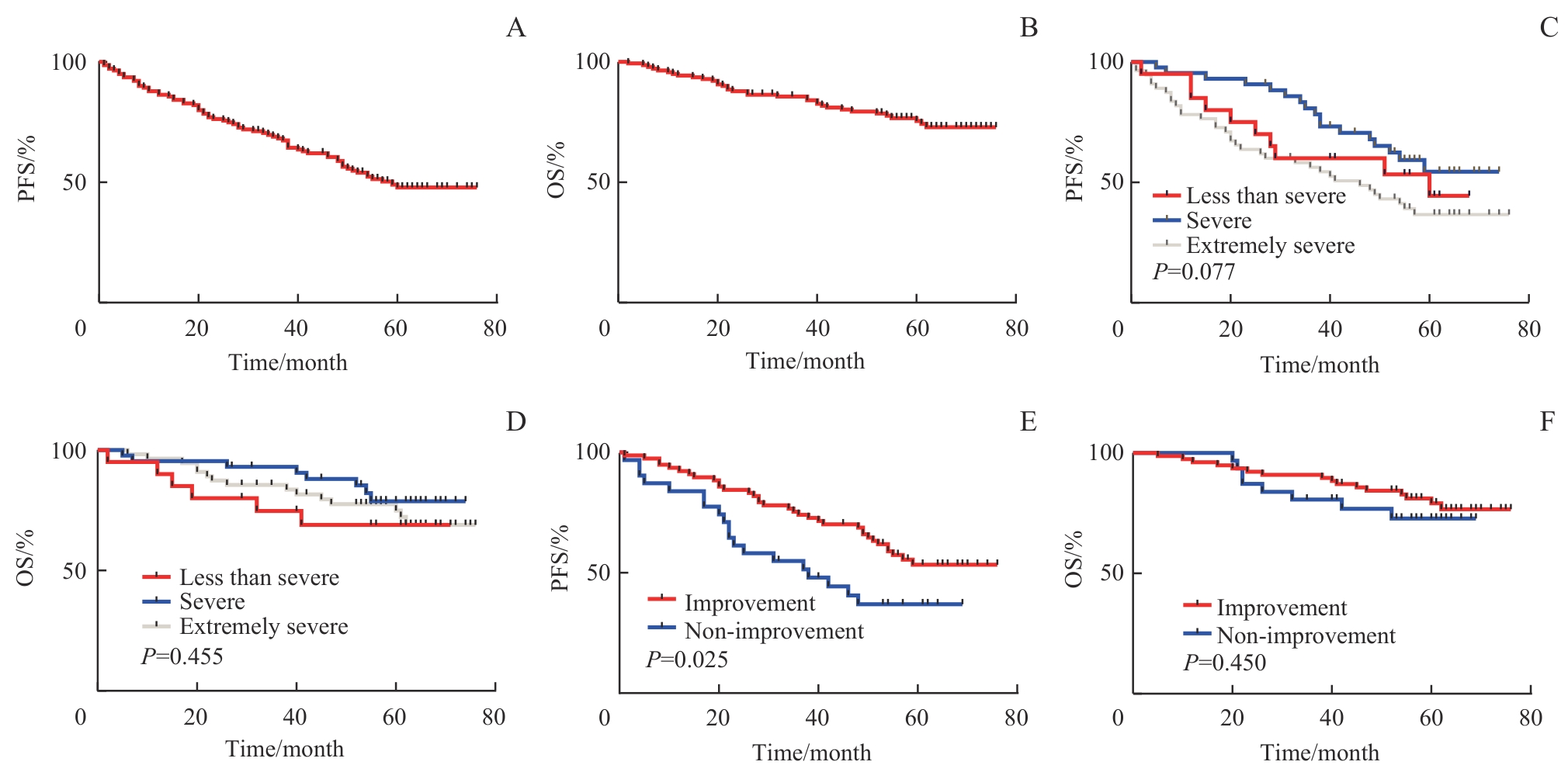
Fig 2 Survival analysis of MM patients
| [1] | BERGIN K, MCQUILTEN Z, MOORE E, et al. Myeloma in the real world: what is really happening?[J]. Clin Lymphoma Myeloma Leuk, 2017, 17(3): 133-144.e1. |
| [2] | 张晓晖. 60例多发性骨髓瘤免疫固定电泳及免疫球蛋白分析[J]. 现代中西医结合杂志, 2012, 21(6): 608-609. |
| ZHANG X H. Immunofixation electrophoresis and immunoglobulin analysis of 60 cases of multiple myeloma[J]. Modern Journal of Integrated Traditional Chinese and Western Medicine, 2012, 21(6): 608-609. | |
| [3] | WALDMANN T A, BRODER S, KRAKAUER R, et al. The role of suppressor cells in the pathogenesis of common variable hypogammaglobulinemia and the immunodeficiency associated with myeloma[J]. Fed Proc, 1976, 35(9): 2067-2072. |
| [4] | BARWICK B G, GUPTA V A, VERTINO P M, et al. Cell of origin and genetic alterations in the pathogenesis of multiple myeloma[J]. Front Immunol, 2019, 10: 1121. |
| [5] | LIU X L, GUO H, WEI Y T, et al. TGF-β induces growth suppression in multiple myeloma MM.1S cells via E2F1[J]. Oncol Lett, 2017, 14(2): 1884-1888. |
| [6] | 桂前乐, 汪延生, 黄山, 等. 肿瘤相关性巨噬细胞在多发性骨髓瘤中的浸润及其临床意义[J]. 中华血液学杂志, 2018, 39(2): 122-127. |
| GUI Q L, WANG Y S, HUANG S, et al. Infiltration of tumor associated macrophages in multiple myeloma and its clinical significance[J]. Chinese Journal of Hematology, 2018, 39(2): 122-127. | |
| [7] | SØRRIG R, KLAUSEN T W, SALOMO M, et al. Immunoparesis in newly diagnosed multiple myeloma patients: effects on overall survival and progression free survival in the Danish population[J]. PLoS One, 2017, 12(12): e0188988. |
| [8] | 中国医师协会血液科医师分会, 中华医学会血液学分会, 中国医师协会多发性骨髓瘤专业委员会. 中国多发性骨髓瘤诊治指南(2017年修订) [J]. 中华内科杂志, 2017, 56(11): 866-870. |
| Chinese Hematology Association, Chinese Society of Hematology, Chinese Myeloma Committee-Chinese Hematology Association. The guidelines for the diagnosis and management of multiple myeloma in China (2017 revision)[J]. Chinese Journal of Internal Medicine, 2017, 56(11): 866-870. | |
| [9] | CHAKRABORTY R, RYBICKI L, NAKASHIMA M O, et al. Characterisation and prognostic impact of immunoparesis in relapsed multiple myeloma[J]. Br J Haematol, 2020, 189(6): 1074-1082. |
| [10] | KUMAR S K, CALLANDER N S, ALSINA M, et al. Multiple myeloma, version 3.2017, NCCN clinical practice guidelines in oncology[J]. J Natl Compr Canc Netw, 2017, 15(2): 230-269. |
| [11] | 中国医师协会血液科医师分会, 中华医学会血液学分会, 中国医师协会多发性骨髓瘤专业委员会.中国多发性骨髓瘤诊治指南(2020年修订)[J].中华内科杂志, 2020, 59(5): 341-346. |
| Chinese Hematology Association, Chinese Society of Hematology, Chinese Myeloma Committee-Chinese Hematology Association. The guidelines for the diagnosis and management of multiple myeloma in China (2020 revision)[J]. Chinese Journal of Internal Medicine, 2020, 59(5): 341-346. | |
| [12] | MERZ M, MOEHLER T M, RITSCH J, et al. Prognostic significance of increased bone marrow microcirculation in newly diagnosed multiple myeloma: results of a prospective DCE-MRI study[J]. Eur Radiol, 2016, 26(5): 1404-1411. |
| [13] | JIMENEZ-ZEPEDA V H, DUGGAN P, NERI P, et al. Immunoparesis and polyclonal immunoglobulin recovery after auto-SCT for patients with multiple myeloma treated at a single institution[J]. Leuk Lymphoma, 2018, 59(8): 1920-1926. |
| [14] | 曹乐乐, 黄芮, 王晓雪, 等. 多发性骨髓瘤免疫不全麻痹特征及临床意义分析[J]. 世界最新医学信息文摘, 2021, 21(49): 5-6. |
| CAO L L, HUANG R, WANG X X, at el. Analysis of the characteristics and clinical significance of immunoincomplete paralysis in multiple myeloma[J]. World Latest Medicine Information, 2021, 21(49): 5-6. | |
| [15] | HEANEY J L J, CAMPBELL J P, IQBAL G, et al. Characterisation of immunoparesis in newly diagnosed myeloma and its impact on progression-free and overall survival in both old and recent myeloma trials[J]. Leukemia, 2018, 32(8): 1727-1738. |
| [16] | GAY F, LAROCCA A, WIJERMANS P, et al. Complete response correlates with long-term progression-free and overall survival in elderly myeloma treated with novel agents: analysis of 1 175 patients[J]. Blood, 2011, 117(11): 3025-3031. |
| [17] | SKLENAR I, SCHIFFMAN G, JØNSSON V, et al. Effect of various doses of intravenous polyclonal IgG on in vivo levels of 12 pneumococcal antibodies in patients with chronic lymphocytic leukaemia and multiple myeloma[J]. Oncology, 1993, 50(6): 466-477. |
| [18] | SØRRIG R, KLAUSEN T W, SALOMO M, et al. Risk factors for blood stream infections in multiple myeloma: a population-based study of 1 154 patients in Denmark[J]. Eur J Haematol, 2018, 101(1): 21-27. |
| [19] | LEE L, DRAPER B, CHAPLIN N, et al. An APRIL-based chimeric antigen receptor for dual targeting of BCMA and TACI in multiple myeloma[J]. Blood, 2018, 131(7): 746-758. |
| [1] | Deng Yuanyuan, Yuan Yuan. Case report of central nervous system infection caused by Candida krusei [J]. Journal of Shanghai Jiao Tong University (Medical Science), 2026, 46(5): 688-692. |
| [2] | Mei Zixian, Meng Xuchen, Su Wenjing, Zhong Weijie, Tang Dingzhong, Li Yi. Clinical-inflammatory combined model for predicting poor prognosis in male patients with anterior circulation acute ischemic stroke with large vessel occlusion after mechanical thrombectomy [J]. Journal of Shanghai Jiao Tong University (Medical Science), 2026, 46(3): 332-339. |
| [3] | Yin Xuying, Wang Xuanjia, Yang Mina, Jiang Haojie, Dai Jing, Sun Xiaoyu, Xu Yanyan. Procoagulant platelets regulate H1N1-induced thrombosis formation [J]. Journal of Shanghai Jiao Tong University (Medical Science), 2026, 46(1): 25-33. |
| [4] | CHEN Siyuan, SHI Qing, FU Di, WANG Li, CHENG Shu, XU Pengpeng, ZHAO Weili. Clinicopathologic characteristics, gene mutation profile, and prognostic analysis of diffuse large B-cell lymphoma with lung involvement [J]. Journal of Shanghai Jiao Tong University (Medical Science), 2025, 45(9): 1214-1220. |
| [5] | ZHANG Xingli, TIAN Jie, LUO Jing, LIU Qian, OUYANG Wanyan, QIU Hongchun, WANG Yan, MI Jianqing. Efficacy analysis in elderly and frail newly diagnosed multiple myeloma patients with dose-reduced lenalidomide/melphalan/prednisone acetate regimens [J]. Journal of Shanghai Jiao Tong University (Medical Science), 2025, 45(7): 815-822. |
| [6] | LIN Tong, TAO Yi, JIN Shiwei, SUN Miao, MI Jianqing. Effect of plasma exchange combined with classical chemotherapy on renal function in patients with multiple myeloma [J]. Journal of Shanghai Jiao Tong University (Medical Science), 2025, 45(7): 823-828. |
| [7] | ZHU Hanyi, SHI Huan, YU Chuangqi, ZHENG Lingyan. Preliminary study on early warning value and mechanism of interleukin-1β in extremely severe oral and maxillofacial space infections [J]. Journal of Shanghai Jiao Tong University (Medical Science), 2025, 45(6): 661-672. |
| [8] | LIANG Xiaoning, SHI Tingwang, CHEN Yunfeng. Pathogenic mechanisms and therapeutic advances of small colony variants [J]. Journal of Shanghai Jiao Tong University (Medical Science), 2025, 45(6): 784-791. |
| [9] | LIAN Mingzhu, ZHANG Changxiao, SHENG Kai, GUO Meng, FANG Shuyu. Predictive value of geriatric nutritional risk index for pulmonary infections in hospitalized elderly patients with type 2 diabetes mellitus [J]. Journal of Shanghai Jiao Tong University (Medical Science), 2025, 45(4): 452-458. |
| [10] | XU Tianyun, SHEN Yiming, JIANG Meng. Clinical management of heart failure with improved ejection fraction: treatment and maintenance [J]. Journal of Shanghai Jiao Tong University (Medical Science), 2025, 45(4): 493-499. |
| [11] | DU Fang, ZHOU Lingyun, CHEN Jiao, LIU Danbo, XIANG Hongxian, CHEN Haifei. A case report of relapsed and refractory multiple myeloma with multifocal extramedullary infiltration and pulmonary adenocarcinoma [J]. Journal of Shanghai Jiao Tong University (Medical Science), 2025, 45(1): 122-128. |
| [12] | WANG Boen, CHEN Siyuan, SHI Qing, ZHANG Muchen, YI Hongmei, DONG Lei, WANG Li, CHENG Shu, XU Pengpeng, ZHAO Weili. Clinicopathologic characteristics of patients with kidney-involved diffuse large B-cell lymphoma [J]. Journal of Shanghai Jiao Tong University (Medical Science), 2024, 44(9): 1162-1168. |
| [13] | LI Yibai, CUI Ruiji, GAO Shan, HU Jiajin, GUO Xiaoying. Research progress in late-onset group B Streptococcus infection in infants and its prevention [J]. Journal of Shanghai Jiao Tong University (Medical Science), 2024, 44(8): 1044-1049. |
| [14] | SONG Chenlu, XIANG Jun, YANG Huizhong. Early alarming effect of serum heparin-binding protein on prognosis and occurrence of sepsis in severely burned patients [J]. Journal of Shanghai Jiao Tong University (Medical Science), 2024, 44(4): 474-481. |
| [15] | ZHOU Lingyun, CHEN Haifei. Multiple myeloma with cardiac amyloidosis and secondary adrenal cortical dysfunction: a case report [J]. Journal of Shanghai Jiao Tong University (Medical Science), 2024, 44(4): 537-542. |
| Viewed | ||||||
|
Full text |
|
|||||
|
Abstract |
|
|||||
