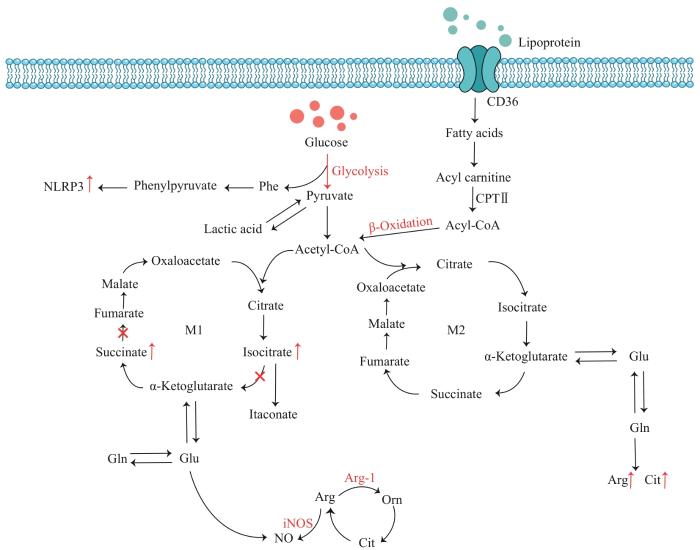
全球成人糖尿病患病率逐年递增,其中以2型糖尿病(diabetes mellitus type 2,T2DM)为主。T2DM是由胰岛素抵抗和胰岛素分泌不足引起的伴随糖、蛋白质和脂肪代谢紊乱的一种慢性疾病。创面愈合障碍是T2DM的主要并发症之一。研究表明T2DM患者创面愈合受巨噬细胞调控,并与其表型、活性和数量相关。不同表型的巨噬细胞在T2DM创面愈合的各个阶段扮演不同角色:M1型巨噬细胞参与创伤早期的炎症反应和病原体清除,M2型巨噬细胞在创面愈合后期发挥抗炎症作用并介导创面修复。巨噬细胞表型转换障碍影响创面炎症反应、皮肤细胞功能和细胞外基质(extracellular matrix,ECM)合成等过程,最终导致愈合障碍。目前,巨噬细胞代谢改变与表型转换之间的相互作用机制研究取得了显著进展,且这种动态关联可能通过协同调控参与T2DM创面的愈合进程。该文总结巨噬细胞在正常创面愈合与T2DM患者创面愈合中的功能特点,就病理环境下巨噬细胞糖代谢、脂质代谢和氨基酸代谢变化及这些变化对创面愈合的调控作用展开综述,并讨论靶向巨噬细胞代谢治疗创面愈合的应用前景。
关键词:创面愈合
;
2型糖尿病
;
巨噬细胞
;
代谢
Abstract
The global prevalence of diabetes among adults is increasing year by year, with diabetes mellitus type 2 (T2DM) being the most common form. T2DM is a chronic disease characterized by insulin resistance and insufficient insulin secretion, often accompanied by disturbances in glucose, protein, and lipid metabolism. Impaired wound healing is one of the major complications of T2DM. Studies have shown that wound healing in T2DM patients are regulated by macrophages and are closely related to their phenotype, activity, and abundance. Macrophages of different phenotypes play distinct roles in various stages of T2DM wound healing: M1 macrophages are involved in the early inflammatory response and pathogen clearance, while M2 macrophages contribute to anti-inflammatory responses and wound repair during later stages. Dysregulation of macrophage phenotype switching affects wound inflammatory response, skin cell function, and extracellular matrix (ECM) synthesis, ultimately leading to impaired healing. Significant progress has been made in understanding the interactions between macrophage metabolic changes and phenotype switching, and this dynamic relationship might play a synergistic role in regulating the wound healing process in T2DM. This review summarizes the functional roles of macrophages in both normal and T2DM-associated wound healing, discusses alterations in glucose, lipid, and amino acid metabolism in macrophages under pathological conditions, and explores how these metabolic shifts regulate wound healing. Furthermore, it examines the therapeutic potential of targeting macrophage metabolism to improve wound healing outcomes.
HUANG Yinghe, ZHAO Guanyu, SUN Yang, HOU Jianji, ZUO Yong. Research progress on macrophage metabolic regulation in wound healing of diabetes mellitus type 2. Journal of Shanghai Jiao Tong University (Medical Science)[J], 2025, 45(6): 792-799 doi:10.3969/j.issn.1674-8115.2025.06.015
2型糖尿病(diabetes mellitus type 2,T2DM)以胰岛素抵抗为病理特征,主要表现为组织细胞对胰岛素介导的葡萄糖利用的反应性降低。这种代谢异常会导致多种并发症,其中创面愈合障碍尤为常见[1]。
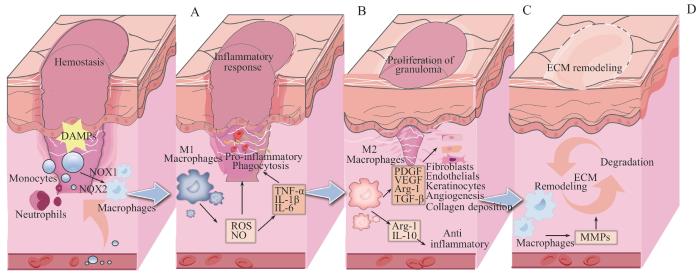
Note: A. Hemostasis period. B. Inflammatory response period. C. Granulation tissue proliferation period. D. ECM remodeling period. DAMPs—damage-associated molecular patterns; NOX1—NADPH oxidase 1; NOX2—NADPH oxidase 2; VEGF—vascular endothelial growth factor; PDGF—platelet-derived growth factor.
Fig 1
Mechanisms of macrophage function in normal wound healing
1.2 巨噬细胞对T2DM创面愈合的调控作用
T2DM创面常以微血管生成障碍、长期持续的炎症反应、高ROS水平以及持续的细菌感染等为特征[6]。在炎症期,持续的高糖微环境使创面中晚期糖基化终产物(advanced glycation end product,AGE)表达增加,AGE与M1型巨噬细胞表面的AGE受体结合造成ROS产生、炎症、氧化应激增加和细胞凋亡等一系列不良后果[16]。一方面,T2DM患者创面的高糖微环境为微生物的生长提供了充足养分[6],同时异常积累的AGE削弱了巨噬细胞对病原体的清除能力。这种免疫功能障碍使创面细菌快速繁殖,进一步触发免疫细胞募集机制,导致炎症反应过度激活[17]。随着氧化应激水平增加,成纤维细胞、内皮细胞凋亡增多,且凋亡细胞无法被及时清除,从而影响创面的上皮化和胶原沉积[18]。上述情况最终形成“高糖-感染-炎症”的恶性循环。另一方面,炎症和氧化应激反过来促进AGE的产生,它们之间的相互作用最终介导T2DM创面的愈合障碍[16]。此外,T2DM环境还会导致巨噬细胞发生程序性细胞死亡,干扰T2DM创面的炎症反应、上皮化、肉芽组织形成等过程[18]。
HUANG Yinghe was responsible for determining the topic and structure, collecting literature, and writing and revising the manuscript. ZHAO Guanyu participated in the topic selection, literature collection, and revision of the manuscript. SUN Yang and HOU Jianji participated in the revision of the manuscript. ZUO Yong was responsible for writing guidance and revision. All authors have read the final version of the paper and consented to its submission.
利益冲突声明
所有作者声明不存在利益冲突。
COMPETING INTERESTS
All authors disclose no relevant conflict of interests.
YU F X, LEE P S Y, YANG L L, et al. The impact of sensory neuropathy and inflammation on epithelial wound healing in diabetic corneas[J]. Prog Retin Eye Res, 2022, 89: 101039.
SHARIFIAGHDAM M, SHAABANI E, FARIDI-MAJIDI R, et al. Macrophages as a therapeutic target to promote diabetic wound healing[J]. Mol Ther, 2022, 30(9): 2891-2908.
ZHOU B S, MAGANA L, HONG Z G, et al. The angiocrine Rspondin3 instructs interstitial macrophage transition via metabolic-epigenetic reprogramming and resolves inflammatory injury[J]. Nat Immunol, 2020, 21(11): 1430-1443.
SHAN X, HU P H, NI L N, et al. Serine metabolism orchestrates macrophage polarization by regulating the IGF1-p38 axis[J]. Cell Mol Immunol, 2022, 19(11): 1263-1278.
AUDU C O, MELVIN W J, JOSHI A D, et al. Macrophage-specific inhibition of the histone demethylase JMJD3 decreases STING and pathologic inflammation in diabetic wound repair[J]. Cell Mol Immunol, 2022, 19(11): 1251-1262.
APAYDIN O, ALTAIKYZY A, FILOSA A, et al. Alpha-1 adrenergic signaling drives cardiac regeneration via extracellular matrix remodeling transcriptional program in zebrafish macrophages[J]. Dev Cell, 2023, 58(22): 2460-2476.e7.
ZHAO P X, CAI Z S, ZHANG X J, et al. Hydrogen attenuates inflammation by inducing early M2 macrophage polarization in skin wound healing[J]. Pharmaceuticals (Basel), 2023, 16(6): 885.
RUNGRATANAWANICH W, QU Y, WANG X, et al. Advanced glycation end products (AGEs) and other adducts in aging-related diseases and alcohol-mediated tissue injury[J]. Exp Mol Med, 2021, 53(2): 168-188.
SONG J Y, ZHU K Y, WANG H P, et al. Deciphering the emerging role of programmed cell death in diabetic wound healing[J]. Int J Biol Sci, 2023, 19(15): 4989-5003.
LIU Y, LI Z N, LI W D, et al. Discovery of β-sitosterol's effects on molecular changes in rat diabetic wounds and its impact on angiogenesis and macrophages[J]. Int Immunopharmacol, 2024, 126: 111283.
ZHANG F X, SHAN S, FU C L, et al. Advanced mass spectrometry-based biomarker identification for metabolomics of diabetes mellitus and its complications[J]. Molecules, 2024, 29(11): 2530.
VAN DEN BOSSCHE J, BAARDMAN J, OTTO N A, et al. Mitochondrial dysfunction prevents repolarization of inflammatory macrophages[J]. Cell Rep, 2016, 17(3): 684-696.
PILLON N J, LOOS R J F, MARSHALL S M, et al. Metabolic consequences of obesity and type 2 diabetes: balancing genes and environment for personalized care[J]. Cell, 2021, 184(6): 1530-1544.
RUSSO S, KWIATKOWSKI M, GOVORUKHINA N, et al. Meta-inflammation and metabolic reprogramming of macrophages in diabetes and obesity: the importance of metabolites[J]. Front Immunol, 2021, 12: 746151.
MOUTON A J, LI X, HALL M E, et al. Obesity, hypertension, and cardiac dysfunction: novel roles of immunometabolism in macrophage activation and inflammation[J]. Circ Res, 2020, 126(6): 789-806.
HE X T, LI X, ZHANG M, et al. Role of molybdenum in material immunomodulation and periodontal wound healing: targeting immunometabolism and mitochondrial function for macrophage modulation[J]. Biomaterials, 2022, 283: 121439.
WILLENBORG S, SANIN D E, JAIS A, et al. Mitochondrial metabolism coordinates stage-specific repair processes in macrophages during wound healing[J]. Cell Metab, 2021, 33(12): 2398-2414.e9.
LIN C W, HUNG C M, CHEN W J, et al. New horizons of macrophage immunomodulation in the healing of diabetic foot ulcers[J]. Pharmaceutics, 2022, 14(10): 2065.
LI Q H, SONG H J, LI S Y, et al. Macrophage metabolism reprogramming EGCG-Cu coordination capsules delivered in polyzwitterionic hydrogel for burn wound healing and regeneration[J]. Bioact Mater, 2023, 29: 251-264.
HE J B, ZHOU S S, WANG J X, et al. Anti-inflammatory and anti-oxidative electrospun nanofiber membrane promotes diabetic wound healing via macrophage modulation[J]. J Nanobiotechnology, 2024, 22(1): 116.
BATISTA-GONZALEZ A, VIDAL R, CRIOLLO A, et al. New insights on the role of lipid metabolism in the metabolic reprogramming of macrophages[J]. Front Immunol, 2020, 10: 2993.
LEE J H, PHELAN P, SHIN M, et al. SREBP-1a-stimulated lipid synthesis is required for macrophage phagocytosis downstream of TLR4-directed mTORC1[J]. Proc Natl Acad Sci USA, 2018, 115(52): E12228-E12234.
VASSILIOU E, FARIAS-PEREIRA R. Impact of lipid metabolism on macrophage polarization: implications for inflammation and tumor immunity[J]. Int J Mol Sci, 2023, 24(15): 12032.
SHOOK B A, WASKO R R, MANO O, et al. Dermal adipocyte lipolysis and myofibroblast conversion are required for efficient skin repair[J]. Cell Stem Cell, 2020, 26(6): 880-895.e6.
COOPER P O, KLEB S S, NOONEPALLE S K, et al. G-protein-coupled receptor 84 regulates acute inflammation in normal and diabetic skin wounds[J]. Cell Rep, 2024, 43(6): 114288.
JETTEN N, ROUMANS N, GIJBELS M J, et al. Wound administration of M2-polarized macrophages does not improve murine cutaneous healing responses[J]. PLoS One, 2014, 9(7): e102994.
PERCIVAL S L, MCCARTY S, HUNT J A, et al. The effects of pH on wound healing, biofilms, and antimicrobial efficacy[J]. Wound Repair Regen, 2014, 22(2): 174-186.
PAN Y, HUI X Y, HOO R L C, et al. Adipocyte-secreted exosomal microRNA-34a inhibits M2 macrophage polarization to promote obesity-induced adipose inflammation[J]. J Clin Invest, 2019, 129(2): 834-849.
ITO D, ITO H, IDETA T, et al. Systemic and topical administration of spermidine accelerates skin wound healing[J]. Cell Commun Signal, 2021, 19(1): 36.
ARRIBAS-LÓPEZ E, ZAND N, OJO O, et al. The effect of amino acids on wound healing: a systematic review and meta-analysis on arginine and glutamine[J]. Nutrients, 2021, 13(8): 2498.
LIU Y, SHI J P, XIONG W, et al. Production of an animal model of semi-Yin and semi-Yang syndrome with diabetic ulcers and study of its pathological and metabolic features[J]. Evid Based Complement Alternat Med, 2021, 2021: 6345147.
MANCHANDA M, TORRES M, INUOSSA F, et al. Metabolic reprogramming and reliance in human skin wound healing[J]. J Invest Dermatol, 2023, 143(10): 2039-2051.e10.
LV D M, CAO X L, ZHONG L, et al. Targeting phenylpyruvate restrains excessive NLRP3 inflammasome activation and pathological inflammation in diabetic wound healing[J]. Cell Rep Med, 2023, 4(8): 101129.
GAN Z D, GUO Y, ZHAO M Y, et al. Excitatory amino acid transporter supports inflammatory macrophage responses[J]. Sci Bull (Beijing), 2024, 69(15): 2405-2419.
YAN J L, TIE G D, WANG S Y, et al. Diabetes impairs wound healing by Dnmt1-dependent dysregulation of hematopoietic stem cells differentiation towards macrophages[J]. Nat Commun, 2018, 9(1): 33.
HOU Y X, WEI D, ZHANG Z Q, et al. Downregulation of nutrition sensor GCN2 in macrophages contributes to poor wound healing in diabetes[J]. Cell Rep, 2024, 43(1): 113658.
ZHU H T, XING C, DOU X Q, et al. Chiral hydrogel accelerates re-epithelization in chronic wounds via mechanoregulation[J]. Adv Healthc Mater, 2022, 11(21): e2201032.
MIAO M Y, NIU Y W, XIE T, et al. Diabetes-impaired wound healing and altered macrophage activation: a possible pathophysiologic correlation[J]. Wound Repair Regen, 2012, 20(2): 203-213.
DA PORTO A, MIRANDA C, BROSOLO G, et al. Nutritional supplementation on wound healing in diabetic foot: what is known and what is new?[J]. World J Diabetes, 2022, 13(11): 940-948.