
上海交通大学学报(医学版) ›› 2026, Vol. 46 ›› Issue (7): 847-856.doi: 10.3969/j.issn.1674-8115.2026.07.003
常雨欣, 李百文( ), 倪建波()
收稿日期:2026-03-09
接受日期:2026-04-09
出版日期:2026-07-07
发布日期:2026-07-07
通讯作者:
倪建波,副主任医师,博士;电子信箱:jianbo.ni@shgh.cn。基金资助:
Chang Yuxin, Li Baiwen(), Ni Jianbo()
Received:2026-03-09
Accepted:2026-04-09
Online:2026-07-07
Published:2026-07-07
Contact:
Ni Jianbo, E-mail: jianbo.ni@shgh.cn.Supported by:摘要:
超声内镜引导胰管引流术(endoscopic ultrasound‑guided pancreatic duct drainage,EUS-PD/EUS-PDD)是治疗性超声内镜应用于胰腺疾病领域的重要进展,主要用于内镜逆行胰胆胰管造影(endoscopic retrograde pancreatography,ERCP)失败或无法实施的症状性胰管梗阻患者。该术式可通过胃、十二指肠或术后肠袢经壁穿刺主胰管,完成导丝置入、瘘道扩张与支架置放,实现胰管减压及胰液引流重建。系统评价与Meta分析显示,EUS-PD总体技术成功率为84.8%,临床成功率为89.2%,总体不良事件发生率为18.1%;提示其疗效确切但风险仍不可忽视。EUS-PD的常见适应证包括胰腺外伤致胰管断裂、胰腺手术并胰管损伤、重症急性胰腺炎伴胰管断裂以及术后解剖改变等,并发症主要包括术后胰腺炎、出血、穿孔及支架相关功能障碍。该文围绕适应证分层、术式路径、关键技术、并发症管理、长期随访与再干预策略等方面构建证据链,旨在为我国消化内镜中心开展EUS‑PD提供可复制的临床决策框架。
中图分类号:
常雨欣, 李百文, 倪建波. 超声内镜引导胰管引流术的适应证分层与临床策略述评[J]. 上海交通大学学报(医学版), 2026, 46(7): 847-856.
Chang Yuxin, Li Baiwen, Ni Jianbo. Review of indication stratification and clinical strategies for endoscopic ultrasound-guided pancreatic duct drainage[J]. Journal of Shanghai Jiao Tong University (Medical Science), 2026,(7): 847-856.
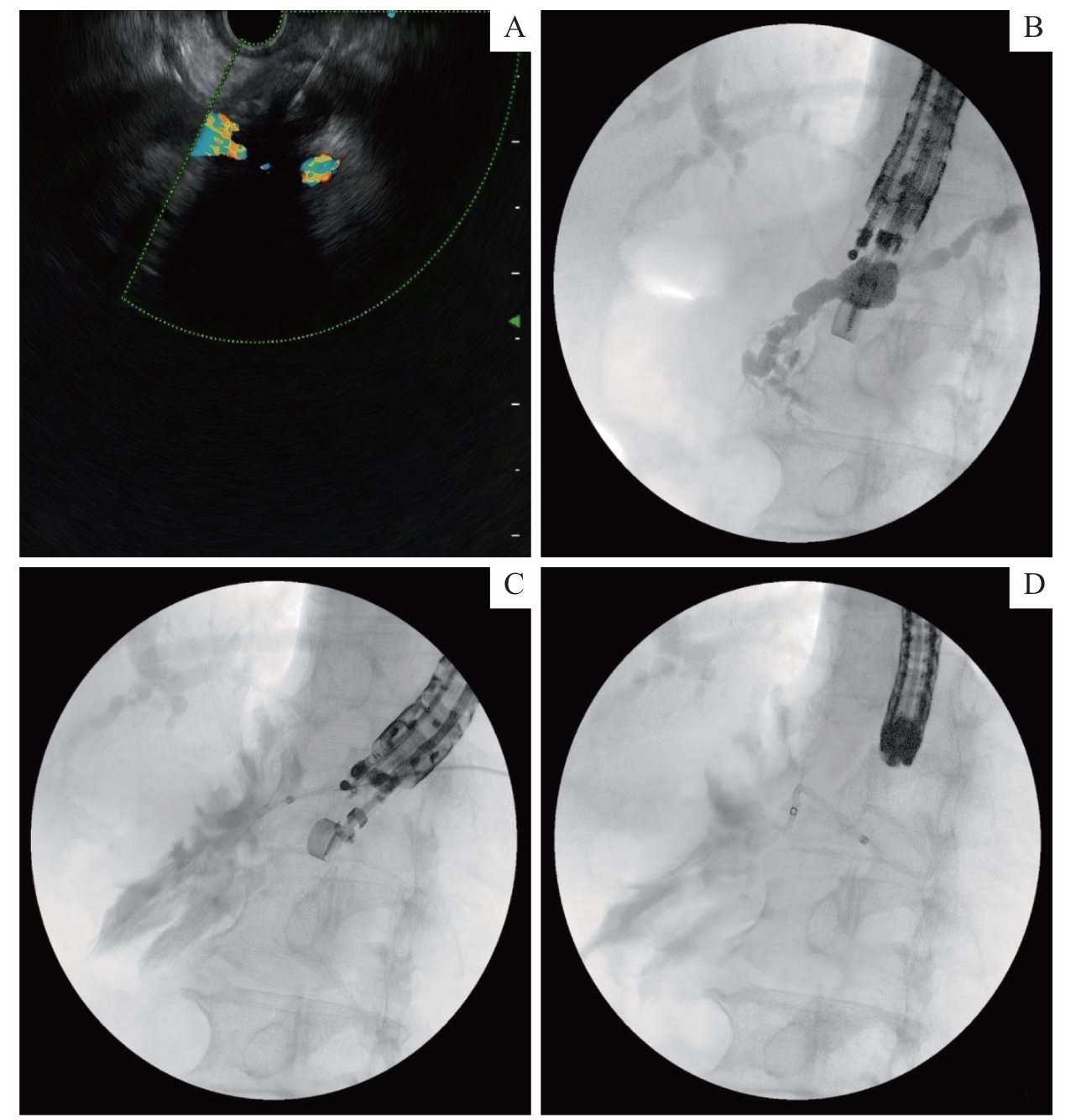
图1 EUS-PD操作步骤分解图Note: A. EUS puncture; B. Guidewire insertion; C. Tract dilation; D. Stent placement.
Fig 1 Step-by-step illustration of the EUS-PD procedure
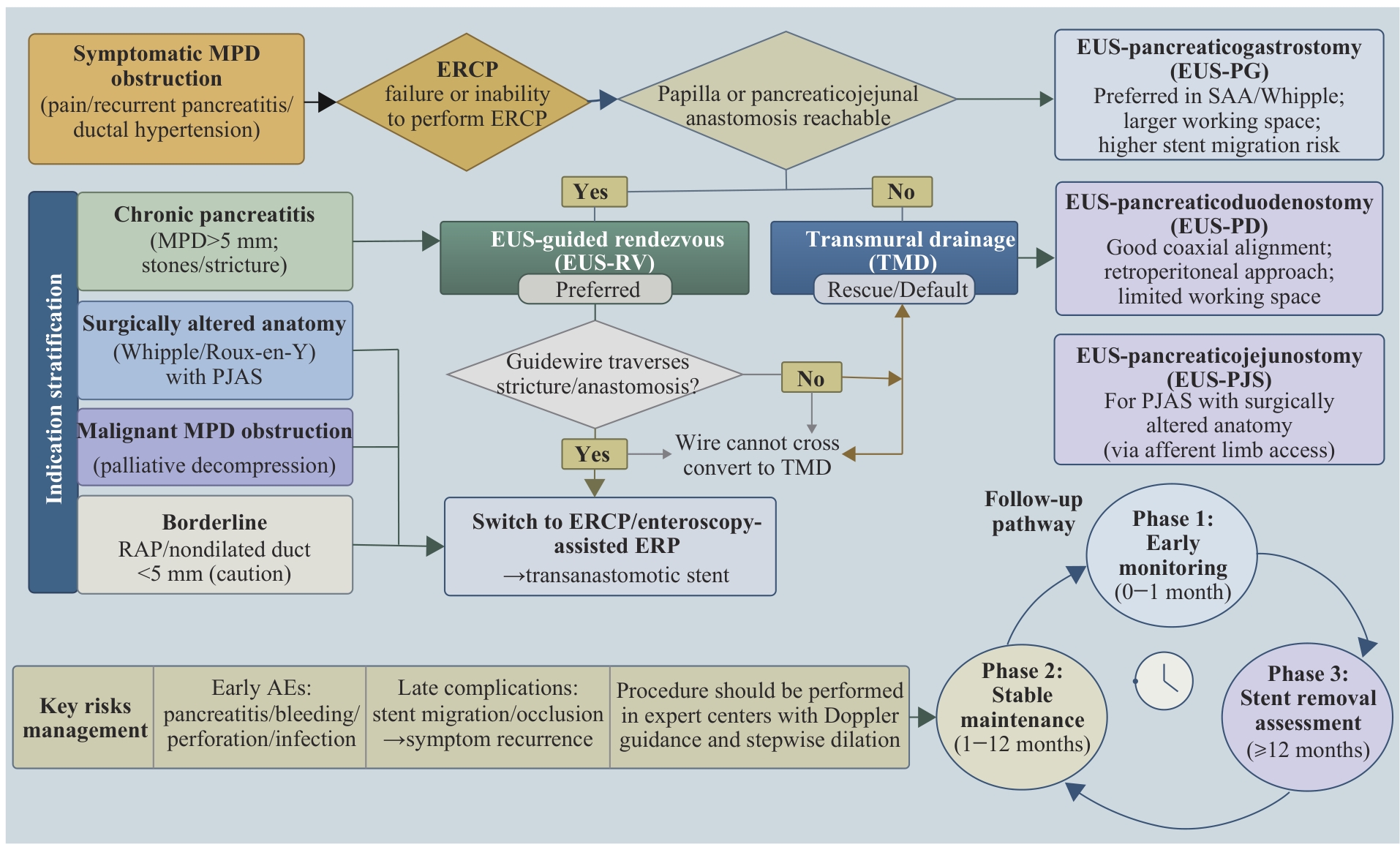
图2 EUS-PD适应证分层与入路选择决策图Note: MPD—main pancreatic duct; ERCP—endoscopic retrograde cholangiopancreatography; SAA—surgically altered anatomy; PJAS—pancreaticojejunostomy anastomotic stricture RAP—recurrent acute pancreatitis; AEs—adverse events.
Fig 2 Indication stratification and route selection algorithm for EUS-PD
| Reference | Study design | n | Indication | Approach | TS/% | CS/% | FU/ month | Migration/Occlusion | Reintervention | Overall AE/% |
|---|---|---|---|---|---|---|---|---|---|---|
| François[ | Case series | 4 | MPD obstruction, pain | TMD | 100.0 | 75.0 | 12.0 | NR | NR | 0 |
| Matsunami[ | Single-center | 30 | ARP, PJAS, MPD stricture | TMD | 83.3 | 92.0 | 23.0① | 24.0% | Median 3② | NR |
| Falque[ | Single-center | 27 | CP or SAA | TMD | 92.5 | 88.8 | 34.2① | 18.5% | 7.4% | NR |
| Chandan[ | Meta-analysis | 714 | Mixed cohort | RV+TMD | 84.8 | 89.2 | Var | 21.3% | 15.2% | 18.1 |
| Tyberg[ | Operator cohort | 56 | Mixed cohort | RV+TMD | 84.0 | 98.0 | 13.0① | 3.6% | 3.6% | 24.0 |
| Tessier[ | Case series | 36 | CP, MPD dilation | TMD | 92.0 | 69.0 | 14.5 | NR | NR | 14.0 |
| Brauer[ | Case series | 8 | MPD obstruction | TMD | 88.0 | 50.0 | 14.0 | NR | NR | 0 |
| Barkay[ | Retrospective | 21 | Complex MPD disease | TMD | 48.0 | 12.0 | 13.0 | NR | NR | 13.0 |
表1 EUS‑PD代表性研究特征与结局汇总
Tab 1 Summary of the characteristics and outcomes of representative studies on EUS‑PD
| Reference | Study design | n | Indication | Approach | TS/% | CS/% | FU/ month | Migration/Occlusion | Reintervention | Overall AE/% |
|---|---|---|---|---|---|---|---|---|---|---|
| François[ | Case series | 4 | MPD obstruction, pain | TMD | 100.0 | 75.0 | 12.0 | NR | NR | 0 |
| Matsunami[ | Single-center | 30 | ARP, PJAS, MPD stricture | TMD | 83.3 | 92.0 | 23.0① | 24.0% | Median 3② | NR |
| Falque[ | Single-center | 27 | CP or SAA | TMD | 92.5 | 88.8 | 34.2① | 18.5% | 7.4% | NR |
| Chandan[ | Meta-analysis | 714 | Mixed cohort | RV+TMD | 84.8 | 89.2 | Var | 21.3% | 15.2% | 18.1 |
| Tyberg[ | Operator cohort | 56 | Mixed cohort | RV+TMD | 84.0 | 98.0 | 13.0① | 3.6% | 3.6% | 24.0 |
| Tessier[ | Case series | 36 | CP, MPD dilation | TMD | 92.0 | 69.0 | 14.5 | NR | NR | 14.0 |
| Brauer[ | Case series | 8 | MPD obstruction | TMD | 88.0 | 50.0 | 14.0 | NR | NR | 0 |
| Barkay[ | Retrospective | 21 | Complex MPD disease | TMD | 48.0 | 12.0 | 13.0 | NR | NR | 13.0 |
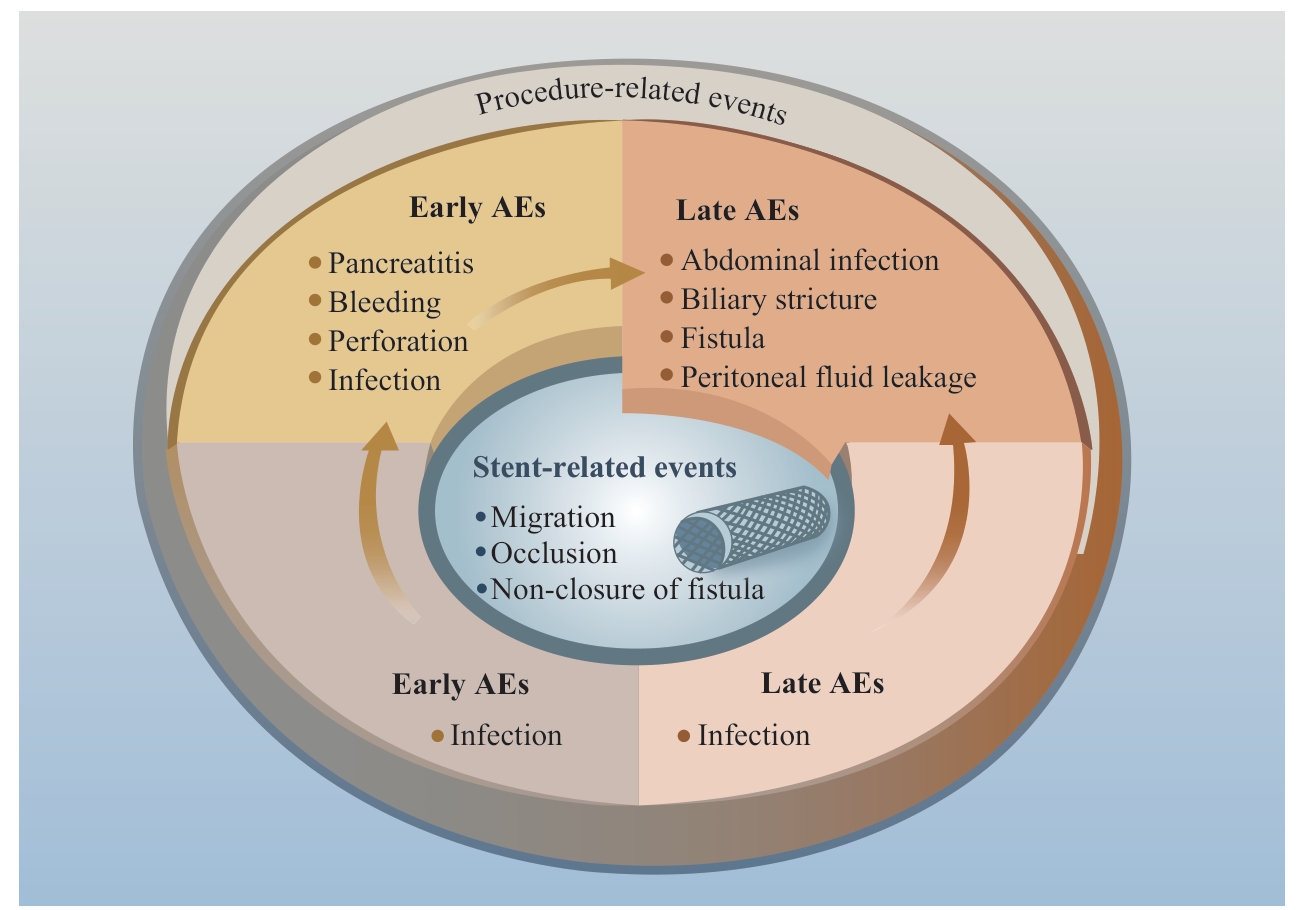
图3 EUS-PD两层风险模型:操作相关并发症与支架相关事件Note: AEs—adverse events.
Fig 3 Two-layer risk model for EUS-PD: procedure-related adverse events and stent-related events
| [1] | Strand D S, Law R J, Yang D, et al. AGA clinical practice update on the endoscopic approach to recurrent acute and chronic pancreatitis: expert review[J]. Gastroenterology, 2022, 163(4): 1107-1114. |
| [2] | Han D G, Jing Z T, Liu W. Pancreatic duct stones and severely dilated pancreatic duct in chronic pancreatitis[J]. Dig Liver Dis, 2024, 56(3): 525-527. |
| [3] | Cohen S M, Kent T S. Etiology, diagnosis, and modern management of chronic pancreatitis: a systematic review[J]. JAMA Surg, 2023, 158(6): 652-661. |
| [4] | Toyonaga H, Masaki M, Oka A, et al. Balloon-assisted ERCP for bile duct stones in surgically altered anatomy: current techniques, devices, and evolving strategies[J]. Ther Adv Gastroenterol, 2025, 18: 17562848251387600. |
| [5] | Shiomi H. Current status of endoscopic ultrasound-guided antegrade stone removal for patients with a surgically altered anatomy[J]. Dig Endosc, 2022, 34(1): 82-84. |
| [6] | Wang S Y, Zhao S Q, Wang S P, et al. Endoscopic ultrasound-guided pancreatic duct drainage: progress and future outlook[J]. World J Gastrointest Surg, 2025, 17(5): 104267. |
| [7] | Cai Q Y, Wu X M. Ultrasound-guided percutaneous transhepatic biliary drainage for distal biliary malignant obstructive jaundice[J]. Sci Rep, 2024, 14(1): 12481. |
| [8] | Itonaga M, Takenaka M, Shiomi H, et al. Comparative evaluation of percutaneous transhepatic biliary drainage and endoscopic ultrasound-guided biliary drainage for preoperative management of malignant distal bile duct obstruction after failed ERCP: a multicenter retrospective analysis[J]. Dig Endosc, 2026, 38(1): e70048. |
| [9] | Ishiwatari H, Sato J, Sakamoto H, et al. Current status of preoperative endoscopic biliary drainage for distal and hilar biliary obstruction[J]. Dig Endosc, 2024, 36(9): 969-980. |
| [10] | François E, Devière J. Endoscopic retrograde cholangiopancreatography[J]. Endoscopy, 2002, 34(11): 882-887. |
| [11] | ASGE Standards of Practice Committee, Pawa S, Marya N B, et al. American Society for Gastrointestinal Endoscopy guideline on the role of therapeutic EUS in the management of biliary tract disorders: summary and recommendations[J]. Gastrointest Endosc, 2024, 100(6): 967-979. |
| [12] | van Eecke E, Degroote H, Vanlander A, et al. Outcome of primary ERCP versus primary PTC for biliary drainage in malignant hilar biliary strictures: a systematic review and meta-analysis[J]. Surg Endosc, 2022, 36(10): 7160-7170. |
| [13] | Facciorusso A, Mangiavillano B, Paduano D, et al. Methods for drainage of distal malignant biliary obstruction after ERCP failure: a systematic review and network meta-analysis[J]. Cancers, 2022, 14(13): 3291. |
| [14] | van der Merwe S W, van Wanrooij R L J, Bronswijk M, et al. Therapeutic endoscopic ultrasound: European Society of Gastrointestinal Endoscopy (ESGE) guideline[J]. Endoscopy, 2022, 54(2):185-205. |
| [15] | Liu X M, Li Y, Xiang J X, et al. Magnetic compression anastomosis for biliojejunostomy and pancreaticojejunostomy in Whipple's procedure: an initial clinical study[J]. J Gastroenterol Hepatol, 2019, 34(3): 589-594. |
| [16] | Dell'Anna G, Ogura T, Vanella G, et al. Endoscopic ultrasound guided biliary interventions[J]. Best Pract Res Clin Gastroenterol, 2022(60/61): 101810. |
| [17] | Madhu D, Dhir V. Endoscopic ultrasound-guided biliary interventions[J]. Indian J Gastroenterol, 2024, 43(5): 943-953. |
| [18] | Samanta J, Sundaram S, Dhar J, et al. EUS-guided biliary drainage in patients with moderate-severe cholangitis is safe and effective: a multi-center experience[J]. Surg Endosc, 2023, 37(1): 298-308. |
| [19] | Khan R, Law R. Therapeutic endoscopic ultrasound and endoscopic ultrasound-endoscopic retrograde cholangiopancreatography interventions[J]. Gastroenterol Clin North Am, 2024, 53(4): 683-707. |
| [20] | Zhao Y Z, Fang L W, Zhang Y X, et al. Endoscopic ultrasound guided rendez-vous technique performed for stent implantation[J]. Rev Esp Enferm Dig, 2025, 117(10): 610-611. |
| [21] | Fritzsche J A, de Vries I, van Hooft J E, et al. Changing the flow: how EUS-guided drainage is reshaping the management of distal malignant biliary obstruction[J]. United European Gastroenterol J, 2026, 14(1): e70166. |
| [22] | Wauters L, Talley N J, Walker M M, et al. Novel concepts in the pathophysiology and treatment of functional dyspepsia[J]. Gut, 2020, 69(3): 591-600. |
| [23] | Fábián A, Bor R, Gede N, et al. Double stenting for malignant biliary and duodenal obstruction: a systematic review and meta-analysis[J]. Clin Transl Gastroenterol, 2020, 11(4): e00161. |
| [24] | Gabr M M, Frost T, Kudaravalli P, et al. Why is EUS-guided cyst-gastrostomy more common than cyst-duodenostomy: a disease state or endoscopist preference[J]. Endosc Ultrasound, 2020, 9(5): 352-353. |
| [25] | Wang M H, Chen Y J, Wang W H. Trans-fistulous pancreatoscopy-guided pancreatic duct stone extraction after endoscopic ultrasound-guided pancreaticogastrostomy in post-Whipple patient[J]. Endoscopy, 2026, 58(S 01): E202. |
| [26] | Fernández García R, Guadalupe Santana V J, Valverde-López F, et al. Sustained transmural drainage with plastic stents after LAMS removal in disconnected pancreatic duct syndrome: evidence from a systematic review and meta-analysis[J]. Rev Esp Enferm Dig, 2026. DOI: 10.17235/reed.2026.11742/2025. |
| [27] | Minaga K, Ogura T, Shiomi H, et al. Comparison of the efficacy and safety of endoscopic ultrasound-guided choledochoduodenostomy and hepaticogastrostomy for malignant distal biliary obstruction: multicenter, randomized, clinical trial[J]. Dig Endosc, 2019, 31(5): 575-582. |
| [28] | Teoh A Y B, Napoleon B, Kunda R, et al. EUS-guided choledocho-duodenostomy using lumen apposing stent versus ERCP with covered metallic stents in patients with unresectable malignant distal biliary obstruction: a multicenter randomized controlled trial (DRA-MBO trial)[J]. Gastroenterology, 2023, 165(2): 473-482.e2. |
| [29] | de Miguel P, Arrubla A, Carrascosa J, et al. Resolution of pancreatic ductal disruption through endoscopic ultrasound (EUS)-guided rendez-vous in a patient with pancreas divisum[J]. Rev Esp Enferm Dig, 2025. DOI: 10.17235/reed.2025.11124/2025. |
| [30] | Yasuda T, Matsuda A, Arai H, et al. Feeding gastrostomy and duodenostomy using the round ligament of the liver versus conventional feeding jejunostomy after esophagectomy: a meta-analysis[J]. Dis Esophagus, 2023, 36(9): doac105. |
| [31] | Bassaganyas C, Darnell A, Soler-Perromat A, et al. Accessibility of percutaneous biopsy in retrocolic-placed pancreatic grafts with a duodeno-duodenostomy[J]. Transpl Int, 2024, 37: 12682. |
| [32] | Martínez-Guillén M, Gornals J B, Consiglieri C F, et al. EUS-guided recanalization of complete gastrointestinal strictures[J]. Rev Esp Enferm Dig, 2017, 109(9): 643-647. |
| [33] | Di Mitri R, Amata M, Mocciaro F, et al. EUS-guided biliary drainage with LAMS for distal malignant biliary obstruction when ERCP fails: single-center retrospective study and maldeployment management[J]. Surg Endosc, 2022, 36(6): 4553-4569. |
| [34] | Jearth V, Sundaram S, Kale A, et al. Current paradigm of endoscopic ultrasound in biliary and pancreatic duct drainage: an update[J]. Ann Gastroenterol, 2024, 37(1): 1-14. |
| [35] | van Wanrooij R L J, Bronswijk M, Kunda R, et al. Therapeutic endoscopic ultrasound: European Society Of Gastrointestinal Endoscopy (ESGE) technical review[J]. Endoscopy, 2022, 54(3): 310-332. |
| [36] | Issa Y, Kempeneers M A, Bruno M J, et al. Effect of early surgery vs endoscopy-first approach on pain in patients with chronic pancreatitis: the ESCAPE randomized clinical trial[J]. JAMA, 2020, 323(3): 237-247. |
| [37] | Bronswijk M, Persyn D, van Malenstein H, et al. Outcomes of minor versus major papilla rendez-vous for EUS-guided pancreatic duct drainage[J]. Dig Liver Dis, 2024, 56(1): 170-175. |
| [38] | Sakai T, Koshita S, Kanno Y, et al. Early and long-term clinical outcomes of endoscopic interventions for benign pancreatic duct stricture/obstruction-the possibility of additional clinical effects of endoscopic ultrasonography-guided pancreatic drainage[J]. Pancreatology, 2022, 22(1): 58-66. |
| [39] | Hanaki T, Tanabe H, Sakamoto T, et al. Emergency partington-Rochelle procedure for hemorrhagic peritonitis due to stent migration following endoscopic ultrasonography-guided pancreatic duct drainage[J]. Cureus, 2025, 17(5): e83384. |
| [40] | Matsunami Y, Itoi T, Sofuni A, et al. Evaluation of a new stent for EUS-guided pancreatic duct drainage: long-term follow-up outcome[J]. Endosc Int Open, 2018, 6(5): E505-E512. |
| [41] | Falque A, Gasmi M, Barthet M, et al. Safety and efficacy of EUS-guided pancreatic duct drainage in symptomatic main pancreatic duct obstruction: is there still a place for surgery?[J]. Endosc Int Open, 2021, 9(6): E934-E942. |
| [42] | Liu Y, Yin X Y, Cui J H, et al. Long-term clinical outcomes of extracorporeal shockwave lithotripsy and endoscopic retrograde cholangiopancreatography for pancreatic duct stone treatment in patients with chronic pancreatitis[J]. Aliment Pharmacol Ther, 2024, 60(8): 1110-1121. |
| [43] | Hu L H, Ye B, Yang Y G, et al. Extracorporeal shock wave lithotripsy for Chinese patients with pancreatic stones: a prospective study of 214 cases[J]. Pancreas, 2016, 45(2): 298-305. |
| [44] | Liu Y, Yi J H, Wang P Y, et al. Safety evaluation of extracorporeal shockwave lithotripsy for pancreatic stones: experience based on a large chronic pancreatitis cohort[J]. Dig Liver Dis, 2025, 57(2): 417-426. |
| [45] | Wang D, An W, Yi J H, et al. Treatment of large pancreatic radiolucent stone[J]. Hepatobiliary Pancreat Dis Int, 2025, 24(4): 404-411. |
| [46] | Kohli D R, Amateau S K, Desai M, et al. American Society for Gastrointestinal Endoscopy guideline on management of post-liver transplant biliary strictures: summary and recommendations[J]. Gastrointest Endosc, 2023, 97(4): 607-614. |
| [47] | Chen Y I, Levy M J, Moreels T G, et al. An international multicenter study comparing EUS-guided pancreatic duct drainage with enteroscopy-assisted endoscopic retrograde pancreatography after Whipple surgery[J]. Gastrointest Endosc, 2017, 85(1): 170-177. |
| [48] | Cintolo M, Forti E, Bonato G, et al. Role of the EUS in the treatment of biliopancreatic disease in patients with surgically altered anatomy[J]. Diagnostics (Basel), 2025, 15(21): 2707. |
| [49] | Chandan S, Mohan B P, Khan S R, et al. Efficacy and safety of endoscopic ultrasound-guided pancreatic duct drainage (EUS-PDD): a systematic review and meta-analysis of 714 patients[J]. Endosc Int Open, 2020, 8(11):E1664-E1672. |
| [50] | Tyberg A, Bodiwala V, Kedia P, et al. EUS-guided pancreatic drainage: a steep learning curve[J]. Endosc Ultrasound, 2020, 9(3): 175-179. |
| [51] | Wilcox C M, Bang J Y, Asombang A, et al. Management of the disconnected pancreatic duct in pancreatic necrosis[J]. Clin Gastroenterol Hepatol, 2025, 23(11): 1878-1887.e3. |
| [52] | Takenaka M, Saito T, Hamada T, et al. Disconnected pancreatic duct syndrome: diagnostic and therapeutic challenges and future directions[J]. Expert Rev Gastroenterol Hepatol, 2024, 18(10): 631-645. |
| [53] | Gornals J B, Sumalla-Garcia A, Luna-Rodriguez D, et al. Long-term outcomes of endoscopic ultrasound-guided pancreatic duct interventions: a single tertiary center experience[J]. Gastroenterol Hepatol, 2025, 48(2): 502221. |
| [54] | Tessier G, Bories E, Arvanitakis M, et al. EUS-guided pancreatogastrostomy and pancreatobulbostomy for the treatment of pain in patients with pancreatic ductal dilatation inaccessible for transpapillary endoscopic therapy[J]. Gastrointest Endosc, 2007, 65(2): 233-241. |
| [55] | Brauer B C, Chen Y K, Fukami N, et al. Single-operator EUS-guided cholangiopancreatography for difficult pancreaticobiliary access (with video)[J]. Gastrointest Endosc, 2009, 70(3): 471-479. |
| [56] | Barkay O, Sherman S, McHenry L, et al. Therapeutic EUS-assisted endoscopic retrograde pancreatography after failed pancreatic duct cannulation at ERCP[J]. Gastrointest Endosc, 2010, 71(7): 1166-1173. |
| [57] | Liao Y J, Lin W T, Tsai H J, et al. Critically-ill patients with biliary obstruction and cholangitis: bedside fluoroscopic-free endoscopic drainage versus percutaneous drainage[J]. J Clin Med, 2022, 11(7): 1869. |
| [58] | Ingabire Z, Hanna A B, Sebera E, et al. Management and outcomes of patients with obstructive jaundice from pancreatobiliary diseases in Rwanda[J]. BMC Gastroenterol, 2025, 25(1): 535. |
| [59] | Zafar Y, Azam H, Azhar M A B, et al. Efficacy of endoscopic ultrasound-guided biliary drainage of malignant biliary obstruction: a systematic review and meta-analysis of randomized controlled trials[J]. Clin Endosc, 2025, 58(4): 533-543. |
| [60] | Gupta A, Chernyak V, Chang K J, et al. ACR Appropriateness Criteria® chronic pancreatitis[J]. J Am Coll Radiol, 2026, 23(3): 472-482. |
| [61] | Gkolfakis P, Bourguignon A, Arvanitakis M, et al. Indwelling double-pigtail plastic stents for treating disconnected pancreatic duct syndrome-associated peripancreatic fluid collections: long-term safety and efficacy[J]. Endoscopy, 2021, 53(11): 1141-1149. |
| [62] | Thiruvengadam N R, Saumoy M, Schneider Y, et al. Fully covered self-expanding stents are cost-effective at remediating biliary strictures in patients with chronic pancreatitis[J]. Clin Gastroenterol Hepatol, 2023, 21(2): 552-554.e4. |
| [63] | Shimizu K, Ito T, Irisawa A, et al. Evidence-based clinical practice guidelines for chronic pancreatitis 2021[J]. J Gastroenterol, 2022, 57(10): 709-724. |
| [64] | Ramchandani M, Lakhtakia S, Costamagna G, et al. Fully covered self-expanding metal stent vs multiple plastic stents to treat benign biliary strictures secondary to chronic pancreatitis: a multicenter randomized trial[J]. Gastroenterology, 2021, 161(1): 185-195. |
| [65] | Andrade M F, Fabris-Moraes W, Pacheco-Barrios K, et al. Effect of neurostimulation on chronic pancreatic pain: a systematic review[J]. Neuromodulation Technol Neural Interface, 2024, 27(8): 1255-1265. |
| [66] | Kaushik N, Dasari V, Jain D. Management of pancreatic calculi in chronic pancreatitis: a review article[J]. Cureus, 2023: 15(3): e35788. |
| [67] | Ko S W, So H, Oh D, et al. Long-term clinical outcomes of a fully covered self-expandable metal stent for refractory pancreatic strictures in symptomatic chronic pancreatitis: an 11-year follow-up study[J]. J Gastroenterol Hepatol, 2023, 38(3): 460-467. |
| [68] | Nakai Y, Kogure H, Isayama H, et al. Endoscopic ultrasound-guided pancreatic duct drainage[J]. Saudi J Gastroenterol, 2019, 25(4): 210. |
| [69] | Oh D, Park D H, Song T J, et al. Long-term outcome of endoscopic ultrasound-guided pancreatic duct drainage using a fully covered self-expandable metal stent for pancreaticojejunal anastomosis stricture[J]. J Gastroenterol Hepatol, 2020, 35(6): 994-1001. |
| [70] | Hayat U, Bakker C, Dirweesh A, et al. EUS-guided versus percutaneous transhepatic cholangiography biliary drainage for obstructed distal malignant biliary strictures in patients who have failed endoscopic retrograde cholangiopancreatography: a systematic review and meta-analysis[J]. Endosc Ultrasound, 2022, 11(1): 4-16. |
| [71] | Bhurwal A, Tawadros A, Mutneja H, et al. EUS guided pancreatic duct decompression in surgically altered anatomy or failed ERCP: a systematic review, meta-analysis and meta-regression[J]. Pancreatology, 2021, 21(5): 990-1000. |
| [1] | 郑 雄,李 健,孙 颖,等. 133例胃癌患者的超声内镜术前分期结果分析[J]. 上海交通大学学报(医学版), 2014, 34(10): 1516-. |
| 阅读次数 | ||||||
|
全文 |
|
|||||
|
摘要 |
|
|||||
