
上海交通大学学报(医学版) ›› 2026, Vol. 46 ›› Issue (7): 928-937.doi: 10.3969/j.issn.1674-8115.2026.07.011
倪璐彦1,2, 巫辰1, 陶政宇1, 王晓柠1, 张芷萱1, 董佳炜1, 姜萌1( )
)
收稿日期:2025-09-10
接受日期:2026-02-06
出版日期:2026-07-28
发布日期:2026-07-28
通讯作者:
姜 萌,教授,博士;电子信箱:jiangmeng0919@163.com。基金资助:
Ni Luyan1,2, Wu Chen1, Tao Zhengyu1, Wang Xiaoning1, Zhang Zhixuan1, Dong Jiawei1, Jiang Meng1()
Received:2025-09-10
Accepted:2026-02-06
Online:2026-07-28
Published:2026-07-28
Contact:
Jiang Meng, E-mail: jiangmeng0919@163.com.Supported by:摘要:
目的·报道在中国人群中新发现的PKP2致病基因变异,分析其与致心律失常性心肌病临床表型的关联。方法·收集251例中国不明原因心肌病患者临床资料,包括基因检测结果、影像学特征等。对所有测得的罕见变异进行全外显子测序及Sanger验证,分析携带PKP2变异患者的临床表型。结果·8例诊断为致心律失常性心肌病,其中3例(37.5%)携带国内新发现的PKP2变异。3个变异中,错义变异c.1256T>C(p.Leu419Ser)致左心室受累,错义变异c.2264T>C(p.Leu755Ser)致右心室受累,剪接变异c.2167+1G>C致双心室受累且患者易发室性心动过速。3例患者均伴心律失常,平均发病年龄(23.3±10.5)岁。结论·国内新发现的PKP2致病性变异拓宽了PKP2变异谱,揭示了PKP2基因功能获得性(错义变异)与功能丧失性(剪接变异)突变在导致心室受累模式(单室或双室)及室性心动过速易感性上的关键差异。
中图分类号:
倪璐彦, 巫辰, 陶政宇, 王晓柠, 张芷萱, 董佳炜, 姜萌. 3例PKP2新致病变异致心律失常性心肌病患者临床特征分析[J]. 上海交通大学学报(医学版), 2026, 46(7): 928-937.
Ni Luyan, Wu Chen, Tao Zhengyu, Wang Xiaoning, Zhang Zhixuan, Dong Jiawei, Jiang Meng. Analysis of clinical characteristics of three patients with arrhythmogenic cardiomyopathy carrying novel pathogenic PKP2 variants[J]. Journal of Shanghai Jiao Tong University (Medical Science), 2026,(7): 928-937.
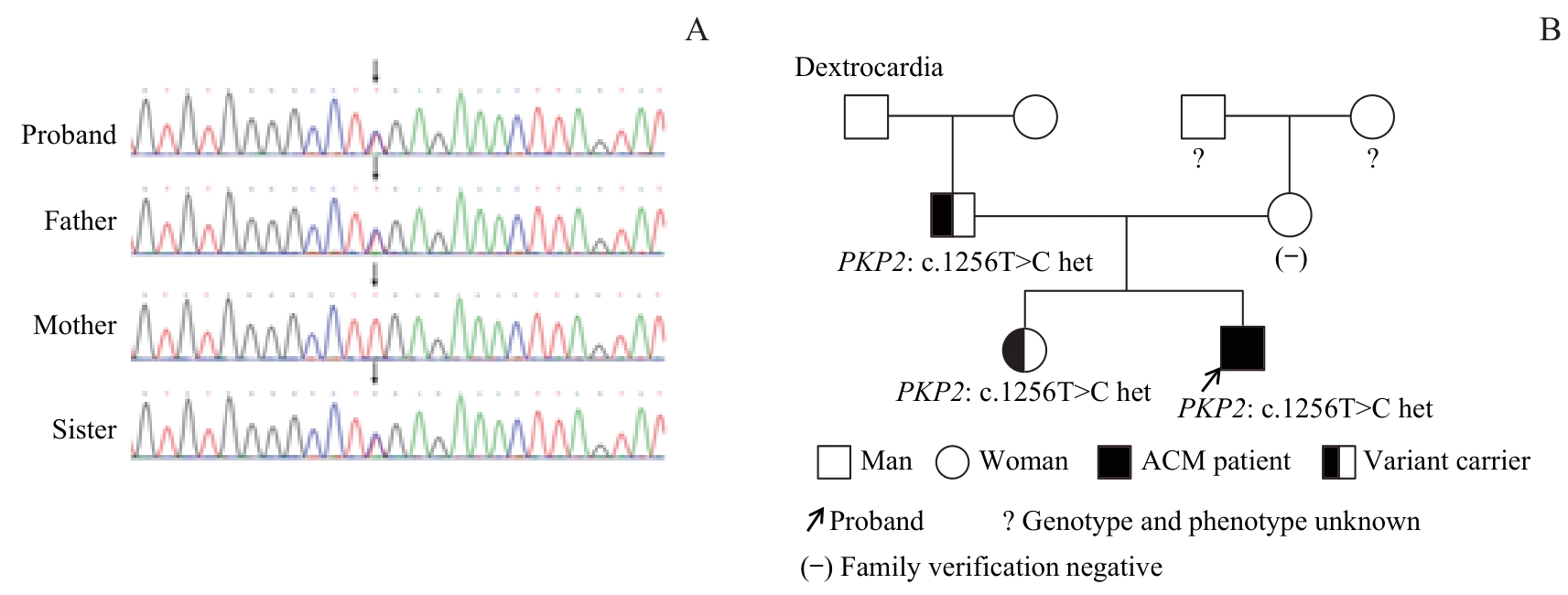
图1 病例1的Sanger测序结果(A)及家系图(B)
Fig 1 Sanger sequencing results (A) and pedigree chart (B) of Case 1
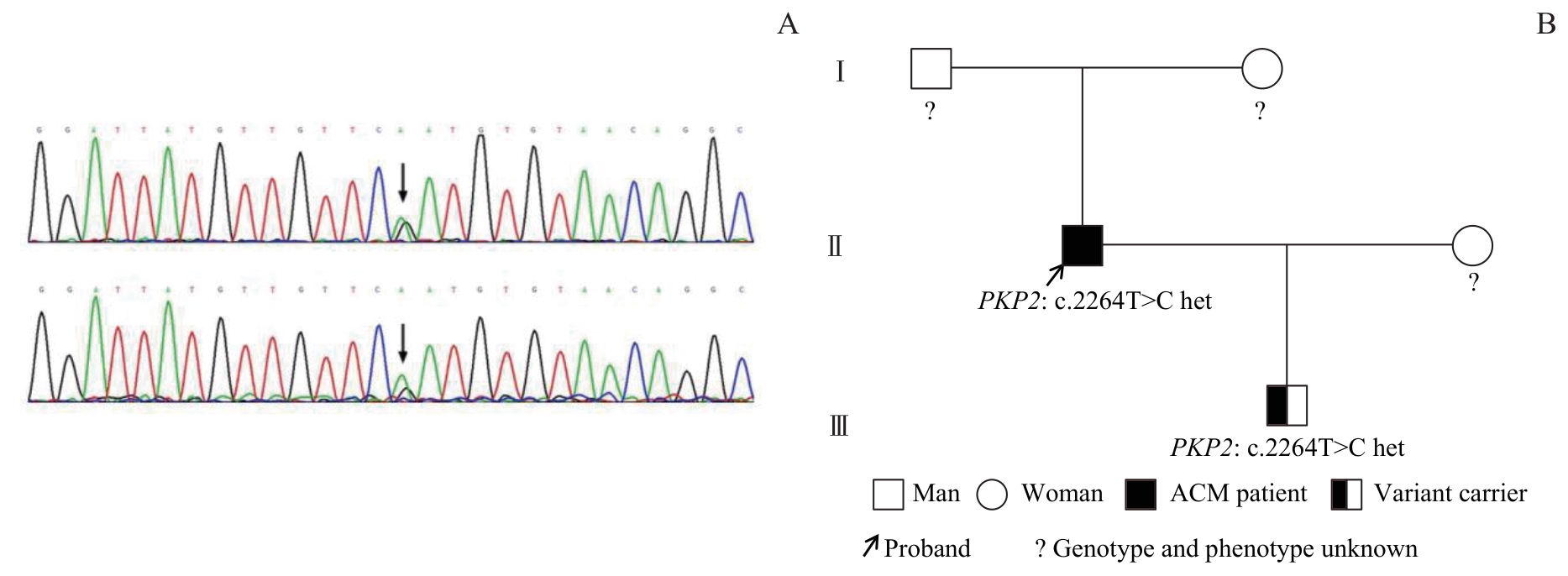
图2 病例2的Sanger测序结果(A)及家系图(B)
Fig 2 Sanger sequencing results (A) and pedigree chart (B) of Case 2
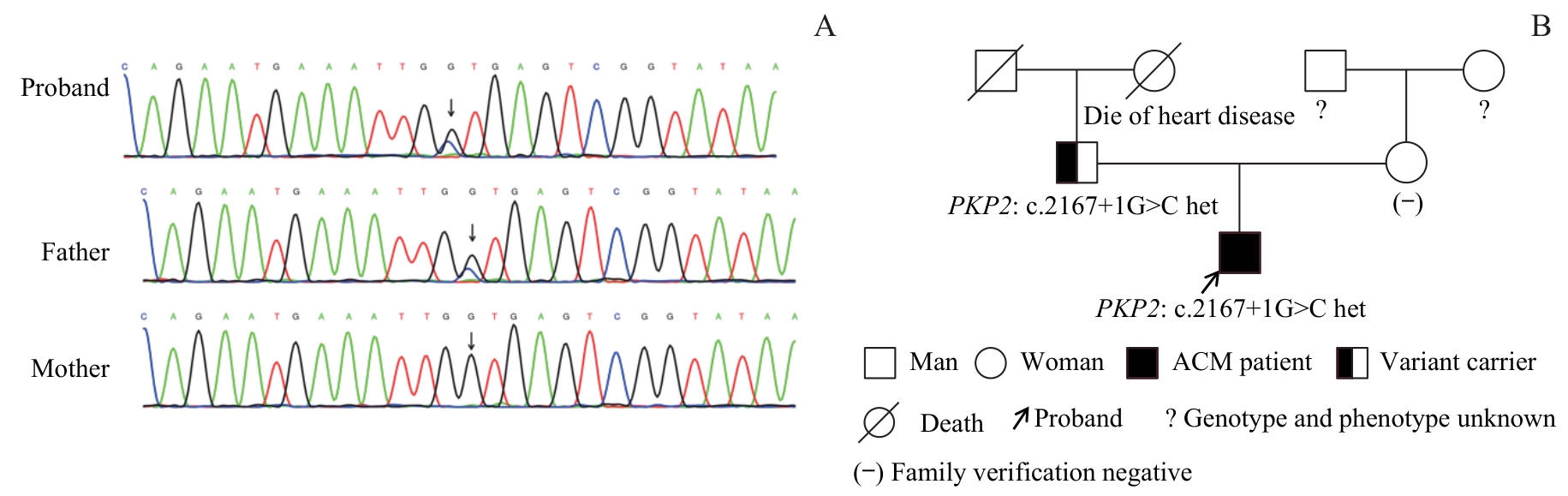
图3 病例3的Sanger测序结果(A)及家系图(B)
Fig 3 Sanger sequencing results (A) and pedigree chart (B) of Case 3
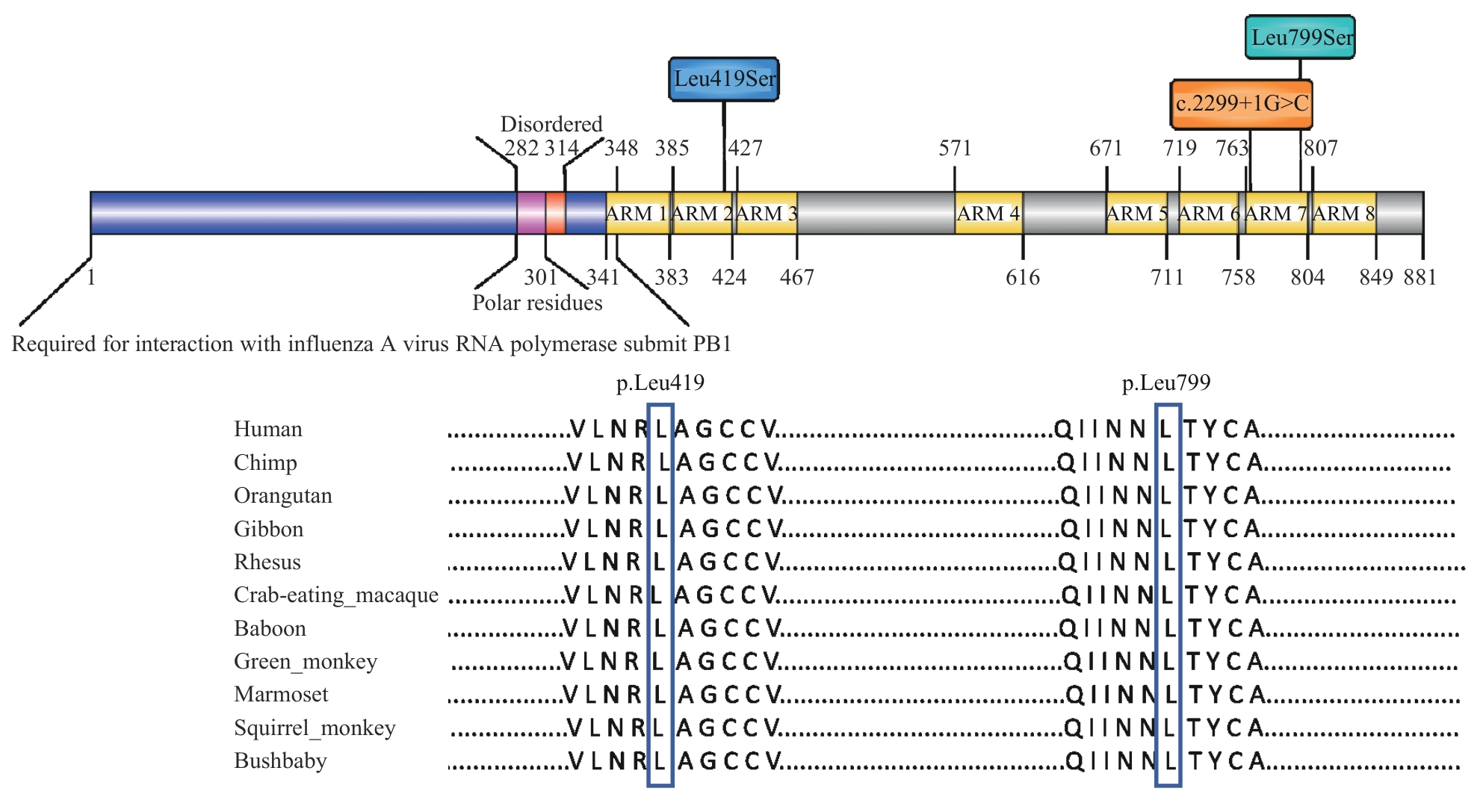
图4 错义变异物种保守性分析
Fig 4 Species conservation analysis of missense variants
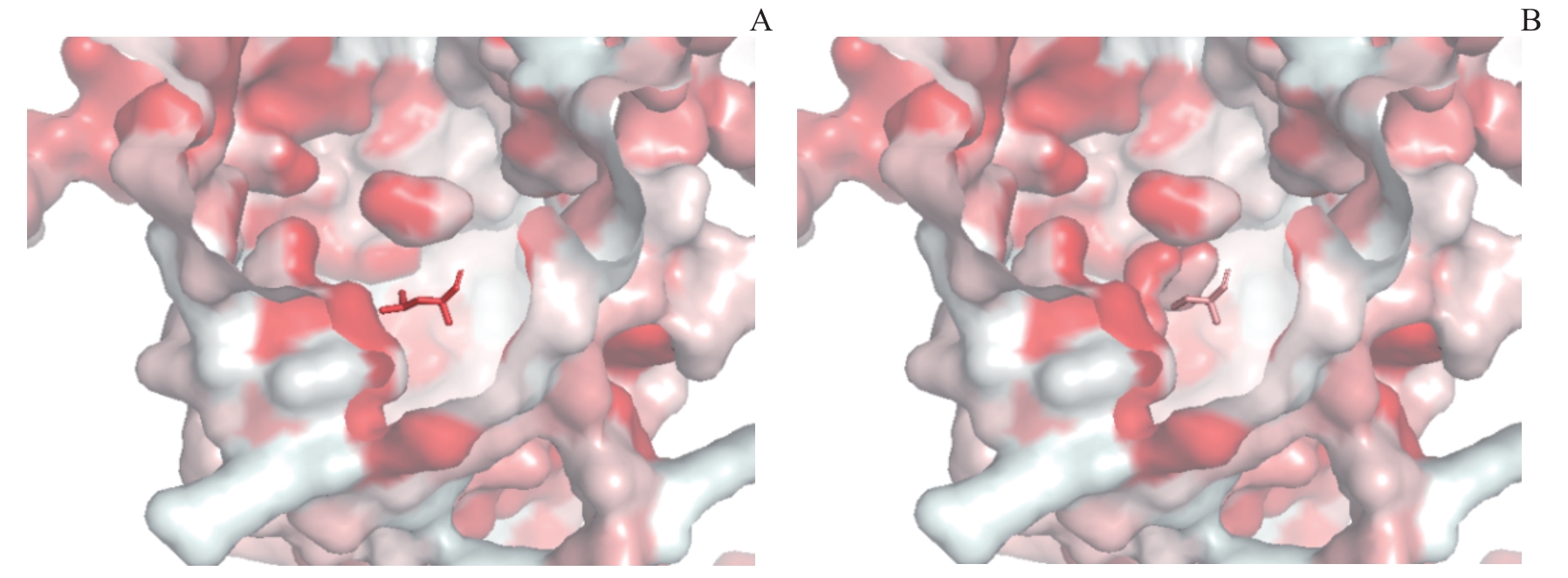
图5 基因 PKP2 野生型(A)及p.Leu419Ser变异后(B)的氨基酸疏水性Note: The gradient from red to white represents decreasing hydrophobicity.
Fig 5 Hydrophobicity of amino acids in the wild-type (A) and p.Leu419Ser-variation (B) PKP2 gene
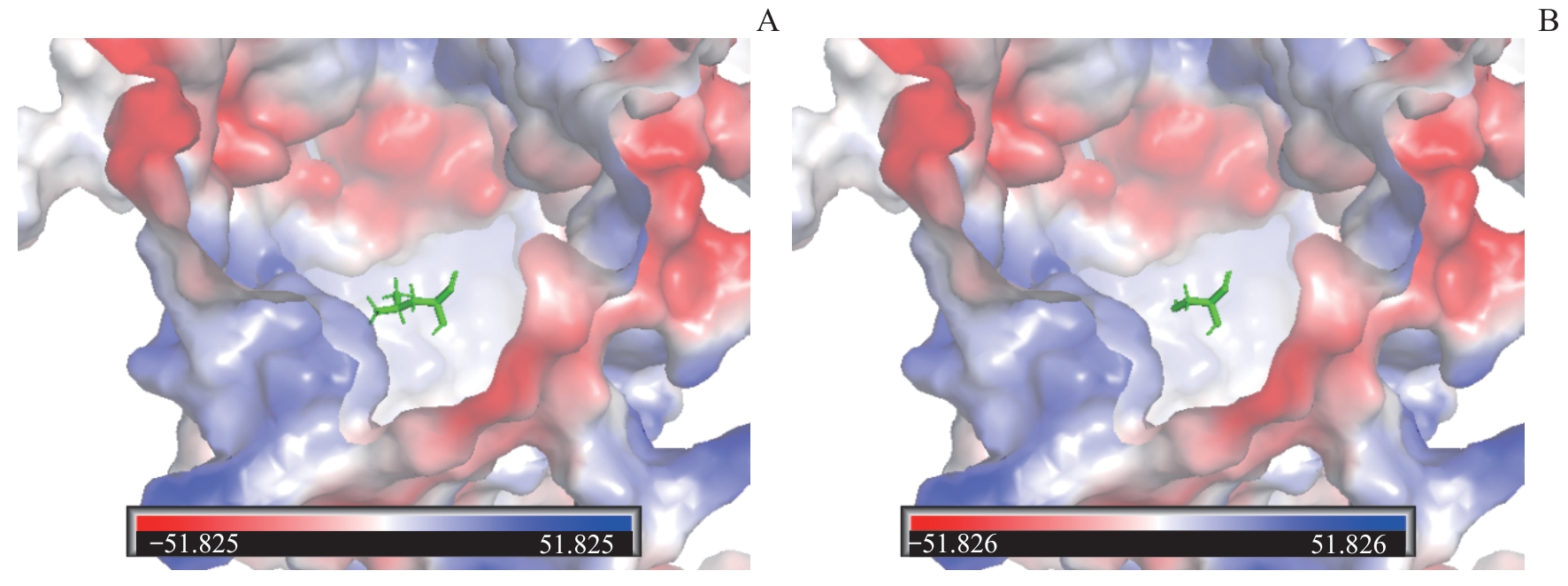
图6 基因 PKP2 野生型(A)及p.Leu419Ser变异后(B)的静电势能Note: The predicted electrostatic potentials of the wild-type and mutant of the PKP2 gene were mapped onto the surface, and colored with a gradient from red (negative) to blue (positive).
Fig 6 Electrostatic potentials of the wild-type (A) and p.Leu419Ser-variation (B) PKP2 gene
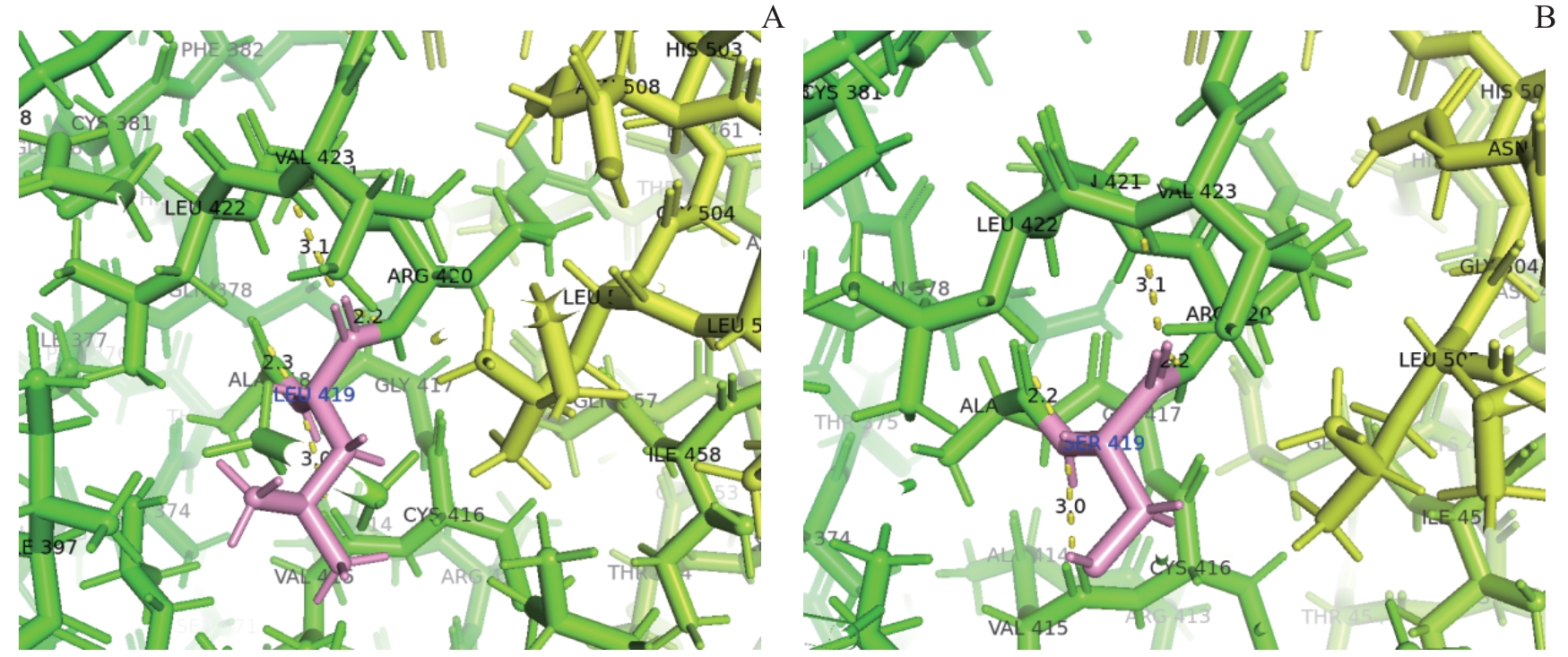
图7 野生型(A)及p.Leu419变异后(B)的 PKP2 基因第419位氨基酸氢键
Fig 7 Hydrogen bonds of amino acid at position 419 in the wild-type (A) and p.Leu419Ser-variation (B) PKP2 gene
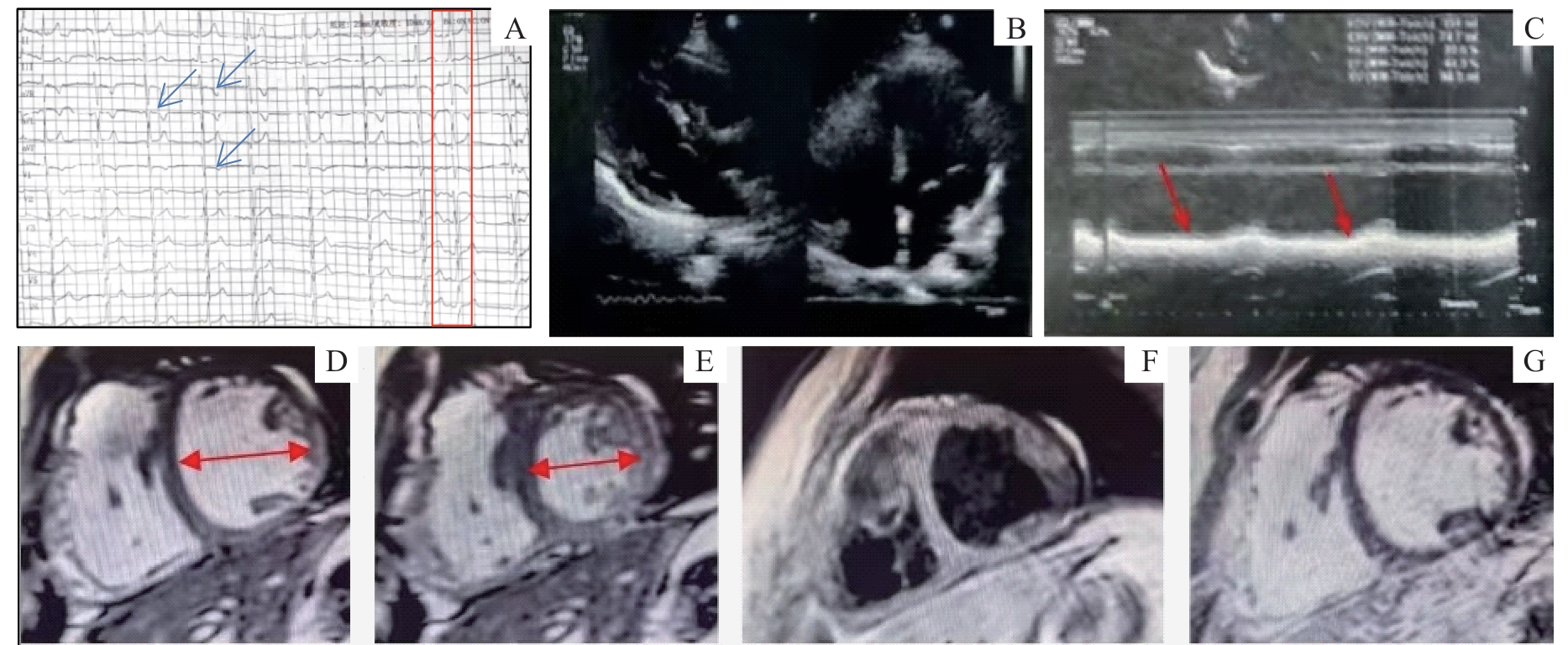
图8 病例1心电图(A)、UCG(B、C)及CMR(D⁓G)表现Note: A. T-wave inversion (arrows) in leads Ⅱ, aVF and V1, and atrial premature beats (frame). B. Enlarged left heart, reduced global left ventricular myocardial contractility (reduced left ventricular systolic function, LVEF 44%). C. Incoordinate wall motion, reduced amplitude of septal motion (arrows). D. Slightly increased LVEDD (arrow) on cine short-axis sequence. E. Slightly increased LVESD (arrow) on cine short-axis sequence. F. T2 fat-saturated imaging shows no myocardial edema. G. LGE imaging shows no myocardial fibrosis or injury.
Fig 8 Electrocardiogram(A), UCG (B/C), and CMR(D-G) findings in Case 1
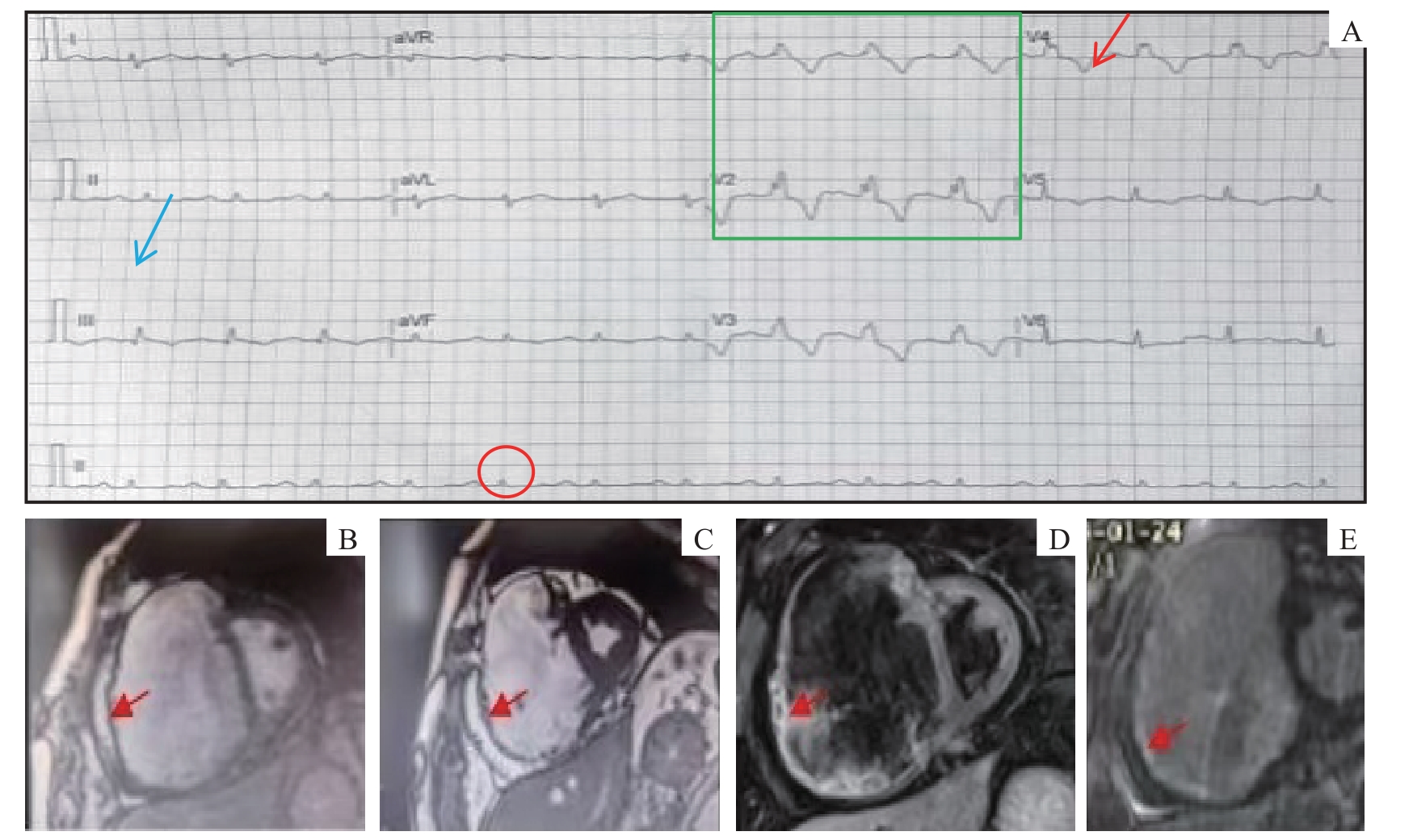
图9 病例2心电图(A)及CMR(B⁓E)表现Note: A. Low voltage (circle) in all leads, complete right bundle branch block (frame), first-degree atrioventricular block (bule arrow), flattened and inverted T waves (red arrow) in leads Ⅱ, Ⅲ, aVF, and V1-V6. B. Cine short-axis sequence shows enlargement of both left and right ventricular internal diameters at end-diastole, small aneurysm-like changes in the right ventricular free wall, and abundant fat (arrow) in the right ventricle. C. Cine short-axis sequence shows enlargement of both left and right ventricular internal diameters at end-systole, reduced systolic function of both ventricles, small aneurysm-like changes (arrow) in the right ventricular free wall, and abundant fat in the right ventricle. D. T2 fat suppression shows edema (arrow) in the right ventricular free wall (+), with pericardial fat suppressed and darkened. E. LGE imaging shows delayed enhancement (arrow) in the right ventricular free wall (+).
Fig 9 Electrocardiogram (A) and CMR (B-E) findings in Case 2
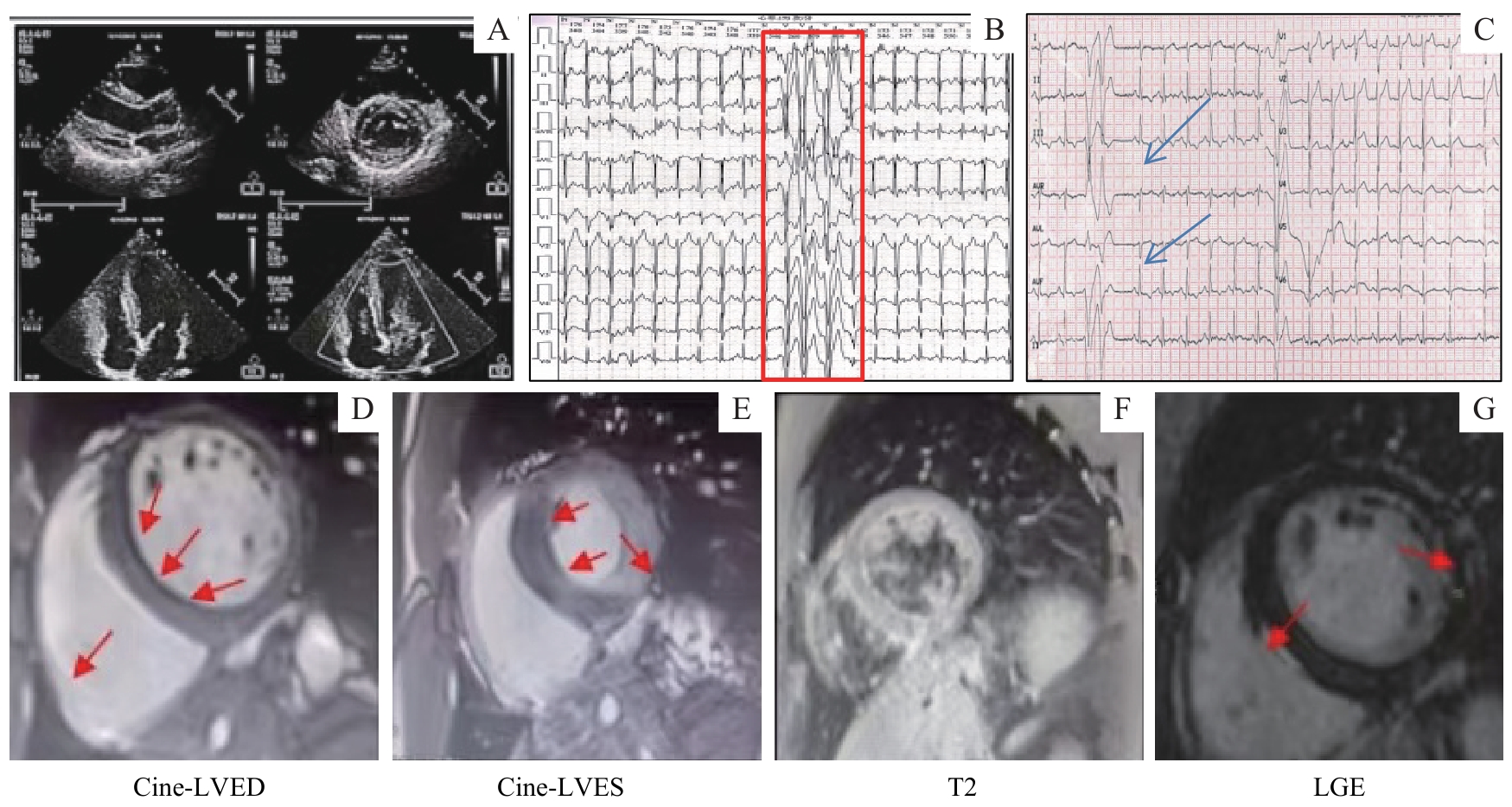
图10 病例3 UCG(A)、心电图(B、C)及CMR(D⁓G)表现Note: A. No significant abnormalities found on echocardiography. B. Paroxysmal ventricular tachycardia frame in Holter electrocardiogram. C. Sinus tachycardia and frequent premature ventricular contractions in resting electrocardiogram (arrows). D. Cine short-axis sequence shows increased left ventricular cavity diameter at end-diastole, symmetrically mild thickening of the left ventricular wall, and reduced diastolic function of both left and right ventricles (arrows). E. Cine short-axis sequence shows increased left ventricular cavity diameter at end-systole, symmetrically mild thickening of the left ventricular wall, and reduced systolic function of both left and right ventricles (arrows). F. T2 fat suppression shows no myocardial edema. G. LGE imaging shows linear delayed enhancement (arrows) in the basal septum and lateral wall.
Fig 10 UCG (A), electrocardiogram (B/C), and CMR (D-G) findings in Case 3
| [1] | Basso C, Corrado D, Marcus F I, et al. Arrhythmogenic right ventricular cardiomyopathy[J]. Lancet, 2009, 373(9671): 1289-1300. |
| [2] | 卢聪, 王倩. 致心律失常右室心肌病的诊治进展[J]. 临床内科杂志, 2023, 40(3): 207-209. |
| Lu C, Wang Q. Progress in diagnosis and treatment of arrhythmogenic right ventricular cardiomyopathy[J]. Journal of Clinical Internal Medicine, 2023, 40(3): 207-209. | |
| [3] | 黄小芳, 张淑芳, 许强宏, 等. 致心律失常性右心室心肌病进展[J]. 中华急诊医学杂志, 2018, 27(11): 1307-1310. |
| Huang X F, Zhang S F, Xu Q H, et al. The advance in arrhythmogenic right ventricular cardiomyopathy[J]. Chinese Journal of Emergency Medicine, 2018, 27(11): 1307-1310. | |
| [4] | 王继超, 陈义汉. 桥粒蛋白PKP2在心律失常性心肌病中的作用机制研究进展[J]. 中华心血管病杂志, 2020, 48(5): 423-428. |
| Wang J C, Chen Y H. Research progress on the mechanism of desmosomal protein PKP2 in arrhythmogenic cardiomyopathy[J]. Chinese Journal of Cardiology, 2020, 48(5): 423-428. | |
| [5] | Bao J R, Wang J Z, Yao Y, et al. Screening of pathogenic genes in Chinese patients with arrhythmogenic right ventricular cardiomyopathy[J]. Chin Med J, 2013, 126(22): 4238-4241. |
| [6] | Gandjbakhch E, Redheuil A, Pousset F, et al. Clinical diagnosis, imaging, and genetics of arrhythmogenic right ventricular cardiomyopathy/dysplasia: JACC state-of-the-art review[J]. J Am Coll Cardiol, 2018, 72(7): 784-804. |
| [7] | Gerull B, Heuser A, Wichter T, et al. Mutations in the desmosomal protein plakophilin-2 are common in arrhythmogenic right ventricular cardiomyopathy[J]. Nat Genet, 2004, 36(11): 1162-1164. |
| [8] | Towbin J A, McKenna W J, Abrams D J, et al. 2019 HRS expert consensus statement on evaluation, risk stratification, and management of arrhythmogenic cardiomyopathy[J]. Heart Rhythm, 2019, 16(11): e301-e372. |
| [9] | Corrado D, Anastasakis A, Basso C, et al. Proposed diagnostic criteria for arrhythmogenic cardiomyopathy: European Task Force consensus report[J]. Int J Cardiol, 2024, 395: 131447. |
| [10] | Wilde A A M, Semsarian C, Márquez M F, et al. European Heart Rhythm Association (EHRA)/Heart Rhythm Society (HRS)/Asia Pacific Heart Rhythm Society (APHRS)/Latin American Heart Rhythm Society (LAHRS) Expert Consensus Statement on the state of genetic testing for cardiac diseases[J]. Europace, 2022, 24(8): 1307-1367. |
| [11] | 王秋菊, 沈亦平, 邬玲仟, 等. 遗传变异分类标准与指南[J]. 中国科学: 生命科学, 2017, 47(6): 1-21. |
| Wang Q J, Shen Y P, Wu L Q, et al. Standards and guidelines for the interpretation of sequence variants[J]. Science China Life Sciences, 2017, 47(6): 1-21. | |
| [12] | 中华医学会心血管病学分会, 中华心血管病杂志编辑委员会, 中国医师协会医学遗传医师分会. 遗传性心血管疾病基因检测与遗传咨询中国专家共识[J]. 中华心血管病杂志, 2024, 52(7): 745-767. |
| Chinese Society of Cardiology, Chinese Journal of Cardiology Editorial Board, Chinese Medical Doctor Association Medical Genetic Physician Branch. Chinese expert consensus on genetic testing and genetic counseling for inherited cardiovascular diseases[J]. Chinese Journal of Cardiology, 2024, 52(7): 745-767. | |
| [13] | Qiu X L, Liu W L, Hu D Y, et al. Mutations of plakophilin-2 in Chinese with arrhythmogenic right ventricular dysplasia/cardiomyopathy[J]. Am J Cardiol, 2009, 103(10): 1439-1444. |
| [14] | Cerrone M, Montnach J, Lin X M, et al. Plakophilin-2 is required for transcription of genes that control calcium cycling and cardiac rhythm[J]. Nat Commun, 2017, 8(1): 106. |
| [15] | Grossmann K S, Grund C, Huelsken J, et al. Requirement of plakophilin 2 for heart morphogenesis and cardiac junction formation[J]. J Cell Biol, 2004, 167(1): 149-160. |
| [16] | Kircher D, Amodeo G, Cukierman D S, et al. Arrhythmogenic right ventricular cardiomyopathy-associated mutations in the plakophilin-2 gene: a structural and computational analysis[J]. Mol Med Rep, 2015, 12(3): 3921-3928. |
| [17] | Groeneweg J A, van der Zwaag P A, Oldenburg R A, et al. Compound heterozygous PKP2 mutations in arrhythmogenic cardiomyopathy[J]. J Cardiovasc Transl Res, 2015, 8(7): 424-432. |
| [18] | Biernacka E K, Borowiec K, Franaszczyk M, et al. Pathogenic variants in plakophilin-2 gene (PKP2) are associated with better survival in arrhythmogenic right ventricular cardiomyopathy[J]. J Appl Genet, 2021, 62(4): 613-620. |
| [19] | Syrris P, Ward D, Asimaki A, et al. Clinical expression of plakophilin-2 mutations in familial arrhythmogenic right ventricular cardiomyopathy[J]. Circulation, 2006, 113(3): 356-364. |
| [20] | Dalal D, James C, Devanagondi R, et al. Penetrance of mutations in plakophilin-2 among families with arrhythmogenic right ventricular dysplasia/cardiomyopathy[J]. J Am Coll Cardiol, 2006, 48(7): 1416-1424. |
| [21] | Christensen A H, Platonov P G, Jensen H K, et al. Genotype-phenotype correlation in arrhythmogenic right ventricular cardiomyopathy-risk of arrhythmias and heart failure[J]. J Med Genet, 2022, 59(9): 858-864. |
| [22] | Bao J R, Wang J Z, Yao Y, et al. Correlation of ventricular arrhythmias with genotype in arrhythmogenic right ventricular cardiomyopathy[J]. Circ Cardiovasc Genet, 2013, 6(6): 552-556. |
| [23] | Jain R, Dalal D, Daly A, et al. Electrocardiographic features of arrhythmogenic right ventricular dysplasia[J]. Circulation, 2009, 120(6): 477-487. |
| [24] | Dalal D, Molin L H, Piccini J, et al. Clinical features of arrhythmogenic right ventricular dysplasia/cardiomyopathy associated with mutations in plakophilin-2[J]. Circulation, 2006, 113(13): 1641-1649. |
| [25] | Muller S A, Bertoli G, Wang J N, et al. Arrhythmogenic cardiomyopathy: towards genotype based diagnoses and management[J]. J Cardiovasc Electrophysiol, 2025, 36(10): 2662-2670. |
| [1] | 李静, 梁旭霞, 邬华, 张春, 卢燕群, 张继红. 广西南宁地区地中海贫血孕妇基因型分布及其对妊娠结局的影响[J]. 上海交通大学学报(医学版), 2026, 46(5): 624-632. |
| [2] | 李可可, 陈朝霖, 冯莹, 肖扬. 遗传性凝血因子Ⅴ缺乏基因型和表型的关联研究[J]. 上海交通大学学报(医学版), 2021, 41(8): 1074-1080. |
| [3] | 祖 娟*,钱方媛*,吴 迪,谢新欣,任庆国,张志珺. 成年晚发型糖原贮积症Ⅱ型临床特征及基因突变分析[J]. 上海交通大学学报(医学版), 2020, 40(8): 1108-1112. |
| [4] | 余小燕 1, 2,李霞 1. 载脂蛋白E基因型与常见重性精神疾病的关联性[J]. 上海交通大学学报(医学版), 2018, 38(6): 704-. |
| [5] | 王柳,丘彦. 多囊卵巢综合征患者结合珠蛋白基因型及血清水平的研究[J]. 上海交通大学学报(医学版), 2017, 37(4): 532-. |
| [6] | 康路路 刘晓青 张惠文 邱文娟 孙昱 顾学范. 3例Sotos综合征的基因型与临床表现分析[J]. 上海交通大学学报(医学版), 2016, 36(8): 1165-. |
| [7] | 秦广益,陶敏芳. 人乳头状瘤病毒感染及整合状态与子宫颈病变的关系[J]. 上海交通大学学报(医学版), 2014, 34(6): 825-. |
| [8] | 张 晨,吴志国,洪 武,等. Bcl-2基因启动子多态性与重度抑郁症及其临床表型的关联分析[J]. 上海交通大学学报(医学版), 2014, 34(4): 422-. |
| [9] | 王 蕾, 刘 华, 宁小晓, 等. HBsAg和HBsAb双阳性慢性乙肝患者血清中HBV基因型与S区突变的关系[J]. , 2010, 30(10): 1226-. |
| 阅读次数 | ||||||
|
全文 |
|
|||||
|
摘要 |
|
|||||
