
上海交通大学学报(医学版) ›› 2026, Vol. 46 ›› Issue (8): 1134-1142.doi: 10.3969/j.issn.1674-8115.2026.08.014
• 论著 · 公共卫生 • 上一篇
王涛1,2, 赵梦晴1, 屈春瑾1, 王琳1( )
)
收稿日期:2026-02-27
接受日期:2026-04-14
出版日期:2026-08-28
发布日期:2026-08-28
通讯作者:
王 琳,副教授,博士;电子信箱:wanglsd@shsmu.edu.cn。作者简介:第一联系人:王涛负责实验设计,王涛、王琳参与论文的写作和修改,赵梦晴、屈春瑾参与论文数据的收集。所有作者均阅读并同意最终稿件的提交。
基金资助:
Wang Tao1,2, Zhao Mengqing1, Qu Chunjin1, Wang Lin1()
Received:2026-02-27
Accepted:2026-04-14
Online:2026-08-28
Published:2026-08-28
Contact:
Wang Lin, E-mail: wanglsd@shsmu.edu.cn.About author:First author contact:The study was designed by Wang Tao. The manuscript was drafted and revised by Wang Tao and Wang Lin. Zhao Mengqing and Qu Chunjin participated in the data collection for this study. All authors have read the final version of the manuscript and consented to its submission.
Supported by:摘要:
目的·探讨中青年胃肠道癌症化学治疗(化疗)患者抗逆力的潜在剖面,并分析剖面归属的相关因素。方法·采用目的抽样法,选取2024年10月—2025年8月在上海交通大学医学院附属仁济医院肿瘤科接受规范化疗的中青年胃肠道癌症患者(18~59岁)作为调查对象。采用一般资料问卷、抗逆力量表、情绪调节问卷、社会支持评定量表、医院焦虑抑郁量表进行横断面调查。采用Mplus 8.3软件进行潜在剖面分析,以抗逆力各条目得分为观测指标,识别中青年胃肠道癌症化疗患者抗逆力的潜在类别。随后以剖面类别为因变量,采用多因素Logistic回归进行相关因素分析。结果·共纳入有效样本393例,患者抗逆力总分为(65.72±13.54)分。模型拟合结果显示3类别模型最优,依据条目得分特征将其分别命名为被动脆弱组(21.4%)、稳健适应组(51.1%)和主动成长组(27.5%)。多因素Logistic回归分析表明:以主动成长组为参照,男性、无宗教信仰、月收入<3 000元、抑郁水平较高、主观支持及认知重评得分较低的患者,更易归入被动脆弱组,无宗教信仰、月收入<10 000元、主观支持及认知重评得分较低的患者,更易归入稳健适应组。结论·中青年胃肠道癌症化疗患者抗逆力存在异质性,可分为被动脆弱组、稳健适应组和主动成长组;男性、无宗教信仰、月收入较低、抑郁水平较高、主观支持较低及认知重评策略使用较少的患者可能抗逆力水平更低。
中图分类号:
王涛, 赵梦晴, 屈春瑾, 王琳. 中青年胃肠道癌症化学治疗患者抗逆力的潜在剖面及相关因素分析[J]. 上海交通大学学报(医学版), 2026, 46(8): 1134-1142.
Wang Tao, Zhao Mengqing, Qu Chunjin, Wang Lin. Analysis of latent profiles and associated factors of resilience among young and middle-aged patients with gastrointestinal cancer undergoing chemotherapy[J]. Journal of Shanghai Jiao Tong University (Medical Science), 2026,(8): 1134-1142.
| Item | Total (n=393) | Passive vulnerability group (n=84) | Stable adaptation group (n=201) | Active growth group (n=108) | χ2/F/H value | P value |
|---|---|---|---|---|---|---|
| Gender/n(%) | 10.966 | 0.004 | ||||
| Male | 205 (52.16) | 31 (36.90) | 109 (54.23) | 65 (60.19) | ||
| Female | 188 (47.84) | 53 (63.10) | 92 (45.77) | 43 (39.81) | ||
| Age/year | 51.0 (43.0, 55.0) | 50.50 (41.0, 56.0) | 51.00 (43.0, 56.0) | 50.50 (44.0, 54.0) | 0.686 | 0.709 |
| Living arrangement/n(%) | 4.875 | 0.087 | ||||
| Alone | 17 (4.33) | 2 (2.38) | 13 (6.47) | 2 (1.85) | ||
| Not alone | 376 (95.67) | 82 (97.62) | 188 (93.53) | 106 (98.15) | ||
| Religion/n(%) | 6.019 | 0.049 | ||||
| Yes | 28 (7.12) | 10 (11.90) | 15 (7.46) | 3 (2.78) | ||
| No | 365 (92.88) | 74 (88.10) | 186 (92.54) | 105 (97.22) | ||
| Education level/n(%) | 14.811 | 0.022 | ||||
| Primary school and below | 38 (9.67) | 15 (17.86) | 18 (8.96) | 5 (4.63) | ||
| Junior middle school | 111 (28.24) | 22 (26.19) | 57 (28.36) | 32 (29.63) | ||
| Senior middle school | 110 (27.99) | 28 (33.33) | 50 (24.88) | 32 (29.63) | ||
| College and above | 134 (34.10) | 19 (22.62) | 76 (37.81) | 39 (36.11) | ||
| Marital status/n(%) | 2.439 | 0.295 | ||||
| Single/divorced/widowed | 39 (9.92) | 11 (13.10) | 21 (10.45) | 7 (6.48) | ||
| Married | 354 (90.08) | 73 (86.90) | 180 (89.55) | 101 (93.52) | ||
| Monthly income/n(%) | 23.351 | 0.001 | ||||
| <3 000 yuan | 131 (33.33) | 42 (50.00) | 62 (30.85) | 27 (25.00) | ||
| 3 000‒<7 000 yuan | 118 (30.03) | 21 (25.00) | 64 (31.84) | 33 (30.56) | ||
| 7 000‒<10 000 yuan | 58 (14.76) | 10 (11.90) | 36 (17.91) | 12 (11.11) | ||
| ≥10 000 yuan | 86 (21.88) | 11 (13.10) | 39 (19.40) | 36 (33.33) | ||
| Medical payment method/n(%) | 5.837 | 0.442 | ||||
| Urban resident basic medical insurance | 203 (51.65) | 39 (46.43) | 104 (51.74) | 60 (55.56) | ||
| Urban employee basic medical insurance | 127 (32.32) | 26 (30.95) | 64 (31.84) | 37 (34.26) | ||
| New rural cooperative medical insurance | 51 (12.98) | 16 (19.05) | 26 (12.94) | 9 (8.33) | ||
| Others | 12 (3.05) | 3 (3.57) | 7 (3.48) | 2 (1.85) | ||
| Cancer diagnosis/n(%) | 4.660 | 0.324 | ||||
| Gastric cancer | 134 (34.10) | 29 (34.52) | 75 (37.31) | 30 (27.78) | ||
| Colon cancer | 172 (43.77) | 40 (47.62) | 79 (39.30) | 53 (49.07) | ||
| Rectal cancer | 87 (22.14) | 15 (17.86) | 47 (23.38) | 25 (23.15) | ||
| Stage/n(%) | 6.109 | 0.411 | ||||
| Ⅰ | 6 (1.53) | 3 (3.57) | 2 (1.00) | 1 (0.93) | ||
| Ⅱ | 38 (9.67) | 7 (8.33) | 24 (11.94) | 7 (6.48) | ||
| Ⅲ | 115 (29.26) | 23 (27.38) | 55 (27.36) | 37 (34.26) | ||
| Ⅳ | 234 (59.54) | 51 (60.71) | 120 (59.70) | 63 (58.33) | ||
| Distant metastasis/n(%) | 0.124 | 0.940 | ||||
| Yes | 232 (59.03) | 50 (59.52) | 117 (58.21) | 65 (60.19) | ||
| No | 161 (40.97) | 34 (40.48) | 84 (41.79) | 43 (39.81) | ||
| Surgery/n(%) | 0.423 | 0.809 | ||||
| Yes | 330 (83.97) | 69 (82.14) | 171 (85.07) | 90 (83.33) | ||
| No | 63 (16.03) | 15 (17.86) | 30 (14.93) | 18 (16.67) | ||
| Hb level/(g·L-1) | 126.0 (111.5, 138.0) | 116.5 (108.0, 137.8) | 126 (115.0, 137.5) | 131 (111.3, 142.0) | 6.433 | 0.040 |
| Anxiety/score | 4.00 (1.00, 7.00) | 7.00 (3.00, 10.00) | 4.00 (1.00, 6.00) | 3.00 (1.00, 5.00) | 27.782 | <0.001 |
| Depression/score | 3.00 (1.00, 6.00) | 6.50 (3.00, 9.75) | 3.00 (1.00, 5.00) | 2.00 (1.00, 4.75) | 50.461 | <0.001 |
| Cognitive reappraisal/score | 30.34±5.06 | 27.61±5.21 | 30.40±4.42 | 32.36±5.13 | 23.253 | <0.001 |
| Expressive suppression/score | 14.71±4.97 | 15.51±4.74 | 14.39±4.82 | 14.69±5.38 | 1.520 | 0.220 |
| Subjective support/score | 24.52±4.33 | 23.06±4.66 | 24.36±4.24 | 25.96±3.79 | 11.506 | <0.001 |
| Objective support/score | 10.59±2.73 | 9.92±2.21 | 10.67±2.72 | 10.97±3.02 | 3.756 | 0.024 |
| Utilization of social support/score | 7.08±2.36 | 6.37±2.12 | 7.10±2.27 | 7.59±2.57 | 6.562 | 0.002 |
表1 患者的一般资料及抗逆力潜在剖面的单因素分析
Tab 1 Univariate analysis of general information and latent profiles of resilience in patients
| Item | Total (n=393) | Passive vulnerability group (n=84) | Stable adaptation group (n=201) | Active growth group (n=108) | χ2/F/H value | P value |
|---|---|---|---|---|---|---|
| Gender/n(%) | 10.966 | 0.004 | ||||
| Male | 205 (52.16) | 31 (36.90) | 109 (54.23) | 65 (60.19) | ||
| Female | 188 (47.84) | 53 (63.10) | 92 (45.77) | 43 (39.81) | ||
| Age/year | 51.0 (43.0, 55.0) | 50.50 (41.0, 56.0) | 51.00 (43.0, 56.0) | 50.50 (44.0, 54.0) | 0.686 | 0.709 |
| Living arrangement/n(%) | 4.875 | 0.087 | ||||
| Alone | 17 (4.33) | 2 (2.38) | 13 (6.47) | 2 (1.85) | ||
| Not alone | 376 (95.67) | 82 (97.62) | 188 (93.53) | 106 (98.15) | ||
| Religion/n(%) | 6.019 | 0.049 | ||||
| Yes | 28 (7.12) | 10 (11.90) | 15 (7.46) | 3 (2.78) | ||
| No | 365 (92.88) | 74 (88.10) | 186 (92.54) | 105 (97.22) | ||
| Education level/n(%) | 14.811 | 0.022 | ||||
| Primary school and below | 38 (9.67) | 15 (17.86) | 18 (8.96) | 5 (4.63) | ||
| Junior middle school | 111 (28.24) | 22 (26.19) | 57 (28.36) | 32 (29.63) | ||
| Senior middle school | 110 (27.99) | 28 (33.33) | 50 (24.88) | 32 (29.63) | ||
| College and above | 134 (34.10) | 19 (22.62) | 76 (37.81) | 39 (36.11) | ||
| Marital status/n(%) | 2.439 | 0.295 | ||||
| Single/divorced/widowed | 39 (9.92) | 11 (13.10) | 21 (10.45) | 7 (6.48) | ||
| Married | 354 (90.08) | 73 (86.90) | 180 (89.55) | 101 (93.52) | ||
| Monthly income/n(%) | 23.351 | 0.001 | ||||
| <3 000 yuan | 131 (33.33) | 42 (50.00) | 62 (30.85) | 27 (25.00) | ||
| 3 000‒<7 000 yuan | 118 (30.03) | 21 (25.00) | 64 (31.84) | 33 (30.56) | ||
| 7 000‒<10 000 yuan | 58 (14.76) | 10 (11.90) | 36 (17.91) | 12 (11.11) | ||
| ≥10 000 yuan | 86 (21.88) | 11 (13.10) | 39 (19.40) | 36 (33.33) | ||
| Medical payment method/n(%) | 5.837 | 0.442 | ||||
| Urban resident basic medical insurance | 203 (51.65) | 39 (46.43) | 104 (51.74) | 60 (55.56) | ||
| Urban employee basic medical insurance | 127 (32.32) | 26 (30.95) | 64 (31.84) | 37 (34.26) | ||
| New rural cooperative medical insurance | 51 (12.98) | 16 (19.05) | 26 (12.94) | 9 (8.33) | ||
| Others | 12 (3.05) | 3 (3.57) | 7 (3.48) | 2 (1.85) | ||
| Cancer diagnosis/n(%) | 4.660 | 0.324 | ||||
| Gastric cancer | 134 (34.10) | 29 (34.52) | 75 (37.31) | 30 (27.78) | ||
| Colon cancer | 172 (43.77) | 40 (47.62) | 79 (39.30) | 53 (49.07) | ||
| Rectal cancer | 87 (22.14) | 15 (17.86) | 47 (23.38) | 25 (23.15) | ||
| Stage/n(%) | 6.109 | 0.411 | ||||
| Ⅰ | 6 (1.53) | 3 (3.57) | 2 (1.00) | 1 (0.93) | ||
| Ⅱ | 38 (9.67) | 7 (8.33) | 24 (11.94) | 7 (6.48) | ||
| Ⅲ | 115 (29.26) | 23 (27.38) | 55 (27.36) | 37 (34.26) | ||
| Ⅳ | 234 (59.54) | 51 (60.71) | 120 (59.70) | 63 (58.33) | ||
| Distant metastasis/n(%) | 0.124 | 0.940 | ||||
| Yes | 232 (59.03) | 50 (59.52) | 117 (58.21) | 65 (60.19) | ||
| No | 161 (40.97) | 34 (40.48) | 84 (41.79) | 43 (39.81) | ||
| Surgery/n(%) | 0.423 | 0.809 | ||||
| Yes | 330 (83.97) | 69 (82.14) | 171 (85.07) | 90 (83.33) | ||
| No | 63 (16.03) | 15 (17.86) | 30 (14.93) | 18 (16.67) | ||
| Hb level/(g·L-1) | 126.0 (111.5, 138.0) | 116.5 (108.0, 137.8) | 126 (115.0, 137.5) | 131 (111.3, 142.0) | 6.433 | 0.040 |
| Anxiety/score | 4.00 (1.00, 7.00) | 7.00 (3.00, 10.00) | 4.00 (1.00, 6.00) | 3.00 (1.00, 5.00) | 27.782 | <0.001 |
| Depression/score | 3.00 (1.00, 6.00) | 6.50 (3.00, 9.75) | 3.00 (1.00, 5.00) | 2.00 (1.00, 4.75) | 50.461 | <0.001 |
| Cognitive reappraisal/score | 30.34±5.06 | 27.61±5.21 | 30.40±4.42 | 32.36±5.13 | 23.253 | <0.001 |
| Expressive suppression/score | 14.71±4.97 | 15.51±4.74 | 14.39±4.82 | 14.69±5.38 | 1.520 | 0.220 |
| Subjective support/score | 24.52±4.33 | 23.06±4.66 | 24.36±4.24 | 25.96±3.79 | 11.506 | <0.001 |
| Objective support/score | 10.59±2.73 | 9.92±2.21 | 10.67±2.72 | 10.97±3.02 | 3.756 | 0.024 |
| Utilization of social support/score | 7.08±2.36 | 6.37±2.12 | 7.10±2.27 | 7.59±2.57 | 6.562 | 0.002 |
| Model | AIC | BIC | aBIC | LMR (P value) | BLRT (P value) | Entropy | Class probability |
|---|---|---|---|---|---|---|---|
| 1 | 26 786.203 | 26 984.893 | 26 826.244 | ‒ | ‒ | ‒ | 1 |
| 2 | 24 840.525 | 25 142.535 | 24 901.388 | <0.001 | <0.001 | 0.921 | 0.356/0.644 |
| 3 | 24 225.387 | 24 630.715 | 24 307.072 | 0.001 | <0.001 | 0.911 | 0.213/0.511/0.275 |
| 4 | 24 032.901 | 24 541.548 | 24 135.407 | 0.423 | <0.001 | 0.907 | 0.046/0.232/0.476/0.247 |
| 5 | 23 914.470 | 24 526.438 | 24 037.800 | 0.510 | <0.001 | 0.875 | 0.041/0.170/0.303/0.356/0.130 |
表2 中青年胃肠道癌症化疗患者抗逆力LPA模型拟合指标
Tab 2 Model fit indices for LPA of resilience in young and middle-aged patients with gastrointestinal cancer undergoing chemotherapy
| Model | AIC | BIC | aBIC | LMR (P value) | BLRT (P value) | Entropy | Class probability |
|---|---|---|---|---|---|---|---|
| 1 | 26 786.203 | 26 984.893 | 26 826.244 | ‒ | ‒ | ‒ | 1 |
| 2 | 24 840.525 | 25 142.535 | 24 901.388 | <0.001 | <0.001 | 0.921 | 0.356/0.644 |
| 3 | 24 225.387 | 24 630.715 | 24 307.072 | 0.001 | <0.001 | 0.911 | 0.213/0.511/0.275 |
| 4 | 24 032.901 | 24 541.548 | 24 135.407 | 0.423 | <0.001 | 0.907 | 0.046/0.232/0.476/0.247 |
| 5 | 23 914.470 | 24 526.438 | 24 037.800 | 0.510 | <0.001 | 0.875 | 0.041/0.170/0.303/0.356/0.130 |
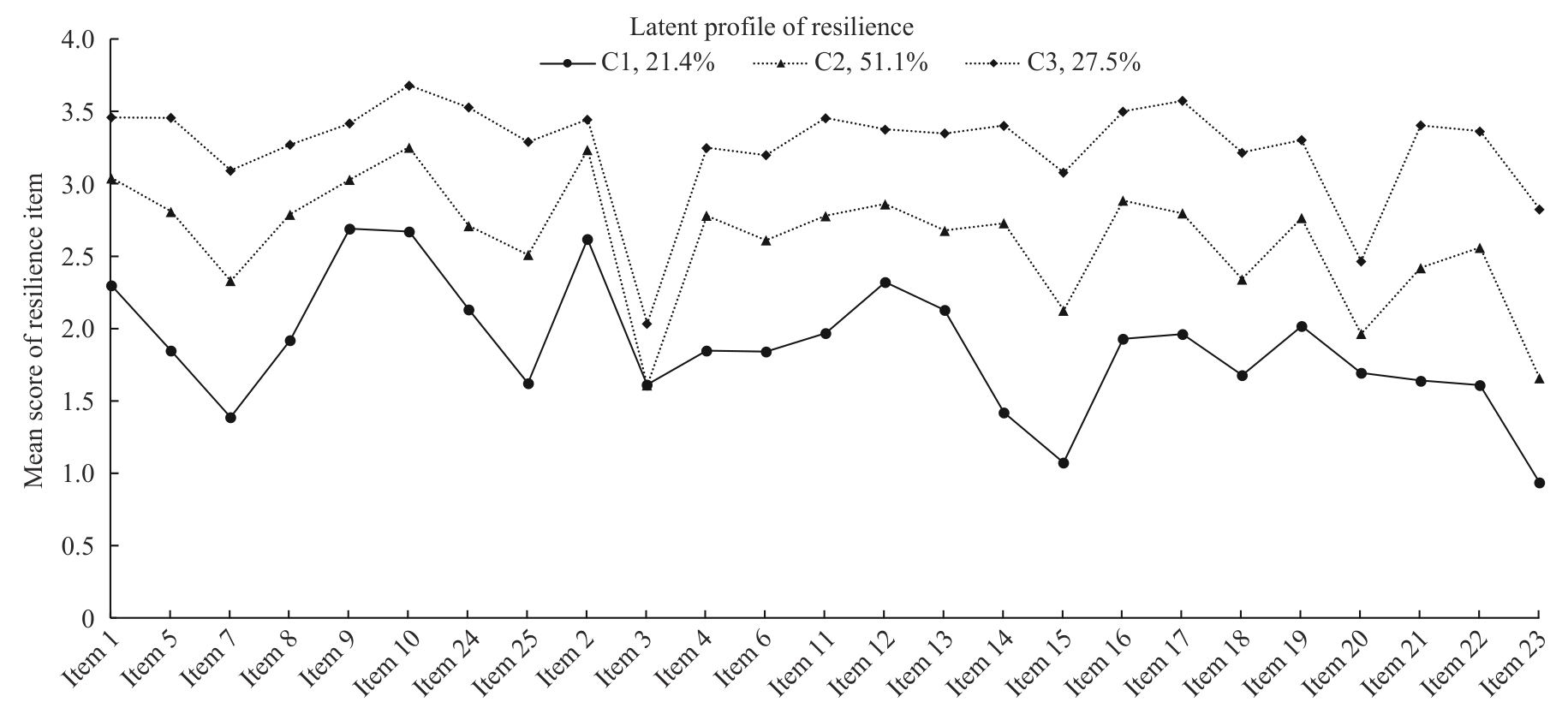
图1 中青年胃肠道癌症化疗患者抗逆力的LPA图Note: C1—passive vulnerability group; C2—stable adaptation group; C3—active growth group. The items on the horizontal axis are arranged according to clustering based on the three dimensions of the scale. Items 1, 5, 7‒10, 24, and 25 belong to “Strength”, items 2, 3, 4, and 6 belong to “Optimism”, and items 11‒23 belong to “Tenacity”.
Fig 1 LPA plot of resilience among young and middle-aged patients with gastrointestinal cancer undergoing chemotherapy
| Item | C1 vs C3 (C3 as the reference group) | C2 vs C3 (C3 as the reference group) | ||||||||||
|---|---|---|---|---|---|---|---|---|---|---|---|---|
| B | SE | Wald χ² | P value | OR | 95% CI | B | SE | Wald χ2 | P value | OR | 95% CI | |
| Male | 0.752 | 0.380 | 3.910 | 0.048 | 2.121 | 1.007‒4.470 | 0.201 | 0.283 | 0.502 | 0.479 | 1.222 | 0.701‒2.130 |
| Having religion | -1.997 | 0.778 | 6.591 | 0.010 | 0.136 | 0.030‒0.623 | -1.516 | 0.685 | 4.904 | 0.027 | 0.219 | 0.057‒0.840 |
| Education level | ||||||||||||
| Primary school and below | 0.713 | 0.737 | 0.937 | 0.333 | 2.040 | 0.481‒8.647 | 0.152 | 0.613 | 0.061 | 0.804 | 1.164 | 0.350‒3.872 |
| Junior high school | -0.354 | 0.544 | 0.424 | 0.515 | 0.702 | 0.241‒2.039 | -0.346 | 0.373 | 0.861 | 0.353 | 0.708 | 0.341‒1.469 |
| Senior high school | 0.253 | 0.488 | 0.270 | 0.603 | 1.288 | 0.495‒3.350 | -0.544 | 0.352 | 2.387 | 0.122 | 0.580 | 0.291‒1.157 |
| Monthly income | ||||||||||||
| <3 000 yuan | 1.276 | 0.597 | 4.571 | 0.033 | 3.582 | 1.112‒11.536 | 0.859 | 0.421 | 4.165 | 0.041 | 2.361 | 1.035‒5.388 |
| 3 000‒<7 000 yuan | 0.567 | 0.571 | 0.987 | 0.320 | 1.764 | 0.576‒5.403 | 0.786 | 0.376 | 4.355 | 0.037 | 2.194 | 1.049‒4.587 |
| 7 000‒<10 000 yuan | 0.590 | 0.663 | 0.793 | 0.373 | 1.804 | 0.492‒6.614 | 1.153 | 0.450 | 6.569 | 0.010 | 3.167 | 1.312‒7.646 |
| Anxiety level | -0.011 | 0.071 | 0.022 | 0.881 | 0.989 | 0.861‒1.137 | -0.012 | 0.055 | 0.046 | 0.831 | 0.988 | 0.888‒1.100 |
| Depression level | 0.263 | 0.086 | 9.377 | 0.002 | 1.301 | 1.099‒1.539 | 0.064 | 0.067 | 0.920 | 0.337 | 1.066 | 0.935‒1.216 |
| Subjective support | -0.127 | 0.049 | 6.793 | 0.009 | 0.880 | 0.800‒0.969 | -0.102 | 0.037 | 7.507 | 0.006 | 0.903 | 0.839‒0.971 |
| Objective support | 0.050 | 0.075 | 0.450 | 0.502 | 1.052 | 0.908‒1.218 | 0.050 | 0.051 | 0.952 | 0.329 | 1.051 | 0.951‒1.162 |
| Utilization of social support | -0.126 | 0.080 | 2.500 | 0.114 | 0.881 | 0.754‒1.031 | -0.015 | 0.056 | 0.067 | 0.795 | 0.986 | 0.883‒1.100 |
| Cognitive reappraisal | -0.129 | 0.041 | 10.164 | 0.001 | 0.879 | 0.811‒0.951 | -0.074 | 0.030 | 6.199 | 0.013 | 0.929 | 0.877‒0.984 |
| Hb level | -0.004 | 0.010 | 0.160 | 0.689 | 0.996 | 0.977‒1.015 | 0.004 | 0.008 | 0.270 | 0.603 | 1.004 | 0.989‒1.020 |
表3 抗逆力潜在剖面的多因素Logistic回归分析
Tab 3 Multivariate Logistic regression analysis of latent profiles of resilience
| Item | C1 vs C3 (C3 as the reference group) | C2 vs C3 (C3 as the reference group) | ||||||||||
|---|---|---|---|---|---|---|---|---|---|---|---|---|
| B | SE | Wald χ² | P value | OR | 95% CI | B | SE | Wald χ2 | P value | OR | 95% CI | |
| Male | 0.752 | 0.380 | 3.910 | 0.048 | 2.121 | 1.007‒4.470 | 0.201 | 0.283 | 0.502 | 0.479 | 1.222 | 0.701‒2.130 |
| Having religion | -1.997 | 0.778 | 6.591 | 0.010 | 0.136 | 0.030‒0.623 | -1.516 | 0.685 | 4.904 | 0.027 | 0.219 | 0.057‒0.840 |
| Education level | ||||||||||||
| Primary school and below | 0.713 | 0.737 | 0.937 | 0.333 | 2.040 | 0.481‒8.647 | 0.152 | 0.613 | 0.061 | 0.804 | 1.164 | 0.350‒3.872 |
| Junior high school | -0.354 | 0.544 | 0.424 | 0.515 | 0.702 | 0.241‒2.039 | -0.346 | 0.373 | 0.861 | 0.353 | 0.708 | 0.341‒1.469 |
| Senior high school | 0.253 | 0.488 | 0.270 | 0.603 | 1.288 | 0.495‒3.350 | -0.544 | 0.352 | 2.387 | 0.122 | 0.580 | 0.291‒1.157 |
| Monthly income | ||||||||||||
| <3 000 yuan | 1.276 | 0.597 | 4.571 | 0.033 | 3.582 | 1.112‒11.536 | 0.859 | 0.421 | 4.165 | 0.041 | 2.361 | 1.035‒5.388 |
| 3 000‒<7 000 yuan | 0.567 | 0.571 | 0.987 | 0.320 | 1.764 | 0.576‒5.403 | 0.786 | 0.376 | 4.355 | 0.037 | 2.194 | 1.049‒4.587 |
| 7 000‒<10 000 yuan | 0.590 | 0.663 | 0.793 | 0.373 | 1.804 | 0.492‒6.614 | 1.153 | 0.450 | 6.569 | 0.010 | 3.167 | 1.312‒7.646 |
| Anxiety level | -0.011 | 0.071 | 0.022 | 0.881 | 0.989 | 0.861‒1.137 | -0.012 | 0.055 | 0.046 | 0.831 | 0.988 | 0.888‒1.100 |
| Depression level | 0.263 | 0.086 | 9.377 | 0.002 | 1.301 | 1.099‒1.539 | 0.064 | 0.067 | 0.920 | 0.337 | 1.066 | 0.935‒1.216 |
| Subjective support | -0.127 | 0.049 | 6.793 | 0.009 | 0.880 | 0.800‒0.969 | -0.102 | 0.037 | 7.507 | 0.006 | 0.903 | 0.839‒0.971 |
| Objective support | 0.050 | 0.075 | 0.450 | 0.502 | 1.052 | 0.908‒1.218 | 0.050 | 0.051 | 0.952 | 0.329 | 1.051 | 0.951‒1.162 |
| Utilization of social support | -0.126 | 0.080 | 2.500 | 0.114 | 0.881 | 0.754‒1.031 | -0.015 | 0.056 | 0.067 | 0.795 | 0.986 | 0.883‒1.100 |
| Cognitive reappraisal | -0.129 | 0.041 | 10.164 | 0.001 | 0.879 | 0.811‒0.951 | -0.074 | 0.030 | 6.199 | 0.013 | 0.929 | 0.877‒0.984 |
| Hb level | -0.004 | 0.010 | 0.160 | 0.689 | 0.996 | 0.977‒1.015 | 0.004 | 0.008 | 0.270 | 0.603 | 1.004 | 0.989‒1.020 |
| [1] | 吴琪, 范伯男, 李岩. 2022全球癌症统计报告分析解读: 中国与世界癌症疾病负担与流行趋势[J]. 诊断学理论与实践, 2025, 24(2): 135-145. |
| Wu Q, Fan B N, Li Y. Analysis and interpretation of the 2022 Global Cancer Statistics Report: cancer burden and epidemiological trends in China and the world[J]. Journal of Diagnostics Concepts & Practice, 2025, 24(2): 135-145. | |
| [2] | 刘福燕, 刘玉琪, 王睿, 等. 化疗期青年癌症患者心理痛苦现状及对其生活质量的影响[J]. 护理学, 2022, 11(2): 184-191. |
| Liu F Y, Liu Y Q, Wang R, et al. Psychological distress and quality of life in young cancer patients during chemotherapy[J]. Nursing Science, 2022, 11(2): 184-191. | |
| [3] | Chu Q, Cheong I H, Le P D, et al. The unaddressed mental health burden among cancer patients in China: a call to action[J]. Lancet Psychiatry, 2021, 8(8): 646-647. |
| [4] | Joyce S, Shand F, Tighe J, et al. Road to resilience: a systematic review and meta-analysis of resilience training programmes and interventions[J]. BMJ Open, 2018, 8(6): e017858. |
| [5] | 王颖, 刘焕焕, 王爱华. 乳腺癌化疗患者创伤后成长与心身症状及心理弹性的相关性[J]. 国际护理学杂志, 2022, 41(18): 3333-3337. |
| Wang Y, Liu H H, Wang A H. Correlation of posttraumatic growth with psychosomatic symptoms and psychological resilience in breast cancer patients undergoing chemotherapy[J]. International Journal of Nursing, 2022, 41(18): 3333-3337. | |
| [6] | 高广超, 姬艳博, 孙菲菲, 等. 癌症病人心理弹性水平及其影响因素的分析研究[J]. 护理研究, 2016, 30(34): 4263-4267. |
| Gao G C, Ji Y B, Sun F F, et al. Analysis of psychological resilience level and its influencing factors in cancer patients[J]. Chinese Nursing Research, 2016, 30(34): 4263-4267. | |
| [7] | 刘丽琼, 余杨, 郭思琪, 等. 基于CiteSpace近10年国内外癌症病人心理弹性的研究热点和前沿分析[J]. 循证护理, 2023, 9(20): 3714-3721. |
| Liu L Q, Yu Y, Guo S Q, et al. Research hotspots and frontier analysis of psychological resilience of cancer patients both domestically and internationally based on CiteSpace in the past decade[J]. Chinese Evidence-Based Nursing, 2023, 9(20): 3714-3721. | |
| [8] | 尹奎, 彭坚, 张君. 潜在剖面分析在组织行为领域中的应用[J]. 心理科学进展, 2020, 28(7): 1056-1070. |
| Yin K, Peng J, Zhang J. The application of latent profile analysis in organizational behavior research[J]. Advances in Psychological Science, 2020, 28(7): 1056-1070. | |
| [9] | Yang L H, Li Y, Wang X Q, et al. Examining the role of resilience in the relationship between social support and fear of recurrence among patients with gastric cancer on chemotherapy: a cross-sectional study in Jiangsu, China[J]. BMJ Open, 2024, 14(6): e078679. |
| [10] | 于肖楠, 张建新. 自我韧性量表与Connor-Davidson韧性量表的应用比较[J]. 心理科学, 2007, 30(5): 1169-1171. |
| Yu X N, Zhang J X. A comparison between the Chinese version of Ego-Resiliency Scale and Connor-Davidson Resilience Scale[J]. Journal of Psychological Science, 2007, 30(5): 1169-1171. | |
| [11] | 陈维, 张谷吟, 田雪, 等. Gross-John情绪调节问卷在中学生中的试用[J]. 中国心理卫生杂志, 2020, 34(3): 206-211. |
| Chen W, Zhang G Y, Tian X, et al. Test of the Emotion Regulation Questionnaire in the middle school students[J]. Chinese Mental Health Journal, 2020, 34(3): 206-211. | |
| [12] | Gross J J, John O P. Individual differences in two emotion regulation processes: implications for affect, relationships, and well-being[J]. J Pers Soc Psychol, 2003, 85(2): 348-362. |
| [13] | 王力, 柳恒超, 李中权, 等. 情绪调节问卷中文版的信效度研究[J]. 中国健康心理学杂志, 2007, 15(6): 503-505. |
| Wang L, Liu H C, Li Z Q, et al. Reliability and validity of Emotion Regulation Questionnaire Chinese revised version[J]. China Journal of Health Psychology, 2007, 15(6): 503-505. | |
| [14] | 肖水源. 《社会支持评定量表》的理论基础与研究应用[J]. 临床精神医学杂志, 1994, 4(2): 98-100. |
| Xiao S Y. Theoretical basis and research application of Social Support Rating Scale[J]. Journal of Clinical Psychiatry, 1994, 4(2): 98-100. | |
| [15] | 张国华, 许明智, 金海燕. 医院焦虑抑郁量表的因素结构研究[J]. 中国临床心理学杂志, 2006, 14(6): 591-592. |
| Zhang G H, Xu M Z, Jin H Y. Factorial structure of the Hospital Anxiety And Depression Scale in outpatients with somatic disease[J]. Chinese Journal of Clinical Psychology, 2006, 14(6): 591-592. | |
| [16] | Jung J Y, Yun J Y, Kang J H, et al. Interaction effect of comorbid depression and proactive positivity coping strategy on the 1-year survival of patients with advanced cancer: a nationwide multicentre study in South Korea[J]. BMC Psychiatry, 2025, 25(1): 565. |
| [17] | 彭思意, 魏涛, 谭艳, 等. 消化道肿瘤病人术后症状群、心理弹性和社会支持与生活质量的相关性研究[J]. 循证护理, 2023, 9(8): 1400-1405. |
| Peng S Y, Wei T, Tan Y, et al. Study on the correlation between quality of life and postoperative symptoms, resilience, social support in patients with gastrointestinal cancer[J]. Chinese Evidence-Based Nursing, 2023, 9(8): 1400-1405. | |
| [18] | Deshields T L, Asvat Y, Tippey A R, et al. Distress, depression, anxiety, and resilience in patients with cancer and caregivers[J]. Health Psychol, 2022, 41(4): 246-255. |
| [19] | Heuschkel G, Fischer von Weikersthal L, Junghans C, et al. Spirituality in oncology: relations between spirituality, its facets, and psychological and demographic factors in cancer patients in Germany[J]. Oncol Res Treat, 2024, 47(4): 123-134. |
| [20] | Narvaez R A, Dinglasa C, Gomez C M, et al. Mental health interventions for patients with haematological malignancies[J]. Int J Palliat Nurs, 2026, 32(2): 86-98. |
| [21] | Su J Y, Liu X Y, Deng X L, et al. Profiles of resilience and patient activation among patients with colorectal cancer and an enterostomy: a latent profile analysis[J]. Asia Pac J Oncol Nurs, 2025, 12: 100768. |
| [22] | 冯定青, 郝雅楠. 中青年肺癌术后患者经济毒性的现状及影响因素分析[J]. 护理与康复, 2025, 24(11): 1-6, 12. |
| Feng D Q, Hao Y N. Analysis of the current situation and influencing factors of financial toxicity among young and middle-aged patients after lung cancer surgery[J]. Journal of Nursing and Rehabilitation, 2025, 24(11): 1-6, 12. | |
| [23] | 姚芡芡, 刘丽, 罗艳芳, 等. 原发性脑肿瘤患者心理弹性潜在类别分析[J]. 中华护理杂志, 2022, 57(19): 2363-2370. |
| Yao Q Q, Liu L, Luo Y F, et al. Analysis of potential categories of psychological resilience in primary brain tumor patients[J]. Chinese Journal of Nursing, 2022, 57(19): 2363-2370. | |
| [24] | 胡梦石, 马娟. 癌症患者心理弹性水平与社会支持关系及其影响因素研究[J]. 心理学进展, 2017, 7(9): 1096-1100. |
| Hu M S, Ma J. The relationship between mental resilience of cancer patients and social support and its influencing factors[J]. Advances in Psychology, 2017, 7(9): 1096-1100. | |
| [25] | Bano S, Chidinma Ibeji U, Jamil U, et al. Psychological distress and coping mechanisms among women diagnosed with breast cancer: a cross-sectional study of anxiety, depression, and social support[J]. Cureus, 2025, 17(4): e81831. |
| [26] | Xiao R H, Zhou L Y, Xiao T, et al. Effects of illness perception and emotion regulation strategies on posttraumatic growth in lung cancer chemotherapy patients and their family caregivers: an actor-partner interdependence model analysis[J]. Nurs Res Pract, 2026, 2026: 6687304. |
| [27] | Teng S, Wang M M, Han B X, et al. The relationship between post-traumatic stress and negative emotions in patients with breast cancer: the mediating role of emotion regulation[J]. J Psychosoc Oncol, 2022, 40(4): 506-518. |
| [28] | Stover A D, Shulkin J, Lac A, et al. A meta-analysis of cognitive reappraisal and personal resilience[J]. Clin Psychol Rev, 2024, 110: 102428. |
| [29] | Vaughan E, Koczwara B, Kemp E, et al. Exploring emotion regulation as a mediator of the relationship between resilience and distress in cancer[J]. Psychooncology, 2019, 28(7): 1506-1512. |
| [1] | 李剑, 王甦平. 大学生抑郁和焦虑共病的潜在剖面分析及其与社交网络成瘾的关联[J]. 上海交通大学学报(医学版), 2026, 46(2): 213-219. |
| [2] | 奚慧琴, 田梅梅, 谢雷, 徐于睿, 黄欣, 徐颖, 章雅青. 不孕(育)症夫妻二元应对异质性研究及相关因素分析[J]. 上海交通大学学报(医学版), 2024, 44(6): 746-754. |
| [3] | 朱涵菁, 殷弘凡, 尤思洁, 杨艳. 前列腺癌患者内分泌治疗相关不良反应的潜在剖面分析[J]. 上海交通大学学报(医学版), 2023, 43(9): 1186-1193. |
| [4] | 张媛媛, 吴安琪, 吴捷, 朱雅琪, 李梦瑶, 闫德修, 章雅青, 侯黎莉. 中青年癌症生存者重返工作干预方案的系统评价[J]. 上海交通大学学报(医学版), 2023, 43(3): 333-341. |
| [5] | 刘砚燕, 杨田田, 沈南平, 何梦雪, 张洪燕. 儿童青少年癌症患者多症状困扰潜在剖面分析及其对体力活动的影响[J]. 上海交通大学学报(医学版), 2023, 43(11): 1408-1416. |
| [6] | 吴圣佳1, 2,李贤华3,康 磊2,忻 笑4,倪雪萍5,宋 婷1. 冠状动脉旁路移植术后中青年患者社会参与水平及影响因素的调查研究[J]. 上海交通大学学报(医学版), 2020, 40(2): 247-. |
| 阅读次数 | ||||||
|
全文 |
|
|||||
|
摘要 |
|
|||||
