上海交通大学学报(医学版), 2024, 44(12): 1593-1600 doi: 10.3969/j.issn.1674-8115.2024.12.013

综述

β-抑制蛋白1在炎症反应调控中作用的研究进展

衣文婧,, 范宜璇, 仇佳泰, 付晓燕, 刘梅芳,

山东第二医科大学基础医学院免疫微环境与炎症性疾病研究特色实验室,潍坊 261053

Research progress in the role of β-arrestin 1 in the regulation of inflammatory response

YI Wenjing,, FAN Yixuan, QIU Jiatai, FU Xiaoyan, LIU Meifang,

Key Laboratory of Immune Microenvironment and Inflammatory Disease Research, School of Basic Medical Sciences, Shandong Second Medical University, Weifang 261053, China

通讯作者: 刘梅芳,电子信箱:lmf00719@163.com

编委: 邢宇洋

收稿日期: 2024-02-01   接受日期: 2024-09-03   网络出版日期: 2024-12-16

基金资助: 国家自然科学基金.  82000525.  81873883
山东省大学生创新创业训练计划.  S202310438068
山东省高等学校青创科技支持计划.  2021KJ106
山东省自然科学基金.  ZR2023MH359
山东省高等学校青创人才引育计划“免疫微环境与炎症性疾病研究创新团队”

Corresponding authors: LIU Meifang, E-mail:lmf00719@163.com.

Received: 2024-02-01   Accepted: 2024-09-03   Online: 2024-12-16

作者简介 About authors

衣文婧(2002—),女,本科生;电子信箱:2682445008@qq.com。 E-mail:2682445008@qq.com

摘要

炎症反应是机体应对感染或损伤等刺激时产生的系统性响应过程,与多种疾病的发生机制密切相关,并在疾病进展与转归过程中起着重要作用。正常情况下,炎症反应能够在机体受损不严重时做出响应并维持组织稳态;而在受到较严重的刺激时,失控的炎症反应往往会对机体造成严重危害。理想的炎症反应是在消除了炎症刺激后终止响应,因此有效调控炎症反应的程度和范围显得尤为重要。β-抑制蛋白1(β-arrestin 1,ARRB1)是一种多功能调节蛋白,在G蛋白偶联受体(G protein-coupled receptor,GPCR)和非GPCR介导的信号转导中发挥关键作用;同时,该蛋白还参与部分免疫细胞发育、分化等功能的调控。尽管ARRB1最初被认为是GPCR信号转导的终止子,可抑制炎症反应,但近年来的研究提示ARRB1在炎症反应中的作用较为复杂,具有抑制炎症和促进炎症的双重作用。基于此,该文回顾了近年来ARRB1与炎症反应的相关研究,详细阐述并讨论了ARRB1对信号通路转导和免疫细胞发育、分化功能的调控作用以及其调控炎症性疾病进展的作用机制,以期为炎症性疾病的临床精准治疗和药物效应靶点的筛选提供新思路。

关键词: β-抑制蛋白1 ; 抑制炎症作用 ; 促进炎症作用 ; 信号通路 ; 免疫细胞 ; 炎症因子

Abstract

The inflammatory response is a systemic process produced by the body in response to stimulation such as infection or injury. The inflammatory response is closely related to the pathogenesis of various diseases, and plays an important role in the progression and outcome of diseases. Under normal conditions, the inflammatory response can maintain tissue homeostasis when the body is not seriously damaged. However, an uncontrolled inflammatory response that occurs when the body is subjected to more severe stimuli may often cause serious harm to the body. The termination of the ideal inflammatory response occurs after the elimination of the inflammatory stimulus. Therefore, it is particularly important to effectively modulate the extent and scope of the inflammatory response. β-arrestin 1 (ARRB1) is a multifunctional regulatory protein that plays a key role in G protein-coupled receptor (GPCR) and non-GPCR-mediated signal transduction. Meanwhile, this protein also participates in the regulation of some immune cell development, differentiation and other functions. Although ARRB1 was originally thought to be a terminator of GPCR signal transduction and can inhibit the inflammatory response, recent studies suggest that its role in inflammatory responses is complex, with dual anti-inflammatory and pro-inflammatory effects. Based on this, this article reviews the relevant research on ARRB1 and the inflammatory response in recent years, focusing on the regulatory role of ARRB1 in signaling pathway transduction and immune cell development and differentiation function, as well as its mechanism of action in regulating the progression of inflammatory diseases, in order to provide new insights for the clinical precision treatment of inflammatory diseases and the screening of drug effect targets.

Keywords: β-arrestin 1 (ARRB1) ; anti-inflammatory role ; pro-inflammatory role ; signaling pathway ; immune cell ; inflammatory factor

PDF (3422KB) 元数据 多维度评价 相关文章 导出 EndNote| Ris| Bibtex  收藏本文

本文引用格式

衣文婧, 范宜璇, 仇佳泰, 付晓燕, 刘梅芳. β-抑制蛋白1在炎症反应调控中作用的研究进展. 上海交通大学学报(医学版)[J], 2024, 44(12): 1593-1600 doi:10.3969/j.issn.1674-8115.2024.12.013

YI Wenjing, FAN Yixuan, QIU Jiatai, FU Xiaoyan, LIU Meifang. Research progress in the role of β-arrestin 1 in the regulation of inflammatory response. Journal of Shanghai Jiao Tong University (Medical Science)[J], 2024, 44(12): 1593-1600 doi:10.3969/j.issn.1674-8115.2024.12.013

炎症反应是人体对抗感染和损伤的重要生理过程,是影响疾病进展的重要因素。在宏观层面,炎症反应表现为局部的“红、肿、热、痛”和功能障碍;在微观层面,炎症反应可通过免疫细胞、炎症因子、炎症信号通路等发挥作用1-2。然而,炎症反应在超出机体自身调节范围时,会蔓延发展为慢性炎症并引发诸多并发症,如非酒精性脂肪肝(non-alcoholic fatty liver disease,NAFLD)、自身免疫病、脑血管疾病、2型糖尿病等,最终对机体造成严重的危害3-7

β-抑制蛋白(β-arrestins,ARRBs)家族是一组细胞内支架蛋白,参与协调多种细胞过程中的复杂信号转导网络,具有影响细胞分化、增殖和细胞因子产生等功能8-9。ARRB1是ARRBs家族的重要成员,已知在多种炎症性疾病中具有调节作用。对于炎症反应,目前的研究已探明了其部分的激活机制和信号转导机制,但其具体调控机制仍不清晰10。且有研究11显示,ARRB1是参与炎症反应调控的关键蛋白。因此,深入研究ARRB1调控炎症反应的分子机制,有助于为药物开发、临床治疗提供新的靶点,也符合精准医学的实际需要。本文就ARRB1的功能,包括对信号转导、免疫细胞的调控,以及其在炎症性疾病中的调控作用和作用机制进行综述。

1 ARRB1对信号转导的调节功能

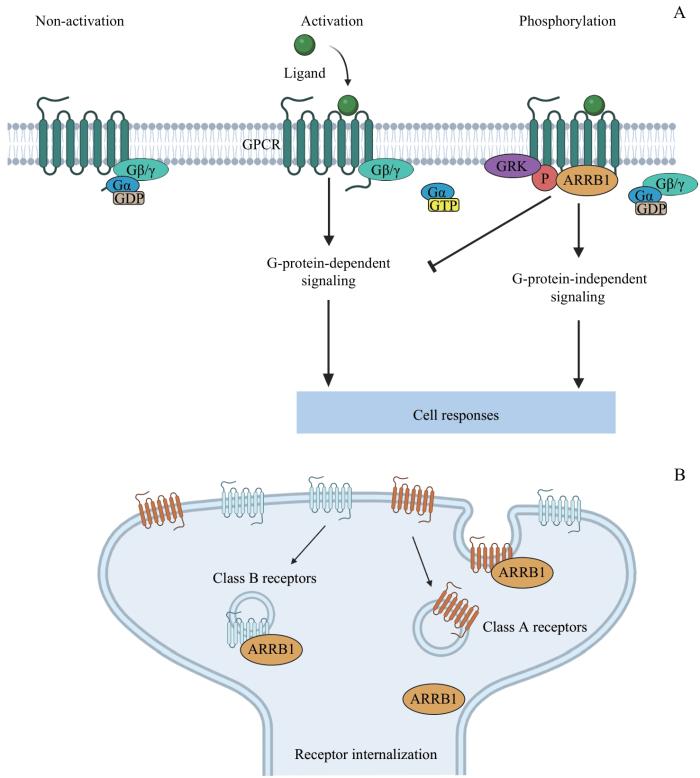
ARRB1最初在G蛋白偶联受体(G protein-coupled receptor,GPCR)的脱敏机制中被广泛研究。GPCR是7次跨膜受体蛋白,当其与配体结合后会发生构象变化,以激活偶联的G蛋白。G蛋白由Gα、Gβ、Gγ亚基组成,当该蛋白被激活时,活化的Gα亚基发生解离并启动信号通路,以调控细胞功能12。为避免被过度激活,G蛋白偶联受体激酶(G protein-coupled receptor kinase,GRK)会与GPCR结合并使其磷酸化,而ARRB1可高亲和力地结合磷酸化的GPCR以阻止G蛋白偶联,从而减少信号传递。此过程即为脱敏13。除了参与调控GPCR介导的信号转导外,ARRB1还可与磷酸化的GPCR结合以启动G蛋白非依赖的信号转导,如ARRB1可直接参与对细胞外信号调节激酶1/2(extracellular signal-regulated kinase 1/2,ERK1/2)14、蛋白激酶B(protein kinase B,PKB/AKT)15、信号转导及转录激活蛋白3(signal transducer and activator of transcription 3,STAT3)16、核因子κB(nuclear factor κB,NF-κB)17等信号通路的调控。

此外,ARRB1还可以通过介导多种受体的内吞,调节细胞膜受体的有效数量,影响相应的信号转导。根据与ARRB1结合能力的差异,GPCR可分为A类和B类18。其中,A类受体N端外部结构较短(如e2AR和μ阿片受体),其与ARRB1的结合能力较弱,随着该类受体的内吞,ARRB1会发生解离,因此A类受体能够较快地重新被激活,对外部信号的响应更加灵活和快速;B类受体N端外部结构较长(如胰岛素样生长因子1受体),其与ARRB1结合紧密,随着该类受体的内吞,ARRB1会进入细胞并在内体囊泡中停留较长时间,这使得B类受体的信号传递更为持久,从而对细胞的长期反应和适应产生影响,例如调节增殖、分化、存活等多种细胞行为1319-20

综上所述,ARRB1对信号转导的调节功能主要体现在如下2个方面:①其可与磷酸化的GPCR结合,从而阻断G蛋白依赖的信号转导,还可激活G蛋白非依赖的信号通路。②ARRB1可通过调控受体的内化,影响细胞内信号的转导。相关机制总结的示意图见图1

图1

图1   ARRB1调控细胞内信号转导的相关机制示意图

Note: A. ARRB1 is involved in GPCR desensitization and activation of G-protein-independent signaling pathways. B. ARRB1 is involved in receptor internalization.

Fig 1   Schematic diagram of the mechanism by which ARRBl regulates intracellular signal transduction


2 ARRB1对免疫细胞的调控作用

免疫细胞是炎症反应的主要参与者之一。近来的研究表明ARRB1除参与对细胞内的信号通路转导外,还参与免疫细胞的发育、分化、凋亡等过程的调控。具体介绍如下。

2.1 对T细胞发育、活化、增殖、分化的影响

2.1.1 对T细胞发育的影响

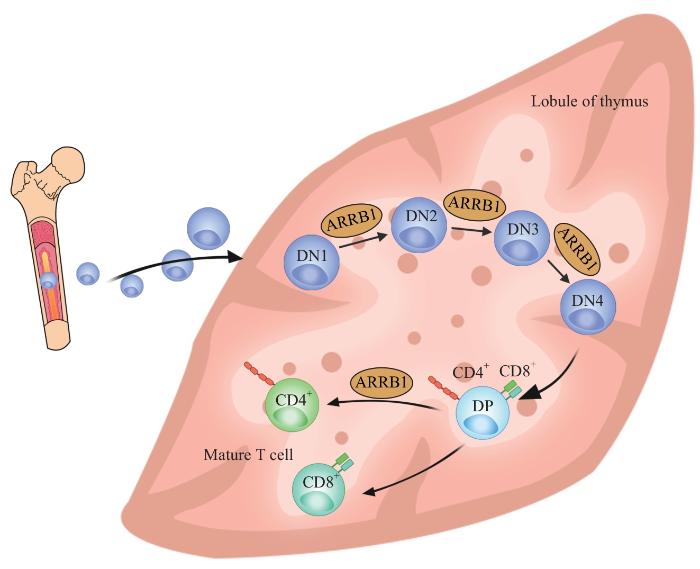
T细胞是在胸腺内发育成熟的,T细胞前体在胸腺内需经历CD4- CD8-双阴性(double negative,DN)期到CD4+ CD8+双阳性(double positive,DP)期的转变,最终分化为成熟的CD4+或CD8+单阳性T细胞21。基因敲除实验22发现,Arrb1缺失会导致小鼠T淋巴细胞发育阻滞在DN期(特别是DN1期),同时Arrb1缺失不会影响CD8+T细胞的比例但会降低外周CD4+T细胞的比例,这提示ARRB1对于维持DN期T细胞的发育至关重要(图2)。

图2

图2   ARRB1T细胞发育中的调控作用示意图

Fig 2   Schematic diagram of the regulatory role of ARRB1 in T cell development


2.1.2 对T细胞活化、增殖的影响

在胸腺内发育成熟的初始T细胞需经过抗原信号和共刺激信号的双信号激活以及细胞因子的作用才能被完全活化,进而进行增殖和分化。抗原信号的传递有赖于T细胞与抗原提呈细胞(antigen presenting cell,APC)间形成的免疫突触(immunological synapse,IS),该突触可稳定并延长T细胞与APC的结合时间,并为T细胞的活化提供稳定的信号平台。共刺激信号是指由T细胞与APC表面的多对共刺激分子(如CD28和CD80/CD86)相互作用产生的信号。研究发现,ARRB1参与T细胞的活化过程。一方面,ARRB1可以使“未参与IS形成”的T细胞受体(T cell receptor,TCR)转运到IS,以增强抗原信号,还可以结合T细胞表面的C-X-C模体趋化因子受体4(C-X-C motif chemokine receptor 4,CXCR4)以促进其内化,并阻断由CXCR4/ C-X-C模体趋化因子配体12(C-X-C motif chemokine ligand 12,CXCL12)介导的T细胞迁移,从而延长T细胞与APC的作用时间,即ARRB1通过促进TCR的转运、抑制T细胞的迁移来增强并维持T细胞的抗原信号23。另一方面,ARRB1还参与CD28介导的共刺激信号向细胞内的转导。研究24-25显示由CD28介导的共刺激信号可募集ARRB1和磷酸二酯酶4,并能将cAMP转化为AMP以降低胞内cAMP水平,从而拮抗cAMP对T细胞活化信号转导的抑制作用。

2.1.3 对T细胞分化的影响

T细胞被激活后,依据其受到的刺激类型和周围环境中的信号差异,可分化为多个功能不同的亚群。据报道ARRB1参与CD4+ T细胞的分化过程。有研究26发现ARRB1不只存在于细胞质中,还可进入细胞核,通过与B细胞淋巴瘤2(B-cell lymphoma-2,Bcl-2)的启动子区结合来促进Bcl-2在CD4+ T细胞中的表达。这对于维持CD4+ T细胞的存活至关重要。此外,ARRB1还可以通过激活CD4+ T细胞内的STAT3信号通路,诱导该细胞分化为辅助性T细胞17(T helper cell 17,Th17),进而影响免疫系统的稳态1627-28。因此,ARRB1广泛参与T细胞从发育、活化、增殖、分化到发挥功能的各个阶段,在T细胞介导的免疫应答中发挥着较为重要的作用。

2.2 对巨噬细胞功能的影响

ARRB1对巨噬细胞功能的影响主要体现在其对内质网应激的调控上。在急性肝损伤(acute liver injury,ALI)过程中,内质网应激会导致肝巨噬细胞过度激活,进而引发肝细胞凋亡,加剧ALI病情29。LEI等30发现,ARRB1可通过调节巨噬细胞的内质网应激来抑制巨噬细胞的活化并减少促炎症因子的释放,从而降低肝细胞凋亡水平,减轻ALI。

此外,ARRB1还通过参与对炎症因子分泌的调控,影响免疫细胞的功能。如在溃疡性结肠炎(ulcerative colitis,UC)模型中,ARRB1可减少白介素-6(interleukin-6,IL-6)的分泌,而IL-6可影响B细胞和T细胞的分化等31-32。综上所述,ARRB1对机体免疫细胞的发育、分化及功能均具有重要的调控作用,会影响该类细胞介导的后续免疫效应。

3 ARRB1调控炎症性疾病的作用机制

ARRB1在多种炎症性疾病的发生、进展过程中发挥着较为复杂的调控作用;依据不同的炎症刺激因素、炎症状态和细胞类型,其可发挥促进或抑制炎症的作用。

3.1 ARRB1的促进炎症作用及其作用机制

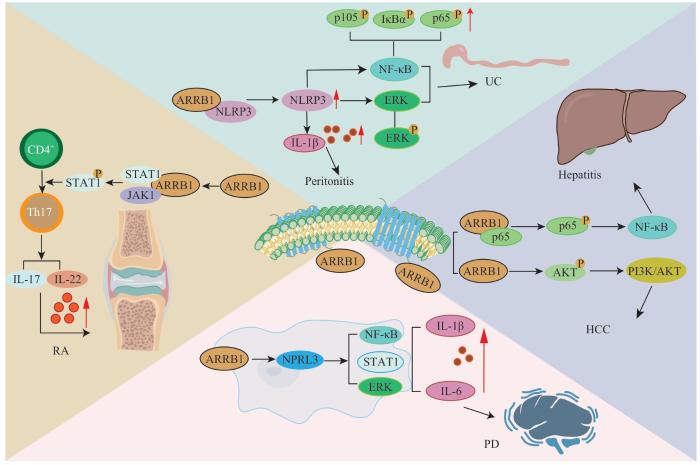
ARRB1促进炎症性疾病进展的作用机制(图3)可能涉及多种炎症相关信号通路(如NF-κB、STAT1等)的活化。近年来,在帕金森病小鼠模型中,研究人员发现ARRB1可直接上调胶质细胞中氮酶调节因子样蛋白3(nitrogen permease regulator like protein 3,NPRL3)的表达,促进下游NF-κB、STAT1信号通路的激活,进而增强胶质细胞介导的炎症反应程度33。有研究34在UC小鼠模型中发现,ARRB1可通过与核苷酸结合结构域富含亮氨酸重复序列和含热蛋白结构域受体3(nucleotide-binding domain leucine-rich repeat and pyrin domain-containing receptor 3,NLRP3)结合促进其寡聚化并使其合成增多,继而促进下游信号通路与促炎症因子的表达,最终导致结肠炎的恶化。同样,在小鼠腹膜炎模型的研究35中也发现,ARRB1可直接激活NLRP3并促进IL-1β的分泌,从而加重炎症反应。上述2项研究提示,NLRP3是ARRB1的重要靶蛋白,较高水平的ARRB1表达可加重由NLRP3介导的炎症反应。

图3

图3   ARRB1促进炎症反应的机制总结图示

Note: IκBα—inhibitor-κ binding protein α; HCC—hepatocellular carcinoma; PD—Parkinson's disease; RA—rheumatoid arthritis.

Fig 3   Summary diagram of the mechanism of ARRB1 promoting inflammatory response


此外,ARRB1还对信号蛋白的激活有直接的调控作用。在小鼠肝炎模型中,ARRB1可直接结合NF-κB信号通路中的p65蛋白,使p65蛋白在Ser536位点发生磷酸化,从而促进NF-κB信号通路的活化并导致肝炎加重17;在炎症介导的肝细胞癌变模型中,高表达的ARRB1可通过促进AKT磷酸化来激活磷脂酰肌醇3-激酶(phosphatidylinositol 3-kinase,PI3K)/AKT信号通路,从而促进由慢性炎症诱导的癌变36;在胶原诱导的类风湿性关节炎(rheumatoid arthritis,RA)模型中,ARRB1可通过促进CD4+ T细胞内JAK1和STAT3的相互作用激活STAT3,进而诱导T细胞向Th17分化,并促进IL-17、IL-22等促炎症因子的表达,加重RA16

3.2 ARRB1的抑制炎症作用及其相关机制

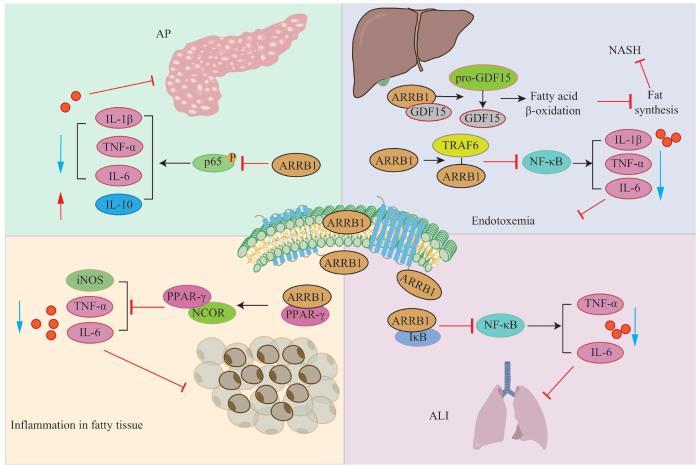
在一些病理条件下,ARRB1也可发挥抑制炎症反应的作用(图4)。一方面,ARRB1可通过直接结合某些信号转导相关蛋白来抑制炎症性疾病的进展。例如,在非酒精性脂肪性肝炎(nonalcoholic steatohepatitis,NASH)模型中,ARRB1可通过结合生长分化因子-15(growth differentiation factor-15,GDF-15)并促进其成熟,诱导脂肪酸β氧化、抑制脂肪的合成,从而减缓NASH的进展37;ARRB1也可通过与过氧化物酶体增殖物激活受体γ(peroxisome proliferator-activated receptor γ,PPARγ)结合,促进PPARγ/核受体辅阻遏物(nuclear receptor corepressor,NCOR)复合体的形成,抑制诱导型一氧化氮合酶(inducible nitric oxide synthase,iNOS)、TNF-α、IL-6等促炎症因子的表达,从而减轻由肥胖诱导的炎症反应38。另一方面,在某些炎症性疾病中ARRB1也可通过抑制炎症信号通路的转导来减轻疾病进展。例如,在胰腺炎模型中ARRB1可抑制p65蛋白的磷酸化及促炎症因子IL-1β、TNF-α、IL-6的产生,促进抑炎症因子IL-10的表达,进而减轻胰腺炎的病情39;ARRB1也可以通过与NF-κB抑制物(inhibitor of NF-κB,IκB)的互相作用来抑制NF-κB信号通路的激活,并减轻由脂多糖(lipopolysaccharide,LPS)诱导的肺血管内皮炎症性损伤40-41;在内毒素血症模型中,ARRB1可与肿瘤坏死因子受体相关因子6(tumor necrosis factor receptor-associated factor 6,TRAF6)相互作用并形成复合物,这种复合物能抑制NF-κB通路的活化,从而发挥抑制炎症的作用42;同时,在睾丸炎模型中激活的1型甲状旁腺激素受体(parathyroid hormone 1 receptor,PTH1R)可将信号传递至ARRB1,而后者能进一步降低TNF-α、IL-6等炎症因子的表达,以延缓睾丸炎的进展43

图 4

图 4   ARRB1抑制炎症反应的机制总结图示

Note: AP—acute pancreatitis.

Fig 4   Summary diagram of the mechanism by which ARRB1 inhibits inflammatory response


此外,ARRB1还能够通过影响T细胞存活来抑制炎症性疾病的进展。如在急性T淋巴细胞白血病(T cell acute lymphoblastic leukemia,T-ALL)中,增加ARRB1的表达可以促进T细胞内缺刻基因1(notch receptor 1,Notch1)信号的泛素化降解,进而抑制T细胞异常增殖,缓解疾病进展44

4 总结与展望

综上所述,ARRB1是一种多功能调节因子,可参与G蛋白依赖性信号转导的脱敏,也能直接调控下游信号通路转导、介导受体内吞等;同时,其还能对诸如T细胞、巨噬细胞等免疫细胞的发育、活化等过程产生影响。值得注意的是,ARRB1对炎症性疾病的调控具有一定的复杂性,其对炎症反应的影响可因炎症状态、疾病类型的差异呈现出促进或抑制炎症反应的效应。本文对近几年来有关ARRB1调控炎症反应的文献进行了整理,发现当前对于ARRB1的研究多停留在动物模型层面,且ARRB1在不同疾病模型中的具体调控机制存在显著的差异,这或与其功能的复杂性密切相关。目前的研究进展初步提示,在UC、RA等自身免疫性疾病模型中,ARRB1更倾向于发挥促进炎症作用;而在感染、损伤等因素诱导的炎症模型中,ARRB1的作用更倾向于抑制炎症进展。未来,相关研究仍需对ARRB1在不同炎症模型中的作用的共性与差异性进行深入探索,以便更好地评估该蛋白的潜在治疗价值,为其临床应用提供科学依据。

作者贡献声明

衣文婧负责论文的撰写与修改,范宜璇负责论文的撰写与文献梳理,仇佳泰参与了论文的修改,刘梅芳和付晓燕提出写作思路,刘梅芳负责对论文的修改进行指导。所有作者均阅读并同意了最终稿件的提交。

AUTHOR's CONTRIBUTIONS

YI Wenjing was responsible for the writing and revision of the manuscript. FAN Yixuan was responsible for the writing and literature combing. QIU Jiatai participated in the revision of the manuscript. LIU Meifang and FU Xiaoyan proposed the writing ideas. LIU Meifang was responsible for guiding the revision of the manuscript. All the authors have read the last version of paper and consented for submission.

利益冲突声明

所有作者声明不存在利益冲突。

COMPETING INTERESTS

All authors disclose no relevant conflict of interests.

参考文献

CHEN S Z, HUANG M Y, ZHANG L M, et al. Inflammatory response signature score model for predicting immunotherapy response and pan-cancer prognosis[J]. Comput Struct Biotechnol J, 2024, 23: 369-383.

[本文引用: 1]

AGIRMAN G, YU K B, HSIAO E Y. Signaling inflammation across the gut-brain axis[J]. Science, 2021, 374(6571): 1087-1092.

[本文引用: 1]

SCHROEDER H T, DE LEMOS MULLER C H, HECK T G, et al. Heat shock response during the resolution of inflammation and its progressive suppression in chronic-degenerative inflammatory diseases[J]. Cell Stress Chaperones, 2024, 29(1): 116-142.

[本文引用: 1]

FURMAN D, CAMPISI J, VERDIN E, et al. Chronic inflammation in the etiology of disease across the life span[J]. Nat Med, 2019, 25(12): 1822-1832.

YING W, FU W X, LEE Y S, et al. The role of macrophages in obesity-associated islet inflammation and β-cell abnormalities[J]. Nat Rev Endocrinol, 2020, 16(2): 81-90.

LI D J, TONG J, LI Y H, et al. Melatonin safeguards against fatty liver by antagonizing TRAFs-mediated ASK1 deubiquitination and stabilization in a β-arrestin-1 dependent manner[J]. J Pineal Res, 2019, 67(4): e12611.

DAWED A Y, MARI A, BROWN A, et al. Pharmacogenomics of GLP-1 receptor agonists: a genome-wide analysis of observational data and large randomised controlled trials[J]. Lancet Diabetes Endocrinol, 2023, 11(1): 33-41.

[本文引用: 1]

DEWIRE S M, AHN S, LEFKOWITZ R J, et al. β-arrestins and cell signaling[J]. Annu Rev Physiol, 2007, 69: 483-510.

[本文引用: 1]

LOVGREN A K, KOVACS J J, XIE T, et al. β-arrestin deficiency protects against pulmonary fibrosis in mice and prevents fibroblast invasion of extracellular matrix[J]. Sci Transl Med, 2011, 3(74): 74ra23.

[本文引用: 1]

CHOI Y J, KIM J E, LEE S J, et al. Promotion of the inflammatory response in mid colon of complement component 3 knockout mice[J]. Sci Rep, 2022, 12(1): 1700.

[本文引用: 1]

张泉, 张梅. β-arrestin1在炎-癌转化中的研究进展[J]. 现代肿瘤医学, 2022, 30(15): 2864-2867.

[本文引用: 1]

ZHANG Q, ZHANG M. Research progress of β-arrestin1 in inflammation-induced carcinogenesis[J]. Journal of Modern Oncology, 2022, 30(15): 2864-2867.

[本文引用: 1]

MAFI A, KIM S K, GODDARD WA 3rd. The mechanism for ligand activation of the GPCR-G protein complex[J]. Proc Natl Acad Sci U S A, 2022, 119(18): e2110085119.

[本文引用: 1]

LEFKOWITZ R J, SHENOY S K. Transduction of receptor signals by β-arrestins[J]. Science, 2005, 308(5721): 512-517.

[本文引用: 2]

KO M J, CHIANG T, MUKADAM A A, et al. β-arrestin-dependent ERK signaling reduces anxiety-like and conditioned fear-related behaviors in mice[J]. Sci Signal, 2021, 14(694): eaba0245.

[本文引用: 1]

ZHANG Z, ZHONG X H, XIAO Y P, et al. MicroRNA-296 inhibits colorectal cancer cell growth and enhances apoptosis by targeting ARRB1-mediated AKT activation[J]. Oncol Rep, 2019, 41(1): 619-629.

[本文引用: 1]

LI J, WEI B, GUO A, et al. Deficiency of β-arrestin1 ameliorates collagen-induced arthritis with impaired TH17 cell differentiation[J]. Proc Natl Acad Sci U S A, 2013, 110(18): 7395-7400.

[本文引用: 3]

XU X, LEI Y M, CHEN L J, et al. Phosphorylation of NF-κBp65 drives inflammation-mediated hepatocellular carcinogenesis and is a novel therapeutic target[J]. J Exp Clin Cancer Res, 2021, 40(1): 253.

[本文引用: 2]

RANJAN R, GUPTA P, SHUKLA A K. GPCR signaling: β-arrestins kiss and remember[J]. Curr Biol, 2016, 26(7): R285-R288.

[本文引用: 1]

OAKLEY R H, LAPORTE S A, HOLT J A, et al. Differential affinities of visual arrestin, β arrestin1, and β arrestin2 for G protein-coupled receptors delineate two major classes of receptors[J]. J Biol Chem, 2000, 275(22): 17201-17210.

[本文引用: 1]

CHEN K, ZHANG C H, LIN S L, et al. Tail engagement of arrestin at the glucagon receptor[J]. Nature, 2023, 620(7975): 904-910.

[本文引用: 1]

SUN L N, SU Y H, JIAO A J, et al. T cells in health and disease[J]. Signal Transduct Target Ther, 2023, 8(1): 235.

[本文引用: 1]

陈燕华, 蒋光洁, 郭维, 等. Arrb1基因敲除对小鼠T淋巴细胞发育的影响[J]. 中国细胞生物学学报, 2018, 40(3): 373-380.

[本文引用: 1]

CHEN Y H, JIANG G J, GUO W, et al. Effects of Arrb1 knockout on the development of mice T lymphocytes[J]. Chinese Journal of Cell Biology, 2018, 40(3): 373-380.

[本文引用: 1]

GUREVICH V V, GUREVICH E V. Arrestin makes T cells stop and become active[J]. EMBO J, 2014, 33(6): 531-533.

[本文引用: 1]

BJØRGO E, TASKÉN K. Novel mechanism of signaling by CD28[J]. Immunol Lett, 2010, 129(1): 1-6.

[本文引用: 1]

ABRAHAMSEN H, BAILLIE G, NGAI J, et al. TCR- and CD28-mediated recruitment of phosphodiesterase 4 to lipid rafts potentiates TCR signaling[J]. J Immunol, 2004, 173(8): 4847-4858.

[本文引用: 1]

SHI Y F, FENG Y, KANG J H, et al. Critical regulation of CD4+ T cell survival and autoimmunity by β-arrestin 1[J]. Nat Immunol, 2007, 8(8): 817-824.

[本文引用: 1]

GÓMEZ-MELERO S, GARCÍA-MACEIRA F I, GARCÍA-MACEIRA T, et al. Amino terminal recognition by a CCR6 chemokine receptor antibody blocks CCL20 signaling and IL-17 expression via β-arrestin[J]. BMC Biotechnol, 2021, 21(1): 41.

[本文引用: 1]

KUMAR R, THEISS A L, VENUPRASAD K. RORγt protein modifications and IL-17-mediated inflammation[J]. Trends Immunol, 2021, 42(11): 1037-1050.

[本文引用: 1]

CAO Y P, HE W, LI X P, et al. Rosiglitazone protects against acetaminophen-induced acute liver injury by inhibiting multiple endoplasmic reticulum stress pathways[J]. Biomed Res Int, 2022, 2022: 6098592.

[本文引用: 1]

LEI Y M, WAN S Z, LIU H L, et al. ARRB1 suppresses the activation of hepatic macrophages via modulating endoplasmic reticulum stress in lipopolysaccharide-induced acute liver injury[J]. Cell Death Discov, 2021, 7(1): 223.

[本文引用: 1]

WU B S, ZHOU Q, HE Z Q, et al. Protective effect of the Abelmoschus manihot flower extract on DSS-induced ulcerative colitis in mice[J]. Evid Based Complement Alternat Med, 2021, 2021: 7422792.

[本文引用: 1]

KANG S, NARAZAKI M, METWALLY H, et al. Historical overview of the interleukin-6 family cytokine[J]. J Exp Med, 2020, 217(5): e20190347.

[本文引用: 1]

FANG Y Q, JIANG Q L, LI S S, et al. Opposing functions of β-arrestin 1 and 2 in Parkinson's disease via microglia inflammation and Nprl3[J]. Cell Death Differ, 2021, 28(6): 1822-1836.

[本文引用: 1]

ZHANG Q, XU N, HU X, et al. Anti-colitic effects of Physalin B on dextran sodium sulfate-induced BALB/c mice by suppressing multiple inflammatory signaling pathways[J]. J Ethnopharmacol, 2020, 259: 112956.

[本文引用: 1]

MAO K, CHEN S, WANG Y, et al. β-arrestin1 is critical for the full activation of NLRP3 and NLRC4 inflammasomes[J]. J Immunol, 2015, 194(4): 1867-1873.

[本文引用: 1]

YANG Y D, GUO Y W, TAN S W, et al. β-arrestin1 enhances hepatocellular carcinogenesis through inflammation-mediated Akt signalling[J]. Nat Commun, 2015, 6: 7369.

[本文引用: 1]

ZHANG Z C, XU X L, TIAN W F, et al. ARRB1 inhibits non-alcoholic steatohepatitis progression by promoting GDF15 maturation[J]. J Hepatol, 2020, 72(5): 976-989.

[本文引用: 1]

ZHUANG L N, HU W X, XIN S M, et al. β-arrestin-1 protein represses adipogenesis and inflammatory responses through its interaction with peroxisome proliferator-activated receptor-γ (PPARγ)[J]. J Biol Chem, 2011, 286(32): 28403-28413.

[本文引用: 1]

TAO L, LIN X Y, TAN S W, et al. β-arrestin1 alleviates acute pancreatitis via repression of NF-κBp65 activation[J]. J Gastroenterol Hepatol, 2019, 34(1): 284-292.

[本文引用: 1]

WITHEROW D S, GARRISON T R, MILLER W E, et al. β-arrestin inhibits NF-κB activity by means of its interaction with the NF-κB inhibitor IκBα[J]. Proc Natl Acad Sci U S A, 2004, 101(23): 8603-8607.

[本文引用: 1]

ZHENG F, XIAO F, YUAN Q H, et al. Penehyclidine hydrochloride decreases pulmonary microvascular endothelial inflammatory injury through a β-arrestin-1-dependent mechanism[J]. Inflammation, 2018, 41(5): 1610-1620.

[本文引用: 1]

FAN H K, LUTTRELL L M, TEMPEL G E, et al. β-arrestins 1 and 2 differentially regulate LPS-induced signaling and pro-inflammatory gene expression[J]. Mol Immunol, 2007, 44(12): 3092-3099.

[本文引用: 1]

WANG M W, YANG Z, CHEN X, et al. Activation of PTH1R alleviates epididymitis and orchitis through Gq and β-arrestin-1 pathways[J]. Proc Natl Acad Sci U S A, 2021, 118(45): e2107363118.

[本文引用: 1]

SHU Y, WANG Y, LV W Q, et al. ARRB1-promoted NOTCH1 degradation is suppressed by oncomiR miR-223 in T-cell acute lymphoblastic leukemia[J]. Cancer Res, 2020, 80(5): 988-998.

[本文引用: 1]

/