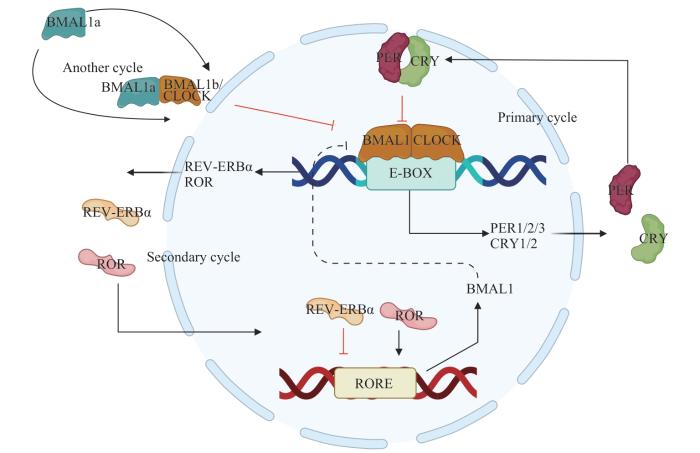
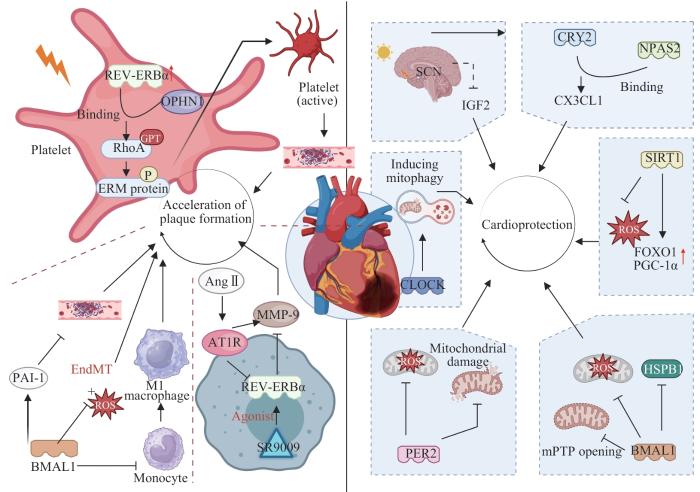
The circadian rhythm of mammals spans approximately 24 h and is of great significance in maintaining life activities and contributing to the occurrence and progression of various diseases. This intrinsic rhythm is primarily regulated by transcription-translation feedback loops (TTFLs) mediated by core circadian molecules. Circadian genes participate in cardiovascular disease by regulating metabolism, oxidative stress, and inflammatory responses, and play a key role in myocardial infarction. In recent years, with advances in circadian gene research, the underlying molecular mechanisms in myocardial infarction have become increasingly elucidated. This review summarizes the specific molecular mechanisms and clinical research evidence related to core circadian molecules (such as BMAL1, CLOCK, PER, and CRY) in the context of myocardial infarction, explores the therapeutic potential of circadian genes, and discusses current research challenges and future directions in this field. These findings indicate that targeting circadian genes may have promising clinical applications, and could provide new strategies for the treatment of myocardial infarction.
HUANG Mingwang, JIA Kangni, YAN Xiaoxiang. Mechanism and therapeutic strategies of myocardial infarction based on circadian rhythm genes. Journal of Shanghai Jiao Tong University (Medical Science)[J], 2025, 45(12): 1671-1678 doi:10.3969/j.issn.1674-8115.2025.12.013
HUANG Mingwang was responsible for the literature search and manuscript drafting. JIA Kangni performed the manuscript revisions. YAN Xiaoxiang provided guidance on manuscript writing and critically reviewed the manuscript. All authors have read the final version of manuscript and consented to its submission.
利益冲突声明
所有作者声明不存在利益冲突。
Conflict of Interests
All authors declare no relevant conflict of interests.
BARGIELLO T A, JACKSON F R, YOUNG M W. Restoration of circadian behavioural rhythms by gene transfer in Drosophila[J]. Nature, 1984, 312(5996): 752-754.
KOIKE N, YOO S H, HUANG H C, et al. Transcriptional architecture and chromatin landscape of the core circadian clock in mammals[J]. Science, 2012, 338(6105): 349-354.
DE LOS REYES P, SERRANO-BUENO G, ROMERO-CAMPERO F J, et al. CONSTANS alters the circadian clock in Arabidopsisthaliana[J]. Mol Plant, 2024, 17(8): 1204-1220.
LIU Z, SELBY C P, YANG Y, et al. Circadian regulation of c-MYC in mice[J]. Proc Natl Acad Sci USA, 2020, 117(35): 21609-21617.
RANA S, PRABHU S D, YOUNG M E. Chronobiological influence over cardiovascular function: the good, the bad, and the ugly[J]. Circ Res, 2020, 126(2): 258-279.
KOLOGRIVOVA I, SHTATOLKINA M, SUSLOVA T, et al. Cells of the immune system in cardiac remodeling: main players in resolution of inflammation and repair after myocardial infarction[J]. Front Immunol, 2021, 12: 664457.
ZHAO D, LIU J, WANG M, et al. Epidemiology of cardiovascular disease in China: current features and implications[J]. Nat Rev Cardiol, 2019, 16(4): 203-212.
LINDSEY M L, IYER R P, JUNG M, et al. Matrix metalloproteinases as input and output signals for post-myocardial infarction remodeling[J]. J Mol Cell Cardiol, 2016, 91: 134-140.
JOHANSSON S, ROSENGREN A, YOUNG K, et al. Mortality and morbidity trends after the first year in survivors of acute myocardial infarction: a systematic review[J]. BMC Cardiovasc Disord, 2017, 17(1): 53.
GEIGER S S, CURTIS A M, O'NEILL L A J, et al. Daily variation in macrophage phagocytosis is clock-independent and dispensable for cytokine production[J]. Immunology, 2019, 157(2): 122-136.
DOMÍNGUEZ F, FUSTER V, FERNÁNDEZ-ALVIRA J M, et al. Association of sleep duration and quality with subclinical atherosclerosis[J]. J Am Coll Cardiol, 2019, 73(2): 134-144.
LI H, KILGALLEN A B, MÜNZEL T, et al. Influence of mental stress and environmental toxins on circadian clocks: implications for redox regulation of the heart and cardioprotection[J]. Br J Pharmacol, 2020, 177(23): 5393-5412.
THOSAR S S, BERMAN A M, HERZIG M X, et al. Circadian rhythm of vascular function in midlife adults[J]. Arterioscler Thromb Vasc Biol, 2019, 39(6): 1203-1211.
MAN A W C, LI H, XIA N. Circadian rhythm: potential therapeutic target for atherosclerosis and thrombosis[J]. Int J Mol Sci, 2021, 22(2): E676.
ZHANG Z Q, DING J W, WANG X A, et al. Abnormal circadian rhythms are associated with plaque instability in acute coronary syndrome patients[J]. Int J Clin Exp Pathol, 2019, 12(10): 3761-3771.
OTA S M, KONG X P, HUT R, et al. The impact of stress and stress hormones on endogenous clocks and circadian rhythms[J]. Front Neuroendocrinol, 2021, 63: 100931.
SOLT L A, KOJETIN D J, BURRIS T P. The REV-ERBs and RORs: molecular links between circadian rhythms and lipid homeostasis[J]. Future Med Chem, 2011, 3(5): 623-638.
LEE J, PARK E, KIM G H, et al. A splice variant of human Bmal1 acts as a negative regulator of the molecular circadian clock[J]. Exp Mol Med, 2018, 50(12): 1-10.
YOUNG M E, BREWER R A, PELICIARI-GARCIA R A, et al. Cardiomyocyte-specific BMAL1 plays critical roles in metabolism, signaling, and maintenance of contractile function of the heart[J]. J Biol Rhythms, 2014, 29(4): 257-276.
SATO F, KOHSAKA A, TAKAHASHI K, et al. Smad3 and Bmal1 regulate p21 and S100A4 expression in myocardial stromal fibroblasts via TNF-α[J]. Histochem Cell Biol, 2017, 148(6): 617-624.
ASTONE M, OBERKERSCH R E, TOSI G, et al. The circadian protein BMAL1 supports endothelial cell cycle during angiogenesis[J]. Cardiovasc Res, 2023, 119(10): 1952-1968.
ABDEL-RAHMAN E A, HOSSEINY S, AALIYA A, et al. Sleep/wake calcium dynamics, respiratory function, and ROS production in cardiac mitochondria[J]. J Adv Res, 2021, 31: 35-47.
SCHRODER E A, BURGESS D E, ZHANG X P, et al. The cardiomyocyte molecular clock regulates the circadian expression of Kcnh2 and contributes to ventricular repolarization[J]. Heart Rhythm, 2015, 12(6): 1306-1314.
MIA S, KANE M S, LATIMER M N, et al. Differential effects of REV-ERBα/β agonism on cardiac gene expression, metabolism, and contractile function in a mouse model of circadian disruption[J]. Am J Physiol Heart Circ Physiol, 2020, 318(6): H1487-H1508.
SHI J, TONG R, ZHOU M, et al. Circadian nuclear receptor Rev-erbα is expressed by platelets and potentiates platelet activation and thrombus formation[J]. Eur Heart J, 2022, 43(24): 2317-2334.
SATO S, SAKURAI T, OGASAWARA J, et al. A circadian clock gene, Rev-erbα, modulates the inflammatory function of macrophages through the negative regulation of Ccl2 expression[J]. J Immunol, 2014, 192(1): 407-417.
MARTINO T A, YOUNG M E. Influence of the cardiomyocyte circadian clock on cardiac physiology and pathophysiology[J]. J Biol Rhythms, 2015, 30(3): 183-205.
ERIKSSON H P, SÖDERBERG M, NEITZEL R L, et al. Cardiovascular mortality in a Swedish cohort of female industrial workers exposed to noise and shift work[J]. Int Arch Occup Environ Health, 2021, 94(2): 285-293.
ARORA N, RICHMOND R C, BRUMPTON B M, et al. Self-reported insomnia symptoms, sleep duration, chronotype and the risk of acute myocardial infarction (AMI): a prospective study in the UK Biobank and the HUNT Study[J]. Eur J Epidemiol, 2023, 38(6): 643-656.
YANG Z, BLACK K, OHMAN-STRICKLAND P, et al. Disruption of central and peripheral circadian clocks and circadian controlled estrogen receptor rhythms in night shift nurses in working environments[J]. FASEB J, 2024, 38(11): e23719.
ŠKRLEC I, MILIC J, HEFFER M, et al. Genetic variations in circadian rhythm genes and susceptibility for myocardial infarction[J]. Genet Mol Biol, 2018, 41(2): 403-409.
YAN X, HUANG Y, WU J. Identify cross talk between circadian rhythm and coronary heart disease by multiple correlation analysis[J]. J Comput Biol, 2018, 25(12): 1312-1327.
ZHAO Y C, LU X Y, WAN F, et al. Disruption of circadian rhythms by shift work exacerbates reperfusion injury in myocardial infarction[J]. J Am Coll Cardiol, 2022, 79(21): 2097-2115.
WANG S, GU X, ZHANG Q, et al. Angiotensin Ⅱ suppresses rev-erbα expression in THP-1 macrophages via the Ang Ⅱ type 1 receptor/liver X receptor α pathway[J]. Cell Physiol Biochem, 2018, 46(1): 303-313.
HAO K L, ZHAI Q C, GU Y, et al. Disturbance of suprachiasmatic nucleus function improves cardiac repair after myocardial infarction by IGF2-mediated macrophage transition[J]. Acta Pharmacol Sin, 2023, 44(8): 1612-1624.
HUANG J, QING W, PAN Y. NPAS2 ameliorates myocardial ischaemia/reperfusion injury in rats via CX3CL1 pathways and regulating autophagy[J]. Aging (Albany NY), 2021, 13(16): 20569-20584.
KILGALLEN A B, VAN DEN AKKER F, FEYEN D A M, et al. Circadian dependence of the acute immune response to myocardial infarction[J]. Front Pharmacol, 2022, 13: 869512.
LIU X, XIAO W, JIANG Y, et al. Bmal1 regulates the redox rhythm of HSPB1, and homooxidized HSPB1 attenuates the oxidative stress injury of cardiomyocytes[J]. Oxid Med Cell Longev, 2021, 2021: 5542815.
ZHANG X Y, WANG L, YAN W J, et al. Period 2-induced activation of autophagy improves cardiac remodeling after myocardial infarction[J]. Hum Gene Ther, 2020, 31(1/2): 119-128.
BEESLEY S, NOGUCHI T, WELSH D K. Cardiomyocyte circadian oscillations are cell-autonomous, amplified by β-adrenergic signaling, and synchronized in cardiac ventricle tissue[J]. PLoS One, 2016, 11(7): e0159618.
WENG Y, LI H, GAO L, et al. PER2 regulates reactive oxygen species production in the circadian susceptibility to ischemia/reperfusion injury in the heart[J]. Oxid Med Cell Longev, 2021, 2021: 6256399.
RABINOVICH-NIKITIN I, RASOULI M, REITZ C J, et al. Mitochondrial autophagy and cell survival is regulated by the circadian Clock gene in cardiac myocytes during ischemic stress[J]. Autophagy, 2021, 17(11): 3794-3812.
MONTAIGNE D, MARECHAL X, MODINE T, et al. Daytime variation of perioperative myocardial injury in cardiac surgery and its prevention by Rev-Erbα antagonism: a single-centre propensity-matched cohort study and a randomised study[J]. Lancet, 2018, 391(10115): 59-69.
OYAMA Y, BARTMAN C M, BONNEY S, et al. Intense light-mediated circadian cardioprotection via transcriptional reprogramming of the endothelium[J]. Cell Rep, 2019, 28(6): 1471-1484.e11.
BARTMAN C M, OYAMA Y, BRODSKY K, et al. Intense light-elicited upregulation of miR-21 facilitates glycolysis and cardioprotection through Per2-dependent mechanisms[J]. PLoS One, 2017, 12(4): e0176243.
HERMIDA R C, AYALA D E. Chronotherapy with the angiotensin-converting enzyme inhibitor ramipril in essential hypertension: improved blood pressure control with bedtime dosing[J]. Hypertension, 2009, 54(1): 40-46.
ZHANG B, WANG C, GUO M, et al. Circadian rhythm-dependent therapy by composite targeted polyphenol nanoparticles for myocardial ischemia-reperfusion injury[J]. ACS Nano, 2024, 18(41): 28154-28169.
ŠKRLEC I, TALAPKO J, JUZBAŠIĆ M, et al. Sex differences in circadian clock genes and myocardial infarction susceptibility[J]. J Cardiovasc Dev Dis, 2021, 8(5): 53.
ALIBHAI F J, REITZ C J, PEPPLER W T, et al. Female ClockΔ19/Δ19 mice are protected from the development of age-dependent cardiomyopathy[J]. Cardiovasc Res, 2018, 114(2): 259-271.
HALADE G V, MAT Y, GOWDA S G B, et al. Sleep deprivation in obesogenic setting alters lipidome and microbiome toward suboptimal inflammation in acute heart failure[J]. FASEB J, 2023, 37(5): e22899.
... PER2同样表现出心肌保护效应,其昼夜节律波动可通过增强自噬活性,促进受损细胞成分的清除,缓解心肌损伤并改善心肌梗死预后[53-54].WENG等[55]研究进一步指出,PER2的下调会导致心肌梗死后心肌细胞中ROS水平升高、线粒体结构破坏和 ATP 合成障碍,进而加重心肌氧化损伤和代谢失衡. ...
1
... PER2同样表现出心肌保护效应,其昼夜节律波动可通过增强自噬活性,促进受损细胞成分的清除,缓解心肌损伤并改善心肌梗死预后[53-54].WENG等[55]研究进一步指出,PER2的下调会导致心肌梗死后心肌细胞中ROS水平升高、线粒体结构破坏和 ATP 合成障碍,进而加重心肌氧化损伤和代谢失衡. ...
1
... PER2同样表现出心肌保护效应,其昼夜节律波动可通过增强自噬活性,促进受损细胞成分的清除,缓解心肌损伤并改善心肌梗死预后[53-54].WENG等[55]研究进一步指出,PER2的下调会导致心肌梗死后心肌细胞中ROS水平升高、线粒体结构破坏和 ATP 合成障碍,进而加重心肌氧化损伤和代谢失衡. ...