上海交通大学学报(医学版), 2025, 45(4): 459-467 doi: 10.3969/j.issn.1674-8115.2025.04.008

论著 · 临床研究

基于抗中性粒细胞胞质抗体的列线图模型对川崎病患儿并发冠状动脉病变风险的预测作用

陈蓉, 张锰, 朱荻绮, 郭颖, 沈捷,

上海交通大学医学院附属上海儿童医学中心心内科,上海 200127

Nomogram for predicting the risk of coronary artery lesions in patients with Kawasaki disease based on anti-neutrophil cytoplasmic antibodies

CHEN Rong, ZHANG Meng, ZHU Diqi, GUO Ying, SHEN Jie,

Department of Cardiovascular, Shanghai Children's Medical Center, Shanghai Jiao Tong University School of Medicine, Shanghai 200127, China

通讯作者: 沈 捷,主任医师,博士;电子信箱:she6nt@163.com

编委: 吴洋

收稿日期: 2024-08-05   接受日期: 2024-12-18   网络出版日期: 2025-04-21

Corresponding authors: SHEN Jie, E-mail:she6t@163.com

Received: 2024-08-05   Accepted: 2024-12-18   Online: 2025-04-21

作者简介 About authors

陈蓉(1999—),女,住院医师,硕士;电子信箱:rong1014@sjtu.edu.cn。 。

摘要

目的·评估抗中性粒细胞胞质抗体(anti-neutrophil cytoplasmic antibody,ANCA)对川崎病(Kawasaki disease,KD)患儿并发冠状动脉病变(coronary artery lesion,CAL)的预测价值。方法·回顾性收集2018年1月至2024年5月上海交通大学医学院附属上海儿童医学中心收治的340例KD患儿的临床资料,按7∶3的比例随机分为训练集(n=237)和验证集(n=103)。通过单因素分析、最小绝对收缩和选择算法(least absolute shrinkage and selection operator,LASSO)筛选出CAL的危险因素,并将其纳入多因素Logistic回归分析,构建列线图预测模型。分别采用受试者操作特征(receiver operating characteristic,ROC)曲线、校准曲线及Hosmer-Lemeshow拟合优度检验、决策曲线分析(decision curve analysis,DCA)评价模型的区分度、校准度和临床适用性。根据Logistic回归方程中的自变量系数对各变量赋分,得到一个预测评分系统,并将其与目前3个常用评分系统(Kobayashi评分、Egami评分和Sano评分)的预测效能进行比较。结果·男性、低白蛋白血症、ANCA阳性和静脉注射免疫球蛋白抵抗是KD患儿发生CAL的危险因素,据此构建列线图预测模型。模型在训练集和验证集中的ROC曲线下面积分别为0.747(95%CI 0.667~0.821)和0.645(95%CI 0.500~0.794),表明模型预测效能良好;模型经校准曲线和Hosmer-Lemeshow拟合优度检验(训练集χ2 =5.105,P=0.746;验证集χ2 =13.549,P=0.094)验证,预测准确性良好;DCA显示模型具有一定的临床适用性。根据Logistic回归方程系数建立CAL的预测评分体系,与Kobayashi评分、Egami评分、Sano评分模型相比,其灵敏度(58.4%)和特异度(78.7%)均较高。结论·研究基于ANCA建立了一个可有效预测KD患儿发生CAL风险的评分模型,可为临床上早期识别高危患儿、制定个性化治疗方案和管理策略提供参考。

关键词: 川崎病 ; 冠状动脉病变 ; 抗中性粒细胞胞质抗体 ; 列线图 ; 预测模型

Abstract

Objective ·To evaluate the predictive value of anti-neutrophil cytoplasmic antibodies (ANCA) in Kawasaki disease (KD) complicated with coronary artery lesions (CALs) and to construct a nomogram prediction model. Methods ·A retrospective study was conducted to collect the clinical data of 340 children with KD admitted to Shanghai Children's Medical Center from January 2018 to May 2024. All patients were randomly divided in a 7:3 ratio into a training set (n=237) and a validation set (n=103). Univariate analysis and least absolute shrinkage and selection operator (LASSO) were applied to screen the risk factors of CALs, which were incorporated into multifactorial Logistic regression analysis to develop the nomogram model. The model's discrimination, calibration and clinical practicability were evaluated using the receiver operating characteristic (ROC) curve, calibration curve, Hosmer-Lemeshow goodness-of-fit test, and decision curve analysis (DCA). A new predictive scoring system was obtained by assigning scores to each variable based on the coefficients of the independent variables in the Logistic regression equation, and its predictive efficacy was then compared with that of three commonly used scoring systems, Kobayashi, Egami, and Sano scoring models. Results ·Male, low serum albumin level, ANCA positivity, and intravenous immunoglobulin resistance were risk factors for the development of CALs in children with KD, based on which a nomogram model was constructed. The area under the ROC curve for the nomogram in the training set and validation set were 0.747 (95%CI 0.667‒0.821) and 0.645 (95%CI 0.500‒0.794), respectively, indicating good effectiveness. The model was verified to have good predictive accuracy through the calibration curve and Hosmer-Lemeshow goodness-of-fit test (training set: χ2 =5.105, P=0.746; validation set:χ2 =13.549, P=0.094). The DCA showed its clinical usefulness. A predictive scoring system for CALs was developed based on the coefficients of the Logistic regression equation, which demonstrated higher sensitivity (58.4%) and specificity (78.7%) compared to the Kobayashi, Egami, and Sano scoring models. Conclusion ·This study developed a new scoring model based on ANCA to effectively predict the risk of CALs in KD patients. The model provides valuable reference for clinicians to identify high-risk patients early, and to formulate personalized treatment plans and management strategies.

Keywords: Kawasaki disease ; coronary artery lesion ; anti-neutrophil cytoplasmic antibody ; nomogram ; prediction model

PDF (2825KB) 元数据 多维度评价 相关文章 导出 EndNote| Ris| Bibtex  收藏本文

本文引用格式

陈蓉, 张锰, 朱荻绮, 郭颖, 沈捷. 基于抗中性粒细胞胞质抗体的列线图模型对川崎病患儿并发冠状动脉病变风险的预测作用. 上海交通大学学报(医学版)[J], 2025, 45(4): 459-467 doi:10.3969/j.issn.1674-8115.2025.04.008

CHEN Rong, ZHANG Meng, ZHU Diqi, GUO Ying, SHEN Jie. Nomogram for predicting the risk of coronary artery lesions in patients with Kawasaki disease based on anti-neutrophil cytoplasmic antibodies. Journal of Shanghai Jiao Tong University (Medical Science)[J], 2025, 45(4): 459-467 doi:10.3969/j.issn.1674-8115.2025.04.008

川崎病(Kawasaki disease,KD)又称黏膜皮肤淋巴结综合征,是一种儿童常见的急性发热出疹性疾病,以超过5 d的持续性发热、多形性皮疹、颈部淋巴结非化脓性肿大、双侧球结膜充血、口唇及口腔改变、手足硬肿及指端脱皮为主要临床特征,可伴发全身多系统表现1。KD以全身性血管炎为主要病理改变,累及全身中、小动脉,以冠状动脉最显著2-3。冠状动脉病变(coronary artery lesion,CAL)是川崎病最重要的并发症,早期主要表现为冠状动脉扩张和冠状动脉瘤形成;随着病情进展,后期形成血栓和内膜增生、钙化,出现冠状动脉狭窄或闭塞;最终导致心肌缺血、梗死甚至猝死,严重危害儿童生命健康4,是部分国家和地区儿童后天性心脏病的主要病因之一5-6

中性粒细胞胞质抗体(anti-neutrophil cytoplasmic antibody,ANCA)是一种以中性粒细胞胞质成分为靶抗原的自身抗体,可以诱导中性粒细胞活化,介导血管内皮细胞损伤,与血管炎症性疾病关系密切7。本研究旨在探讨ANCA对KD合并CAL的预测价值,构建并验证列线图预测模型,为临床早期识别和干预高危患儿提供依据。

1 对象与方法

1.1 研究对象

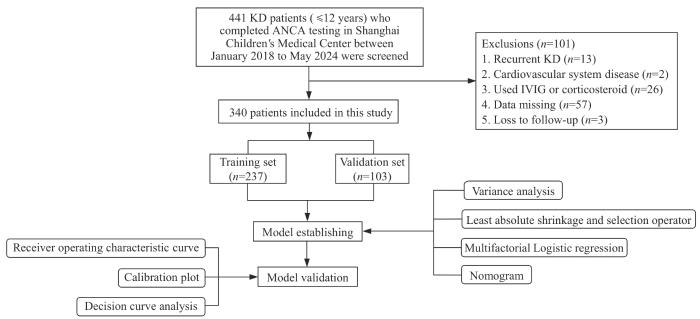
采用回顾性队列研究。研究对象为2018年1月—2024年5月上海交通大学医学院附属上海儿童医学中心收治的340例KD患儿。纳入标准:①川崎病诊断符合2017年美国心脏协会颁布的KD诊断的科学声明5。②治疗前完成血清ANCA检测。③年龄<12岁。排除标准:①入院前已使用静脉注射免疫球蛋白(intravenous immunoglobulin,IVIG)或糖皮质激素治疗。②复发性KD。③严重感染。④合并心血管系统疾病、自身免疫性疾病、血液疾病或恶性肿瘤等。⑤临床资料不完整或失访。通过随机抽样将研究对象按照7∶3的比例分为训练集(n=237)和验证集(n=103)。研究设计流程见图1

图1

图1   研究设计流程图

Fig 1   Flowchart of the study design


1.2 资料收集

通过医院电子病历系统收集患儿临床资料。①一般资料:性别、年龄、IVIG使用前发热时间、IVIG治疗反应。②IVIG治疗前实验室检查指标:C反应蛋白(C reactive protein,CRP)、中性粒细胞百分比(neutrophil percentage,NEUT%)、血红蛋白(hemoglobin,HGB)、血小板计数(platelet,PLT)、红细胞沉降率(erythrocyte sedimentation rate,ESR)、铁蛋白(ferritin,Ferr)、血钠(serum sodium,Na+)、丙氨酸氨基转移酶(alanine amino-transferase,ALT)、天冬氨酸氨基转移酶(aspartate amino-transferase,AST)、白蛋白(albumin,ALB)、总胆红素(total bilirubin,TBIL)、氨基末端脑钠肽前体(N-terminal pro-brain natriuretic peptide,NT-proBNP)、白介素-6(interleukin-6,IL-6)、CD3+CD4+T细胞计数、抗核抗体(antinuclear antibodies,ANA)、ANCA。③影像学资料:超声心动图、冠状动脉造影结果等。

1.3 血清ANCA检测

采集肝素促凝血3 mL,静置至血液凝固,2 683×g离心5 min后取血清,2~8 ℃冰箱保存。采用间接免疫荧光法测定血清ANCA,所用试剂均购于欧蒙医学实验诊断有限公司,荧光显微镜下出现特异性荧光判为阳性。

1.4 结局定义与分组

1.4.1 IVIG抵抗

IVIG抵抗定义为标准治疗结束后36 h体温仍高于38 ℃或用药后2周内再次发热,并伴有KD的其他临床表现1

1.4.2 CAL诊断标准

CAL的诊断符合2012年版《川崎病冠状动脉病变的临床处理建议》8,包括冠状动脉扩张、冠状动脉瘤、冠状动脉狭窄和闭塞等。满足以下任意一项即可诊断为冠状动脉扩张性病变:冠状动脉内径>3 mm(<5岁),或冠状动脉内径>4 mm(≥5岁);病变节段内径与邻近正常节段内径的比值≥1.5;经体表面积校正后的冠状动脉内径Z值≥2。

1.4.3 病例分组

将训练集和验证集分别分为CAL组(合并CAL)和NCAL组(不合并CAL)。

1.5 统计学分析

采用SPSS 27.0和R 4.3.1软件进行统计分析。符合正态分布的定量资料用x±s表示,非正态分布的定量资料用MQ1Q3)表示,组间比较分别采用t检验和Mann-Whitney U检验;定性资料以频数(百分率)表示,组间比较采用χ2 检验。将单因素分析、最小绝对收缩和选择算法(least absolute shrinkage and selection operator,LASSO)筛选的危险因素纳入多因素Logistic回归分析,得到CAL的预测因素并构建列线图模型。进一步采用pROC软件包绘制受试者操作特征(receiver operating characteristic,ROC)曲线,评价模型区分度;采用rms软件包绘制校准曲线,评价模型校准度;采用rmda软件包进行决策曲线分析(decision curve analysis,DCA),评价模型临床适用性。将模型指标中的连续型数据根据正常参考范围转化为分类数据,并根据Logistic回归方程中的自变量系数对各指标进行赋分,得到评分模型。采用Medcalc 23.0.1软件对比新评分系统与Kobayashi评分9、Egami评分10、Sano评分11的ROC曲线,并计算曲线下面积(area under the curve,AUC)、灵敏度、特异度、约登指数等。P<0.05为差异具有统计学意义。

2 结果

2.1 训练集和验证集临床资料比较

本研究共纳入340例KD患儿。训练集237例,其中58例KD患儿发生CAL(24.47%);验证集103例,其中19例KD患儿发生CAL(18.45%);2组差异无统计学意义(P=0.281)。2组各项基线资料比较,差异均无统计学意义(均P>0.05),具有可比性(表1)。

表1   训练集和验证集基线资料比较

Tab1  Comparison of baseline characteristics between the training set and validation set

VariableTraining set (n=237)Validation set (n=103)P value
CAL (n=58)NCAL (n=179)P valueCAL (n=19)NCAL (n=84)P value
Gender/n(%)<0.0010.6820.897
Male45 (77.59)85 (47.49)12 (63.16)46 (54.76)
Female13 (22.41)94 (52.51)7 (36.84)38 (45.24)
Age/month30.00 (12.25,47.50)33.00 (18.00,56.50)0.14829.00 (15.00,49.50)31.00 (18.75,52.50)0.7020.781
Fever duration before IVIG/n(%)0.2280.3160.941
<5 d13 (22.41)26 (14.53)5 (26.32)13 (15.48)
≥5 d45 (77.59)153 (85.47)14 (73.68)71 (84.52)
CRP/(mg·L-1)64.80 (37.95,103.03)63.40 (34.90,95.10)0.60181.70 (51.60,109.70)61.60 (39.78,101.92)0.1610.420
NEUT%/%66.26 (55.21,76.89)65.70 (53.70,76.78)0.89568.21 (55.82,80.45)67.32 (52.11,74.67)0.2800.933
HGB/(g·L-1)107.00 (101.00,115.00)110.00 (103.00,117.00)0.209107.00 (101.00,112.50)110.50 (102.75,116.00)0.1390.462
PLT/(×109·L-1)332.00 (227.50,452.50)336.00 (259.00,416.00)0.702253.00 (219.50,338.00)329.50 (262.75,417.00)0.0380.170
Na+/(mmol·L-1)135.60 (134.00,137.25)137.00 (135.00,138.65)0.010136.00 (133.80,137.55)136.55 (135.00,138.15)0.1900.922
ESR/(mm·h-1)65.50 (44.75,75.00)65.00 (48.00,81.00)0.53166.00 (54.50,74.00)71.00 (54.50,87.00)0.6550.120
Ferr/(ng·mL-1)171.25 (110.67,270.36)175.52 (130.20,241.20)0.712252.60 (152.65,291.90)167.55 (136.88,272.72)0.2410.177
ALT/(IU·L-1)27.50 (18.00,48.75)24.00 (15.50,59.50)0.35630.00 (20.00,134.50)28.00 (18.75,60.00)0.5400.215
AST/(IU·L-1)33.00 (27.00,47.75)33.00 (28.00,46.50)0.73133.00 (28.00,70.00)34.00 (26.00,42.50)0.5070.579
ALB/(g·L-1)34.62±4.363 6.66±3.980.00235.22±2.8736.04±4.590.3260.586
TBIL/(μmol·L-1)8.80 (6.12,12.15)8.20 (5.60,11.45)0.3529.10 (4.85,24.05)8.75 (6.65,11.72)0.9530.264
NT-proBNP/(pg·mL-1)652.00 (185.50,2460.25)302.00 (104.00,984.00)0.014291.00 (94.50,1528.50)406.00 (186.50,1189.75)0.7920.691
IL-6/(pg·mL-1)74.51 (25.09,246.56)71.00 (33.11,169.65)0.40274.39 (35.95,150.71)80.64 (24.84,167.78)0.8750.905
Count of CD3+CD4+/n

1 173.84

(694.43,1 779.17)

1 183.81

(635.24,2 016.62)

0.857

862.66

(396.05,1 269.99)

1 110.01

(670.87,2 006.53)

0.2080.724
ANA/n(%)0.9340.5471.000
Positive12 (20.69)40 (22.35)5 (26.32)17 (20.24)
Negative46 (79.31)139 (77.65)14 (73.68)67 (79.76)
ANCA/n(%)0.0070.0020.946
Positive8 (13.79)6 (3.35)5 (36.32)2 (2.38)
Negative50 (86.21)173 (96.65)14 (73.68)82 (97.62)
IVIG resistance/n(%)0.0080.0310.846
Yes14 (24.14)17 (9.50)6 (31.58)9 (10.71)
No44 (75.86)162 (90.50)13 (68.42)75 (89.29)

Note:Comparison between the training set and validation set.

新窗口打开| 下载CSV


2.2 KD患儿发生CAL的预测因素

根据是否发生CAL,将训练集分为CAL组和NCAL组,进行单因素差异性分析。结果显示2组在性别、Na+、ALB、NT-proBNP、ANCA阳性率、IVIG抵抗方面的差异均具有统计学意义(均P<0.05),其余指标的差异均无统计学意义(均P>0.05),详见表1

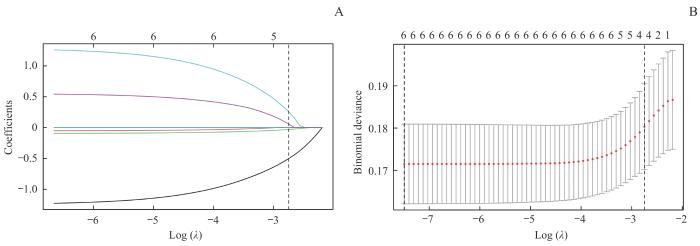
以CAL作为结局变量,纳入上述6个变量,采用LASSO算法进行筛选,选择9重交叉验证,得到一个最简模型,对应至路径系数图,得到4个具有非零系数的特征变量,分别为性别、ALB、ANCA、IVIG抵抗(图2)。应用多因素Logistic回归分析上述4个危险因素,结果显示性别、ALB、ANCA是KD患儿发生CAL的独立预测因素(表2)。

图2

图2   训练集的LASSO回归模型风险因素筛选

Note: A. LASSO coefficient profiles for 6 variables. B. A 9-fold cross-validation used in the LASSO regression. Dotted vertical lines represent the optimal values, determined using the minimum criteria (left dotted line) and the 1 standard error criterion (right dotted line). λmin=0.000 6, λ1se=0.064 0.

Fig 2   Risk factors selection using a LASSO regression model in the training set


表2   训练集KD患儿合并CAL影响因素的Logistic回归分析

Tab 2  Logistic regression analysis of factors associated with CALs in patients with KD in the training set

VariableBSEP valueOR95%CI
Male-1.2590.3620.0010.2830.135‒0.564
ALB-0.1150.0410.0050.8910.820‒0.964
ANCA1.2920.6200.0373.6391.078‒12.740
IVIG resistance0.6530.4370.1351.9220.800‒4.496

新窗口打开| 下载CSV


2.3 列线图预测模型的构建

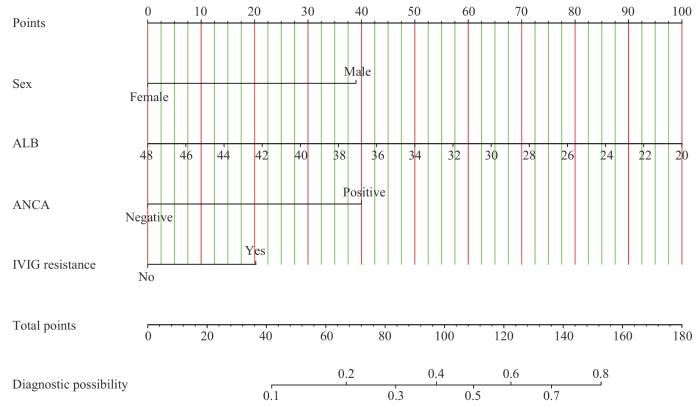
相比于由性别、ALB、ANCA构建的CAL预测模型,由性别、ALB、ANCA、IVIG抵抗4个因素构建的模型赤池信息准则(Akaike information criterion,AIC)值更小,模型拟合更好。根据AIC准则构建的模型方程为Logit P=4.508-1.259×性别-0.115×ALB+1.292×ANCA+0.653×IVIG抵抗;式中ALB单位为g/L。绘制列线图,将回归方程可视化(图3)。通过下方的刻度尺,可以得出每个变量在不同取值下所对应的单项分数,单项分数相加为总得分,与总得分相对应的预测概率即为KD患儿发生CAL的风险。

图3

图3   KD患儿合并CAL的列线图预测模型

Fig 3   Nomogram for prediction of CALs risk in patients with KD


2.4 列线图预测模型的验证与评价

2.4.1 区分度

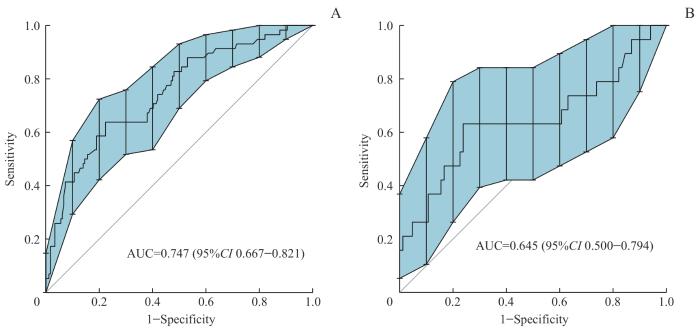
采用Bootstrap重抽样法在训练集和验证集的ROC曲线中对模型进行验证(重抽样次数为500),AUC分别为0.747(95%CI 0.667~0.821)和0.645(95%CI 0.500~0.794),表明模型区分度良好 (图4)。

图4

图4   预测模型在训练集和验证集中的ROC曲线

Note: A.Training set. B.Validation set.

Fig 4   ROC curve of the nomogram in the training set and validation set


2.4.2 校准度

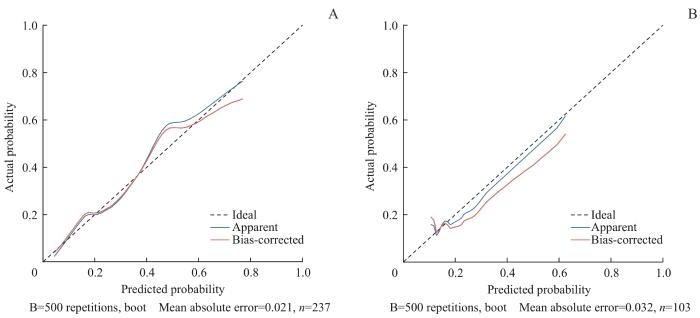
模型在训练集和验证集中的校准曲线显示,预测曲线及Bootstrap重抽样500次的校准曲线贴近对角线,预测概率与实际概率一致性良好。进一步行Hosmer-Lemeshow拟合优度检验,在训练集和验证集中结果分别为χ2=5.105(P=0.746)和χ2=13.549(P=0.094),提示模型拟合良好(图5)。

图5

图5   预测模型在训练集和验证集中的校准曲线

Note: A.Training set. B.Validation set.

Fig 5   Calibration curve of the nomogram in the training set and validation set


2.4.3 临床适用性

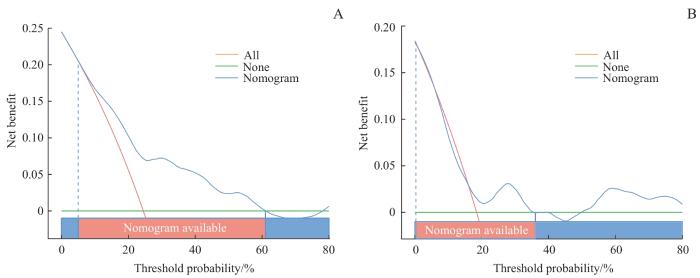
训练集和验证集的DCA显示,当阈概率值分别在5%~61%和1%~36%范围时,采用该预测模型预测KD患儿CAL发生风险的净获益较高,表明该模型具有一定临床应用价值(图6)。

图6

图6   预测模型在训练集和验证集中的决策曲线

Note: A.Training set. B.Validation set.

Fig 6   Decision curve of the nomogram in the training set and validation set


2.5 预测评分模型性能的比较

将上述模型中的4个变量均转化为二分类变量,再次进行多因素Logistic回归分析,结果显示男性、ALB<35 g/L、ANCA阳性、IVIG抵抗是KD合并CAL的独立危险因素(均P<0.05;表3)。根据Logistic回归方程中的自变量系数,将男性赋为5分,ALB<35 g/L赋为3分,ANCA阳性赋为8分,IVIG抵抗赋为4分,总分20分。ROC曲线分析结果显示,总分≥7为截断值时,此评分体系预测KD合并CAL的约登指数最大(0.372);因此将7分设置为截断点,≥7分为阳性,<7分为阴性,预测KD合并CAL的灵敏度和特异度分别为58.4%和78.7%(表4)。

表3   KD合并CAL影响因素的Logistic回归分析

Tab 3  Logistic regression analysis of factors associated with CALs in patients with KD

VariableBSEP valueOR95%CIScore
Male-0.9720.2990.0010.3780.206‒0.6705
ALB<35 g·L-10.6870.2790.0141.9861.149‒3.4413
ANCA positivity1.5500.5070.0024.7111.758‒13.1408
IVIG resistance0.7920.3650.0302.2081.064‒4.4814

新窗口打开| 下载CSV


表4   4种评分系统对KD合并CAL的预测性能比较

Tab 4  Comparison of the predictive performance of 4 scoring systems for KD combined with CALs

Scoring modelAUC95%CISensitivitySpecificityPPVNPVYouden index
New score0.7160.665‒0.7640.5840.78744.686.60.372
Kobayashi score0.5490.494‒0.6020.2600.84032.379.50.100
Egami score0.5560.502‒0.6100.4550.65828.080.50.113
Sano score0.5370.483‒0.5910.5460.51024.679.30.055

Note: PPV—positive predictive value; NPV—negative predictive value.

新窗口打开| 下载CSV


将3种目前常用的评分体系分别应用于340例KD患儿,对是否合并CAL进行预测。结果显示:Kobayashi评分特异度最高,灵敏度最低;Sano评分灵敏度最高,特异度最低;3种评分体系的约登指数均低于0.3。与以上3种评分体系相比,本研究建立的评分体系约登指数最高,灵敏度和特异度较高(表4)。

3 讨论

川崎病的病因和发病机制尚不明确12,目前认为与免疫功能紊乱和炎症因子的瀑布式释放引起血管炎症有关13-16。研究17发现KD血管炎发生的关键环节是血管内皮细胞损伤。ANCA是一种存在于循环中的自身抗体,以中性粒细胞胞质中的蛋白水解酶3、髓过氧化物酶、弹力蛋白酶等成分为靶抗原,可诱导中性粒细胞活化,释放活性氧、细胞因子等毒性介质,进而引起血管内皮细胞损伤和局部血管功能障碍。ANCA作为小血管炎的生物学标志物,见于系统性血管炎、自身免疫性肝病、炎症性肠病等自身免疫性疾病患者中;血清ANCA检测对相关疾病的诊断、分型、病情监测及预后评估具有重要意义718-19

江志贵等20通过检测46例KD患儿的血清ANCA,发现KD患儿ANCA阳性率高于对照组健康儿童,但在不完全性KD和完全性KD之间的差异无统计学意义。本研究与类似研究比较,KD患儿的ANCA阳性率存在一定差异,考虑可能原因如下。①各研究样本量不同。②间接免疫荧光法结果主要由人工判读,主观性较强,误差较大21。③IVIG使用和ANCA检测时间顺序不统一。有研究22-23表明,静脉使用IVIG,被动输注自身抗体可导致在给药后的数周内,针对感染性或自身免疫性疾病进行的一系列血清学试验出现假阳性,如乙型肝炎、梅毒血清学和ANCA检测等。赵建美等24研究发现,合并CAL的KD患儿ANCA阳性率高于无CAL的KD患儿。可见,ANCA在KD相关冠状动脉病变的病理生理过程中可能发挥重要作用。传统的CAL预测模型多基于炎症指标和治疗响应参数,缺乏基因、代谢组学等分子层面信息和免疫学标志物等,不能完全适用于所有地区、种族的KD群体。本研究全面纳入包括ANCA在内的可获取的20项临床指标,构建新的预测模型并验证其效能,希冀为KD患儿的早期风险评估和精准管理提供参考。

除ANCA以外,本研究还发现男性、ALB水平低、IVIG抵抗也是CAL的危险因素。KD具有明显的性别、年龄特征,既往已有多项研究25-26报道了发病年龄<1岁、男性是CAL发生的独立危险因素,男性患儿并发CAL的危险性约为女性患儿的2倍。一项来自日本的为期20年的回顾性研究27也证实患者的年龄和性别与CAL的发生显著相关。ALB是一种由肝细胞合成的炎症急性期反应蛋白,可以作为多种物质的转运体,参与急性和慢性炎症过程,在感染和慢性炎症时其水平降低28。KD急性期ALB水平下降,考虑与肝功能损伤、毛细血管渗漏和肾脏受累导致正常排泄屏障受损及大量ALB排出有关。有研究29发现,合并CAL的KD患儿ALB水平低于正常KD患儿,合并冠状动脉瘤的KD患儿ALB水平低于冠状动脉扩张患儿,提示ALB可作为冠状动脉病变严重程度的评价指标。低蛋白血症也是许多心血管疾病的独立预后指标30。大剂量IVIG联合阿司匹林是预防急性期KD患儿发生CAL的一线治疗方案,早期应用IVIG可将CAL发病率由25%降至5%;但部分患儿对该治疗无反应,其CAL发生率明显升高31。有研究32显示,IVIG应用时间延迟和IVIG无反应都可能引起血管炎症的持续状态,造成血流动力学改变,从而导致CAL;与本研究结果一致。

综上所述,ANCA可以作为一项新的预测指标,用于建立CAL预测模型;与经典的Kobayashi评分、Egami评分、Sano评分比较,灵敏度和特异度均较高,具有一定临床推广价值,可实现对KD患儿CAL发生风险的个体化预测。但本研究为单中心回顾性研究,缺乏多中心外部验证评估模型泛化能力。因部分患儿资料不完整、未完善血清ANCA检测、在外院已接受初始治疗等,未纳入研究队列,导致样本量和结局事件数量偏少,可能导致模型过拟合。未来仍需开展多中心、大样本的前瞻性研究进一步验证。

作者贡献声明

陈蓉、沈捷参与研究方案设计、论文写作和修改;陈蓉、张锰、朱荻绮参与数据收集和数据分析;所有作者参与病例随访。所有作者均阅读最终稿件并同意提交。

AUTHOR's CONTRIBUTIONS

The study was designed by CHEN Rong and SHEN Jie. The paper was drafted and revised by CHEN Rong and SHEN Jie. The data were collected and analyzed by CHEN Rong, ZHANG Meng and ZHU Diqi. Case follow-up was completed by all the authors. All authors have read the last version of paper and consented to submission.

利益冲突声明

所有作者声明不存在利益冲突。

COMPETING INTERESTS

All authors declare no relevant conflict of interests.

参考文献

中华医学会儿科学分会心血管学组, 中华医学会儿科学分会风湿学组,中华医学会儿科学分会免疫学组,等. 川崎病诊断和急性期治疗专家共识[J]. 中华儿科杂志,2022, 60(1): 6-13.

[本文引用: 2]

The Subspecialty Group of Cardiology, the Society of Pediatrics, Chinese Medical Association; the Subspecialty Group of Rheumatology, the Society of Pediatrics, Chinese Medical Association; the Subspecialty Group of Immunology, the Society of Pediatrics, Chinese Medical Association, et al. The expert consensus on diagnosis and acute-phase treatment of Kawasaki disease[J]. Chinese Journal of Pediatrics, 2022, 60(1): 6-13.

[本文引用: 2]

de GRAEFF N, GROOT N, OZEN S, et al. European consensus-based recommendations for the diagnosis and treatment of Kawasaki disease: the SHARE initiative[J]. Rheumatology (Oxford), 2019, 58(4): 672-682.

[本文引用: 1]

JCS Joint Working Group. Guidelines for diagnosis and management of cardiovascular sequelae in Kawasaki disease (JCS 2013), digest version[J]. Circ J, 2014, 78(10): 2521-2562.

[本文引用: 1]

Newburger J W, Takahashi M, Burns J C. Kawasaki disease[J]. J Am Coll Cardiol, 2016, 67(14): 1738-1749.

[本文引用: 1]

MCCRINDLE B W, ROWLEY A H, NEWBURGER J W, et al. Diagnosis, treatment, and long-term management of Kawasaki disease: a scientific statement for health professionals from the American heart association[J]. Circulation, 2017, 135(17): e927-e999.

[本文引用: 2]

BROGAN P, BURNS J C, CORNISH J, et al. Lifetime cardiovascular management of patients with previous Kawasaki disease[J]. Heart, 2020, 106(6): 411-420.

[本文引用: 1]

SCHULTE-PELKUM J, RADICE A, NORMAN G L, et al. Novel clinical and diagnostic aspects of antineutrophil cytoplasmic antibodies[J]. J Immunol Res, 2014, 2014: 185416.

[本文引用: 2]

中华医学会儿科学分会心血管学组, 中华医学会儿科学分会免疫学组. 川崎病冠状动脉病变的临床处理建议[J]. 中华儿科杂志, 2012, 50(10): 746-749.

[本文引用: 1]

The Subspecialty Group of Cardiology, the Society of Pediatrics, Chinese Medical Association; the Subspecialty Group of Rheumatology, the Society of Pediatrics, Chinese Medical Association. Recommendations for clinical management of Kawasaki disease with coronary arterial lesions[J]. Chinese Journal of Pediatrics, 2012, 50(10): 746-749.

[本文引用: 1]

KOBAYASHI T, INOUE Y, TAKEUCHI K, et al. Prediction of intravenous immunoglobulin unresponsiveness in patients with Kawasaki disease[J]. Circulation, 2006, 113(22): 2606-2612.

[本文引用: 1]

EGAMI K, MUTA H, ISHII M, et al. Prediction of resistance to intravenous immunoglobulin treatment in patients with Kawasaki disease[J]. J Pediatr, 2006, 149(2): 237-240.

[本文引用: 1]

SANO T, KUROTOBI S, MATSUZAKI K, et al. Prediction of non-responsiveness to standard high-dose gamma-globulin therapy in patients with acute Kawasaki disease before starting initial treatment[J]. Eur J Pediatr, 2007, 166(2): 131-137.

[本文引用: 1]

PILANIA R K, BHATTARAI D, SINGH S. Controversies in diagnosis and management of Kawasaki disease[J]. World J Clin Pediatr, 2018, 7(1): 27-35.

[本文引用: 1]

TIAN J, LV H T, AN X J, et al. Endothelial microparticles induce vascular endothelial cell injury in children with Kawasaki disease[J]. Eur Rev Med Pharmacol Sci, 2016, 20(9): 1814-1818.

[本文引用: 1]

LINDQUIST M E, HICAR M D. B cells and antibodies in Kawasaki disease[J]. Int J Mol Sci, 2019, 20(8): E1834.

TAKAHASHI K, OHARASEKI T, YOKOUCHI Y. Pathogenesis of Kawasaki disease[J]. Clin Exp Immunol, 2011, 164(Supplement 1): 20-22.

del PRINCIPE D, PIETRAFORTE D, GAMBARDELLA L, et al. Pathogenetic determinants in Kawasaki disease: the haematological point of view[J]. J Cell Mol Med, 2017, 21(4): 632-639.

[本文引用: 1]

马乐, 杜忠东. 川崎病血管内皮细胞损伤机制的研究进展[J]. 中华儿科杂志, 2016, 54(2): 158-160.

[本文引用: 1]

MA L, DU Z D. Advances in the pathogenesis of vascular endothelial cells injury in Kawasaki disease[J]. Chinese Journal of Pediatrics, 2016, 54(2): 158-160.

[本文引用: 1]

中国医师协会风湿免疫科医师分会自身抗体检测专业委员会. 抗中性粒细胞胞浆抗体检测的临床应用专家共识[J].中华检验医学杂志, 2018, 41(9): 644-650.

[本文引用: 1]

The Committee of the Autoantibodies Detection of Rheumatology and Immunology Physicians Committee of Chinese Medical Doctor Association. Experts consensus on the clinical application of antineutrophil cytoplasmic antibodies detection[J].Chinese Journal of Laboratory Medicine, 2018,41(9):644-650.

[本文引用: 1]

LIBERAL R, MIELI-VERGANI G, VERGANI D. Clinical significance of autoantibodies in autoimmune hepatitis[J]. J Autoimmun, 2013, 46: 17-24.

[本文引用: 1]

江志贵, 刘玲, 杨翠艳, 等. 抗中性粒细胞抗体在川崎病诊断中的价值[J]. 中国当代儿科杂志, 2012, 14(1): 45-47.

[本文引用: 1]

JIANG Z G, LIU L, YANG C Y, et al. Value of anti-neutrophil cytoplasmic antibody in diagnosis of Kawasaki disease[J].Chinese Journal of Contemporary Pediatrics, 2012, 14(1): 45-47.

[本文引用: 1]

刘坦, 孟晓峰, 杜世杰. 三种方法检测抗中性粒细胞胞浆抗体的比较分析[J]. 国际医药卫生导报, 2018, 24(4): 590-592.

[本文引用: 1]

LIU T, MENG X F, DU S J. Three methods for detecting antineutrophil cytoplasmic antibodies[J].International Medicine and Health Guildance News, 2018, 24(4): 590-592.

[本文引用: 1]

van DER MOLEN R G, HAMANN D, JACOBS J F, et al. Anti-SSA antibodies are present in immunoglobulin preparations[J]. Transfusion, 2015, 55(4): 832-837.

[本文引用: 1]

BRIGHT P D, SMITH L, USHER J, et al. False interpretation of diagnostic serology tests for patients treated with pooled human immunoglobulin G infusions: a trap for the unwary[J]. Clin Med, 2015, 15(2): 125-129.

[本文引用: 1]

赵建美, 王晓华. 川崎病患儿血清抗内皮细胞抗体和抗中性粒细胞胞浆抗体检测的临床意义[J]. 中国当代儿科杂志, 2014, 16(7): 740-744.

[本文引用: 1]

ZHAO J M, WANG X H. Clinical significance of anti-neutrophil cytoplasmic antibodies and anti-endothelial cell antibodies in children with Kawasaki disease[J].Chinese Journal of Contemporary Pediatrics, 2014, 16(7): 740-744.

[本文引用: 1]

RUAN Y, YE B, ZHAO X. Clinical characteristics of Kawasaki syndrome and the risk factors for coronary artery lesions in China[J]. Pediatr Infect Dis J, 2013, 32(10): e397-402.

[本文引用: 1]

PIAO J H, JIN L H, LV J, et al. Epidemiological investigation of Kawasaki disease in Jilin Province of China from 2000 to 2008[J]. Cardiol Young, 2010, 20(4): 426-432.

[本文引用: 1]

TAKEKOSHI N, KITANO N, TAKEUCHI T, et al. Analysis of age, sex, lack of response to intravenous immunoglobulin, and development of coronary artery abnormalities in children with Kawasaki disease in Japan[J]. JAMA Netw Open, 2022, 5(6): e2216642.

[本文引用: 1]

KAYAPINAR O, OZDE C, KAYA A. Relationship between the reciprocal change in inflammation-related biomarkers (fibrinogen-to-albumin and hsCRP-to-albumin ratios) and the presence and severity of coronary slow flow[J]. Clin Appl Thromb Hemost, 2019, 25: 1076029619835383.

[本文引用: 1]

张玉坤, 黄春华, 杨蕾, 等. 血清白蛋白、血沉、血小板/淋巴细胞比值、中性粒细胞/淋巴细胞比值与川崎病患儿冠脉病变程度的关系[J]. 中国医师杂志, 2023, 25(1): 23-27.

[本文引用: 1]

ZHANG Y K, HUANG C H, YANG L, et al. The relationship between albumin, erythrocyte sedimentation rate, platelet/lymphocyte ratio, neutrophil/lymphocyte ratio and the degree of coronary artery disease in children with Kawasaki disease[J]. Journal of Chinese Physician, 2023, 25(1): 23-27.

[本文引用: 1]

ARQUES S. Human serum albumin in cardiovascular diseases[J]. Eur J Intern Med, 2018, 52: 8-12.

[本文引用: 1]

FUKAZAWA R, KOBAYASHI J, AYUSAWA M, et al. JCS/JSCS 2020 guideline on diagnosis and management of cardiovascular sequelae in Kawasaki disease[J]. Circ J, 2020, 84(8): 1348-1407.

[本文引用: 1]

XIE T, WANG Y, FU S, et al. Predictors for intravenous immunoglobulin resistance and coronary artery lesions in Kawasaki disease[J]. Pediatr Rheumatol Online J, 2017, 15(1): 17.

[本文引用: 1]

/