
上海交通大学学报(医学版), 2026, 46(8): 1082-1090 doi: 10.3969/j.issn.1674-8115.2026.08.008

论著 · 临床研究

国产微流控系统对儿童胃肠道感染的诊断性能及其与主流进口平台的比较

魏嘉祺1, 任宏2, 沈楠3, 周媛婕3, 潘艺4, 孙相鑫4, 莫茜1, 陶悦,1

1.上海交通大学医学院附属上海儿童医学中心儿科转化医学研究所,上海 200127

2.上海交通大学医学院附属上海儿童医学中心重症医学科,上海 200127

3.上海交通大学医学院附属上海儿童医学中心感染科,上海 200127

4.上海宏大远景生物科技有限公司,上海 200127

Diagnostic performance of a domestic microfluidic system in pediatric gastrointestinal infections: a comparative study with leading imported platforms

Wei Jiaqi1, Ren Hong2, Shen Nan3, Zhou Yuanjie3, Pan Yi4, Sun Xiangxin4, Mo Xi1, Tao Yue,1

1.Pediatric Translational Medicine Institute, Shanghai Children's Medical Center, Shanghai Jiao Tong University School of Medicine, Shanghai 200127, China

2.Pediatric Intensive Care Unit, Shanghai Children's Medical Center, Shanghai Jiao Tong University School of Medicine, Shanghai 200127, China

3.Department of Infectious Disease, Shanghai Children's Medical Center, Shanghai Jiao Tong University School of Medicine, Shanghai 200127, China

4.Shanghai Hongda Yuanjing Biotechnology Company Limited, Shanghai 200127, China

通讯作者: 陶 悦,研究员,博士;电子信箱:taoyue@scmc.com.cn。

第一联系人: 魏嘉祺、陶悦参与研究设计、数据收集、实验操作及论文初稿撰写,任宏、沈楠参与临床样本与数据收集、结果分析与统计分析,周媛婕参与实验操作、数据整理及经费支持,潘艺、孙相鑫参与技术平台支持及试剂设备提供,莫茜、陶悦参与研究指导、数据分析、经费支持、论文修改与最终审阅。所有作者均阅读并同意最终稿件的提交。

编委: 包玲

收稿日期: 2025-12-29   接受日期: 2026-04-30   网络出版日期: 2026-08-28

基金资助: 国家重点研发计划.  2024YFC2422300
中央高校基本科研业务费专项资金.  YG2024LC09
中央高校基本科研业务费专项资金.  YG2024QNA45
上海市浦东新区卫生健康委员会重点学科群.  PWZxq2022-07

Corresponding authors: Tao Yue, E-mail:taoyue@scmc.com.cn.

First author contact: Wei Jiaqi and Tao Yue contributed to the study design, data collection, experimental operations, and drafting of the initial manuscript. Ren Hong and Shen Nan contributed to the collection of clinical samples and data, as well as data analysis and statistical analysis. Zhou Yuanjie contributed to experimental operations, data collation, and funding support. Pan Yi and Sun Xiangxin contributed to technical platform support and provision of reagents and equipment. Mo Xi and Tao Yue contributed to study guidance, data analysis, funding support, manuscript revision, and final review. All authors have read the final version of the paper and consented to its submission.

Received: 2025-12-29   Accepted: 2026-04-30   Online: 2026-08-28

Fund supported: National Key Research and Development Program of China.  2024YFC2422300
Fundamental Reasearch Funds for the Central Universities.  YG2024LC09.  YG2024QNA45
Key Discipline Group of Pudong New Area Health Commission of Shanghai.  PWZxq2022-07

摘要

目的·评估基于微流控技术的国产自主研发胃肠道病原体核酸检测系统的诊断性能和应用价值。方法·收集上海交通大学医学院附属上海儿童医学中心2024年4月5日—2025年10月6日的534例粪便样本,根据检测目的划分为3个独立队列。队列A纳入经Xpert艰难梭菌检测试剂盒(Xpert Clostridium difficile,Xpert C. difficile)检测确认为艰难梭菌阳性的样本,共15例,用于评估胃肠道病原体检测试剂盒(high definition gastrointestinal panel,HD GI panel)检测艰难梭菌的性能;队列B为临床需要进行胃肠道病原体全面筛查的样本,共167例,用于比较HD GI panel与FilmArray胃肠道病原体检测试剂盒(FilmArray gastrointestinal panel,FilmArray GI panel)的多病原体检测性能;队列C为儿童重症监护室(pediatric intensive care unit,PICU)收治的临床疑似胃肠道感染患儿的粪便样本,共352例,用于分析重症患儿胃肠道病原体流行特征及HD GI panel的临床应用价值。收集队列C患儿的社会人口学和临床基线资料。2种检测方法的一致性通过Kappa检验评估。采用McNemar检验比较2种方法阳性检出率的差异。采用Pearson相关分析评估2种方法CT值的相关性。以FilmArray GI panel结果为参考标准,计算HD GI panel检测的灵敏度、特异度、阳性预测值、阴性预测值及其95%置信区间。采用多因素Logistic回归分析影响检测准确性的因素。结果·HD GI panel与Xpert C. difficile的艰难梭菌检测结果一致,两者CT值呈中等程度正相关(r=0.594,P=0.019)。HD GI panel与FilmArray GI panel检测的总体符合率为92.22%,Kappa检验显示两者的一致性较好(κ=0.823,P<0.001);与FilmArray GI panel相比,HD GI panel的灵敏度为88.89%、特异度为93.81%、阳性预测值为87.27%、阴性预测值为94.64%。在重症患儿中,采用HD GI panel检测的样本阳性率为39.77%,诺如病毒GⅡ型、轮状病毒A组、腺病毒为主要病毒性病原体,肠集聚性大肠埃希菌(enteroaggregative Escherichia coli,EAEC)、艰难梭菌和沙门菌为主要细菌性病原体,多重感染占30.00%;与临床诊断相比,HD GI panel灵敏度和阴性预测值均为100.00%,诊断准确率93.60%,Kappa检验提示两者存在高度一致性(κ=0.860,P<0.001)。此外,多因素Logistic回归分析表明,基础疾病是影响检测准确性的独立相关因素(OR=0.051,95%CI 0.014~0.141,P<0.001)。结论·HD GI panel在胃肠道病原体检测中表现出与主流平台相当的诊断性能,具有操作简便、检测快速、病原谱符合中国儿童感染特点等优势,适用于基层医院及高通量检测场景。

关键词: 微流控 ; 核酸扩增技术 ; 敏感度 ; 特异度 ; 胃肠疾病 ; 儿童

Abstract

Objective ·To evaluate the diagnostic performance and application value of a domestically developed microfluidic technology-based nucleic acid detection system for gastrointestinal pathogens. Methods ·A total of 534 fecal samples were collected from Shanghai Children's Medical Center, Shanghai Jiao Tong University School of Medicine, between April 5th, 2024 and October 6th, 2025. Based on the purpose of testing, the samples were divided into three independent cohorts. Cohort A included 15 samples confirmed positive for Clostridium difficile by the Xpert Clostridiumdifficile assay (Xpert C. difficile), which were used to evaluate the performance of the gastrointestinal pathogen detection panel (high definition gastrointestinal panel, HD GI panel) for detecting Clostridium difficile. Cohort B included 167 samples from patients requiring comprehensive gastrointestinal pathogen screening and was used to compare the multi-pathogen detection performance of the HD GI panel with the FilmArray gastrointestinal panel (FilmArray GI panel). Cohort C consisted of 352 fecal samples from children with clinically suspected gastrointestinal infections who were admitted to the pediatric intensive care unit (PICU), and was used to analyze the epidemiological characteristics of gastrointestinal pathogens in critically ill children and the clinical application value of the HD GI panel. Sociodemographic and baseline clinical data of children in Cohort C were collected. The Kappa test assessed the agreement between the two detection methods. The McNemar test was used to compare the differences in positive detection rates between the two methods. Pearson correlation analysis was used to evaluate the correlation CT values obtained by the two methods. Using the results of the FilmArray GI panel as the reference standard, the sensitivity, specificity, positive predictive value, and negative predictive value of the HD GI panel, along with their 95% confidence intervals, were calculated. Multivariate Logistic regression analysis was used to identify factors affecting the detection accuracy. Results ·The detection results for Clostridium difficile obtained with the HD GI panel and the Xpert C. difficile assay were consistent, and the CT values showed a moderate positive correlation (r=0.594, P=0.019). The overall compliance between the HD GI panel and the FilmArray GI panel was 92.22%, and the Kappa test indicated good consistency between the two methods (κ=0.823, P<0.001). Compared with the FilmArray GI panel, the HD GI panel achieved a sensitivity of 88.89%, a specificity of 93.81%, a positive predictive value of 87.27%, and a negative predictive value of 94.64%. Among critically ill children, the overall positivity rate detected by the HD GI panel was 39.77%. Norovirus GⅡ, rotavirus A, and adenovirus were the predominant viral pathogens, whereas enteroaggregative Escherichia coli (EAEC), Clostridium difficile, and Salmonella were the main bacterial pathogens. Co-infections accounted for 30.00%. Compared with clinical diagnosis, the HD GI panel demonstrated a sensitivity and a negative predictive value of 100.00%, with a diagnostic accuracy of 93.60%. The Kappa test showed a high level of agreement between the two methods (κ=0.860, P<0.001). Multivariate Logistic regression analysis further revealed that the presence of underlying diseases was an independent factor associated with detection accuracy (OR=0.051, 95%CI 0.014‒0.141, P<0.001). Conclusion ·The HD GI panel demonstrates diagnostic performance comparable to that of mainstream platforms for gastrointestinal pathogen detection, offering advantages such as simple operation, rapid turnaround, and a pathogen spectrum consistent with the characteristics of pediatric gastrointestinal infections in China. It is well suited for use in primary hospitals and high-throughput testing settings.

Keywords: microfluidics ; nucleic acid amplification technique ; sensitivity ; specificity ; gastrointestinal disease ; child

PDF (1145KB) 元数据 多维度评价 相关文章 导出 EndNote| Ris| Bibtex  收藏本文

本文引用格式

魏嘉祺, 任宏, 沈楠, 周媛婕, 潘艺, 孙相鑫, 莫茜, 陶悦. 国产微流控系统对儿童胃肠道感染的诊断性能及其与主流进口平台的比较. 上海交通大学学报(医学版)[J], 2026, 46(8): 1082-1090 doi:10.3969/j.issn.1674-8115.2026.08.008

Wei Jiaqi, Ren Hong, Shen Nan, Zhou Yuanjie, Pan Yi, Sun Xiangxin, Mo Xi, Tao Yue. Diagnostic performance of a domestic microfluidic system in pediatric gastrointestinal infections: a comparative study with leading imported platforms. Journal of Shanghai Jiao Tong University (Medical Science)[J], 2026, 46(8): 1082-1090 doi:10.3969/j.issn.1674-8115.2026.08.008

胃肠道感染是全球高发的公共卫生问题,对儿童群体的危害尤为突出[1]。在中国,0~5岁儿童占胃肠道传染病病例的60%以上,是此类疾病防控的重点人群[2]。由于儿童免疫系统发育尚未完善,胃肠道感染后病情进展迅速,且腹泻、发热等症状在不同病原体间表现相似,仅凭临床经验难以实现精准诊断。更重要的是,儿童对抗菌药物高度敏感,不当用药不仅会延长病程,还可能加速耐药性的产生。因此,开发一款符合中国儿童病原谱特征,且能实现“早期、多重、精准”检测的工具,对优化儿科个体化治疗及疾病防控具有重要的临床意义[3-5]。

目前国内临床对胃肠道感染的诊断仍依赖传统病原体培养与免疫学检测方法,这些技术存在检测周期长、灵敏度低、病原体覆盖范围有限等缺点,难以满足临床对快速、准确诊断的需求[6]。此外,实验过程中产生的气溶胶不仅会增加实验室样本交叉污染的风险,也对操作人员的安全构成威胁,进而影响检测效率、制约这些技术的推广应用[7]。近年来,分子诊断技术的快速发展为胃肠道病原体检测带来革命性的突破。多重PCR技术,尤其是综合性胃肠道病原体检测,能够通过单次检测同时识别多种细菌、病毒和寄生虫,显著提高检测灵敏度和准确性[8]。目前,国际市场上较为成熟的胃肠道核酸检测系统,包括FilmArray胃肠道病原体检测试剂盒(FilmArray gastrointestinal panel,FilmArray GI panel)、QIAstat-Dx胃肠道病原体检测试剂盒2(QIAstat-Dx GI panel 2)及Xpert艰难梭菌检测试剂盒(Xpert Clostridium difficile,Xpert C. difficile)等,均在中国得到广泛应用。然而,这些检测系统多为进口,设备与试剂成本高昂、操作复杂,限制了其在基层医院的普及应用。此外,国内儿童胃肠道感染的病原谱和流行病学特征与国外存在差异,亟需开发一款针对中国儿童人群特点、兼具成本效益与操作便捷性的国产检测系统[1,9]。

微流控技术通过将样本制备、反应、分离和检测等功能集成于微米尺度的芯片,为核酸检测提供了小型化、自动化的解决方案。基于此技术原理开发而成的微流控卡盒,则将上述功能进一步整合为密闭、一体化的核酸检测平台,并凭借其小型化、高通量及高便捷性的特点,逐渐成为临床病原体检测的重要工具[10]。胃肠道病原体检测试剂盒(high definition gastrointestinal panel,HD GI panel)正是这样一款基于微流控卡盒的国产胃肠道病原体检测系统,它整合样本处理、核酸提取、扩增及检测等多个步骤,实现“一站式”快速检测,极大缩短检测时间并降低交叉污染风险。此外,该试剂盒的病原谱涵盖了22种儿童常见病原体靶标(包括白念珠菌)。这一设计对于儿童重症监护室(pediatric intensive care unit,PICU)免疫功能低下的患儿具有重要的鉴别诊断价值,有助于识别机会性真菌感染或定植[9]。本研究拟系统评估该技术在胃肠道病原体检测中的临床应用效果,并与国际主流核酸检测系统(Xpert C. difficile和FilmArray GI panel)比较,考察其在检测性能、操作便捷性、检测通量及适用场景等方面的优势与不足,以期为中国儿童胃肠道感染的精准诊断提供一种可靠且高效的国产化解决方案。

1 材料与方法

1.1 患儿粪便样本及资料收集

收集上海交通大学医学院附属上海儿童医学中心2024年4月5日—2025年10月6日送检的粪便样本。根据不同比较目的,将样本分为3个独立队列,各队列入组标准如下。①队列A:纳入经Xpert C. difficile检测确认为艰难梭菌阳性的粪便样本,共15例,用于评估HD GI panel检测艰难梭菌的性能。②队列B:纳入经临床医师判断需要进行胃肠道病原体全面筛查的粪便样本,共167例,用于比较HD GI panel与FilmArray GI panel的多病原体检测性能。③队列C:纳入PICU收治的临床疑似胃肠道感染患儿的粪便样本,共352例,用于分析重症患儿胃肠道病原体的流行特征及HD GI panel的临床应用价值。3个队列共534例非重复的粪便样本。通过医院电子病历系统收集队列C患儿的社会人口学和临床基线资料,包括年龄、性别、现病史、基础疾病情况、实验室检查结果及临床诊断资料。

1.2 主要试剂与仪器

全自动基因分析系统HD GI panel及其配套试剂由上海儿童医学中心与上海宏大远景生物科技有限公司联合开发并提供,FilmArray Torch全自动医用PCR分析系统及FilmArray GI panel试剂盒购自美国BioFire Diagnostics公司,GeneXpert Dx系统及Xpert C. difficile试剂盒购自美国Cepheid公司。所有检测步骤均严格按照各厂商说明书进行,并使用原装配套试剂操作。

1.3 检测方法

所有送检样本均按照不同试剂盒的检测要求处理,并立即检测。在非工作时间收到的样本,为确保核酸稳定性,将其暂存于-80 °C冰箱,并于次日尽早统一检测。

1.3.1 HD GI panel检测

全自动基因分析系统在检测时可直接使用固体或固液混合的临床粪便样本。将100 μL样本置于试剂盒的反应池中央,盖紧反应池盖后,将试剂盒置于全自动基因分析一体机中运行。该过程手工操作时间约1 min,仪器随后自动完成样本处理、核酸提取、扩增及荧光检测分析,总运行时间约1.5 h。HD GI panel可同时检测22种病原靶标,包括:肠集聚性大肠埃希菌(enteroaggregative Escherichia coli,EAEC)、肠致病性大肠埃希菌(enteropathogenic Escherichia coli,EPEC)、肠产毒性大肠埃希菌(enterotoxigenic Escherichia coli,ETEC)、产志贺毒素大肠埃希菌(Shiga toxin-producing Escherichia coli,STEC)、弯曲杆菌(Campylobacter)、艰难梭菌、沙门菌(Salmonella)、弧菌(Vibrio)、霍乱弧菌(Vibrio cholerae)、小肠结肠炎耶尔森菌(Yersinia enterocolitica)、阴沟肠杆菌(Enterobacter cloacae)、腺病毒(adenovirus)、诺如病毒GⅠ/GⅡ型(norovirus GⅠ/GⅡ)、轮状病毒A组(rotavirus A)、星状病毒(astrovirus)、札幌病毒(sapovirus)、EB病毒(Epstein-Barr virus,EBV)、白念珠菌(Candida albicans)、隐孢子虫(Cryptosporidium parvum)、卡耶塔环孢子虫(Cyclospora cayetanensis)、溶组织内阿米巴(Entamoeba histolytica)、蓝氏贾第鞭毛虫(Giardia lamblia)。

1.3.2 Xpert C. difficile检测

该检测可直接使用拭子从疑似艰难梭菌感染患者未成形的粪便中取样,经样本稀释液涡旋悬浮后,取适量悬浮液直接转移至试剂盒内,随后将整个试剂盒置于GeneXpert Dx系统中运行。该过程手工操作时间约5 min,仪器随后自动完成样本裂解、核酸纯化、针对艰难梭菌毒素B(Clostridioides difficile toxin B,TcdB)基因的实时荧光定量PCR扩增及检测分析,总运行时间约45 min。

1.3.3 FilmArray GI panel检测

取200 μL保存于Cary–Blair运送培养基中的粪便样本与专用缓冲液混合后,注入一次性测试试剂袋中,随后将该试剂袋装入FilmArray检测试剂盒并置入FilmArray Torch全自动医用PCR分析系统运行。该过程手工操作时间约2 min,后续的核酸提取、2轮扩增(首轮多重PCR,第二轮巢式PCR)及熔解曲线分析均由仪器在封闭试剂盒内自动完成,总检测时间约1 h。

1.4 统计学方法

采用R 4.5.1软件进行统计分析。不符合正态分布的定量资料采用M(Q1,Q3)表示。定性资料以例数和百分比表示。2种检测方法的一致性通过Kappa检验评估。采用McNemar检验比较2种方法阳性检出率的差异。采用Pearson相关分析评估2种方法CT值的相关性。以FilmArray GI panel结果为参考标准,计算HD GI panel检测的灵敏度、特异度、阳性预测值、阴性预测值及其95%置信区间。采用多因素Logistic回归分析影响检测准确性的因素。P<0.05表示差异具有统计学意义。

2 结果

2.1 HD GI panel与Xpert C. difficile 检测对比

2.1.1 艰难梭菌的定性检测

采用HD GI panel检测队列A艰难梭菌阳性的15例粪便样本(经Xpert C. difficile检测证实),用于评估HD GI panel的诊断性能。一致性分析显示,2种方法对艰难梭菌的检测结果完全一致。HD GI panel在其中9例样本中同时检出其他病原体,提示存在多重感染(表1)。为进一步验证HD GI panel对艰难梭菌的阴性检测能力,从队列B中选取15例经HD GI panel检测为艰难梭菌阴性的样本,使用Xpert C. difficile进行回顾性验证。结果显示,这15例样本Xpert C. difficile检测结果均为阴性。综合上述结果,HD GI panel在检测艰难梭菌方面的表现与Xpert C. difficile高度一致。

表1   采用HD GI panel检出的多重感染的病原体分布

Tab 1  Distribution of pathogens in co-infections detected by the HD GI panel

Pathogen

Number of

co-detections/n

Percentage among co-infected samples/%Percentage of total samples/%
EAEC777.8046.67
Salmonella333.3320.00
Adenovirus111.116.67
Sapovirus111.116.67
Candida albicans111.116.67

Note: The sample is Cohort A, included 15 fecal samples, of which 9 were co-infection samples.

新窗口打开| 下载CSV


2.1.2 艰难梭菌的定量检测

Pearson相关分析显示,队列A样本采用HD GI panel与Xpert C. difficile检测的CT值呈中等程度正相关(r=0.594,P=0.019;图1A)。基于队列A的15例艰难梭菌阳性样本,以Xpert C. difficile检测的CT值为自变量、HD GI panel检测的CT值为因变量,建立回归模型。计算得出决定系数R²=0.353,表明仅有约35.3%的变异可由线性关系解释;基于Xpert C. difficile检测CT值预测HD GI panel检测CT值的均方根误差为3.12个CT单位。

图1
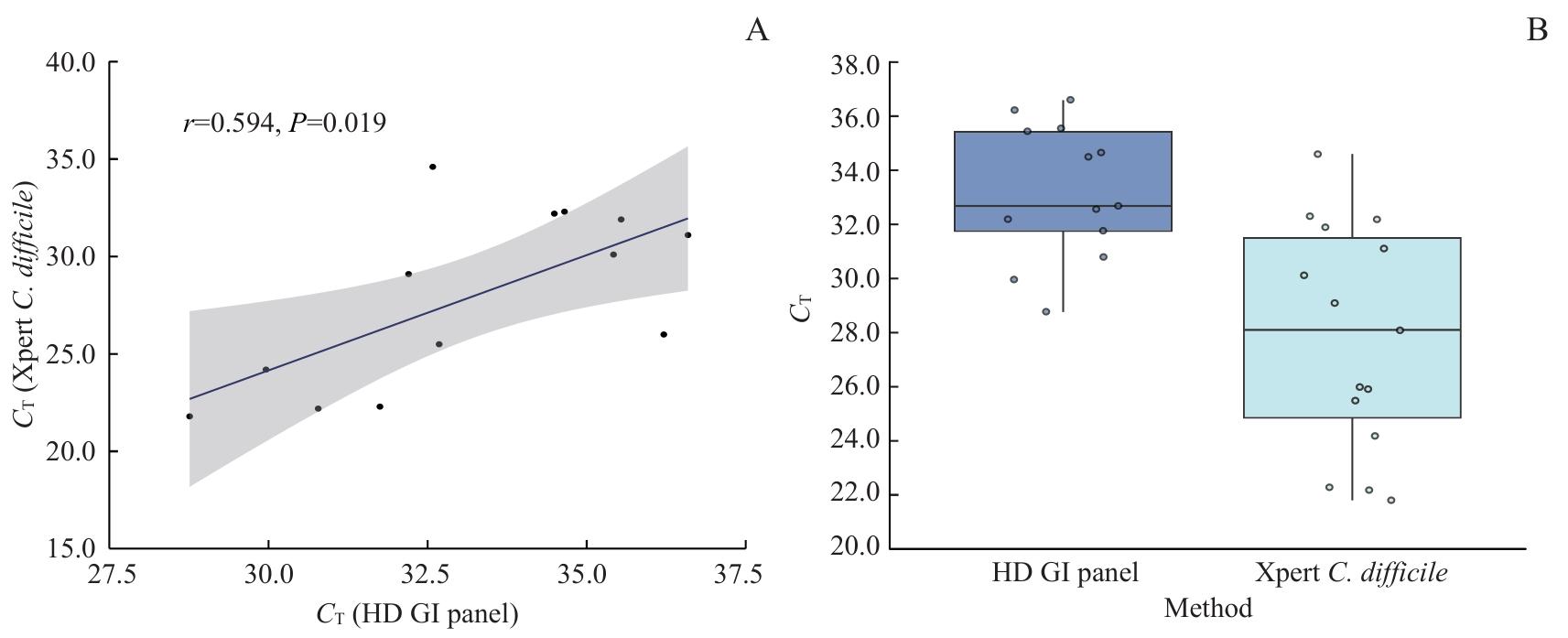
图1   HD GI panel与Xpert C. difficile 检测 CT 值相关性(A)及分布分析(B)

Fig 1   Correlation (A) and distribution (B) analyses of CT values obtained with the HD GI panel and Xpert C. difficile assay


图1B显示了2种方法的CT值分布差异。与Xpert C. difficile相比,HD GI panel的CT值普遍较高。这提示HD GI panel的绝对检测灵敏度可能略低于Xpert C. difficile。然而,在临床重症相关的阈值范围内(CT值<35),2种方法的一致性良好。上述差异可能与两者不同的引物/探针设计、扩增体系及荧光信号读出策略有关。

2.2 HD GI panel与FilmArray GI panel检测对比

2.2.1 胃肠道病原体检出情况

对于队列B的167例粪便样本,HD GI panel和FilmArray GI panel的阳性检出率分别为33.53%和32.93%,分别检出8种和7种病原体;除HD GI panel因检测靶标覆盖差异额外检出7例白念珠菌外,其余检出的7种病原体均相同。2种方法检出率前3位的病原体包括艰难梭菌、EAEC和诺如病毒GⅡ型(表2)。HD GI panel检出单一病原体感染的样本49例(29.34%),检出2种及以上病原体混合感染的样本7例(4.19%);FilmArray GI panel检出单一病原体感染46例(27.54%),检出2种及以上病原体混合感染9例(5.39%)。对于HD GI panel检出的7例混合感染样本,FilmArray GI panel的检测结果与之一致,主要为艰难梭菌或沙门菌与其他病原体共同感染。

表2   HD GI panel和FilmArray GI panel胃肠道病原体检测结果

Tab 2  Gastrointestinal pathogen detection results obtained with the HD GI panel and FilmArray GI panel

PathogenHD GI panelFilmArray GI panel
Positive samples/nDetection rate/%Positive samples/nDetection rate/%
Adenovirus42.4052.99
Campylobacter42.4042.40
Candida albicans74.19‒‒
Clostridium difficile158.98158.98
EAEC127.19169.58
Norovirus GⅡ148.38148.38
Rotavirus A10.6010.60
Salmonella74.1995.39

Note: The sample is Cohort B, included 167 fecal samples.

新窗口打开| 下载CSV


2.2.2 检测性能比较

以FilmArray GI panel为参照,分析队列B中167例粪便样本的HD GI panel检测结果(表3)。需要说明的是,本研究未对不一致的结果行进一步验证,可能存在一定的偏倚。在167例样本中,2种方法检测结果相同的有154例,总体符合率为92.22%,对弯曲杆菌、艰难梭菌、轮状病毒A组和诺如病毒GⅡ型检测结果符合率达100.00%。与FilmArray GI panel方法相比,HD GI panel检测的灵敏度为88.89%、特异度为93.81%、阳性预测值为87.27%、阴性预测值为94.64%。Kappa检验显示两者的一致性较好(κ=0.823,P<0.001)。McNemar检验提示2种方法的阳性检出率差异无统计学意义。

表3   HD GI panel和FilmArray GI panel对病原体的检测性能比较

Tab 3  Comparison of pathogen detection performances between the HD GI panel and FilmArray GI panel

PathogenHD GI panelFilmArray GI panelSensitivity①/%Specificity①/%Overall compliance rate/%κ coefficient
+-
Adenovirus+4080.00 (28.36—99.49)100.00 (97.75—100.00)99.400.886
-1162
Campylobacter+40100.00 (39.80—100.00)100.00 (96.60—100.00)100.001.000
-0163
Clostridium difficile+150100.00 (78.20—100.00)100.00 (97.60—100.00)100.001.000
-0152
EAEC+12075.00 (47.62—92.73)100.00 (97.59—100.00)97.600.844
-4151
Norovirus GⅡ+140100.00 (76.84—100.00)100.00 (97.62—100.00)100.001.000
-0153
Rotavirus A+10100.00 (2.50—100.00)100.00 (97.80—100.00)100.001.000
-0166
Salmonella+7077.78 (39.99—97.19)100.00 (96.70—100.00)98.800.869
-2158

Note: The sample is Cohort B, included 167 fecal samples. ①Values in parentheses indicate 95% confidence intervals.

新窗口打开| 下载CSV


2.3 HD GI panel在PICU患儿胃肠道感染中的应用评估

2.3.1 胃肠道病原体检出情况

队列C的粪便样本来源于PICU患儿。患儿中位年龄为7.1(1.93,12.24)岁。352例样本中,采用HD GI panel检出病原体阳性的样本140例,样本阳性率为39.77%,共检出病原体192株。诺如病毒GⅡ型、轮状病毒A组、腺病毒为主要病毒性病原体,EAEC、艰难梭菌和沙门菌为主要细菌性病原体,具体病原体构成见表4所示。在所有阳性样本中,共检出42例多重感染(占30.00%),其中EAEC合并EPEC、艰难梭菌合并轮状病毒A组、诺如病毒GⅡ型合并沙门菌感染较为常见。

表4   HD GI panel对队列C每种病原体检测结果及与临床诊断的比较

Tab 4  Diagnostic performance of the HD GI panel for individual pathogens in cohort C compared with clinical diagnosis

PathogenPositive samples/nDetection rate/%Sensitivity①/%Specificity①/%Diagnostic accuracy②/%κ coefficient
Adenovirus85.71100.00 (63.06—100.00)100.00 (98.28—100.00)100.001.000
Campylobacter96.43100.00 (63.06—100.00)100.00 (98.28—100.00)100.001.000
Candida albicans2316.43100.00 (78.20—100.00)97.70 (94.71—99.99)97.840.846
Clostridium difficile3122.14100.00 (86.28—100.00)98.60 (95.98—99.71)98.750.846
EAEC4330.71100.00 (89.11—100.00)95.93 (92.41—99.25)96.440.856
EBV32.14100.00 (15.81—100.00)99.53 (97.41—99.99)99.530.798
Enterobacter cloacae42.86100.00 (15.81—100.00)99.53 (97.41—99.99)99.530.789
EPEC1410.00100.00 (66.37—100.00)99.07 (96.66—99.89)99.100.895
Norovirus GⅡ2517.86100.00 (83.89—100.00)98.60 (95.98—99.71)98.730.926
Rotavirus A128.57100.00 (73.54—100.00)100.00 (98.28—100.00)100.001.000
Salmonella1913.57100.00 (81.47—100.00)99.53 (97.41—99.99)99.570.971
STEC10.71100.00 (2.50—100.00)100.00 (98.28—100.00)100.001.000

Note: The sample is Cohort C, included 352 fecal samples. ①Values in parentheses indicate 95% confidence intervals. ②Diagnostic accuracy was calculated using comprehensive clinical judgment as the reference standard: (true positives + true negatives)/total number of samples.

新窗口打开| 下载CSV


2.3.2 HD GI panel检测结果与临床诊断比较

为进一步评估HD GI panel的诊断性能,本研究以临床综合诊断作为参考标准,比较队列C样本HD GI panel检测结果与临床诊断的一致性。结果显示,HD GI panel对PICU患儿胃肠道病原体感染的灵敏度与阴性预测值均为100.00%,提示其在排除胃肠道感染方面具有可靠性;HD GI panel的诊断准确率为93.60%、特异度为90.60%、阳性预测值为83.33%,表明该方法在重症患儿中的诊断效能较为稳定。

尽管Kappa检验提示HD GI panel检测结果与临床诊断之间存在高度一致性(κ=0.860,P<0.001),但McNemar检验发现两者的阳性判定结果差异存在统计学意义(P<0.001),HD GI panel检测结果阳性率高于临床诊断。以2个患者为例。患儿1,13岁11个月,因“确诊非霍奇金淋巴瘤3个月,发热5 d”入院。该患儿末次化学治疗1周后出现骨髓抑制,5 d前高热,予抗感染治疗,期间出现呕吐,门诊测得低血压,予扩容治疗后收入PICU。入院后患儿仍有呕吐,伴稀糊状黄色便,血常规显示C反应蛋白、降钙素原水平明显升高,HD GI panel结果提示检测到艰难梭菌(CT值26.76)和EAEC(CT值21.10)。腹部超声提示部分肠壁水肿,双份血培养均呈阴性,经外周静脉穿刺的中心静脉导管(peripherally inserted central venous catheter,PICC)末端二代测序检出耐碳青霉烯大肠埃希菌。结合患儿HD GI panel病原体CT值、基础疾病、临床表现、实验室检查结果、影像学表现,考虑为EAEC和艰难梭菌多重感染,属于临床症状与检验结果一致。患儿2,6岁9个月,因“呕吐2周,发现泡沫尿1周”入院。该患儿2周内呕吐10余次,多发生在餐后;1周前发现泡沫尿,急诊查尿蛋白、尿糖呈阳性,遂收入院。相关检查发现患儿血常规C反应蛋白、降钙素原水平正常,血红蛋白水平、血小板计数下降,血肌酐水平升高并伴有高血压;腹部超声示肠壁正常、双肾实质回声异常。临床考虑为肾病综合征、肾功能衰竭和多浆膜腔积液。患儿虽有呕吐症状,但HD GI panel结果提示检测到EAEC的CT值为35.24,因此临床不考虑患儿同时合并肠道感染,倾向病原体于胃肠道定植。

在检测结果的分析中,本研究发现基础疾病对检测准确性有显著影响。在队列C粪便样本来源的患儿中,265例无基础疾病,87例有基础疾病。无基础疾病患儿粪便样本的病原体检测结果与临床诊断结果一致率达98.50%;而在有基础疾病的患儿中,一致率为79.31%。为进一步排除潜在混杂因素对检测准确性评估的干扰,将年龄、性别和基础疾病等纳入多因素Logistic回归分析,结果显示基础疾病仍是影响检测准确性的独立相关因素(OR=0.051,95%CI 0.014~0.141,P<0.001)。该结果表明存在基础疾病的患儿,其检测结果与临床诊断的一致性显著降低。

3 讨论

胃肠道病原体检测试剂盒的开发和应用使临床实验室能够更快速、更准确地诊断胃肠道感染。选择采用哪种检测平台最终取决于多重因素的权衡,包括检测性能、成本效益、操作流程、检测通量及目标患者群体等[11]。本研究所纳入的每款胃肠道病原体检测试剂盒都有其独特的优势和局限,临床微生物实验室需综合考量。例如,Xpert C. difficile检测专门针对单一病原体艰难梭菌毒素,其完成单次检测约0.75 h,手工操作时间约5 min,试剂成本在对比平台中最低;但其检测范围有限,不适用于病因不明的急性胃肠道感染的全面筛查[12]。而经典的多重检测试剂盒(如FilmArray GI panel),覆盖约22种高度重叠的靶标,涵盖全球范围内胃肠道感染最常见的病原体,运行时间约1 h;但其所需样本量较大、单次检测成本较高、检测通量扩展能力有限,这可能制约其在需要高通量检测的大型实验室中的广泛应用[13-14]。鉴于病毒感染是中国儿童急性感染性腹泻的首要病因,轮状病毒A组、诺如病毒与腺病毒是其中的核心病原体,本研究比较的2款试剂盒(FilmArray GI和HD GI panel)涵盖了这3个核心病原靶标[9]。与QIAstat-Dx GI panel及FilmArray GI panel(均含5种病毒靶标)相比,HD GI panel将病毒检测种类扩展至6种,除上述常见病毒外,还包含了EBV,该病毒在儿童中可引起伴有胃肠道症状的传染性单核细胞增多症,因此HD GI panel完善了对病毒感染源的排查[15]。在细菌检测层面,HD GI panel特有阴沟肠杆菌靶点,可针对新生儿、免疫功能低下及长期住院患儿群体,有助于及早发现院内感染或继发性肠道感染,提升对复杂及非典型胃肠感染的病原学诊断能力。此外,该试剂盒是三者中唯一常规纳入真菌(白念珠菌)检测的,这为识别继发性或机会性肠道感染提供了额外信息;但另一方面,对于多重PCR检出的白念珠菌,需结合宿主因素、临床表现及其他微生物学证据综合解读,以准确区分定植与感染,避免临床干预扩大化。在操作层面,HD GI panel操作时间约1 min,显著减轻了技术人员的工作负担并降低了操作误差风险。其所需样本量(50~100 μL)显著低于QIAstat-Dx GI panel和FilmArray GI panel,这对样本量有限的儿科患者尤为有利。它的总检测时间约为1.5 h,且其模块化设计支持最多16个处理模块并行,具备良好的通量扩展潜力。研究[16]显示,腹泻患者平均接受约3次常规微生物学检测,而HD GI panel单次检测的试剂成本显著低于QIAstat-Dx GI panel和FilmArray GI panel,在需要高通量筛查时具备明显的成本优势。

在与临床综合诊断的对比中,McNemar检验所发现的系统性差异表现为HD GI panel的阳性率显著高于临床诊断。这一现象的根本原因在于分子检测与临床诊断所回答的问题本质不同。HD GI panel检测的是病原体核酸的存在,其高灵敏度使其能够识别包括急性感染、无症状定植、既往感染后核酸残留以及非致病性携带在内的多种情况。而临床诊断是一个综合判断,主要基于患儿的临床症状、体征及病程,旨在确认是否存在由特定病原体引起的、需要临床干预的急性感染性疾病。因此,许多被HD GI panel判定为阳性的结果,尤其是那些载量较低或存在于有基础疾病患儿中的检测信号,可能并未引起典型的急性胃肠炎症状,或者其症状被基础疾病所掩盖或混淆,从而导致临床医师未作出相应的感染诊断。多因素Logistic回归分析发现基础疾病是影响一致率的独立因素,恰恰支持了这一解释,表明患儿复杂的临床背景会扩大分子检测结果与临床综合判断之间的差距。

尽管本研究为国产微流控核酸检测系统的诊断性能提供了初步的临床证据,并系统评估了其应用价值,但仍存在若干局限性。在样本量方面,本研究队列A仅纳入15例经Xpert C. difficile检测证实为艰难梭菌阳性的样本,样本量有限。这虽然能初步验证两者在阳性检出上的一致性,但无法充分评估HD GI panel对艰难梭菌阴性样本的检测性能,也可能影响对两者定量相关关系(CT值)评估的稳定性。此外,队列B纳入的167例样本中,实际仅检出如表2所示的8种病原体,并未全面覆盖HD GI panel所包含的全部22种靶标。这一方面可能与样本收集期间的季节性流行特征及地域性差异有关(某些病原体在该时段或该地区人群中的流行率本身较低),另一方面也可能受到纳入人群特定临床特征与暴露史的限制。上述因素共同导致本研究中部分靶标检出种类有限,在一定程度上影响了本研究对HD GI panel性能进行全面评估。在方法学层面,本研究以进口主流检测平台作为参考标准进行性能比对,但对于2种方法检测结果不一致的样本,未能采用更具鉴别力的第3种方法(如二代测序或特异性培养)进一步验证。该局限性使得本研究得出的性能指标(如敏感度与特异度)实质上是基于所选参考标准的相对评估,难以深入揭示差异产生的具体技术根源,如检测灵敏度、引物/探针覆盖范围或对低载量样本的识别能力等。因此,本研究报告的检测性能应理解为在特定对照体系下的比较结果,而非对系统绝对性能的最终定论。

HD GI panel国产一体化检测系统展现了明确的应用价值。其全自动、“样本进—结果出”的操作模式、更具竞争力的成本及模块化设计带来的高通量潜力,使其尤其适合中国大型医院检验科或区域检测中心对批量筛查的需求。它的应用不仅能突破传统方法的瓶颈,更能推动中国胃肠道感染诊断的“国产化、标准化”进程,为公共卫生防控与临床治疗决策提供有力支撑。后续研究可在更广泛的人群中验证其性能,并开展卫生经济学评价,进一步明确其降低总体医疗成本、促进抗生素合理使用的效益。

本研究中使用的全自动基因分析系统HD GI panel及其配套试剂由上海交通大学医学院附属上海儿童医学中心和上海宏大远景生物科技有限公司联合研发/提供,但资助方未参与研究设计、数据收集及结果分析。
The full-automatic genetic analysis system and its supporting reagent, the HD GI panel, used in this study were jointly developed/provided by Shanghai Children's Medical Center, Shanghai Jiao Tong University School of Medicine, and Shanghai Hongda Yuanjing Biotechnology Company Limited. However, the funding party did not participate in the study design, data collection, data analysis, or interpretation of the results.

参考文献

GBD 2021 Diarrhoeal Diseases Collaborators. Global, regional, and national age-sex-specific burden of diarrhoeal diseases, their risk factors, and aetiologies, 1990—2021, for 204 countries and territories: a systematic analysis for the Global Burden of Disease Study 2021[J]. Lancet Infect Dis, 2025, 25(5): 519-536.

[本文引用: 2]

田雪莹, 金柏君, 师悦, 等. 2013—2022年中国肠道传染病流行特征分析[J]. 中华流行病学杂志, 2025, 46(5): 776-783.

[本文引用: 1]

Tian X Y, Jin B J, Shi Y, et al. Epidemiological characteristics of intestinal infectious diseases in China, 2013—2022[J]. Chinese Journal of Epidemiology, 2025, 46(5): 776-783.

[本文引用: 1]

Teh R, Tee, Tan E, et al. Review of the role of gastrointestinal multiplex polymerase chain reaction in the management of diarrheal illness[J]. J Gastroenterol Hepatol, 2021, 36(12): 3286-3297.

[本文引用: 1]

Torres-Miranda D, Akselrod H, Karsner R, et al. Use of BioFire FilmArray gastrointestinal PCR panel associated with reductions in antibiotic use, time to optimal antibiotics, and length of stay[J]. BMC Gastroenterol, 2020, 20(1): 246.

Binnicker M J. Multiplex molecular panels for diagnosis of gastrointestinal infection: performance, result interpretation, and cost-effectiveness[J]. J Clin Microbiol, 2015, 53(12): 3723-3728.

[本文引用: 1]

Macfarlane-Smith L R, Ahmed S, Wilcox M H. Molecular versus culture-based testing for gastrointestinal infection[J]. Curr Opin Gastroenterol, 2018, 34(1): 19-24.

[本文引用: 1]

周琰, 张春燕, 王蓓丽, 等. 气溶胶对实验室安全的危害及防护研究进展[J]. 中华检验医学杂志, 2021, 44(1): 66-70.

[本文引用: 1]

Zhou Y, Zhang C Y, Wang B L, et al. Research progress on hazards of aerosols to laboratory safety and key points for protection[J]. Chinese Journal of Laboratory Medicine, 2021, 44(1): 66-70.

[本文引用: 1]

Relich R F, Abbott A N. Syndromic and point-of-care molecular testing[J]. Clin Lab Med, 2022, 42(4): 507-531.

[本文引用: 1]

Zhang S X, Zuo Q Y, Zheng J X, et al. Co-infection and interaction of enteric pathogens in acute diarrhea among children under five years: a large-scale multicenter observational study from China[J]. Infect Dis Poverty, 2025, 14(1): 122.

[本文引用: 3]

Xie R B, Shen J N, Zhou L T, et al. Rapid bacterial identification through multiplexed nucleic acid detection on a digital microfluidic platform for enhanced clinical intervention against infections[J]. ACS Sens, 2025, 10(4): 2520-2530.

[本文引用: 1]

Ambrosius-Eichner J, Hogardt M, Berger A, et al. Comparative evaluation of the detection rate, workflow and associated costs of a multiplex PCR panel versus conventional methods in diagnosis of infectious gastroenteritis[J]. J Med Microbiol, 2024, 73(2). DOI: 10.1099/jmm.0.001795.

[本文引用: 1]

Valenzuela C, Legarraga P, Peña A, et al. Etiologic and clinical characterization of community acquired gastroenteritis in adult patients in a Chilean emergency room by the FilmArray GI panel[J]. PLoS One, 2018, 13(11): e0207850.

[本文引用: 1]

Sabharwal L, Purpora A, Gerstbrein D, et al. Performance evaluation of the QIAstat-Dx gastrointestinal panel 2 for the detection of Clostridioides difficile against multiple commercial assays[J]. J Clin Microbiol, 2025, 63(11): e0057625.

[本文引用: 1]

Suleiman M, Tang P, Imam O, et al. Clostridioides difficile infections in children: what is the optimal laboratory diagnostic method?[J]. Microorganisms, 2024, 12(9): 1785.

[本文引用: 1]

Wreghitt T, Kudesia G. Virus infections in immunocompromised patients[M/OL]//Clinical and Diagnostic Virology. Cambridge: Cambridge University Press, 2024: 212-221. https://www.cambridge.org/core/books/clinical-and-diagnostic-virology/virus-infections-in-immu nocompromised-patients/D925A96C1B01622750A0E85E68308BB1.

[本文引用: 1]

Stockmann C, Rogatcheva M, Harrel B, et al. How well does physician selection of microbiologic tests identify Clostridium difficile and other pathogens in paediatric diarrhoea? Insights using multiplex PCR-based detection[J]. Clin Microbiol Infect, 2015, 21(2): 179.e9-179.e15.

[本文引用: 1]

/

〈 〉