上海交通大学学报(医学版) ›› 2026, Vol. 46 ›› Issue (8): 1082-1090.doi: 10.3969/j.issn.1674-8115.2026.08.008

• 论著 · 临床研究 • 上一篇    

国产微流控系统对儿童胃肠道感染的诊断性能及其与主流进口平台的比较

魏嘉祺1, 任宏2, 沈楠3, 周媛婕3, 潘艺4, 孙相鑫4, 莫茜1, 陶悦1()   

  1. 1.上海交通大学医学院附属上海儿童医学中心儿科转化医学研究所,上海 200127
    2.上海交通大学医学院附属上海儿童医学中心重症医学科,上海 200127
    3.上海交通大学医学院附属上海儿童医学中心感染科,上海 200127
    4.上海宏大远景生物科技有限公司,上海 200127
  • 收稿日期:2025-12-29 接受日期:2026-04-30 出版日期:2026-08-28 发布日期:2026-08-28
  • 通讯作者: 陶 悦,研究员,博士;电子信箱:taoyue@scmc.com.cn
  • 作者简介:第一联系人:魏嘉祺、陶悦参与研究设计、数据收集、实验操作及论文初稿撰写,任宏、沈楠参与临床样本与数据收集、结果分析与统计分析,周媛婕参与实验操作、数据整理及经费支持,潘艺、孙相鑫参与技术平台支持及试剂设备提供,莫茜、陶悦参与研究指导、数据分析、经费支持、论文修改与最终审阅。所有作者均阅读并同意最终稿件的提交。
  • 基金资助:
    国家重点研发计划(2024YFC2422300);中央高校基本科研业务费专项资金(YG2024LC09);中央高校基本科研业务费专项资金(YG2024QNA45);上海市浦东新区卫生健康委员会重点学科群(PWZxq2022-07)

Diagnostic performance of a domestic microfluidic system in pediatric gastrointestinal infections: a comparative study with leading imported platforms

Wei Jiaqi1, Ren Hong2, Shen Nan3, Zhou Yuanjie3, Pan Yi4, Sun Xiangxin4, Mo Xi1, Tao Yue1()   

  1. 1.Pediatric Translational Medicine Institute, Shanghai Children's Medical Center, Shanghai Jiao Tong University School of Medicine, Shanghai 200127, China
    2.Pediatric Intensive Care Unit, Shanghai Children's Medical Center, Shanghai Jiao Tong University School of Medicine, Shanghai 200127, China
    3.Department of Infectious Disease, Shanghai Children's Medical Center, Shanghai Jiao Tong University School of Medicine, Shanghai 200127, China
    4.Shanghai Hongda Yuanjing Biotechnology Company Limited, Shanghai 200127, China
  • Received:2025-12-29 Accepted:2026-04-30 Online:2026-08-28 Published:2026-08-28
  • Contact: Tao Yue, E-mail: taoyue@scmc.com.cn.
  • About author:First author contact:Wei Jiaqi and Tao Yue contributed to the study design, data collection, experimental operations, and drafting of the initial manuscript. Ren Hong and Shen Nan contributed to the collection of clinical samples and data, as well as data analysis and statistical analysis. Zhou Yuanjie contributed to experimental operations, data collation, and funding support. Pan Yi and Sun Xiangxin contributed to technical platform support and provision of reagents and equipment. Mo Xi and Tao Yue contributed to study guidance, data analysis, funding support, manuscript revision, and final review. All authors have read the final version of the paper and consented to its submission.
  • Supported by:
    National Key Research and Development Program of China(2024YFC2422300);Fundamental Reasearch Funds for the Central Universities(YG2024LC09);Key Discipline Group of Pudong New Area Health Commission of Shanghai(PWZxq2022-07)

摘要:

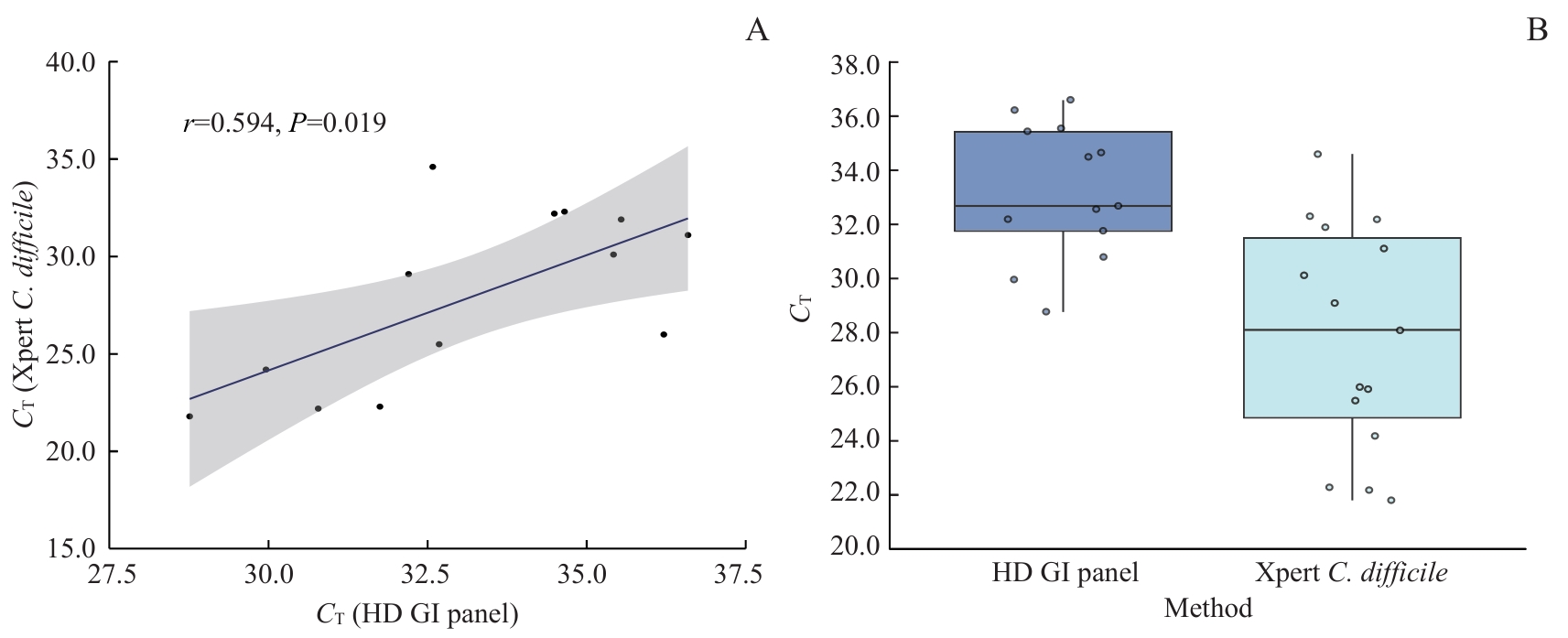
目的·评估基于微流控技术的国产自主研发胃肠道病原体核酸检测系统的诊断性能和应用价值。方法·收集上海交通大学医学院附属上海儿童医学中心2024年4月5日—2025年10月6日的534例粪便样本,根据检测目的划分为3个独立队列。队列A纳入经Xpert艰难梭菌检测试剂盒(Xpert Clostridium difficile,Xpert C. difficile)检测确认为艰难梭菌阳性的样本,共15例,用于评估胃肠道病原体检测试剂盒(high definition gastrointestinal panel,HD GI panel)检测艰难梭菌的性能;队列B为临床需要进行胃肠道病原体全面筛查的样本,共167例,用于比较HD GI panel与FilmArray胃肠道病原体检测试剂盒(FilmArray gastrointestinal panel,FilmArray GI panel)的多病原体检测性能;队列C为儿童重症监护室(pediatric intensive care unit,PICU)收治的临床疑似胃肠道感染患儿的粪便样本,共352例,用于分析重症患儿胃肠道病原体流行特征及HD GI panel的临床应用价值。收集队列C患儿的社会人口学和临床基线资料。2种检测方法的一致性通过Kappa检验评估。采用McNemar检验比较2种方法阳性检出率的差异。采用Pearson相关分析评估2种方法CT值的相关性。以FilmArray GI panel结果为参考标准,计算HD GI panel检测的灵敏度、特异度、阳性预测值、阴性预测值及其95%置信区间。采用多因素Logistic回归分析影响检测准确性的因素。结果·HD GI panel与Xpert C. difficile的艰难梭菌检测结果一致,两者CT值呈中等程度正相关(r=0.594,P=0.019)。HD GI panel与FilmArray GI panel检测的总体符合率为92.22%,Kappa检验显示两者的一致性较好(κ=0.823,P<0.001);与FilmArray GI panel相比,HD GI panel的灵敏度为88.89%、特异度为93.81%、阳性预测值为87.27%、阴性预测值为94.64%。在重症患儿中,采用HD GI panel检测的样本阳性率为39.77%,诺如病毒GⅡ型、轮状病毒A组、腺病毒为主要病毒性病原体,肠集聚性大肠埃希菌(enteroaggregative Escherichia coli,EAEC)、艰难梭菌和沙门菌为主要细菌性病原体,多重感染占30.00%;与临床诊断相比,HD GI panel灵敏度和阴性预测值均为100.00%,诊断准确率93.60%,Kappa检验提示两者存在高度一致性(κ=0.860,P<0.001)。此外,多因素Logistic回归分析表明,基础疾病是影响检测准确性的独立相关因素(OR=0.051,95%CI 0.014~0.141,P<0.001)。结论·HD GI panel在胃肠道病原体检测中表现出与主流平台相当的诊断性能,具有操作简便、检测快速、病原谱符合中国儿童感染特点等优势,适用于基层医院及高通量检测场景。

关键词: 微流控, 核酸扩增技术, 敏感度, 特异度, 胃肠疾病, 儿童

Abstract:

Objective ·To evaluate the diagnostic performance and application value of a domestically developed microfluidic technology-based nucleic acid detection system for gastrointestinal pathogens. Methods ·A total of 534 fecal samples were collected from Shanghai Children's Medical Center, Shanghai Jiao Tong University School of Medicine, between April 5th, 2024 and October 6th, 2025. Based on the purpose of testing, the samples were divided into three independent cohorts. Cohort A included 15 samples confirmed positive for Clostridium difficile by the Xpert Clostridiumdifficile assay (Xpert C. difficile), which were used to evaluate the performance of the gastrointestinal pathogen detection panel (high definition gastrointestinal panel, HD GI panel) for detecting Clostridium difficile. Cohort B included 167 samples from patients requiring comprehensive gastrointestinal pathogen screening and was used to compare the multi-pathogen detection performance of the HD GI panel with the FilmArray gastrointestinal panel (FilmArray GI panel). Cohort C consisted of 352 fecal samples from children with clinically suspected gastrointestinal infections who were admitted to the pediatric intensive care unit (PICU), and was used to analyze the epidemiological characteristics of gastrointestinal pathogens in critically ill children and the clinical application value of the HD GI panel. Sociodemographic and baseline clinical data of children in Cohort C were collected. The Kappa test assessed the agreement between the two detection methods. The McNemar test was used to compare the differences in positive detection rates between the two methods. Pearson correlation analysis was used to evaluate the correlation CT values obtained by the two methods. Using the results of the FilmArray GI panel as the reference standard, the sensitivity, specificity, positive predictive value, and negative predictive value of the HD GI panel, along with their 95% confidence intervals, were calculated. Multivariate Logistic regression analysis was used to identify factors affecting the detection accuracy. Results ·The detection results for Clostridium difficile obtained with the HD GI panel and the Xpert C. difficile assay were consistent, and the CT values showed a moderate positive correlation (r=0.594, P=0.019). The overall compliance between the HD GI panel and the FilmArray GI panel was 92.22%, and the Kappa test indicated good consistency between the two methods (κ=0.823, P<0.001). Compared with the FilmArray GI panel, the HD GI panel achieved a sensitivity of 88.89%, a specificity of 93.81%, a positive predictive value of 87.27%, and a negative predictive value of 94.64%. Among critically ill children, the overall positivity rate detected by the HD GI panel was 39.77%. Norovirus GⅡ, rotavirus A, and adenovirus were the predominant viral pathogens, whereas enteroaggregative Escherichia coli (EAEC), Clostridium difficile, and Salmonella were the main bacterial pathogens. Co-infections accounted for 30.00%. Compared with clinical diagnosis, the HD GI panel demonstrated a sensitivity and a negative predictive value of 100.00%, with a diagnostic accuracy of 93.60%. The Kappa test showed a high level of agreement between the two methods (κ=0.860, P<0.001). Multivariate Logistic regression analysis further revealed that the presence of underlying diseases was an independent factor associated with detection accuracy (OR=0.051, 95%CI 0.014‒0.141, P<0.001). Conclusion ·The HD GI panel demonstrates diagnostic performance comparable to that of mainstream platforms for gastrointestinal pathogen detection, offering advantages such as simple operation, rapid turnaround, and a pathogen spectrum consistent with the characteristics of pediatric gastrointestinal infections in China. It is well suited for use in primary hospitals and high-throughput testing settings.

Key words: microfluidics, nucleic acid amplification technique, sensitivity, specificity, gastrointestinal disease, child

中图分类号: