
上海交通大学学报(医学版) ›› 2025, Vol. 45 ›› Issue (7): 883-891.doi: 10.3969/j.issn.1674-8115.2025.07.010
程菲1, 陈天真1, 游旭2, 薛保双2, 杨云斌2, 杜江1( )
)
收稿日期:2024-12-30
接受日期:2025-03-17
出版日期:2025-07-28
发布日期:2025-07-28
通讯作者:
杜 江,教授,主任医师,博士;电子信箱:dujiangdongfang@163.com。基金资助:
CHENG Fei1, CHEN Tianzhen1, YOU Xu2, XUE Baoshuang2, YANG Yunbin2, DU Jiang1()
Received:2024-12-30
Accepted:2025-03-17
Online:2025-07-28
Published:2025-07-28
Contact:
DU Jiang, E-mail: dujiangdongfang@163.com.Supported by:摘要:
目的·探究酒精使用障碍(alcohol use disorder,AUD)患者在不同情绪背景下的抑制控制表现及心理机制,了解情绪调节困难对抑制控制功能的影响。方法·招募28名男性AUD住院患者(AUD组)和28名年龄、受教育程度相匹配的健康对照(健康对照组)。采用情绪Go/Nogo任务(愤怒/中性表情面孔)评估被试行为抑制功能,结合层级贝叶斯漂移扩散模型(hierarchical drift-diffusion model,HDDM)量化他们的认知参数(漂移率、决策阈值、非决策时间)。通过情绪调节困难量表(Difficulties in Emotion Regulation Scale,DERS)和酒精使用障碍筛查量表(Alcohol Use Disorders Identification Test,AUDIT)进行临床评估,并运用bootstrap法检验有调节的中介效应模型。结果·AUD组在DERS总分及所有子维度(目标导向行为、冲动控制、策略获取、情绪清晰性)得分均高于健康对照组,差异有统计学意义(均P<0.05)。行为层面,与健康对照组相比,AUD组误按率[F(1,54)=8.62,P=0.005]与遗漏率[F(1,54)=4.28,P=0.043]更高,且愤怒面孔刺激反应时普遍延长[F(1,54)=12.26,P=0.001]。认知建模显示AUD组漂移率显著低于健康对照组[F(1,54)=15.56,P<0.001],提示信息加工效率受损。有调节的中介模型显示,在愤怒面孔刺激条件下,漂移率部分中介组别对误按率的影响,总间接效应值为9.564(95%CI 3.874~16.387);进一步分析表明,高水平情绪调节困难(比平均值高1个标准差)条件下间接效应增强至10.133(95%CI 3.963~17.927),而低水平(比平均值低1个标准差)时效应为9.011(95%CI 3.778~14.921)。结论·AUD患者信息加工效率的降低部分解释了患者的抑制控制功能障碍,且该影响与个体情绪调节能力存在关联。提示社会威胁信息加工异常可能是AUD患者,特别是在情绪调节能力较弱的个体抑制控制功能损害的重要影响因素。
中图分类号:
程菲, 陈天真, 游旭, 薛保双, 杨云斌, 杜江. 情绪调节能力对酒精使用障碍患者抑制控制功能的影响[J]. 上海交通大学学报(医学版), 2025, 45(7): 883-891.
CHENG Fei, CHEN Tianzhen, YOU Xu, XUE Baoshuang, YANG Yunbin, DU Jiang. Effects of emotion regulation ability on inhibitory control in patients with alcohol use disorder[J]. Journal of Shanghai Jiao Tong University (Medical Science), 2025, 45(7): 883-891.
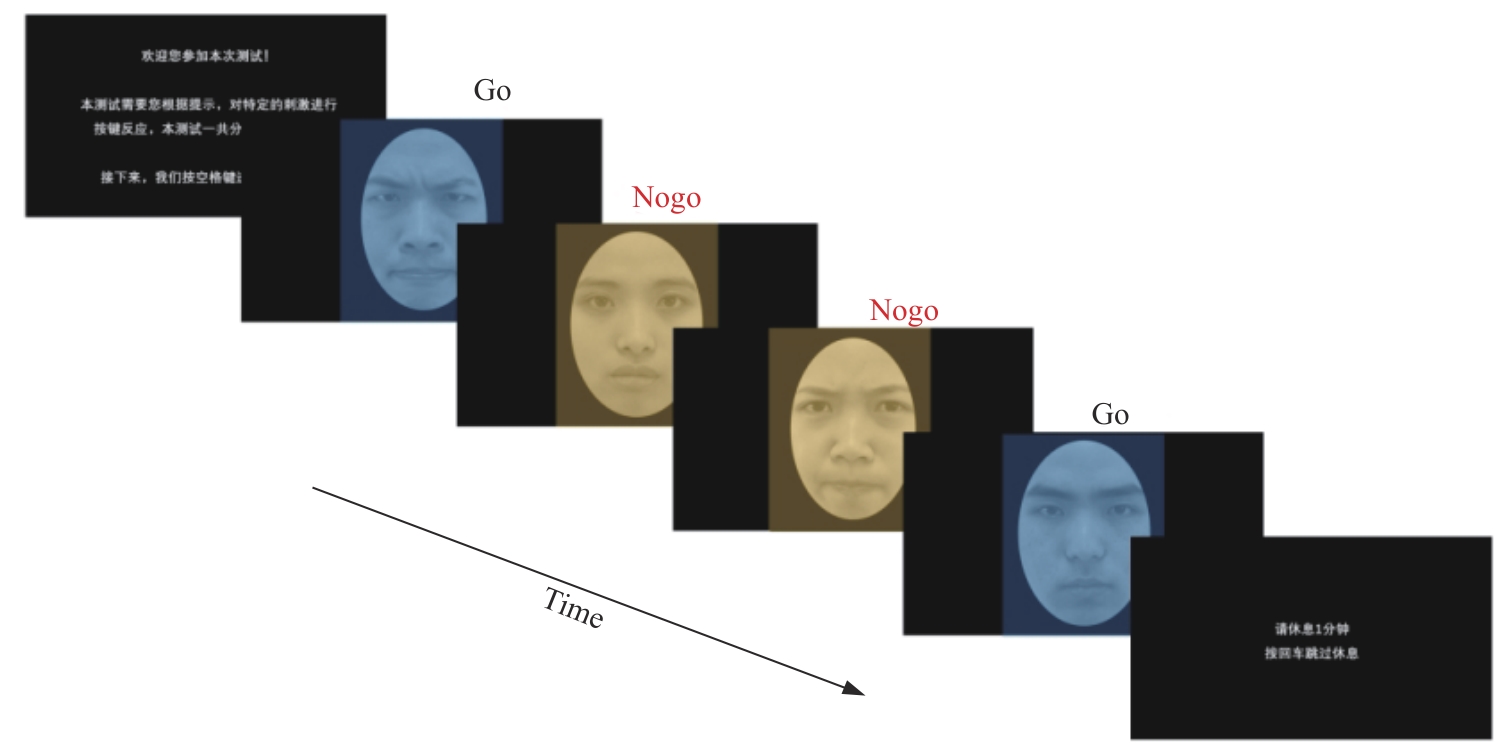
图1 情绪Go/Nogo范式流程示意图
Fig 1 Schematic illustration of the emotional Go/Nogo task protocol
| Item | AUD (n=28) | HC (n=28) | t/U value | P value |
|---|---|---|---|---|
| Age/year | 46.82±4.94 | 50.18±8.01 | -1.89 | 0.065 |
| Education/year | 6.30±4.88 | 7.96±3.20 | -1.50 | 0.138 |
| Monthly income/yuan | 1 000 (0, 5 250) | 2 700 (2 000, 3 250) | 300.00 | 0.132 |
| AUDIT/score | 29.61±6.14 | 1.21±2.30 | 1.00 | <0.001 |
| DERS/score | 43.64±12.60 | 23.89±8.27 | 1.85 | <0.001 |
| Goal | 9.75±3.40 | 5.61±2.77 | 1.34 | <0.001 |
| Impulse | 9.00 (7.00, 11.00) | 3.00 (3.00, 4.00) | 684.00 | <0.001 |
| Strategy | 12.21±3.81 | 6.57±2.47 | 0.78 | <0.001 |
| Clarity | 5.25±2.72 | 3.61±1.87 | 0.34 | 0.011 |
表1 AUD患者与健康对照人口统计学特征和临床评估结果比较
Tab 1 Comparison of demographic characteristics and clinical assessment results between AUD patients and healthy controls
| Item | AUD (n=28) | HC (n=28) | t/U value | P value |
|---|---|---|---|---|
| Age/year | 46.82±4.94 | 50.18±8.01 | -1.89 | 0.065 |
| Education/year | 6.30±4.88 | 7.96±3.20 | -1.50 | 0.138 |
| Monthly income/yuan | 1 000 (0, 5 250) | 2 700 (2 000, 3 250) | 300.00 | 0.132 |
| AUDIT/score | 29.61±6.14 | 1.21±2.30 | 1.00 | <0.001 |
| DERS/score | 43.64±12.60 | 23.89±8.27 | 1.85 | <0.001 |
| Goal | 9.75±3.40 | 5.61±2.77 | 1.34 | <0.001 |
| Impulse | 9.00 (7.00, 11.00) | 3.00 (3.00, 4.00) | 684.00 | <0.001 |
| Strategy | 12.21±3.81 | 6.57±2.47 | 0.78 | <0.001 |
| Clarity | 5.25±2.72 | 3.61±1.87 | 0.34 | 0.011 |
| Item | Emotion type | AUD (n=28) | HC (n=28) | Statistical test result |
|---|---|---|---|---|
| Reaction time/ms | Angry | 545.80±106.08 | 492.67±87.66 | Group: F(1,54)=3.75, P=0.058, Emotion: F(1,54)=12.26, P=0.001, Interaction: F(1,54)=2.84, P=0.098, |
| Neutral | 530.13±96.12 | 487.18±82.39 | ||
| Comission error rate/% | Angry | 6.25 (0, 12.50) | 0 (0, 6.25) | Group: F(1,54)=8.62, P=0.005, Emotion: F(1,54)=1.12, P=0.295, Interaction: F(1,54)=0.14, P=0.712, |
| Neutral | 7.50 (0, 15.00) | 0 (0, 5.00) | ||
| Omission error rate/% | Angry | 0 (0, 2.23) | 0 (0, 1.79) | Group: F(1,54)=4.28, P=0.043, Emotion: F(1,54)=1.90, P=0.173, Interaction: F(1,54)=2.61, P=0.111, |
| Neutral | 1.92 (0, 3.85) | 0 (0, 1.92) |
表2 不同组别不同情绪条件下的Go/Nogo任务行为表现
Tab 2 Comparison of Go/Nogo task performance under different emotional conditions between the two groups
| Item | Emotion type | AUD (n=28) | HC (n=28) | Statistical test result |
|---|---|---|---|---|
| Reaction time/ms | Angry | 545.80±106.08 | 492.67±87.66 | Group: F(1,54)=3.75, P=0.058, Emotion: F(1,54)=12.26, P=0.001, Interaction: F(1,54)=2.84, P=0.098, |
| Neutral | 530.13±96.12 | 487.18±82.39 | ||
| Comission error rate/% | Angry | 6.25 (0, 12.50) | 0 (0, 6.25) | Group: F(1,54)=8.62, P=0.005, Emotion: F(1,54)=1.12, P=0.295, Interaction: F(1,54)=0.14, P=0.712, |
| Neutral | 7.50 (0, 15.00) | 0 (0, 5.00) | ||
| Omission error rate/% | Angry | 0 (0, 2.23) | 0 (0, 1.79) | Group: F(1,54)=4.28, P=0.043, Emotion: F(1,54)=1.90, P=0.173, Interaction: F(1,54)=2.61, P=0.111, |
| Neutral | 1.92 (0, 3.85) | 0 (0, 1.92) |
| Parameter | Emotion type | AUD (n=28) | HC (n=28) | Statistical test result |
|---|---|---|---|---|
| Decision threshold | Angry | 2.28±0.82 | 2.23±0.94 | Group: F(1,54)=0.31, P=0.582, Emotion: F(1,54)=1.61, P=0.210, Interaction: F(1,54)=1.11, P=0.298, |
| Neutral | 1.96±0.69 | 2.20±0.86 | ||
| Drift rate | Angry | 3.13±2.00 | 4.39±1.61 | Group: F(1,54)=15.56, P<0.001, η Emotion: F(1,54)=2.66, P=0.108, Interaction: F(1,54)=2.85, P=0.097, |
| Neutral | 3.12±1.32 | 5.12±1.98 | ||
| Non-decision time/s | Angry | 0.26±0.07 | 0.28±0.07 | Group: F(1,54)=0.47, P=0.494, Emotion: F(1,54)=1.29, P=0.261, Interaction: F(1,54)=0.02, P=0.880, |
| Neutral | 0.25±0.10 | 0.27±0.09 |
表3 不同组别不同情绪条件下的认知参数比较
Tab 3 Between-group comparison of cognitive parameters across emotional conditions
| Parameter | Emotion type | AUD (n=28) | HC (n=28) | Statistical test result |
|---|---|---|---|---|
| Decision threshold | Angry | 2.28±0.82 | 2.23±0.94 | Group: F(1,54)=0.31, P=0.582, Emotion: F(1,54)=1.61, P=0.210, Interaction: F(1,54)=1.11, P=0.298, |
| Neutral | 1.96±0.69 | 2.20±0.86 | ||
| Drift rate | Angry | 3.13±2.00 | 4.39±1.61 | Group: F(1,54)=15.56, P<0.001, η Emotion: F(1,54)=2.66, P=0.108, Interaction: F(1,54)=2.85, P=0.097, |
| Neutral | 3.12±1.32 | 5.12±1.98 | ||
| Non-decision time/s | Angry | 0.26±0.07 | 0.28±0.07 | Group: F(1,54)=0.47, P=0.494, Emotion: F(1,54)=1.29, P=0.261, Interaction: F(1,54)=0.02, P=0.880, |
| Neutral | 0.25±0.10 | 0.27±0.09 |
| Variable | Drift rate | Commission error rate | ||||
|---|---|---|---|---|---|---|
| B | z value | P value | B | z value | P value | |
| Group | -2.443 | -3.159 | 0.002 | -2.624 | -1.005 | 0.315 |
| DERS | 0.045 | 0.691 | 0.490 | ‒ | ‒ | ‒ |
| Group×DERS | -0.264 | -0.750 | 0.453 | ‒ | ‒ | ‒ |
| Drift rate | ‒ | ‒ | ‒ | -3.914 | -4.167 | <0.001 |
| Drift rate×DERS | ‒ | ‒ | ‒ | -0.148 | -1.998 | 0.046 |
| R2 value | 0.298 | 0.847 | ||||
| F value | 7.220 | 16.040 | ||||
表4 愤怒情绪条件下有调节的中介模型分析
Tab 4 Moderated mediation analysis of inhibitory control under the angry emotional condition
| Variable | Drift rate | Commission error rate | ||||
|---|---|---|---|---|---|---|
| B | z value | P value | B | z value | P value | |
| Group | -2.443 | -3.159 | 0.002 | -2.624 | -1.005 | 0.315 |
| DERS | 0.045 | 0.691 | 0.490 | ‒ | ‒ | ‒ |
| Group×DERS | -0.264 | -0.750 | 0.453 | ‒ | ‒ | ‒ |
| Drift rate | ‒ | ‒ | ‒ | -3.914 | -4.167 | <0.001 |
| Drift rate×DERS | ‒ | ‒ | ‒ | -0.148 | -1.998 | 0.046 |
| R2 value | 0.298 | 0.847 | ||||
| F value | 7.220 | 16.040 | ||||
| Effect type | Effect value | SE | 95%CI | β | P value | |
|---|---|---|---|---|---|---|
| Total effect | 6.940 | 3.829 | 0.564‒14.021 | 0.202 | 0.018 | |
| Direct effect | -2.624 | 2.610 | -7.232‒3.202 | -0.077 | 0.315 | |
| Total indirect effect | 9.564 | 3.177 | 3.874‒16.387 | 0.279 | 0.003 | |
| Conditional indirect effect | ||||||
| Low DERS | 9.011 | 2.847 | 3.778‒14.921 | -0.031 | 0.002 | |
| High DERS | 10.133 | 3.555 | 3.963‒17.927 | 0.868 | 0.004 | |
表5 愤怒情绪条件下总效应、直接效应与调节中介效应分析
Tab 5 Total effect, direct effect, and moderated mediation analysis under the angry emotional condition
| Effect type | Effect value | SE | 95%CI | β | P value | |
|---|---|---|---|---|---|---|
| Total effect | 6.940 | 3.829 | 0.564‒14.021 | 0.202 | 0.018 | |
| Direct effect | -2.624 | 2.610 | -7.232‒3.202 | -0.077 | 0.315 | |
| Total indirect effect | 9.564 | 3.177 | 3.874‒16.387 | 0.279 | 0.003 | |
| Conditional indirect effect | ||||||
| Low DERS | 9.011 | 2.847 | 3.778‒14.921 | -0.031 | 0.002 | |
| High DERS | 10.133 | 3.555 | 3.963‒17.927 | 0.868 | 0.004 | |
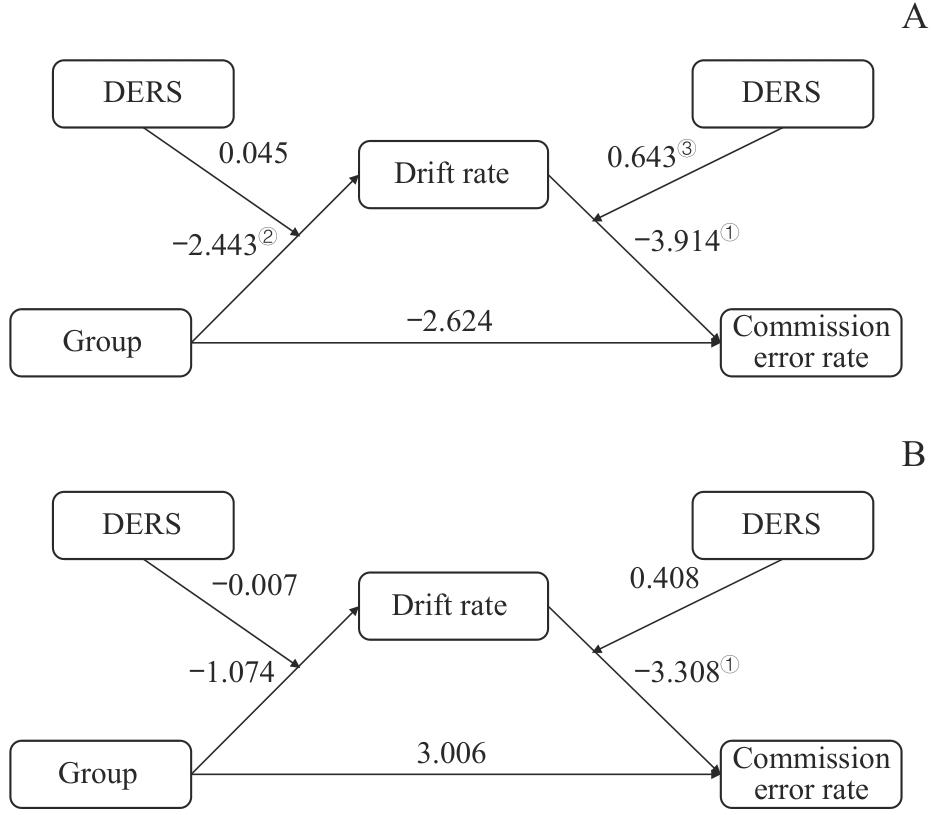
图2 不同情绪条件下的调节中介效应路径图Note: A. Under the angry emotional condition. B. Under the neutral emotional condition. Path coefficients are standardized regression coefficients. ①P<0.001, ②P=0.002, ③P=0.038.
Fig 2 Path analysis of the moderated mediation model under different emotional conditions
| Variable | Drift rate | Commission error rate | ||||
|---|---|---|---|---|---|---|
| B | z value | P value | B | z value | P value | |
| Group | -1.074 | -1.380 | 0.168 | 3.006 | 1.027 | 0.304 |
| DERS | -0.007 | -0.169 | 0.866 | ‒ | ‒ | ‒ |
| Group×DERS | -0.018 | -0.344 | 0.731 | ‒ | ‒ | ‒ |
| Drift rate | ‒ | ‒ | ‒ | -3.308 | -3.623 | <0.001 |
| Drift rate×DERS | ‒ | ‒ | ‒ | -0.430 | -1.475 | 0.140 |
| R2 value | 0.161 | 0.739 | ||||
| F value | 3.260 | 11.010 | ||||
表6 中性情绪条件下有调节的中介模型分析
Tab 6 Moderated mediation analysis of inhibitory control under the neutral emotional condition
| Variable | Drift rate | Commission error rate | ||||
|---|---|---|---|---|---|---|
| B | z value | P value | B | z value | P value | |
| Group | -1.074 | -1.380 | 0.168 | 3.006 | 1.027 | 0.304 |
| DERS | -0.007 | -0.169 | 0.866 | ‒ | ‒ | ‒ |
| Group×DERS | -0.018 | -0.344 | 0.731 | ‒ | ‒ | ‒ |
| Drift rate | ‒ | ‒ | ‒ | -3.308 | -3.623 | <0.001 |
| Drift rate×DERS | ‒ | ‒ | ‒ | -0.430 | -1.475 | 0.140 |
| R2 value | 0.161 | 0.739 | ||||
| F value | 3.260 | 11.010 | ||||
| Effect type | Effect value | SE | 95%CI | β | P value |
|---|---|---|---|---|---|
| Total effect | 6.558 | 4.221 | -1.856‒14.972 | 0.224 | 0.123 |
| Direct effect | 3.006 | 2.926 | -2.949‒8.704 | 0.103 | 0.304 |
| Total indirect effect | 3.552 | 3.066 | -0.907‒11.000 | 0.121 | 0.247 |
| Conditional indirect effect | |||||
| Low DERS | 3.372 | 2.936 | -1.023‒10.458 | -0.003 | 0.251 |
| High DERS | 3.737 | 3.214 | -0.736‒11.654 | 0.332 | 0.245 |
表7 中性情绪条件下总效应、直接效应与调节中介效应分析
Tab 7 Total effect, direct effect, and moderated mediation analysis under the neutral emotional condition
| Effect type | Effect value | SE | 95%CI | β | P value |
|---|---|---|---|---|---|
| Total effect | 6.558 | 4.221 | -1.856‒14.972 | 0.224 | 0.123 |
| Direct effect | 3.006 | 2.926 | -2.949‒8.704 | 0.103 | 0.304 |
| Total indirect effect | 3.552 | 3.066 | -0.907‒11.000 | 0.121 | 0.247 |
| Conditional indirect effect | |||||
| Low DERS | 3.372 | 2.936 | -1.023‒10.458 | -0.003 | 0.251 |
| High DERS | 3.737 | 3.214 | -0.736‒11.654 | 0.332 | 0.245 |
| [1] | World Health Organization. Global status report on alcohol and health and treatment of substance use disorders[R/OL]. (2024-11-25) [2024-12-20]. https://www.who.int/publications/i/item/9789240096745. |
| [2] | HUANG Y Q, WANG Y, WANG H, et al. Prevalence of mental disorders in China: a cross-sectional epidemiological study[J]. Lancet Psychiatry, 2019, 6(3): 211-224. |
| [3] | YU Z, HE L P, WICHAIDIT W, et al. Prevalence of alcohol-related harms in Yi and Han ethnic groups in a prefecture in Yunnan Province, China[J]. Int J Environ Res Public Health, 2022, 19(23): 16081. |
| [4] | Substance Abuse and Mental Health Services Administration. SAMHSA releases annual national survey on drug use and health[R/OL]. (2024-08-02) [2024-12-20]. https://sdaho.org/2024/08/02/samhsa-releases-annual-national-survey-on-drug-use-and-health/. |
| [5] | MIYAKE A, FRIEDMAN N P, EMERSON M J, et al. The unity and diversity of executive functions and their contributions to complex "frontal lobe" tasks: a latent variable analysis[J]. Cogn Psychol, 2000, 41(1): 49-100. |
| [6] | DIAMOND A. Executive functions[J]. Annu Rev Psychol, 2013, 64: 135-168. |
| [7] | RUBIO G, JIMÉNEZ M, RODRÍGUEZ-JIMÉNEZ R, et al. The role of behavioral impulsivity in the development of alcohol dependence: a 4-year follow-up study[J]. Alcohol Clin Exp Res, 2008, 32(9): 1681-1687. |
| [8] | SMITH J L, MATTICK R P, JAMADAR S D, et al. Deficits in behavioural inhibition in substance abuse and addiction: a meta-analysis[J]. Drug Alcohol Depend, 2014, 145: 1-33. |
| [9] | CHEN Y Z, YU H L, GAO X M. Influences of emotional information on response inhibition in gaming disorder: behavioral and ERP evidence from Go/Nogo task[J]. Int J Environ Res Public Health, 2022, 19(23): 16264. |
| [10] | ZHU S Y, LIU Q, ZHANG X L, et al. Transcutaneous auricular vagus nerve stimulation enhanced emotional inhibitory control via increasing intrinsic prefrontal couplings[J]. Int J Clin Health Psychol, 2024, 24(2): 100462. |
| [11] | HERMAN A M, DUKA T. Facets of impulsivity and alcohol use: what role do emotions play?[J]. Neurosci Biobehav Rev, 2019, 106: 202-216. |
| [12] | DVORAK R D, SARGENT E M, KILWEIN T M, et al. Alcohol use and alcohol-related consequences: associations with emotion regulation difficulties[J]. Am J Drug Alcohol Abuse, 2014, 40(2): 125-130. |
| [13] | TOWNSHEND J M, DUKA T. Mixed emotions: alcoholics' impairments in the recognition of specific emotional facial expressions[J]. Neuropsychologia, 2003, 41(7): 773-782. |
| [14] | KORNREICH C, FOISY M L, PHILIPPOT P, et al. Impaired emotional facial expression recognition in alcoholics, opiate dependence subjects, methadone maintained subjects and mixed alcohol-opiate antecedents subjects compared with normal controls[J]. Psychiatry Res, 2003, 119(3): 251-260. |
| [15] | EUSER A S, FRANKEN I H A. Alcohol affects the emotional modulation of cognitive control: an event-related brain potential study[J]. Psychopharmacology (Berl), 2012, 222(3): 459-476. |
| [16] | CAMPOS-MELADY M, SMITH J E. Memory associations between negative emotions and alcohol on the lexical decision task predict alcohol use in women[J]. Addict Behav, 2012, 37(1): 60-66. |
| [17] | BAKER T B, PIPER M E, MCCARTHY D E, et al. Addiction motivation reformulated: an affective processing model of negative reinforcement[J]. Psychol Rev, 2004, 111(1): 33-51. |
| [18] | DVORAK R D, PEARSON M R, SARGENT E M, et al. Daily associations between emotional functioning and alcohol involvement: moderating effects of response inhibition and gender[J]. Drug Alcohol Depend, 2016, 163: S46-S53. |
| [19] | LI Q, BABOR T F, HAO W, et al. The Chinese translations of Alcohol Use Disorders Identification Test (AUDIT) in China: a systematic review[J]. Alcohol Alcohol, 2011, 46(4): 416-423. |
| [20] | KAUFMAN E A, XIA M Y, FOSCO G, et al. The Difficulties in Emotion Regulation Scale Short Form (DERS-SF): validation and replication in adolescent and adult samples[J]. J Psychopathol Behav Assess, 2016, 38(3): 443-455. |
| [21] | WIECKI T V, SOFER I, FRANK M J. HDDM: hierarchical Bayesian estimation of the drift-diffusion model in Python[J]. Front Neuroinform, 2013, 7: 14. |
| [22] | GOLD J I, SHADLEN M N. The neural basis of decision making[J]. Annu Rev Neurosci, 2007, 30: 535-574. |
| [23] | FORSTMANN B U, ANWANDER A, SCHÄFER A, et al. Cortico-striatal connections predict control over speed and accuracy in perceptual decision making[J]. Proc Natl Acad Sci USA, 2010, 107(36): 15916-15920. |
| [24] | SMITH P L, RATCLIFF R. Psychology and neurobiology of simple decisions[J]. Trends Neurosci, 2004, 27(3): 161-168. |
| [25] | ROSSEEL Y. lavaan: An R package for structural equation modeling[J]. J Stat Soft, 2012, 48(2): 1-36. |
| [26] | 温忠麟, 张雷, 侯杰泰, 等. 中介效应检验程序及其应用[J]. 心理学报, 2004, 36(5): 614-620. |
| WEN Z L, ZHANG L, HOU J T, et al. Testing and application of the mediating effects[J]. Acta Psychologica Sinica, 2004, 36(5): 614-620. | |
| [27] | MATHEWS A, MACLEOD C. Cognitive approaches to emotion and emotional disorders[J]. Annu Rev Psychol, 1994(45): 25-50. |
| [28] | ÖHMAN A, FLYKT A, ESTEVES F. Emotion drives attention: detecting the snake in the grass[J]. J Exp Psychol Gen, 2001, 130(3): 466-478. |
| [29] | BAR-HAIM Y, LAMY D, PERGAMIN L, et al. Threat-related attentional bias in anxious and nonanxious individuals: a meta-analytic study[J]. Psychol Bull, 2007, 133(1): 1-24. |
| [30] | ZELAZO P D, MORRIS I F, QU L, et al. Hot executive function: emotion and the development of cognitive control[M]//Child development at the intersection of emotion and cognition. 2nd ed. Washington: American Psychological Association, 2024: 51-73. |
| [31] | MENNELLA R, VILAREM E, GRÈZES J. Rapid approach-avoidance responses to emotional displays reflect value-based decisions: neural evidence from an EEG study[J]. Neuroimage, 2020, 222: 117253. |
| [32] | GIVON E, ITZHAK-RAZ A, KARMON-PRESSER A, et al. How does the emotional experience evolve? Feeling generation as evidence accumulation[J]. Emotion, 2020, 20(2): 271-285. |
| [33] | PICHON S, BEDIOU B, ANTICO L, et al. Emotion perception in habitual players of action video games[J]. Emotion, 2021, 21(6): 1324-1339. |
| [34] | BARI A, XU S Y, PIGNATELLI M, et al. Differential attentional control mechanisms by two distinct noradrenergic coeruleo-frontal cortical pathways[J]. Proc Natl Acad Sci USA, 2020, 117(46): 29080-29089. |
| [35] | EYSENCK M W, DERAKSHAN N, SANTOS R, et al. Anxiety and cognitive performance: attentional control theory[J]. Emotion, 2007, 7(2): 336-353. |
| [36] | ANGELOPOULOU E, DRIGAS A. Working memory, attention and their relationship: a theoretical overview[J]. Res Soc Dev, 2021, 10(5): e46410515288. |
| [37] | HERD T, KIM-SPOON J. A systematic review of associations between adverse peer experiences and emotion regulation in adolescence[J]. Clin Child Fam Psychol Rev, 2021, 24(1): 141-163. |
| [38] | MCRAE K. Cognitive emotion regulation: a review of theory and scientific findings[J]. Curr Opin Behav Sci, 2016, 10: 119-124. |
| [39] | HARE B D, DUMAN R S. Prefrontal cortex circuits in depression and anxiety: contribution of discrete neuronal populations and target regions[J]. Mol Psychiatry, 2020, 25(11): 2742-2758. |
| [40] | LAI T T, GERICKE B, FEJA M, et al. Anxiety in synucleinopathies: neuronal circuitry, underlying pathomechanisms and current therapeutic strategies[J]. NPJ Parkinsons Dis, 2023, 9(1): 97. |
| [1] | 胡嫣然1, 2,陈 涵1#,岳 玲1,许翼翔1,刘 强1,亢 清1,郭 垒1,阮列敏3,陈 珏1#. 未服药神经性贪食症患者反应抑制功能的研究[J]. 上海交通大学学报(医学版), 2020, 40(6): 809-813. |
| 阅读次数 | ||||||
|
全文 |
|
|||||
|
摘要 |
|
|||||
