
上海交通大学学报(医学版) ›› 2026, Vol. 46 ›› Issue (9): 1242-1251.doi: 10.3969/j.issn.1674-8115.2026.09.009
• 论著 · 临床研究 • 上一篇
石亚强1, 白晓宇1, 姜勇杰1, 刘俊2, 祁泉1,3( )
收稿日期:2025-12-29
接受日期:2026-03-16
出版日期:2026-09-09
发布日期:2026-09-09
通讯作者:
祁 泉,主任医师,博士;电子信箱:quanqi@126.com。基金资助:
Shi Yaqiang1, Bai Xiaoyu1, Jiang Yongjie1, Liu Jun2, Qi Quan1,3()
Received:2025-12-29
Accepted:2026-03-16
Online:2026-09-09
Published:2026-09-09
Contact:
Qi Quan, E-mail: quanqi@126.com.Supported by:摘要:
目的·探讨肥厚型梗阻性心肌病(hypertrophic obstructive cardiomyopathy,HOCM)患者术前D-二聚体水平联合N末端B型利钠肽前体(N-terminal pro-B-type natriuretic peptide,NT-proBNP)比值对改良扩大Morrow术后早期主要不良心血管事件(major adverse cardiovascular event,MACE)的预测价值。方法·纳入2015年1月—2025年6月于兰州大学第一医院接受改良扩大Morrow术的HOCM患者。收集患者基线资料[人口统计学指标、症状与功能状态、既往病史、术前血液生物标志物水平(D-二聚体与NT-proBNP,计算后者经年龄-性别校正的比值)及术前超声心动图参数]和围术期资料。研究的主要结局为患者术后30 d内的MACE。采用Logistic回归构建临床基础变量模型、临床基础变量+NT-proBNP比值模型、临床基础变量+D-二聚体模型及临床基础变量联合双标志物(NT-proBNP比值与D-二聚体)模型4个预测模型。采用受试者操作特征曲线下面积、净重分类改善指数与综合判别改善指数评价模型效能,以校准曲线、Brier分数及决策曲线分析评估模型的校准度、预测准确性与临床适用性。根据NT-proBNP比值与D-二聚体的最佳截断值对患者进行风险分层,比较患者围术期风险与临床结局。结果·在最终纳入分析的83例患者中,共有21例于术后30 d内发生MACE,发生率为25.30%。联合双标志物模型展现出最优预测效能,其曲线下面积为0.935,优于临床基础变量模型及临床基础变量+任一单一标志物模型。与临床基础变量模型相比,联合双标志物模型的净重分类改善指数和综合判别改善指数分别为1.390及0.366(均P<0.001),校准度最佳(Hosmer‑Lemeshow检验P=0.767,Brier分数0.080),且决策曲线分析显示其在大部分阈值范围内净获益最高。根据NT-proBNP比值与D-二聚体最佳截断值划分的“双低”“单高”“双高”3组患者,其MACE发生率呈现显著风险梯度。此外,“双高”组患者的围术期临床过程更为复杂,其体外循环时间、主动脉阻断时间、术后机械通气时间及术后住院时长均长于“双低”组(均P<0.05)。结论·术前联合经年龄-性别校正的NT-proBNP比值与D-二聚体水平可构建高效、稳健的术后早期MACE风险预测模型。该策略在区分度、校准度及临床适用性方面均表现优异,能有效识别极高危患者,为个体化围术期管理提供客观依据。
中图分类号:
石亚强, 白晓宇, 姜勇杰, 刘俊, 祁泉. 双联合标志物对肥厚型梗阻性心肌病改良扩大Morrow术后早期风险的预测价值[J]. 上海交通大学学报(医学版), 2026, 46(9): 1242-1251.
Shi Yaqiang, Bai Xiaoyu, Jiang Yongjie, Liu Jun, Qi Quan. Predictive value of combined biomarkers for early postoperative risk following the modified extended Morrow procedure for hypertrophic obstructive cardiomyopathy[J]. Journal of Shanghai Jiao Tong University (Medical Science), 2026,(9): 1242-1251.
| Indicator | Total (n=83) | No-MACE group (n=62) | MACE group (n=21) | t/Z/χ2 value | P value |
|---|---|---|---|---|---|
| Age/year | 56.00 (51.50, 63.00) | 56.00 (51.25, 63.00) | 56.00 (52.00, 61.25) | -0.361 | 0.721 |
| Male/n(%) | 41 (49.40) | 28 (45.16) | 13 (61.90) | 1.153 | 0.283 |
| BMI/(kg·m-2) | 24.61 (22.52, 26.50) | 25.16 (23.20, 26.97) | 23.93 (22.04, 24.91) | 1.995 | 0.047 |
| Heart rate/(beat·min-1) | 81.00 (72.00, 88.50) | 81.00 (72.00, 90.00) | 80.50 (76.00, 86.00) | 0.697 | 0.489 |
| SBP/mmHg | 122.00 (112.00, 132.50) | 125.00 (112.25, 134.75) | 120.00 (110.00, 124.00) | 1.189 | 0.236 |
| DBP/mmHg | 72.00 (68.00, 80.00) | 72.50 (68.00, 80.75) | 68.00 (63.00, 79.00) | 1.409 | 0.160 |
| Clinical characteristic/n(%) | |||||
| Dyspnea | 64 (77.11) | 46 (74.19) | 18 (85.71) | ‒ | 0.374 |
| Chest pain | 34 (40.96) | 27 (43.55) | 7 (33.33) | 0.320 | 0.571 |
| Syncope | 28 (33.73) | 22 (35.48) | 6 (28.57) | 0.097 | 0.755 |
| Palpitation | 17 (20.48) | 11 (17.74) | 6 (28.57) | ‒ | 0.351 |
| NYHA functional class/n(%) | -1.924 | 0.055 | |||
| Ⅰ | 6 (7.23) | 5 (8.06) | 1 (4.76) | ||
| Ⅱ | 28 (33.73) | 24 (38.71) | 4 (19.05) | ||
| Ⅲ | 45 (54.22) | 31 (50.00) | 14 (66.67) | ||
| Ⅳ | 4 (4.82) | 2 (3.23) | 2 (9.52) | ||
| Patient history/n(%) | |||||
| Hypertension | 47 (56.63) | 39 (62.90) | 8 (38.10) | 2.986 | 0.084 |
| Diabetes | 7 (8.43) | 6 (9.68) | 1 (4.76) | ‒ | 0.673 |
| Coronary artery disease | 21 (25.30) | 14 (22.58) | 7 (33.33) | 0.475 | 0.491 |
| Cerebrovascular disease | 9 (10.84) | 6 (9.68) | 3 (14.29) | ‒ | 0.686 |
| Atrial fibrillation | 11 (13.25) | 7 (11.29) | 4 (19.05) | ‒ | 0.457 |
| COPD | 3 (3.61) | 1 (1.61) | 2 (9.52) | ‒ | 0.156 |
| Hyperlipidemia | 20 (24.10) | 14 (22.58) | 6 (28.57) | 0.067 | 0.795 |
| Laboratory parameter | |||||
| D-dimer/(μg·mL-1) | 0.22 (0.15, 0.38) | 0.19 (0.13, 0.23) | 0.51 (0.27, 0.61) | -4.934 | <0.001 |
| NT-proBNP ratio | 15.13 (7.23, 33.84) | 9.69 (4.45, 19.66) | 51.85 (32.79, 76.84) | -5.562 | <0.001 |
| Creatinine/(μmol·L-1) | 70.50 (62.50, 85.00) | 69.50 (62.00, 79.75) | 73.00 (68.20, 99.90) | -1.409 | 0.160 |
| Echocardiographic parameter | |||||
| IVS/mm | 21.00 (18.00, 25.00) | 20.50 (17.00, 24.00) | 23.00 (20.00, 27.00) | -2.006 | 0.045 |
| LAD/mm | 39.73±7.71 | 38.69±7.34 | 42.81±8.16 | -2.160 | 0.034 |
| LVEDD/mm | 47.00 (41.50, 51.50) | 46.50 (41.00, 50.75) | 48.00 (44.00, 52.00) | -0.864 | 0.390 |
| LVESD/mm | 29.00 (25.00, 35.00) | 28.50 (25.00, 33.75) | 33.00 (24.00, 37.00) | -1.278 | 0.202 |
| LVEF/% | 64.19±7.25 | 64.71±7.04 | 62.67±7.81 | 1.118 | 0.267 |
| LVOT PG, max/mmHg | 77.00 (58.50, 106.00) | 74.50 (52.00, 101.25) | 82.00 (64.00, 132.00) | -0.985 | 0.327 |
| SAM/n(%) | 73 (87.95) | 55 (88.71) | 18 (85.71) | ‒ | 0.708 |
| Mitral valve regurgitation/n(%) | -1.823 | 0.069 | |||
| No | 10 (12.05) | 6 (9.68) | 4 (19.05) | ||
| Mild | 32 (38.55) | 22 (35.48) | 10 (47.62) | ||
| Moderate | 26 (31.33) | 21 (33.87) | 5 (23.81) | ||
| Significant | 15 (18.07) | 13 (20.97) | 2 (9.52) |
表1 HOCM患者基线特征
Tab 1 Baseline characteristics of patients with HOCM
| Indicator | Total (n=83) | No-MACE group (n=62) | MACE group (n=21) | t/Z/χ2 value | P value |
|---|---|---|---|---|---|
| Age/year | 56.00 (51.50, 63.00) | 56.00 (51.25, 63.00) | 56.00 (52.00, 61.25) | -0.361 | 0.721 |
| Male/n(%) | 41 (49.40) | 28 (45.16) | 13 (61.90) | 1.153 | 0.283 |
| BMI/(kg·m-2) | 24.61 (22.52, 26.50) | 25.16 (23.20, 26.97) | 23.93 (22.04, 24.91) | 1.995 | 0.047 |
| Heart rate/(beat·min-1) | 81.00 (72.00, 88.50) | 81.00 (72.00, 90.00) | 80.50 (76.00, 86.00) | 0.697 | 0.489 |
| SBP/mmHg | 122.00 (112.00, 132.50) | 125.00 (112.25, 134.75) | 120.00 (110.00, 124.00) | 1.189 | 0.236 |
| DBP/mmHg | 72.00 (68.00, 80.00) | 72.50 (68.00, 80.75) | 68.00 (63.00, 79.00) | 1.409 | 0.160 |
| Clinical characteristic/n(%) | |||||
| Dyspnea | 64 (77.11) | 46 (74.19) | 18 (85.71) | ‒ | 0.374 |
| Chest pain | 34 (40.96) | 27 (43.55) | 7 (33.33) | 0.320 | 0.571 |
| Syncope | 28 (33.73) | 22 (35.48) | 6 (28.57) | 0.097 | 0.755 |
| Palpitation | 17 (20.48) | 11 (17.74) | 6 (28.57) | ‒ | 0.351 |
| NYHA functional class/n(%) | -1.924 | 0.055 | |||
| Ⅰ | 6 (7.23) | 5 (8.06) | 1 (4.76) | ||
| Ⅱ | 28 (33.73) | 24 (38.71) | 4 (19.05) | ||
| Ⅲ | 45 (54.22) | 31 (50.00) | 14 (66.67) | ||
| Ⅳ | 4 (4.82) | 2 (3.23) | 2 (9.52) | ||
| Patient history/n(%) | |||||
| Hypertension | 47 (56.63) | 39 (62.90) | 8 (38.10) | 2.986 | 0.084 |
| Diabetes | 7 (8.43) | 6 (9.68) | 1 (4.76) | ‒ | 0.673 |
| Coronary artery disease | 21 (25.30) | 14 (22.58) | 7 (33.33) | 0.475 | 0.491 |
| Cerebrovascular disease | 9 (10.84) | 6 (9.68) | 3 (14.29) | ‒ | 0.686 |
| Atrial fibrillation | 11 (13.25) | 7 (11.29) | 4 (19.05) | ‒ | 0.457 |
| COPD | 3 (3.61) | 1 (1.61) | 2 (9.52) | ‒ | 0.156 |
| Hyperlipidemia | 20 (24.10) | 14 (22.58) | 6 (28.57) | 0.067 | 0.795 |
| Laboratory parameter | |||||
| D-dimer/(μg·mL-1) | 0.22 (0.15, 0.38) | 0.19 (0.13, 0.23) | 0.51 (0.27, 0.61) | -4.934 | <0.001 |
| NT-proBNP ratio | 15.13 (7.23, 33.84) | 9.69 (4.45, 19.66) | 51.85 (32.79, 76.84) | -5.562 | <0.001 |
| Creatinine/(μmol·L-1) | 70.50 (62.50, 85.00) | 69.50 (62.00, 79.75) | 73.00 (68.20, 99.90) | -1.409 | 0.160 |
| Echocardiographic parameter | |||||
| IVS/mm | 21.00 (18.00, 25.00) | 20.50 (17.00, 24.00) | 23.00 (20.00, 27.00) | -2.006 | 0.045 |
| LAD/mm | 39.73±7.71 | 38.69±7.34 | 42.81±8.16 | -2.160 | 0.034 |
| LVEDD/mm | 47.00 (41.50, 51.50) | 46.50 (41.00, 50.75) | 48.00 (44.00, 52.00) | -0.864 | 0.390 |
| LVESD/mm | 29.00 (25.00, 35.00) | 28.50 (25.00, 33.75) | 33.00 (24.00, 37.00) | -1.278 | 0.202 |
| LVEF/% | 64.19±7.25 | 64.71±7.04 | 62.67±7.81 | 1.118 | 0.267 |
| LVOT PG, max/mmHg | 77.00 (58.50, 106.00) | 74.50 (52.00, 101.25) | 82.00 (64.00, 132.00) | -0.985 | 0.327 |
| SAM/n(%) | 73 (87.95) | 55 (88.71) | 18 (85.71) | ‒ | 0.708 |
| Mitral valve regurgitation/n(%) | -1.823 | 0.069 | |||
| No | 10 (12.05) | 6 (9.68) | 4 (19.05) | ||
| Mild | 32 (38.55) | 22 (35.48) | 10 (47.62) | ||
| Moderate | 26 (31.33) | 21 (33.87) | 5 (23.81) | ||
| Significant | 15 (18.07) | 13 (20.97) | 2 (9.52) |
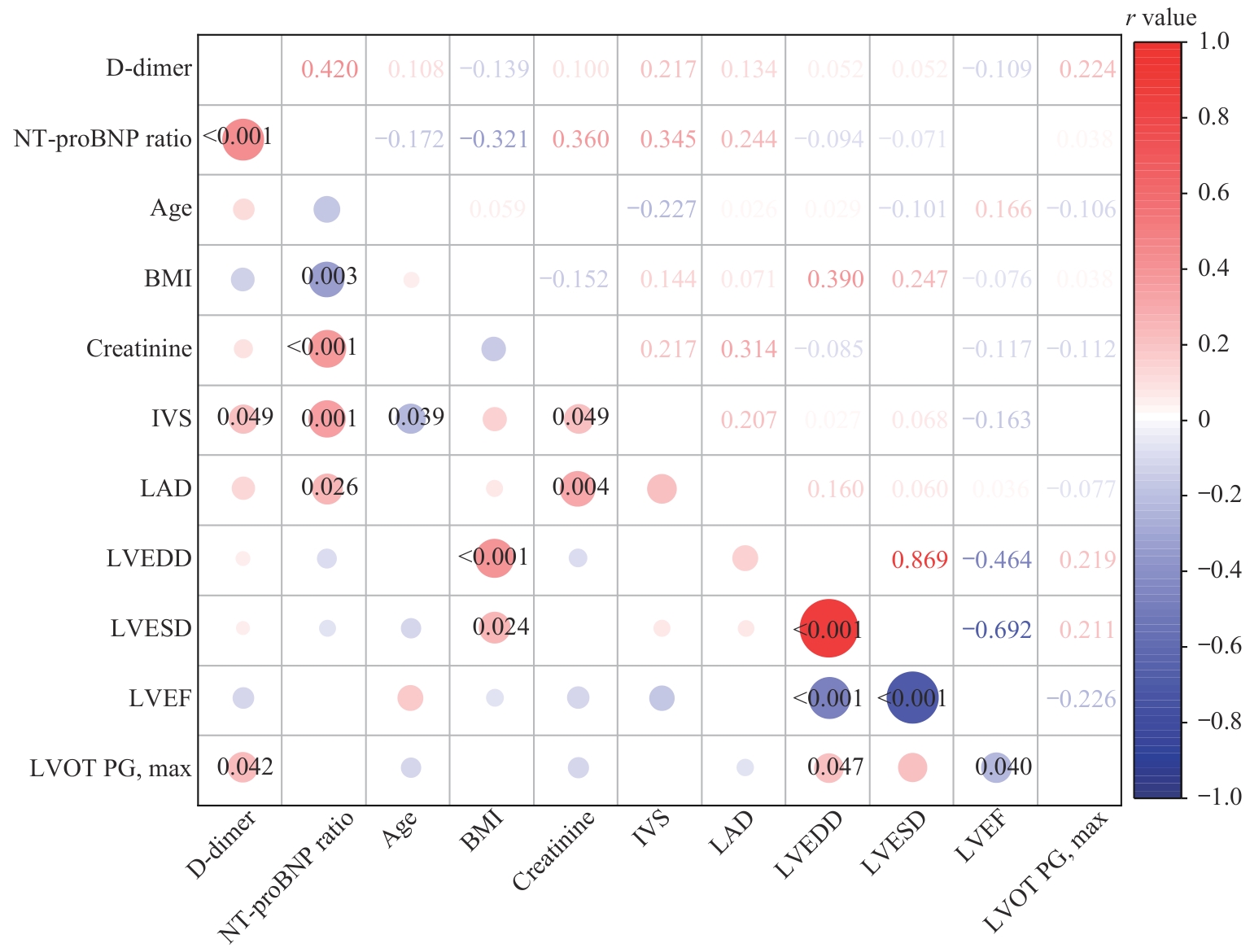
图1 HOCM患者术前D-二聚体水平、NT-proBNP比值及其他关键参数的相关性Note: The P value is shown in the lower left corner, and the r value is shown in the upper right corner.
Fig 1 Correlation between preoperative D-dimer levels, NT-proBNP ratio, and other key parameters in patients with HOCM
| Index | Model A | Model B | Model C | Model D | ||||
|---|---|---|---|---|---|---|---|---|
| aOR (95%CI) | P value | aOR (95%CI) | P value | aOR (95%CI) | P value | aOR (95%CI) | P value | |
| BMI | 0.809 (0.665‒0.985) | 0.035 | 0.877 (0.672‒1.145) | 0.335 | 0.821 (0.653‒1.032) | 0.090 | 0.856 (0.646‒1.133) | 0.277 |
| NYHA class | 3.020 (1.186‒7.688) | 0.020 | 2.103 (0.657‒6.732) | 0.210 | 3.243 (1.092‒9.627) | 0.034 | 2.161 (0.571‒8.176) | 0.256 |
| IVS | 1.214 (1.071‒1.376) | 0.002 | 1.170 (0.972‒1.409) | 0.096 | 1.187 (1.022‒1.379) | 0.025 | 1.166 (0.947‒1.437) | 0.148 |
| NT-proBNP ratio | ‒ | ‒ | 1.086 (1.040‒1.134) | <0.001 | ‒ | ‒ | 1.073 (1.027‒1.121) | 0.002 |
| D-dimer | ‒ | ‒ | ‒ | ‒ | 84.261 (4.387‒1 618.449) | 0.003 | 30.296 (1.067‒860.242) | 0.046 |
表2 预测HOCM患者术后早期发生MACE的Logistic回归模型
Tab 2 Logistic regression models for predicting early postoperative MACE in patients with HOCM
| Index | Model A | Model B | Model C | Model D | ||||
|---|---|---|---|---|---|---|---|---|
| aOR (95%CI) | P value | aOR (95%CI) | P value | aOR (95%CI) | P value | aOR (95%CI) | P value | |
| BMI | 0.809 (0.665‒0.985) | 0.035 | 0.877 (0.672‒1.145) | 0.335 | 0.821 (0.653‒1.032) | 0.090 | 0.856 (0.646‒1.133) | 0.277 |
| NYHA class | 3.020 (1.186‒7.688) | 0.020 | 2.103 (0.657‒6.732) | 0.210 | 3.243 (1.092‒9.627) | 0.034 | 2.161 (0.571‒8.176) | 0.256 |
| IVS | 1.214 (1.071‒1.376) | 0.002 | 1.170 (0.972‒1.409) | 0.096 | 1.187 (1.022‒1.379) | 0.025 | 1.166 (0.947‒1.437) | 0.148 |
| NT-proBNP ratio | ‒ | ‒ | 1.086 (1.040‒1.134) | <0.001 | ‒ | ‒ | 1.073 (1.027‒1.121) | 0.002 |
| D-dimer | ‒ | ‒ | ‒ | ‒ | 84.261 (4.387‒1 618.449) | 0.003 | 30.296 (1.067‒860.242) | 0.046 |
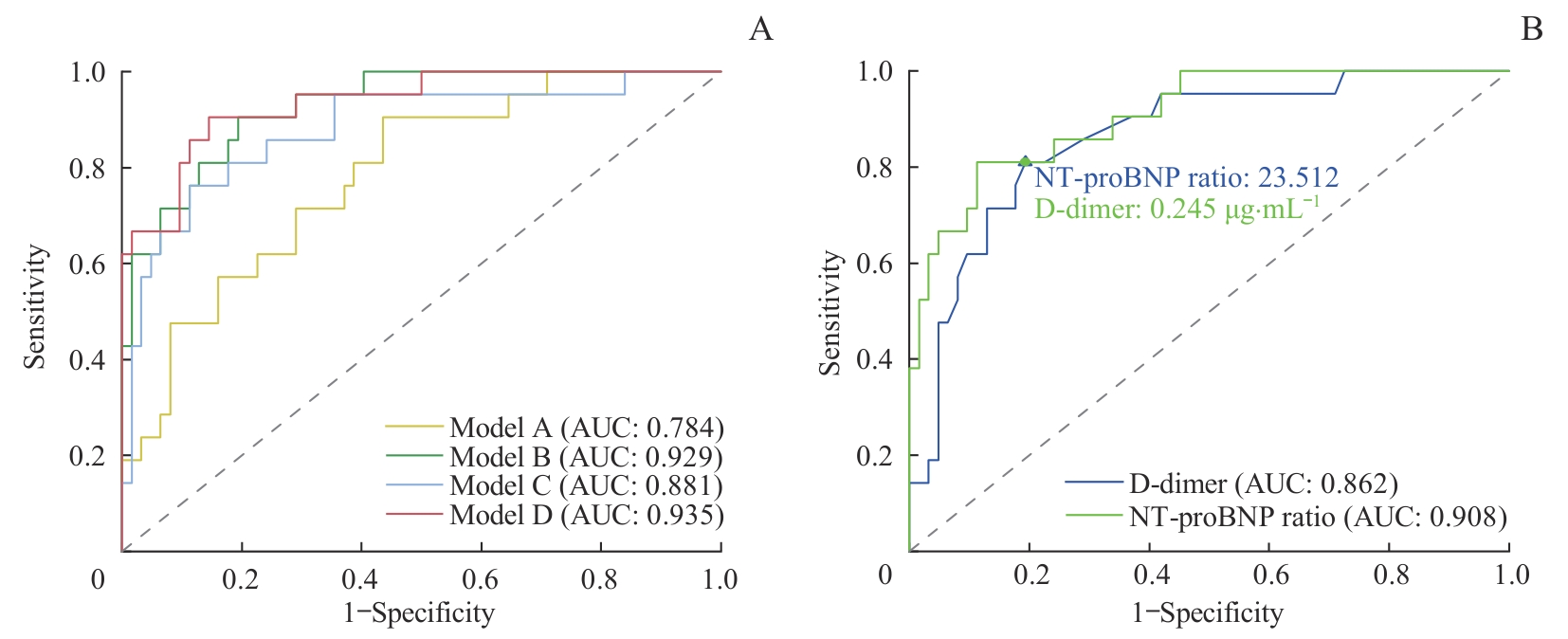
图2 不同模型的预测效能比较与个体标志物分析Note: A. ROC curves of the four nested predictive models. B. ROC curves of preoperative NT-proBNP ratio and D-dimer alone for predicting MACE.
Fig 2 Comparison of predictive efficacy among different models and analysis of individual biomarkers
| Model comparison | NRI (95%CI) | P1 value | IDI (95%CI) | P2 value |
|---|---|---|---|---|
| Model B vs Model A | 1.170 (0.725‒1.600) | <0.001 | 0.306 (0.143‒0.465) | <0.001 |
| Model C vs Model A | 1.170 (0.705‒1.550) | <0.001 | 0.204 (0.100‒0.333) | <0.001 |
| Model D vs Model A | 1.390 (0.987‒1.750) | <0.001 | 0.366 (0.197‒0.531) | <0.001 |
| Model D vs Model B | 0.820 (0.317‒1.280) | 0.002 | 0.060 (0.010‒0.114) | 0.014 |
| Model D vs Model C | 1.110 (0.668‒1.520) | <0.001 | 0.161 (0.010‒0.293) | 0.010 |
表3 不同预测模型间的风险重分类改善比较
Tab 3 Comparison of risk reclassification improvement among different predictive models
| Model comparison | NRI (95%CI) | P1 value | IDI (95%CI) | P2 value |
|---|---|---|---|---|
| Model B vs Model A | 1.170 (0.725‒1.600) | <0.001 | 0.306 (0.143‒0.465) | <0.001 |
| Model C vs Model A | 1.170 (0.705‒1.550) | <0.001 | 0.204 (0.100‒0.333) | <0.001 |
| Model D vs Model A | 1.390 (0.987‒1.750) | <0.001 | 0.366 (0.197‒0.531) | <0.001 |
| Model D vs Model B | 0.820 (0.317‒1.280) | 0.002 | 0.060 (0.010‒0.114) | 0.014 |
| Model D vs Model C | 1.110 (0.668‒1.520) | <0.001 | 0.161 (0.010‒0.293) | 0.010 |
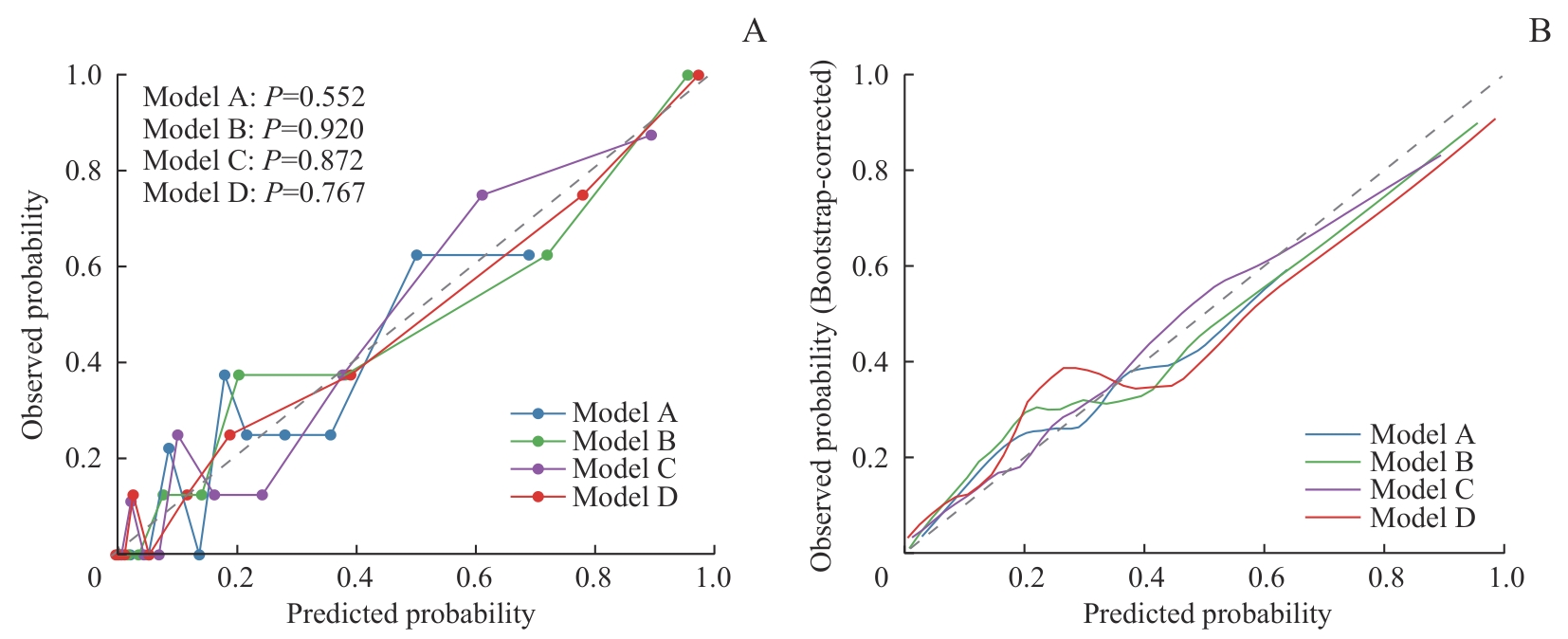
图3 4个预测模型的校准曲线Note: A. Original calibration curves. B. Bias‑corrected calibration curves after Bootstrap resampling.
Fig 3 Calibration plots of the four predictive models
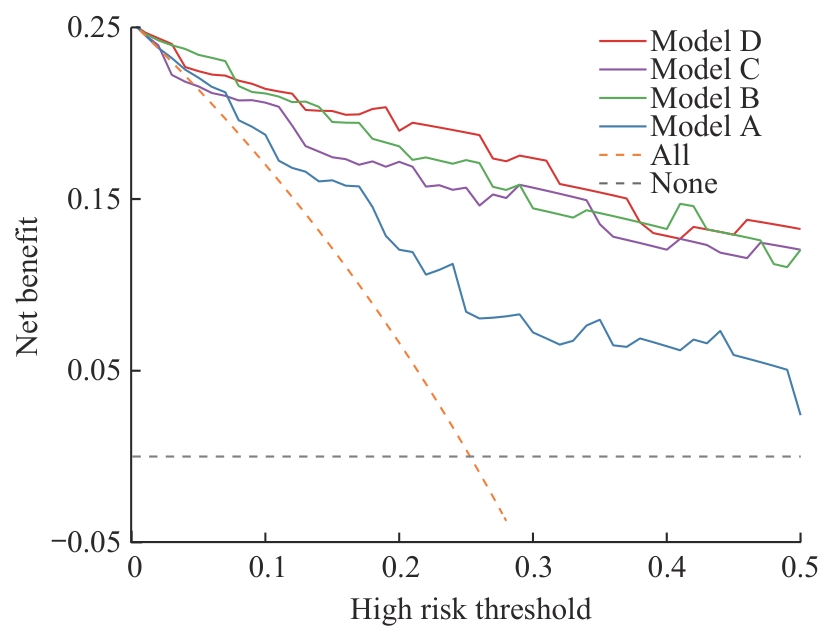
图4 4个预测模型的决策曲线分析
Fig 4 Decision curve analysis of the four predictive models
| Variable | Total (n=83) | Dual-biomarker grouping | H/χ2 value | P value | ||
|---|---|---|---|---|---|---|
“Dual-low” (n=41) | “Single-high” (n=26) | “Dual-high” (n=16) | ||||
| Postoperative occurrence of MACE/n(%) | 21 (25.30) | 2 (4.88)① | 4 (15.38)② | 15 (93.75) | ‒ | <0.001 |
| Cardiopulmonary bypass time/min | 100.00 (90.00, 122.50) | 95.00 (85.00, 115.00)③ | 100.00 (90.00, 115.00) | 125.00 (110.00, 136.25) | 9.699 | 0.008 |
| Aortic cross-clamp time/min | 70.00 (60.00, 90.00) | 65.00 (60.00, 80.00)④ | 70.00 (60.00, 83.75) | 90.00 (82.50, 91.25) | 9.660 | 0.008 |
| Duration of mechanical ventilation/h | 18.00 (12.50, 24.00) | 18.00 (12.00, 21.00)⑤ | 19.50 (12.00, 24.00) | 25.00 (18.63, 63.00) | 10.284 | 0.006 |
| Immediate postoperative LVOT PG/mmHg | 12.00 (8.00, 16.00) | 11.00 (7.00, 16.00) | 13.00 (9.25, 18.25) | 14.00 (6.75, 16.00) | 0.294 | 0.863 |
| Length of postoperative hospital stay/day | 12.00 (10.00, 15.50) | 11.00 (10.00, 14.00)⑥ | 12.50 (10.00, 15.00)⑦ | 19.00 (15.00, 21.00) | 14.421 | <0.001 |
表4 基于术前双标志物分组的患者临床特征与围术期结局比较
Tab 4 Comparison of clinical characteristics and perioperative outcomes among patients stratified by preoperative dual biomarkers
| Variable | Total (n=83) | Dual-biomarker grouping | H/χ2 value | P value | ||
|---|---|---|---|---|---|---|
“Dual-low” (n=41) | “Single-high” (n=26) | “Dual-high” (n=16) | ||||
| Postoperative occurrence of MACE/n(%) | 21 (25.30) | 2 (4.88)① | 4 (15.38)② | 15 (93.75) | ‒ | <0.001 |
| Cardiopulmonary bypass time/min | 100.00 (90.00, 122.50) | 95.00 (85.00, 115.00)③ | 100.00 (90.00, 115.00) | 125.00 (110.00, 136.25) | 9.699 | 0.008 |
| Aortic cross-clamp time/min | 70.00 (60.00, 90.00) | 65.00 (60.00, 80.00)④ | 70.00 (60.00, 83.75) | 90.00 (82.50, 91.25) | 9.660 | 0.008 |
| Duration of mechanical ventilation/h | 18.00 (12.50, 24.00) | 18.00 (12.00, 21.00)⑤ | 19.50 (12.00, 24.00) | 25.00 (18.63, 63.00) | 10.284 | 0.006 |
| Immediate postoperative LVOT PG/mmHg | 12.00 (8.00, 16.00) | 11.00 (7.00, 16.00) | 13.00 (9.25, 18.25) | 14.00 (6.75, 16.00) | 0.294 | 0.863 |
| Length of postoperative hospital stay/day | 12.00 (10.00, 15.50) | 11.00 (10.00, 14.00)⑥ | 12.50 (10.00, 15.00)⑦ | 19.00 (15.00, 21.00) | 14.421 | <0.001 |
| [1] | Maron B J, Maron M S. Hypertrophic cardiomyopathy[J]. Lancet, 2013, 381(9862): 242-255. |
| [2] | Wang S W, Cui H, Ji K S, et al. Impact of type 2 diabetes mellitus on mid-term mortality for hypertrophic cardiomyopathy patients who underwent septal myectomy[J]. Cardiovasc Diabetol, 2020, 19(1): 64. |
| [3] | Veselka J, Anavekar N S, Charron P. Hypertrophic obstructive cardiomyopathy[J]. Lancet, 2017, 389(10075): 1253-1267. |
| [4] | Osawa I, Akita K, Hasegawa K, et al. Plasma SVEP1 levels predict cardiovascular events in hypertrophic cardiomyopathy beyond conventional clinical risk models including NT-proBNP[J]. Circ Heart Fail, 2025, 18(2): e012343. |
| [5] | Argirò A, Parikh V, Jurcut R, et al. Hypertrophic cardiomyopathy[J]. Nat Rev Dis Primers, 2025, 11: 58. |
| [6] | Ommen S R, Ho C Y, Asif I M, et al. 2024 AHA/ACC/AMSSM/HRS/PACES/SCMR guideline for the management of hypertrophic cardiomyopathy: a report of the American Heart Association/American College of Cardiology Joint Committee on clinical practice guidelines[J]. Circulation, 2024, 149(23): e1239-e1311. |
| [7] | Parry D J, Raskin R E, Poynter J A, et al. Short and medium term outcomes of surgery for patients with hypertrophic obstructive cardiomyopathy[J]. Ann Thorac Surg, 2015, 99(4): 1213-1219. |
| [8] | Coats C J, Gallagher M J, Foley M, et al. Relation between serum N-terminal pro-brain natriuretic peptide and prognosis in patients with hypertrophic cardiomyopathy[J]. Eur Heart J, 2013, 34(32): 2529-2537. |
| [9] | Cui H, Wu X, Wang S Y, et al. Time and age dependent decrease of NT-proBNP after septal myectomy in hypertrophic obstructive cardiomyopathy[J]. Clin Chem Lab Med, 2017, 55(10): 1614-1620. |
| [10] | Song C P, Wang S W, Guo Y, et al. Preoperative NT-proBNP predicts midterm outcome after septal myectomy[J]. J Am Heart Assoc, 2019, 8(4): e011075. |
| [11] | Gębka A, Rajtar-Salwa R, Dziewierz A, et al. Serum N-terminal pro-B-type natriuretic peptide levels are associated with left atrial dilation, resting left ventricular outflow tract gradient, and pulmonary hypertension in patients with hypertrophic cardiomyopathy[J]. Postepy Kardiol Interwencyjnej, 2020, 16(1): 97-101. |
| [12] | Hutt E, Mentias A, Alashi A, et al. Prognostic value of age-sex adjusted NT-proBNP ratio in obstructive hypertrophic cardiomyopathy[J]. Prog Cardiovasc Dis, 2022, 74: 11-18. |
| [13] | Huang L Y, Liang L, Tian P C, et al. D-dimer and outcomes in hospitalized heart failure patients across the ejection fraction phenotypes[J]. ESC Heart Fail, 2022, 9(5): 3060-3070. |
| [14] | Lu T, Zhu C S, Cui H, et al. Preoperative D-dimer and outcomes in obstructive hypertrophic cardiomyopathy after myectomy[J]. Int J Cardiol, 2025, 419: 132705. |
| [15] | 华潞, 杜海燕, 牛云枫, 等. 老年高血压性肥厚型心肌病和高血压左心室肥厚患者的比较研究[J]. 中国循环杂志, 2014, 29(6): 432-435. |
| Hua L, Du H Y, Niu Y F, et al. Comparative study for the patients of hypertensive hypertrophic cardiomyopathy in elder age and the patients of hypertensive left ventricular hypertrophy[J]. Chinese Circulation Journal, 2014, 29(6): 432-435. | |
| [16] | 国家心血管病中心心肌病专科联盟, 中国医疗保健国际交流促进 会心血管病精准医学分会“中国成人肥厚型心肌病诊断与治疗指南2023”专家组. 中国成人肥厚型心肌病诊断与治疗指南2023[J]. 中国循环杂志, 2023, 38(1): 1-33. |
| The Joint Committee of Cardiomyopathy Specialty Alliance, National Center for Cardiovascular Diseases/Cardiovascular Precision Medicine Branch of China International Exchange and Promotive Association for Medical and Health Care. 2023 Chinese guideline for the diagnosis and treatment of patients with hypertrophic cardiomyopathy[J]. Chinese Circulation Journal, 2023, 38(1): 1-33. | |
| [17] | Lang R M, Badano L P, Mor-Avi V, et al. Recommendations for cardiac chamber quantification by echocardiography in adults: an update from the American Society of Echocardiography and the European Association of Cardiovascular Imaging[J]. J Am Soc Echocardiogr, 2015, 28(1): 1-39.e14. |
| [18] | Wang S Y, Luo M Y, Sun H T, et al. A retrospective clinical study of transaortic extended septal myectomy for obstructive hypertrophic cardiomyopathy in China[J]. Eur J Cardiothorac Surg, 2013, 43(3): 534-540. |
| [19] | Lin J F, Chen Y J, Xu M K, et al. Association and predictive ability between significant perioperative cardiovascular adverse events and stress glucose rise in patients undergoing non-cardiac surgery[J]. Cardiovasc Diabetol, 2024, 23(1): 445. |
| [20] | Duceppe E, Heels-Ansdell D, Devereaux P J. Preoperative N-terminal pro-B-type natriuretic peptide and cardiovascular events after noncardiac surgery[J]. Ann Intern Med, 2020, 172(12): 843. |
| [21] | Zhang B, Xu H Y, Zhang H T, et al. Prognostic value of N-terminal pro-B-type natriuretic peptide in elderly patients with valvular heart disease[J]. J Am Coll Cardiol, 2020, 75(14): 1659-1672. |
| [22] | Weitz J I, Fredenburgh J C, Eikelboom J W. A test in context: D-dimer[J]. J Am Coll Cardiol, 2017, 70(19): 2411-2420. |
| [23] | Simes J, Robledo K P, White H D, et al. D-dimer predicts long-term cause-specific mortality, cardiovascular events, and cancer in patients with stable coronary heart disease: LIPID study[J]. Circulation, 2018, 138(7): 712-723. |
| [24] | Borgognone A, Shantsila E, Worrall S M, et al. Nitrite circumvents platelet resistance to nitric oxide in patients with heart failure preserved ejection fraction and chronic atrial fibrillation[J]. Cardiovasc Res, 2018, 114(10): 1313-1323. |
| [25] | Raman B, Ariga R, Spartera M, et al. Progression of myocardial fibrosis in hypertrophic cardiomyopathy: mechanisms and clinical implications[J]. Eur Heart J Cardiovasc Imaging, 2019, 20(2): 157-167. |
| [26] | Lowe G D, Yarnell J W, Rumley A, et al. C-reactive protein, fibrin D-dimer, and incident ischemic heart disease in the Speedwell study: are inflammation and fibrin turnover linked in pathogenesis?[J]. Arterioscler Thromb Vasc Biol, 2001, 21(4): 603-610. |
| [27] | Song B R, Yao B, Dang H M, et al. Soluble ST2, Galectin-3 and clinical prognosis of patients with hypertrophic cardiomyopathy undergoing ventricular septal myectomy: a correlation analysis[J]. Cardiovasc Diagn Ther, 2020, 10(2): 145-152. |
| [28] | Coats C J, Masri A, Barriales-Villa R, et al. Cardiac biomarkers and effects of aficamten in obstructive hypertrophic cardiomyopathy: the SEQUOIA-HCM trial[J]. Eur Heart J, 2024, 45(42): 4464-4478. |
| [1] | 冯琳鸿, 吴迪, 朱迎春, 许佳瑞, 张翀, 王亚琨. 腹膜透析患者应用艾考糊精腹透液的临床获益及心血管风险分析[J]. 上海交通大学学报(医学版), 2026, 46(6): 759-769. |
| [2] | 郑梦奕, 毛家亮, 邹治国, 张瑞雷, 张厚, 李世光. 全身免疫炎症指数及躯体化症状评分对首发心梗PCI术后发生院内主要不良心血管事件的预测价值[J]. 上海交通大学学报(医学版), 2024, 44(3): 334-341. |
| [3] | 张义芹 1,谢松铭 2,王文安 1. D-二聚体正常肺栓塞病例的诊断与治疗分析 1例[J]. 上海交通大学学报(医学版), 2019, 39(1): 106-. |
| [4] | 耿燕来 1, 2,倪磊 1, 3,时国朝 1, 3. D-二聚体联合超声心动图及下肢血管超声在肺血栓栓塞症中的诊断价值[J]. 上海交通大学学报(医学版), 2018, 38(10): 1219-. |
| [5] | 李海清,周任,姚皓弋,袁志泽,王哲,陈安清,赵强. RPR技术治疗复杂肥厚型梗阻性心肌病[J]. 上海交通大学学报(医学版), 2017, 37(3): 348-. |
| [6] | 邓银灿,周 华,符一骐,等. 降钙素原、C反应蛋白及D-二聚体在预测重症肺炎患者预后中的作用[J]. 上海交通大学学报(医学版), 2014, 34(9): 1372-. |
| [7] | 周熙琳, 梁 辉, 黄洁杰. 急性脑梗死患者血栓弹力图与血小板聚集率和D-二聚体相关性研究[J]. , 2013, 33(4): 459-. |
| [8] | 侯旭敏, 韩文正, 仇兴标, 等. 联合生物学标志物检测在经皮冠状动脉介入治疗围术期心肌梗死危险分层中的价值[J]. , 2011, 31(10): 1436-. |
| 阅读次数 | ||||||
|
全文 |
|
|||||
|
摘要 |
|
|||||
