
上海交通大学学报(医学版) ›› 2026, Vol. 46 ›› Issue (11): 1486-1493.doi: 10.3969/j.issn.1674-8115.2026.11.004
彭崧峻1, 张捷2, 吴欣然3( )
收稿日期:2026-03-30
接受日期:2026-06-26
出版日期:2026-11-28
发布日期:2026-11-27
通讯作者:
吴欣然,助理教授,博士;电子信箱:wuxinran@sjtu.edu.cn。作者简介:第一联系人:为共同第一作者(*Co-first authors)。
基金资助:
Peng Songjun1, Zhang Jie2, Wu Xinran3()
Received:2026-03-30
Accepted:2026-06-26
Online:2026-11-28
Published:2026-11-27
Contact:
Wu Xinran, E-mail: wuxinran@sjtu.edu.cn.Supported by:摘要:
神经调控技术正由“单靶点、固定参数”的传统范式向“多靶点协同、动态自适应与个体化优化”的精准范式跃迁。然而,如何定量预测干预效应、克服个体疗效异质性并降低临床试错成本,仍是制约其发展的结构性挑战。数字孪生脑(digital twin brain,DTB)作为一种整合多模态数据与机理模型的生成式仿真技术,为破解上述困局提供了新路径。该文首先系统梳理了构建DTB的三大主流技术路线:① 大规模脉冲神经网络(spiking neural network,SNN)通过微观突触交互捕捉涌现特征与级联效应。② 脑网络模型(brain network model,BNM)通过离散拓扑耦合模拟宏观动力学转移。③ 神经场模型(neural field model,NFM)基于连续几何假设模拟皮层波动传播。接着,重点综述了DTB在无创/侵入式脑刺激及药物调控场景中的前沿应用,阐述其在机制解析、方案优化与临床疗效预测中的虚拟试验平台作用。最后,探讨了建立干预机制的精准映射、引入突触可塑性以模拟长期效应,以及加强跨学科协作等关键挑战,旨在为实现可转化的精准神经调控提供计算医学视角的理论参考。
中图分类号:
彭崧峻, 张捷, 吴欣然. 数字孪生脑在神经调控中的潜在应用[J]. 上海交通大学学报(医学版), 2026, 46(11): 1486-1493.
Peng Songjun, Zhang Jie, Wu Xinran. Potential applications of digital twin brains in neuromodulation[J]. Journal of Shanghai Jiao Tong University (Medical Science), 2026,(11): 1486-1493.
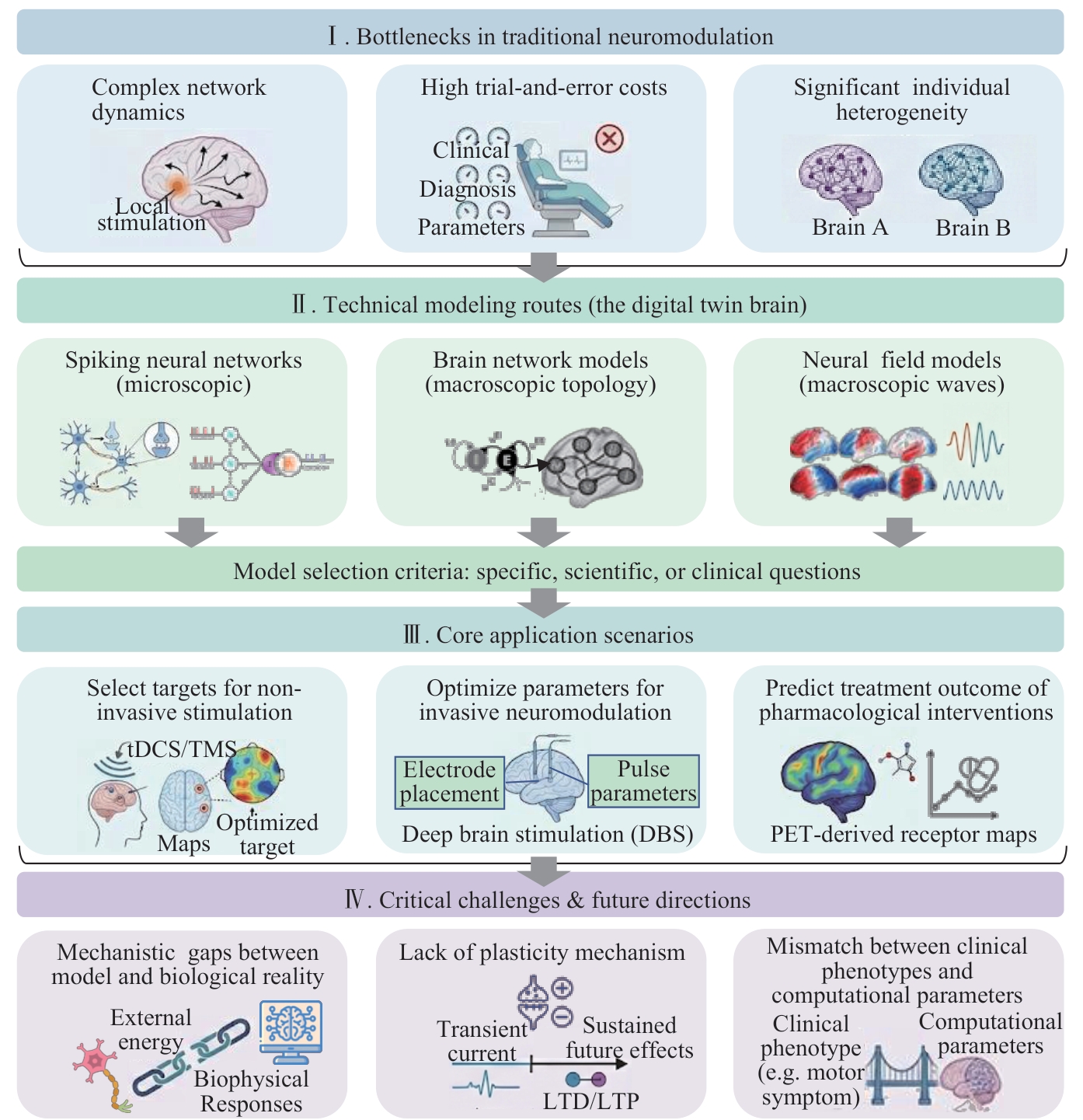
图1 DTB技术在神经调控中的应用示意图Note: Conceptual framework of digital twin brain (DTB) in neuromodulation. Ⅰ. Bottlenecks. Highlights current limitations, including complex network dynamics, high trial-and-error costs, and interindividual variability. Ⅱ. Technical modeling routes. Summarizes multi-scale modeling approaches: microscopic [spiking neural network (SNN)], macroscopic topology [brain network model (BNM)], and macroscopic waves [neural field model (NFM)]. The choice of model depends on the specific clinical question. Ⅲ. Application scenarios. Illustrates the use of DTBs as virtual testbeds for optimizing non-invasive brain stimulation [transcranial magnetic stimulation (TMS) and transcranial direct current stimulation (tDCS)], invasive brain stimulation [deep brain stimulation (DBS)], and pharmacological interventions. Ⅳ. Challenges & future directions. Identifies key gaps in biological realism, long-term plasticity mechanisms, and the mapping between clinical symptoms and model parameters. LTD—long-term depression; LTP—long-term potentiation.
Fig 1 Schematic diagram of DTB applications in neuromodulation
表1 DTB主要技术路线的定义、特点及神经调节应用
Tab 1 Definitions, characteristics, and applications of the main technical routes of DTB in neuromodulation
| [1] | Jayaraj P, Bhonsale A, Panchawagh S, et al. Efficacy of non invasive brain stimulation techniques in depression: an updated systematic review and network meta-analysis (P8-3.019)[J]. Neurology, 2025, 104(7_Supplement_1): 6009. |
| [2] | Lynn C W, Bassett D S. The physics of brain network structure, function and control[J]. Nat Rev Phys, 2019, 1(5): 318-332. |
| [3] | Filmer H L, Ehrhardt S E, Bollmann S, et al. Accounting for individual differences in the response to tDCS with baseline levels of neurochemical excitability[J]. Cortex, 2019, 115: 324-334. |
| [4] | Civardi C, Boccagni C, Vicentini R, et al. Cortical excitability and sleep deprivation: a transcranial magnetic stimulation study[J]. J Neurol Neurosurg Psychiatry, 2001, 71(6): 809-812. |
| [5] | Rodrigues de Almeida L, Pope P A, Hansen P C. Task load modulates tDCS effects on brain network for phonological processing[J]. Cogn Process, 2020, 21(3): 341-363. |
| [6] | Cagnan H, Pedrosa D, Little S, et al. Stimulating at the right time: phase-specific deep brain stimulation[J]. Brain, 2017, 140(1): 132-145. |
| [7] | Guerra A, López-Alonso V, Cheeran B, et al. Variability in non-invasive brain stimulation studies: reasons and results[J]. Neurosci Lett, 2020, 719: 133330. |
| [8] | Bradley C, Nydam A S, Dux P E, et al. State-dependent effects of neural stimulation on brain function and cognition[J]. Nat Rev Neurosci, 2022, 23(8): 459-475. |
| [9] | Menardi A, Rossi S, Koch G, et al. Toward noninvasive brain stimulation 2.0 in Alzheimer's disease[J]. Ageing Res Rev, 2022, 75: 101555. |
| [10] | Stefanovski L, Triebkorn P, Spiegler A, et al. Linking molecular pathways and large-scale computational modeling to assess candidate disease mechanisms and pharmacodynamics in Alzheimer′s disease[J]. Front Comput Neurosci, 2019, 13: 54. |
| [11] | Deco G, Jirsa V K, Robinson P A, et al. The dynamic brain: from spiking neurons to neural masses and cortical fields[J]. PLoS Comput Biol, 2008, 4(8): e1000092. |
| [12] | Lu W L, Du X, Wang J X, et al. Simulation and assimilation of the digital human brain[J]. Nat Comput Sci, 2024, 4(12): 890-898. |
| [13] | Lu W L, Zeng L B, Wang J X, et al. Imitating and exploring the human brain′s resting and task-performing states via brain computing: scaling and architecture[J]. Natl Sci Rev, 2024, 11(5): nwae080. |
| [14] | Bansal K, Nakuci J, Muldoon S F. Personalized brain network models for assessing structure-function relationships[J]. Curr Opin Neurobiol, 2018, 52: 42-47. |
| [15] | Jirsa V, Sheheitli H. Entropy, free energy, symmetry and dynamics in the brain[J]. J Phys Complex, 2022, 3(1): 015007. |
| [16] | Demirtaş M, Burt J B, Helmer M, et al. Hierarchical heterogeneity across human cortex shapes large-scale neural dynamics[J]. Neuron, 2019, 101(6): 1181-1194.e13. |
| [17] | Deco G, Kringelbach M L, Arnatkeviciute A, et al. Dynamical consequences of regional heterogeneity in the brain′s transcriptional landscape[J]. Sci Adv, 2021, 7(29): eabf4752. |
| [18] | Kong X L, Kong R, Orban C, et al. Sensory-motor cortices shape functional connectivity dynamics in the human brain[J]. Nat Commun, 2021, 12(1): 6373. |
| [19] | Wang P, Kong R, Kong X L, et al. Inversion of a large-scale circuit model reveals a cortical hierarchy in the dynamic resting human brain[J]. Sci Adv, 2019, 5(1): eaat7854. |
| [20] | Cabral J, Kringelbach M L, Deco G. Functional connectivity dynamically evolves on multiple time-scales over a static structural connectome: models and mechanisms[J]. Neuroimage, 2017, 160: 84-96. |
| [21] | Hansen E C A, Battaglia D, Spiegler A, et al. Functional connectivity dynamics: modeling the switching behavior of the resting state[J]. Neuroimage, 2015, 105: 525-535. |
| [22] | Zalesky A, Fornito A, Cocchi L, et al. Time-resolved resting-state brain networks[J]. Proc Natl Acad Sci U S A, 2014, 111(28): 10341-10346. |
| [23] | Perl Y S, Zamora-Lopez G, Montbrió E, et al. The impact of regional heterogeneity in whole-brain dynamics in the presence of oscillations[J]. Netw Neurosci, 2023, 7(2): 632-660. |
| [24] | Sip V, Hashemi M, Dickscheid T, et al. Characterization of regional differences in resting-state fMRI with a data-driven network model of brain dynamics[J]. Sci Adv, 2023, 9(11): eabq7547. |
| [25] | Murray J D, Demirtaş M, Anticevic A. Biophysical modeling of large-scale brain dynamics and applications for computational psychiatry[J]. Biol Psychiatry Cogn Neurosci Neuroimaging, 2018, 3(9): 777-787. |
| [26] | Schoonhoven D N, Coomans E M, Millán A P, et al. Tau protein spreads through functionally connected neurons in Alzheimer′s disease: a combined MEG/PET study[J]. Brain, 2023, 146(10): 4040-4054. |
| [27] | Triebkorn P, Stefanovski L, Dhindsa K, et al. Brain simulation augments machine-learning-based classification of dementia[J]. Alzheimers Dement (N Y), 2022, 8(1): e12303. |
| [28] | Saenger V M, Kahan J, Foltynie T, et al. Uncovering the underlying mechanisms and whole-brain dynamics of deep brain stimulation for Parkinson′s disease[J]. Sci Rep, 2017, 7(1): 9882. |
| [29] | Yang G J, Murray J D, Wang X J, et al. Functional hierarchy underlies preferential connectivity disturbances in schizophrenia[J]. Proc Natl Acad Sci U S A, 2016, 113(2): E219-E228. |
| [30] | Yang G J, Murray J D, Repovs G, et al. Altered global brain signal in schizophrenia[J]. Proc Natl Acad Sci U S A, 2014, 111(20): 7438-7443. |
| [31] | Jung K, Florin E, Patil K R, et al. Whole-brain dynamical modelling for classification of Parkinson′s disease[J]. Brain Commun, 2023, 5(1): fcac331. |
| [32] | Wang H E, Triebkorn P, Breyton M, et al. Virtual brain twins: from basic neuroscience to clinical use[J]. Natl Sci Rev, 2024, 11(5): nwae079. |
| [33] | Horvát S, Gămănuț R, Ercsey-Ravasz M, et al. Spatial embedding and wiring cost constrain the functional layout of the cortical network of rodents and primates[J]. PLoS Biol, 2016, 14(7): e1002512. |
| [34] | Cook B J, Peterson A D H, Woldman W, et al. Neural Field Models: a mathematical overview and unifying framework[J]. Math Neurosci Appl, 2022, 2: 7284. |
| [35] | Pang J C, Aquino K M, Oldehinkel M, et al. Geometric constraints on human brain function[J]. Nature, 2023, 618(7965): 566-574. |
| [36] | Muller L, Chavane F, Reynolds J, et al. Cortical travelling waves: mechanisms and computational principles[J]. Nat Rev Neurosci, 2018, 19(5): 255-268. |
| [37] | Ursino M, Cona F, Zavaglia M. The generation of rhythms within a cortical region: analysis of a neural mass model[J]. Neuroimage, 2010, 52(3): 1080-1094. |
| [38] | Abeysuriya R G, Robinson P A. Real-time automated EEG tracking of brain states using neural field theory[J]. J Neurosci Methods, 2016, 258: 28-45. |
| [39] | Sip V, Guye M, Bartolomei F, et al. Computational modeling of seizure spread on a cortical surface[J]. J Comput Neurosci, 2022, 50(1): 17-31. |
| [40] | Bressloff P C. Neural field model of binocular rivalry waves[M/OL]//Bressoff P C. Waves in neural media: from single neurons to neural fields. New York: Springer, 2013: 319-345. https://link.springer.com/chapter/10.1007/978-1-4614-8866-8_8. |
| [41] | Coombes S. Next generation neural population models[J]. Front Appl Math Stat, 2023, 9: 1128224. |
| [42] | D′Angelo E, Jirsa V. The quest for multiscale brain modeling[J]. Trends Neurosci, 2022, 45(10): 777-790. |
| [43] | Denoyer Y, Merlet I, Wendling F, et al. Modelling acute and lasting effects of tDCS on epileptic activity[J]. J Comput Neurosci, 2020, 48(2): 161-176. |
| [44] | Hananeia N, Ebner C, Galanis C, et al. Multi-scale modelling of location- and frequency-dependent synaptic plasticity induced by transcranial magnetic stimulation in the dendrites of pyramidal neurons[PP/OL]. bioRxiv(2024-07-05)[2026-03-30]. https://www.biorxiv.org/content/10.1101/2024.07.03.601851v1. |
| [45] | Lu H, Gallinaro J V, Rotter S. Network remodeling induced by transcranial brain stimulation: a computational model of tDCS-triggered cell assembly formation[J]. Netw Neurosci, 2019, 3(4): 924-943. |
| [46] | Molaee-Ardekani B, Márquez-Ruiz J, Merlet I, et al. Effects of transcranial Direct Current Stimulation (tDCS) on cortical activity: a computational modeling study[J]. Brain Stimul, 2013, 6(1): 25-39. |
| [47] | Kunze T, Hunold A, Haueisen J, et al. Transcranial direct current stimulation changes resting state functional connectivity: a large-scale brain network modeling study[J]. Neuroimage, 2016, 140: 174-187. |
| [48] | Dong Y Q, Wei J, Peng S J, et al. Effects of tDCS of the DLPFC on brain networks: a hybrid brain modeling study[J]. PLoS Comput Biol, 2025, 21(9): e1013486. |
| [49] | Momi D, Wang Z, Parmigiani S, et al. Stimulation mapping and whole-brain modeling reveal gradients of excitability and recurrence in cortical networks[J]. Nat Commun, 2025, 16(1): 3222. |
| [50] | Si Y Y, Zhang H H, Shen Z. Dynamic analysis and neuromodulation of EEG abnormalities in autism spectrum disorder based on a neural mass model[J]. Int J Bifurcation Chaos, 2025, 35(5): 2550060. |
| [51] | Wendling F, Bartolomei F, Bellanger J J, et al. Epileptic fast activity can be explained by a model of impaired GABAergic dendritic inhibition[J]. Eur J Neurosci, 2002, 15(9): 1499-1508. |
| [52] | Iravani B, Arshamian A, Fransson P, et al. Whole-brain modelling of resting state fMRI differentiates ADHD subtypes and facilitates stratified neuro-stimulation therapy[J]. Neuroimage, 2021, 231: 117844. |
| [53] | Momi D, Griffiths J, Wang Z. Modelling large-scale brain network dynamics underlying the TMS-EEG evoked response[J]. Brain Stimul, 2021, 14(6): 1714. |
| [54] | Lopez-Sola E, Mercadal B, Lleal-Custey È, et al. Personalized whole-brain models of seizure propagation[J]. J Neural Eng, 2025, 22(5): 056019. |
| [55] | Wang H E, Dollomaja B, Triebkorn P, et al. Virtual brain twins for stimulation in epilepsy[J]. Nat Comput Sci, 2025, 5(9): 754-768. |
| [56] | Meier J M, Perdikis D, Blickensdörfer A, et al. Virtual deep brain stimulation: multiscale co-simulation of a spiking basal ganglia model and a whole-brain mean-field model with The Virtual Brain[J]. Exp Neurol, 2022, 354: 114111. |
| [57] | van Hartevelt T J, Cabral J, Deco G, et al. Neural plasticity in human brain connectivity: the effects of long term deep brain stimulation of the subthalamic nucleus in Parkinson′s disease[J]. PLoS One, 2014, 9(1): e86496. |
| [58] | Modolo J, Bhattacharya B, Edwards R, et al. Using a virtual cortical module implementing a neural field model to modulate brain rhythms in Parkinson′s disease[J]. Front Neurosci, 2010, 4: 45. |
| [59] | Detorakis G I, Chaillet A, Palfi S, et al. Closed-loop stimulation of a delayed neural fields model of parkinsonian STN-GPe network: a theoretical and computational study[J]. Front Neurosci, 2015, 9: 237. |
| [60] | Polyakov D, Robinson P A, Müller E J, et al. Personalized stimulation therapies for disorders of consciousness: a computational approach to inducing healthy-like brain activity based on neural field theory[J]. J Neural Eng, 2025, 22(3): 036033. |
| [61] | Torres F A, Orio P, Escobar M J. Selection of stimulus parameters for enhancing slow wave sleep events with a neural-field theory thalamocortical model[J]. PLoS Comput Biol, 2021, 17(7): e1008758. |
| [62] | Kringelbach M L, Cruzat J, Cabral J, et al. Dynamic coupling of whole-brain neuronal and neurotransmitter systems[J]. Proc Natl Acad Sci U S A, 2020, 117(17): 9566-9576. |
| [63] | Deco G, Cruzat J, Cabral J, et al. Whole-brain multimodal neuroimaging model using serotonin receptor maps explains non-linear functional effects of LSD[J]. Curr Biol, 2018, 28(19): 3065-3074.e6. |
| [64] | Jobst B M, Atasoy S, Ponce-Alvarez A, et al. Increased sensitivity to strong perturbations in a whole-brain model of LSD[J]. Neuroimage, 2021, 230: 117809. |
| [65] | Herzog R, Mediano P A M, Rosas F E, et al. A whole-brain model of the neural entropy increase elicited by psychedelic drugs[J]. Sci Rep, 2023, 13(1): 6244. |
| [66] | Socoró-Garrigosa M, Perl Y S, Kringelbach M L, et al. Perturbing whole-brain models of brain hierarchy: an application for depression following pharmacological treatment[J]. Ann N Y Acad Sci, 2025, 1550(1): 255-272. |
| [67] | Mindlin I, Herzog R, Belloli L, et al. Whole brain modelling for simulating pharmacological interventions on patients with disorders of consciousness[J]. Commun Biol, 2024, 7(1): 1176. |
| [68] | Cirillo G, Di Pino G, Capone F, et al. Neurobiological after-effects of non-invasive brain stimulation[J]. Brain Stimul, 2017, 10(1): 1-18. |
| [69] | Wilson M T, Fung P K, Robinson P A, et al. Calcium dependent plasticity applied to repetitive transcranial magnetic stimulation with a neural field model[J]. J Comput Neurosci, 2016, 41(1): 107-125. |
| [70] | Bienenstock E L, Cooper L N, Munro P W. Theory for the development of neuron selectivity: orientation specificity and binocular interaction in visual cortex[J]. J Neurosci, 1982, 2(1): 32-48. |
| [1] | 汤皓云, 陈剑华. 慢性疼痛与抑郁障碍共病的神经振荡机制及非侵入性神经调控研究进展[J]. 上海交通大学学报(医学版), 2026, 46(11): 1582-1589. |
| [2] | 叶嘉依, 黄嘉萱, 张慧凤, 金锋, 赵冰蕾, 彭代辉. 无创神经调控技术治疗抑郁症的研究进展[J]. 上海交通大学学报(医学版), 2026, 46(11): 1565-1572. |
| [3] | 熊晓贤, 钟传钰, 张辉, 盛慧球, 狄建忠, 郑元义. 低强度脉冲超声刺激双侧背外侧前额叶皮层对肥胖人群食物相关抑制控制的即时影响[J]. 上海交通大学学报(医学版), 2026, 46(11): 1534-1543. |
| [4] | 陈小畅, 张晨. 精神分裂症患者体质量增加的非药物干预研究进展[J]. 上海交通大学学报(医学版), 2024, 44(5): 635-640. |
| [5] | 胡灿芳, 钟传钰, 曹立. 神经调控技术在帕金森病治疗中的应用研究进展[J]. 上海交通大学学报(医学版), 2024, 44(2): 258-263. |
| [6] | 翟兆琳, 刘登堂. 经颅聚焦超声刺激治疗精神障碍的研究现状及展望[J]. 上海交通大学学报(医学版), 2021, 41(1): 95-98. |
| [7] | 张玲 1,张天宏 2,魏燕燕 2,惠李 1,王继军 2. 自杀意念的物理神经调控干预研究进展[J]. 上海交通大学学报(医学版), 2019, 39(6): 661-. |
| [8] | 许珮玮,江开达,徐一峰,刘登堂 . 精神外科:从毁损术到神经调控技术[J]. 上海交通大学学报(医学版), 2017, 37(2): 245-. |
| 阅读次数 | ||||||
|
全文 |
|
|||||
|
摘要 |
|
|||||
