
上海交通大学学报(医学版) ›› 2026, Vol. 46 ›› Issue (11): 1582-1589.doi: 10.3969/j.issn.1674-8115.2026.11.015
汤皓云, 陈剑华( )
收稿日期:2026-01-27
接受日期:2026-05-07
出版日期:2026-11-28
发布日期:2026-11-12
通讯作者:
陈剑华,主任医师,博士;电子信箱:jianhua.chen@smhc.org.cn。基金资助:
Tang Haoyun, Chen Jianhua()
Received:2026-01-27
Accepted:2026-05-07
Online:2026-11-28
Published:2026-11-12
Contact:
Chen Jianhua, E-mail: jianhua.chen@smhc.org.cn.Supported by:摘要:
慢性疼痛与抑郁障碍是临床常见的共病,两者存在共同的神经病理基础。神经振荡作为反映脑网络动态交互异常的潜在标志物,为揭示共病的神经机制与探索其治疗靶点提供了新的研究视角。该文综述了慢性疼痛与抑郁障碍中神经振荡的改变及其共病特征,以及基于神经振荡的非侵入性神经调控干预的研究进展与未来挑战。现有研究表明,非侵入性神经调控可诱导并稳定神经振荡,进而改善疼痛与抑郁症状。然而,目前证据多来自单一诊断人群,在共病人群中的直接证据不足。研究间方法学异质性大,最优的刺激参数、靶点及疗程尚未明确,导致疗效不一致、可重复性不足等问题。此外,多数研究未在干预过程中监测神经振荡的变化,难以直接验证振荡调控与症状改善之间的因果关系。未来研究需进一步阐明神经振荡在共病中的作用机制和影响因素,建立基于神经振荡特征的评估与应用体系,涵盖标志物识别、疗效预测与靶点筛选,并发展融合个体化建模、闭环反馈与多模态同步的精准干预策略。
中图分类号:
汤皓云, 陈剑华. 慢性疼痛与抑郁障碍共病的神经振荡机制及非侵入性神经调控研究进展[J]. 上海交通大学学报(医学版), 2026, 46(11): 1582-1589.
Tang Haoyun, Chen Jianhua. Research progress in neural oscillation mechanisms and non-invasive neuromodulation in chronic pain and depressive disorder comorbidity[J]. Journal of Shanghai Jiao Tong University (Medical Science), 2026,(11): 1582-1589.
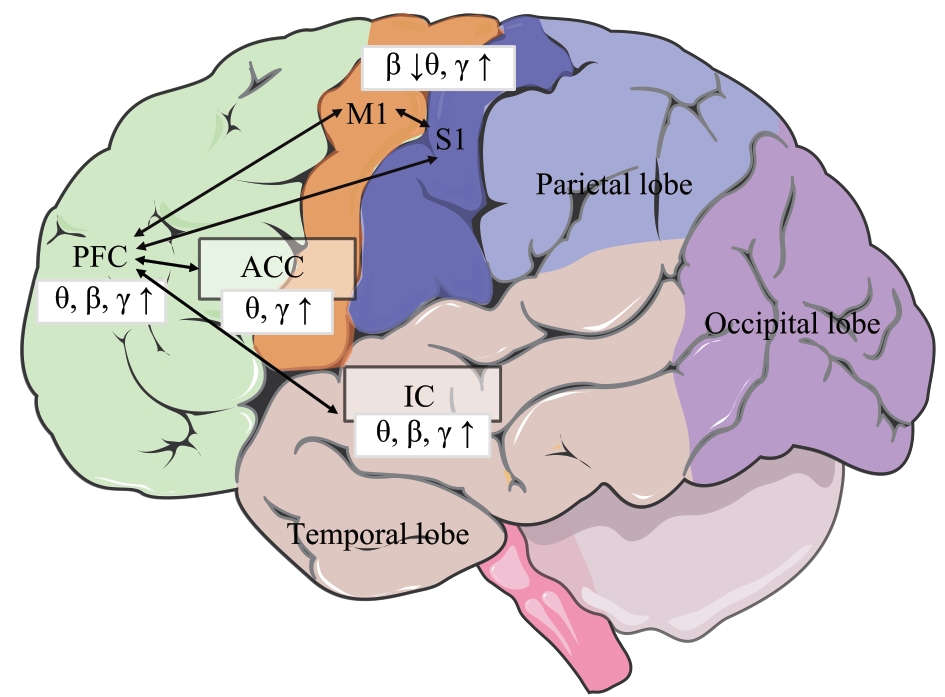
图1 慢性疼痛与抑郁障碍共病中皮质神经振荡及脑网络改变示意图Note: Functional connectivity exists between the prefrontal cortex (PFC), the anterior cingulate cortex (ACC), the insular cortex (IC), and the primary motor/sensory cortex (M1/S1). These brain regions jointly support cognitive regulation, emotional motivation, and sensorimotor integration, which are critical for pain perception and emotion regulation. In comorbid chronic pain and depressive disorder, both the neural oscillations within each region and the inter-regional oscillatory coupling show aberrant changes (as labeled in the figure). Double-headed arrows indicate phase synchrony among brain regions and do not imply causal directionality. The ACC and IC are marked with dashed boxes, indicating that they are located in deep cortical areas rather than in the superficial lateral cortex.
Fig 1 Illustration of changes in cortical neural oscillations and brain networks in chronic pain and depressive disorder comorbidity
| Study | Sample size | Comorbidity type | Intervention | Stimulation site | Stimulation parameter | Stimulation schedule | Outcome |
|---|---|---|---|---|---|---|---|
| 20 | FBSS with depressive symptoms | rTMS | M1, figure-8-shaped coil | 5 Hz, 70%RMT, 1 000 pulses per session, 20 min per session | 5 d/week, 10 sessions (2 weeks) | Pain (VAS, DN4) and depression (BDI) both significantly improved | |
| Kumar et al. (2020)[ | 20 | Chronic migraine with depressive symptoms | rTMS | Left M1 (fMRI-guided), figure-8-shaped coil | 10 Hz, 70%RMT, 600 pulses per session, 6 s trains with 60 s inter-train intervals | 5 d/week, 10 sessions (2 weeks) | Pain (VAS, headache frequency) significantly improved; depression (BDI) showed no significant change |
| Nardone et al. (2017)[ | 12 | SCI with neuropathic pain and depressive symptoms | rTMS | PMC/DLPFC, figure-8-shaped coil | 10 Hz, 120%RMT, 1 250 pulses per session, 5 s trains with 25 s inter-train intervals | 5 d/week, 10 sessions (2 weeks) | Pain (VAS, MPQ) significantly improved; depression (HAMD) improved |
| Cervigni et al. (2018)[ | 13 | Chronic pelvic pain with depressive symptoms | rTMS | M1, H-coil | 20 Hz, 110%RMT, 1 500 pulses per session, 2.5 s trains with 30 s inter-train intervals | 5 d/week, 10 sessions (2 weeks) | Pain (VAS, FPPS, NPSI, MPQ) significantly improved; depression (BDI) showed no significant change |
| Caumo et al. (2022)[ | 48 | Fibromyalgia with depressive symptoms | tDCS | Anode F3 Cathode F4 | 2 mA, 20 min per session, electrode size 35 cm2 | 5 d/week, 20 sessions (4 weeks) | Heat pain threshold increased; pain catastrophizing (PCS) and depressive symptoms (BDI) both significantly improved |
Loreti et al. (2023)[ | 35 | Fibromyalgia with depressive symptoms (inclusion criterion HAMD≥7) | tDCS | Anode C3 Cathode right supraorbital region | 2 mA, 13, 20, 13 min intermittent protocol, electrode size 35 cm2 | Consecutive 5 d→ 2-day interval → Consecutive 5 d, 10 sessions in total | Pain (VAS) significantly and durably improved; depression (HAMD) showed no significant improvement |
de Paula et al. (2023)[ | 86 | Fibromyalgia with depressive symptoms | tDCS combined with low-dose naltrexone | Anode M1 (contralateral to pain) Cathode contralateral supraorbital region | 2 mA, 20 min per session | Consecutive 5 d (during the last 5 d of a 26-d pharmacologic intervention) | Both pain (VAS) and depression (BDI) significantly improved; however, the placebo effect was pronounced, and the independent contribution of tDCS requires further verification |
Lin et al. (2022)[ | 38 | Fibromyalgia with depressive symptoms | HD-tACS (4×1 ring electrode) | C3 | 1 mA, 50 Hz, 2 s on/8 s off duty cycle, 20 min per session | 5 d/week, 10 sessions (2 weeks) | Both pain (NRS) and depression (BDI) improved, but with no significant difference from the sham-stimulation group |
| Bernardi et al. (2021)[ | 15 | Fibromyalgia with depressive symptoms | Individualized tACS+physical therapy | Scalp region with the greatest EEG power difference | 1‒2 mA, individualized frequency (β-tACS or θ-tACS), 30 min per session | 5 d/week, 2 weeks (10 sessions) | Both pain (VAS) and depression (BDI) significantly improved |
表1 非侵入性神经调控技术调节慢性疼痛与抑郁共病的相关研究
Tab 1 Studies on non-invasive neuromodulation techniques for chronic pain and depression comorbidity
| Study | Sample size | Comorbidity type | Intervention | Stimulation site | Stimulation parameter | Stimulation schedule | Outcome |
|---|---|---|---|---|---|---|---|
| 20 | FBSS with depressive symptoms | rTMS | M1, figure-8-shaped coil | 5 Hz, 70%RMT, 1 000 pulses per session, 20 min per session | 5 d/week, 10 sessions (2 weeks) | Pain (VAS, DN4) and depression (BDI) both significantly improved | |
| Kumar et al. (2020)[ | 20 | Chronic migraine with depressive symptoms | rTMS | Left M1 (fMRI-guided), figure-8-shaped coil | 10 Hz, 70%RMT, 600 pulses per session, 6 s trains with 60 s inter-train intervals | 5 d/week, 10 sessions (2 weeks) | Pain (VAS, headache frequency) significantly improved; depression (BDI) showed no significant change |
| Nardone et al. (2017)[ | 12 | SCI with neuropathic pain and depressive symptoms | rTMS | PMC/DLPFC, figure-8-shaped coil | 10 Hz, 120%RMT, 1 250 pulses per session, 5 s trains with 25 s inter-train intervals | 5 d/week, 10 sessions (2 weeks) | Pain (VAS, MPQ) significantly improved; depression (HAMD) improved |
| Cervigni et al. (2018)[ | 13 | Chronic pelvic pain with depressive symptoms | rTMS | M1, H-coil | 20 Hz, 110%RMT, 1 500 pulses per session, 2.5 s trains with 30 s inter-train intervals | 5 d/week, 10 sessions (2 weeks) | Pain (VAS, FPPS, NPSI, MPQ) significantly improved; depression (BDI) showed no significant change |
| Caumo et al. (2022)[ | 48 | Fibromyalgia with depressive symptoms | tDCS | Anode F3 Cathode F4 | 2 mA, 20 min per session, electrode size 35 cm2 | 5 d/week, 20 sessions (4 weeks) | Heat pain threshold increased; pain catastrophizing (PCS) and depressive symptoms (BDI) both significantly improved |
Loreti et al. (2023)[ | 35 | Fibromyalgia with depressive symptoms (inclusion criterion HAMD≥7) | tDCS | Anode C3 Cathode right supraorbital region | 2 mA, 13, 20, 13 min intermittent protocol, electrode size 35 cm2 | Consecutive 5 d→ 2-day interval → Consecutive 5 d, 10 sessions in total | Pain (VAS) significantly and durably improved; depression (HAMD) showed no significant improvement |
de Paula et al. (2023)[ | 86 | Fibromyalgia with depressive symptoms | tDCS combined with low-dose naltrexone | Anode M1 (contralateral to pain) Cathode contralateral supraorbital region | 2 mA, 20 min per session | Consecutive 5 d (during the last 5 d of a 26-d pharmacologic intervention) | Both pain (VAS) and depression (BDI) significantly improved; however, the placebo effect was pronounced, and the independent contribution of tDCS requires further verification |
Lin et al. (2022)[ | 38 | Fibromyalgia with depressive symptoms | HD-tACS (4×1 ring electrode) | C3 | 1 mA, 50 Hz, 2 s on/8 s off duty cycle, 20 min per session | 5 d/week, 10 sessions (2 weeks) | Both pain (NRS) and depression (BDI) improved, but with no significant difference from the sham-stimulation group |
| Bernardi et al. (2021)[ | 15 | Fibromyalgia with depressive symptoms | Individualized tACS+physical therapy | Scalp region with the greatest EEG power difference | 1‒2 mA, individualized frequency (β-tACS or θ-tACS), 30 min per session | 5 d/week, 2 weeks (10 sessions) | Both pain (VAS) and depression (BDI) significantly improved |
| [1] | Cui L L, Li S, Wang S M, et al. Major depressive disorder: hypothesis, mechanism, prevention and treatment[J]. Signal Transduct Target Ther, 2024, 9(1): 30. |
| [2] | Kishi T, Matsuda Y, Mukai T, et al. A cross-sectional survey to investigate the prevalence of pain in Japanese patients with major depressive disorder and schizophrenia[J]. Compr Psychiatry, 2015, 59: 91-97. |
| [3] | Aaron R V, Ravyts S G, Carnahan N D, et al. Prevalence of depression and anxiety among adults with chronic pain: a systematic review and meta-analysis[J]. JAMA Netw Open, 2025, 8(3): e250268. |
| [4] | Zhao S S, Holmes M V, Alam U. Disentangling the relationship between depression and chronic widespread pain: a Mendelian randomisation study[J]. Semin Arthritis Rheum, 2023, 60: 152188. |
| [5] | Lin F Q, Lin C J, Xiang X Y, et al. Comorbidity mechanism and management of chronic low back pain and major depressive disorder: from neural circuit remodeling to precision medicine[J]. Brain Behav, 2026, 16(9): e71713. |
| [6] | Li M H, She K P, Zhu P F, et al. Chronic pain and comorbid emotional disorders: neural circuitry and neuroimmunity pathways[J]. Int J Mol Sci, 2025, 26(2): 436. |
| [7] | Zhao J J, Shi W, Lu Y J, et al. Alterations of monoamine neurotransmitters, HPA-axis hormones, and inflammation cytokines in reserpine-induced hyperalgesia and depression comorbidity rat model[J]. BMC Psychiatry, 2022, 22(1): 419. |
| [8] | McCarberg B, Peppin J. Pain pathways and nervous system plasticity: learning and memory in pain[J]. Pain Med, 2019, 20(12): 2421-2437. |
| [9] | Torta R, Ieraci V, Zizzi F. A review of the emotional aspects of neuropathic pain: from comorbidity to co-pathogenesis[J]. Pain Ther, 2017, 6(Suppl 1): 11-17. |
| [10] | Hashmi J A, Baliki M N, Huang L J, et al. Shape shifting pain: chronification of back pain shifts brain representation from nociceptive to emotional circuits[J]. Brain, 2013, 136(Pt 9): 2751-2768. |
| [11] | Descalzi G, Mitsi V, Purushothaman I, et al. Neuropathic pain promotes adaptive changes in gene expression in brain networks involved in stress and depression[J]. Sci Signal, 2017, 10(471): eaaj1549. |
| [12] | Jiang J Q, Cui S, Wang J, et al. Unraveling the neural underpinnings of major depressive disorder and pain: a Mendelian randomization study and mediation analysis[J]. Psychiatry Res Neuroimaging, 2026, 357: 112136. |
| [13] | Malejko K, Brown R C, Plener P L, et al. Differential neural processing of unpleasant sensory stimulation in patients with major depression[J]. Eur Arch Psychiatry Clin Neurosci, 2021, 271(3): 557-565. |
| [14] | Zheng C J, van Drunen S, Egorova-Brumley N. Neural correlates of co-occurring pain and depression: an activation-likelihood estimation (ALE) meta-analysis and systematic review[J]. Transl Psychiatry, 2022, 12(1): 196. |
| [15] | Brandl F, Weise B, Mulej Bratec S, et al. Common and specific large-scale brain changes in major depressive disorder, anxiety disorders, and chronic pain: a transdiagnostic multimodal meta-analysis of structural and functional MRI studies[J]. Neuropsychopharmacology, 2022, 47(5): 1071-1080. |
| [16] | Tan L L, Oswald M J, Kuner R. Neurobiology of brain oscillations in acute and chronic pain[J]. Trends Neurosci, 2021, 44(8): 629-642. |
| [17] | Yin Y Y, Yan J Z, Lai S X, et al. Gamma oscillations in the mPFC: a potential predictive biomarker of depression and antidepressant effects[J]. Prog Neuropsychopharmacol Biol Psychiatry, 2024, 129: 110893. |
| [18] | Baliki M N, Petre B, Torbey S, et al. Corticostriatal functional connectivity predicts transition to chronic back pain[J]. Nat Neurosci, 2012, 15(8): 1117-1119. |
| [19] | Javaheripour N, Li M, Chand T, et al. Altered resting-state functional connectome in major depressive disorder: a mega-analysis from the PsyMRI consortium[J]. Transl Psychiatry, 2021, 11(1): 511. |
| [20] | Zhou H X, Chen X, Shen Y Q, et al. Rumination and the default mode network: meta-analysis of brain imaging studies and implications for depression[J]. Neuroimage, 2020, 206: 116287. |
| [21] | Hamilton J P, Farmer M, Fogelman P, et al. Depressive rumination, the default-mode network, and the dark matter of clinical neuroscience[J]. Biol Psychiatry, 2015, 78(4): 224-230. |
| [22] | Schimmelpfennig J, Topczewski J, Zajkowski W, et al. The role of the salience network in cognitive and affective deficits[J]. Front Hum Neurosci, 2023, 17: 1133367. |
| [23] | Jiang Y, Oathes D, Hush J, et al. Perturbed connectivity of the amygdala and its subregions with the central executive and default mode networks in chronic pain[J]. Pain, 2016, 157(9): 1970-1978. |
| [24] | Zhu K, Chang J C, Zhang S Y, et al. The enhanced connectivity between the frontoparietal, somatomotor network and thalamus as the most significant network changes of chronic low back pain[J]. Neuroimage, 2024, 290: 120558. |
| [25] | Rycroft C E, Hirst M, Dunlop W C, et al. The suitability of end point designs for health technology assessment in chronic pain studies[J]. Value Health, 2015, 18(8): 987-993. |
| [26] | Ortolá R, Sotos-Prieto M, Carballo-Casla A, et al. Role of serum brain-derived neurotrophic factor as a biomarker of chronic pain in older adults[J]. Eur J Pain, 2025, 29(5): e70014. |
| [27] | Zeng Y, Chourpiliadis C, Hammar N, et al. Inflammatory biomarkers and risk of psychiatric disorders[J]. JAMA Psychiatry, 2024, 81(11): 1118-1129. |
| [28] | Hu X S, Nascimento T D, DaSilva A F. Shedding light on pain for the clinic: a comprehensive review of using functional near-infrared spectroscopy to monitor its process in the brain[J]. Pain, 2021, 162(12): 2805-2820. |
| [29] | Li Y Z, Yang B H, Wang Z W, et al. EEG assessment of brain dysfunction for patients with chronic primary pain and depression under auditory oddball task[J]. Front Neurosci, 2023, 17: 1133834. |
| [30] | Buzsáki G, Draguhn A. Neuronal oscillations in cortical networks[J]. Science, 2004, 304(5679): 1926-1929. |
| [31] | Schomer D L, da Silva F H L. Niedermeyer's electroencephalography: basic principles, clinical applications, and related fields[M]. 7th ed. New York: Oxford University Press, 2017. |
| [32] | Gkintoni E, Halkiopoulos C. Mapping EEG metrics to human affective and cognitive models: an interdisciplinary scoping review from a cognitive neuroscience perspective[J]. Biomimetics (Basel), 2025, 10(11): 730. |
| [33] | Canolty R T, Knight R T. The functional role of cross-frequency coupling[J]. Trends Cogn Sci, 2010, 14(11): 506-515. |
| [34] | Young C K, Eggermont J J. Coupling of mesoscopic brain oscillations: recent advances in analytical and theoretical perspectives[J]. Prog Neurobiol, 2009, 89(1): 61-78. |
| [35] | Eom T H. Electroencephalography source localization[J]. Clin Exp Pediatr, 2023, 66(5): 201-209. |
| [36] | van Pelt S, Boomsma D I, Fries P. Magnetoencephalography in twins reveals a strong genetic determination of the peak frequency of visually induced γ- band synchronization[J]. J Neurosci, 2012, 32(10): 3388-3392. |
| [37] | de Gennaro L, Marzano C, Fratello F, et al. The electroencephalographic fingerprint of sleep is genetically determined: a twin study[J]. Ann Neurol, 2008, 64(4): 455-460. |
| [38] | Buzsáki G, Logothetis N, Singer W. Scaling brain size, keeping timing: evolutionary preservation of brain rhythms[J]. Neuron, 2013, 80(3): 751-764. |
| [39] | Uhlhaas P J, Singer W. Neuronal dynamics and neuropsychiatric disorders: toward a translational paradigm for dysfunctional large-scale networks[J]. Neuron, 2012, 75(6): 963-980. |
| [40] | Ye Q, Yan D, Yao M L, et al. Hyperexcitability of cortical oscillations in patients with somatoform pain disorder: a resting-state EEG study[J]. Neural Plast, 2019, 2019: 2687150. |
| [41] | Fallon N, Chiu Y, Nurmikko T, et al. Altered theta oscillations in resting EEG of fibromyalgia syndrome patients[J]. Eur J Pain, 2018, 22(1): 49-57. |
| [42] | Wang H L, Guo Y F, Tu Y H, et al. Neural processes responsible for the translation of sustained nociceptive inputs into subjective pain experience[J]. Cereb Cortex, 2023, 33(3): 634-650. |
| [43] | Schulz E, May E S, Postorino M, et al. Prefrontal gamma oscillations encode tonic pain in humans[J]. Cereb Cortex, 2015, 25(11): 4407-4414. |
| [44] | May E S, Nickel M M, Dinh S T, et al. Prefrontal gamma oscillations reflect ongoing pain intensity in chronic back pain patients[J]. Hum Brain Mapp, 2019, 40(1): 293-305. |
| [45] | Kemp A H, Griffiths K, Felmingham K L, et al. Disorder specificity despite comorbidity: resting EEG alpha asymmetry in major depressive disorder and post-traumatic stress disorder[J]. Biol Psychol, 2010, 85(2): 350-354. |
| [46] | Alexander M L, Alagapan S, Lugo C E, et al. Double-blind, randomized pilot clinical trial targeting alpha oscillations with transcranial alternating current stimulation (tACS) for the treatment of major depressive disorder (MDD)[J]. Transl Psychiatry, 2019, 9(1): 106. |
| [47] | Sarzi-Puttini P, Giorgi V, Marotto D, et al. Fibromyalgia: an update on clinical characteristics, aetiopathogenesis and treatment[J]. Nat Rev Rheumatol, 2020, 16(11): 645-660. |
| [48] | Lim M, Kim J S, Kim D J, et al. Increased low- and high-frequency oscillatory activity in the prefrontal cortex of fibromyalgia patients[J]. Front Hum Neurosci, 2016, 10: 111. |
| [49] | Camargo L, Pacheco-Barrios K, Marques L M, et al. Adaptive and compensatory neural signatures in fibromyalgia: an analysis of resting-state and stimulus-evoked EEG oscillations[J]. Biomedicines, 2024, 12(7): 1428. |
| [50] | Uygur-Kucukseymen E, Castelo-Branco L, Pacheco-Barrios K, et al. Decreased neural inhibitory state in fibromyalgia pain: a cross-sectional study[J]. Clin Neurophysiol, 2020, 50(4): 279-288. |
| [51] | Barratt E L, Francis S T, Morris P G, et al. Mapping the topological organisation of beta oscillations in motor cortex using MEG[J]. Neuroimage, 2018, 181: 831-844. |
| [52] | Teixeira M, Mancini C, Wicht C A, et al. Beta electroencephalographic oscillation is a potential GABAergic biomarker of chronic peripheral neuropathic pain[J]. Front Neurosci, 2021, 15: 594536. |
| [53] | Scanlon G C, Jain F A, Hunter A M, et al. Neurophysiologic correlates of headache pain in subjects with major depressive disorder[J]. Clin EEG Neurosci, 2017, 48(3): 159-167. |
| [54] | Gao F, Wang M R, Jia H B, et al. Altered neural oscillation patterns and functional connectivity in postherpetic neuralgia: evidence from resting-state EEG[J]. Front Pain Res (Lausanne), 2025, 6: 1603345. |
| [55] | Llorca-Torralba M, Camarena-Delgado C, Suárez-Pereira I, et al. Pain and depression comorbidity causes asymmetric plasticity in the locus coeruleus neurons[J]. Brain, 2022, 145(1): 154-167. |
| [56] | Loreti E H, Freire A M, Alexandre da Silva A, et al. Effects of anodal transcranial direct current stimulation on the primary motor cortex in women with fibromyalgia: a randomized, triple-blind clinical trial[J]. Neuromodulation, 2023, 26(4): 767-777. |
| [57] | Bursali C, Özkan F Ü, Kaysin M Y, et al. Effectiveness of repetitive transcranial magnetic stimulation in patients with failed back surgery syndrome: a double-blind randomized placebo-controlled study[J]. Pain Physician, 2021, 24(1): E23-E30. |
| [58] | Kumar P N S, Krishnan A G, Suresh R, et al. Transcranial direct current stimulation for refractory auditory hallucinations in schizophrenia: acute and 16-week outcomes[J]. Indian J Psychiatry, 2020, 62(5): 572-576. |
| [59] | Nardone R, Höller Y, Langthaler P B, et al. rTMS of the prefrontal cortex has analgesic effects on neuropathic pain in subjects with spinal cord injury[J]. Spinal Cord, 2017, 55(1): 20-25. |
| [60] | Cervigni M, Onesti E, Ceccanti M, et al. Repetitive transcranial magnetic stimulation for chronic neuropathic pain in patients with bladder pain syndrome/interstitial cystitis[J]. Neurourol Urodyn, 2018, 37(8): 2678-2687. |
| [61] | Caumo W, Alves R L, Vicuña P, et al. Impact of bifrontal home-based transcranial direct current stimulation in pain catastrophizing and disability due to pain in fibromyalgia: a randomized, double-blind sham-controlled study[J]. J Pain, 2022, 23(4): 641-656. |
| [62] | de Paula T M H, Castro M S, Medeiros L F, et al. Association of low-dose naltrexone and transcranial direct current stimulation in fibromyalgia: a randomized, double-blinded, parallel clinical trial[J]. Braz J Anesthesiol, 2023, 73(4): 409-417. |
| [63] | Lin A P, Chiu C C, Chen S C, et al. Using high-definition transcranial alternating current stimulation to treat patients with fibromyalgia: a randomized double-blinded controlled study[J]. Life (Basel), 2022, 12(9): 1364. |
| [64] | Bernardi L, Bertuccelli M, Formaggio E, et al. Beyond physiotherapy and pharmacological treatment for fibromyalgia syndrome: tailored tACS as a new therapeutic tool[J]. Eur Arch Psychiatry Clin Neurosci, 2021, 271(1): 199-210. |
| [65] | Corlier J, Tadayonnejad R, Wilson A C, et al. Repetitive transcranial magnetic stimulation treatment of major depressive disorder and comorbid chronic pain: response rates and neurophysiologic biomarkers[J]. Psychol Med, 2023, 53(3): 823-832. |
| [66] | Polanía R, Nitsche M A, Ruff C C. Studying and modifying brain function with non-invasive brain stimulation[J]. Nat Neurosci, 2018, 21(2): 174-187. |
| [67] | Vosskuhl J, Strüber D, Herrmann C S. Non-invasive brain stimulation: a paradigm shift in understanding brain oscillations[J]. Front Hum Neurosci, 2018, 12: 211. |
| [68] | Hosseinian T, Yavari F, Biagi M C, et al. External induction and stabilization of brain oscillations in the human[J]. Brain Stimul, 2021, 14(3): 579-587. |
| [69] | Kenefati G, Rockholt M M, Ok D, et al. Changes in alpha, theta, and gamma oscillations in distinct cortical areas are associated with altered acute pain responses in chronic low back pain patients[J]. Front Neurosci, 2023, 17: 1278183. |
| [70] | Stern J, Jeanmonod D, Sarnthein J. Persistent EEG overactivation in the cortical pain matrix of neurogenic pain patients[J]. Neuroimage, 2006, 31(2): 721-731. |
| [71] | Pan R B, Ye S F, Zhong Y, et al. Transcranial alternating current stimulation for the treatment of major depressive disorder: from basic mechanisms toward clinical applications[J]. Front Hum Neurosci, 2023, 17: 1197393. |
| [72] | Olejarczyk E, Jozwik A, Valiulis V, et al. Statistical analysis of graph-theoretic indices to study EEG-TMS connectivity in patients with depression[J]. Front Neuroinform, 2021, 15: 651082. |
| [73] | Al-Kaysi A M, Al-Ani A, Loo C K, et al. Predicting tDCS treatment outcomes of patients with major depressive disorder using automated EEG classification[J]. J Affect Disord, 2017, 208: 597-603. |
| [74] | Fathi Y, Dissassuca F, Ricci G, et al. Individualised alpha-tACS for modulating pain perception and neural oscillations: a sham-controlled study in healthy participants[J]. Eur J Pain, 2025, 29(7): e70086. |
| [75] | Krause B, Cohen Kadosh R. Not all brains are created equal: the relevance of individual differences in responsiveness to transcranial electrical stimulation[J]. Front Syst Neurosci, 2014, 8: 25. |
| [76] | Laakso I, Tanaka S, Koyama S, et al. Inter-subject variability in electric fields of motor cortical tDCS[J]. Brain Stimul, 2015, 8(5): 906-913. |
| [77] | Stecher H I, Herrmann C S. Absence of alpha-tACS aftereffects in darkness reveals importance of taking derivations of stimulation frequency and individual alpha variability into account[J]. Front Psychol, 2018, 9:984. |
| [78] | Wagner S, Burger M, Wolters C H. An optimization approach for well-targeted transcranial direct current stimulation[J]. SIAM J Appl Math, 2016, 76(6): 2154-2174. |
| [79] | Bergmann T O, Karabanov A, Hartwigsen G, et al. Combining non-invasive transcranial brain stimulation with neuroimaging and electrophysiology: current approaches and future perspectives[J]. Neuroimage, 2016, 140: 4-19. |
| [1] | 朱墨, 陈俊. 重性抑郁障碍相关睡眠表现及其潜在机制的研究进展[J]. 上海交通大学学报(医学版), 2026, 46(6): 795-800. |
| [2] | 赵珈琪, 杜淮昊, 肖晓. 慢性疼痛与成体海马神经发生的双向调控机制[J]. 上海交通大学学报(医学版), 2026, 46(11): 1477-1485. |
| [3] | 崔鑫鑫, 焦清艳, 刘楠楠, 李申. 光照疗法治疗抑郁障碍的神经生物学机制与临床应用进展[J]. 上海交通大学学报(医学版), 2026, 46(11): 1590-1596. |
| [4] | 李彬阁, 王凡, 徐欣然, 许鑫, 陈依明, 洪武. 饮食炎症指数与抑郁障碍关系的研究进展[J]. 上海交通大学学报(医学版), 2026, 46(10): 1406-1411. |
| [5] | 耿梦璐, 李春波. 抑郁障碍患者记忆提取抑制受损的研究进展[J]. 上海交通大学学报(医学版), 2025, 45(10): 1378-1382. |
| [6] | 谷涓华, 焦扬, 鲁琳, 王琳琳. 胶质细胞内SNARE复合体功能及其与抑郁障碍发生的关系[J]. 上海交通大学学报(医学版), 2024, 44(5): 653-657. |
| [7] | 张硕渊, 李春波. 运动治疗抑郁障碍的研究进展[J]. 上海交通大学学报(医学版), 2023, 43(7): 916-922. |
| [8] | 沈琳洁, 黄雨欣, 王勇, 金华. 非侵入性脑刺激在抑郁障碍躯体症状治疗中的应用综述[J]. 上海交通大学学报(医学版), 2021, 41(11): 1535-1539. |
| [9] | 黄雨欣,汤叶舟,赵雅娟,符 浩,王 勇,金 华. 经颅直流电刺激治疗单相和双相抑郁障碍的研究进展[J]. 上海交通大学学报(医学版), 2019, 39(12): 1460-. |
| [10] | 崔旅纯 1,洪武 1,方贻儒 1, 2, 3. 神经甾体在抑郁发作治疗中的作用[J]. 上海交通大学学报(医学版), 2018, 38(6): 685-. |
| [11] | 程永琛,杜亚松,周慧鸣,李改智,李彩霞,郝丽丽,吕桃,茅荣杰,江文庆,李梦瑶,赵志民,张林娜,赵力聪,邓思宇,刘文文,吴增强,马珍珍. 上海市非毕业班中学生抑郁障碍调查与影响因素分析[J]. 上海交通大学学报(医学版), 2015, 35(10): 1539-. |
| [12] | 李宁宁,吴志国,方贻儒. 伴疼痛性躯体症状抑郁障碍的研究进展[J]. 上海交通大学学报(医学版), 2014, 34(4): 455-. |
| [13] | 吴志国,吴 彦,方贻儒. 从“焦虑性抑郁症”概念解析抑郁障碍的复杂性[J]. 上海交通大学学报(医学版), 2014, 34(4): 450-. |
| [14] | 陶 晶, 仇剑崟, 顾红亮, 等. ESR1基因与5-HTT基因多态性的交互作用对女性围绝经期抑郁障碍的影响[J]. , 2012, 32(6): 766-. |
| [15] | 曹 岚, 苑成梅, 李则挚, 等. 中文版心境障碍问卷在心境障碍患者中的应用[J]. , 2011, 31(11): 1509-. |
| 阅读次数 | ||||||
|
全文 |
|
|||||
|
摘要 |
|
|||||
