
上海交通大学学报(医学版) ›› 2026, Vol. 46 ›› Issue (11): 1467-1476.doi: 10.3969/j.issn.1674-8115.2026.11.002
姚郦秦1,2, 孙焕斌1,2, 徐春1,2( )
收稿日期:2026-08-10
接受日期:2026-10-08
出版日期:2026-11-28
发布日期:2026-11-27
通讯作者:
徐 春,研究员,博士;电子信箱:chun.xu@ion.ac.cn。基金资助:
Yao Liqin1,2, Sun Huanbin1,2, Xu Chun1,2()
Received:2026-08-10
Accepted:2026-10-08
Online:2026-11-28
Published:2026-11-27
Contact:
Xu Chun, E-mail: chun.xu@ion.ac.cn.Supported by:摘要:
关联学习与记忆使动物能够将环境线索与潜在的危险或奖励刺激建立关联,并据此预测危险或奖励的发生。这一能力对动物在自然界中的生存至关重要。对于在时间上相互分离的事件,动物往往需要将线索信息在短期记忆中维持一段时间,再与随后出现的刺激信息关联。这被称为时间性关联学习。该文以神经环路、神经编码、神经可塑性和神经调质系统4个方面为框架,综述时间性关联学习的研究进展,梳理海马、内嗅皮质、前额叶皮质和杏仁核及其环路的作用,比较持续性活动和序列性活动编码短期记忆的2种模式,并概述乙酰胆碱和多巴胺等神经调质系统的调控功能。总之,时间性关联学习并非依赖单一脑区或单一编码模式,而是由多个脑区之间的协同活动、神经元群体动态变化以及神经调质的调控共同支持,然而相关神经机制仍需进一步研究。未来研究可利用多脑区神经活动记录和操控技术,以及高时空分辨率的神经调质动态监测技术,进一步揭示时间性关联学习的神经机制。
中图分类号:
姚郦秦, 孙焕斌, 徐春. 时间性关联学习神经机制的研究进展[J]. 上海交通大学学报(医学版), 2026, 46(11): 1467-1476.
Yao Liqin, Sun Huanbin, Xu Chun. Recent advances in the neural mechanisms of temporal associative learning[J]. Journal of Shanghai Jiao Tong University (Medical Science), 2026,(11): 1467-1476.
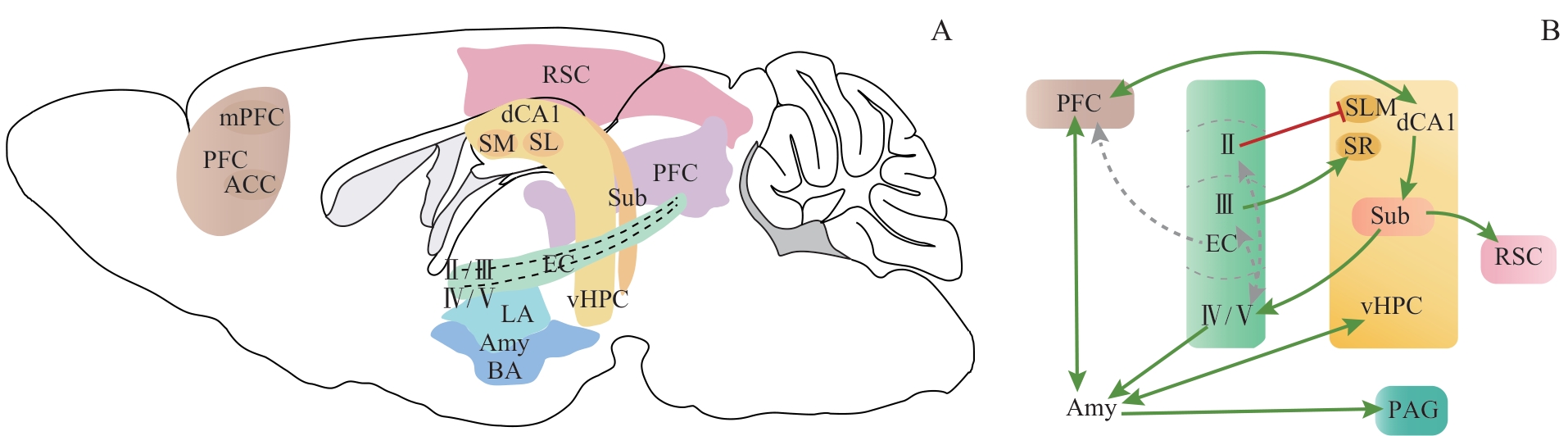
图1 时间性关联学习涉及的重要脑区和神经环路示意图Note: A. Key brain regions involved in temporal associative learning. B. Neural circuit mechanisms of temporal associative learning. Green arrows indicate excitatory projections; red bars indicate inhibitory projections; dashed grey arrows indicate putative projections. vHPC—ventral hippocampus; Amy—amygdala; PAG—periaqueductal gray; SR—stratum radiatum.
Fig 1 Schematic diagram of the key brain regions and neural circuits involved in temporal associative learning
| Mechanistic category | Brain region/circuit/mechanism | Main findings and regulatory role | Key technique | Behavioural paradigm and trace parameter | Reference |
|---|---|---|---|---|---|
| Brain region and circuit | EC-HPC network | Maintaining CS information across the trace interval; supporting CS-US association | Transgenic mice, cell-type-specific labelling, and optogenetics | Auditory TFC (trace=20 s) | [ |
| CA1-Sub pathway | Supporting CS-US association during the trace interval; being required for TFC learning | Optogenetics and circuit-specific manipulation | Auditory TFC (trace=20 s) | [ | |
| Sub-RSC pathway | Engaged in TFC learning and memory retrieval | Neural tracing and fiber photometry | Auditory TFC (trace=15 s) | [ | |
| mPFC-PL pathway and HPC-mPFC network | Maintaining trace-interval information; supporting TFC memory formation and hippocampal-prefrontal coordination | Lesion studies, pharmacological manipulation, and optogenetics | Auditory TFC (trace=20 s[ | [ | |
| Amygdala-related circuits | Supporting CS-US association and fear memory expression | Lesion studies and pharmacological manipulation | Auditory TFC (trace=30 s) | [ | |
| Neural coding | Time cells and sequential activity in CA1 region | Encoding temporal relationships between events; supporting representation across time | In vivo multi-channel electrophysiology | Delayed sequence memory task (delay interval=10 s) | [ |
| Learning-induced reorganization of CA1 activity patterns | Reorganization of CA1 activity patterns during learning; supporting stable memory formation | In vivo calcium imaging and population activity analysis | Auditory TFC (trace=20 s) | [ | |
| Neural plasticity | Changes in CA1 population activity | Representing learning-related changes in CA1 population activity and CS information coding | In vivo calcium imaging and population activity decoding | Auditory TFC (trace=15 s[ | [ |
| Persistent activity and synaptic plasticity in the PFC | Maintaining trace-interval information; supporting long-term memory formation | In vivo electrophysiology | Trace eyeblink conditioning (trace=0.5 s) | [ | |
| Neuromodulatory system | Cholinergic system | Regulating neuronal excitability and local microcircuit activity during the trace interval | Pharmacological manipulation, in vivo electrophysiology, and neurotransmitter detection | TFC and related fear- conditioning paradigms (trace parameters varied across studies) | [ |
| Dopaminergic system | Processing prediction error signals; updating learning outcomes | Pharmacological manipulation and electrophysiology | Reinforcement learning and aversive paradigms such as CFC/DFC (not TFC-specific parameters) | [ |
表1 时间性关联学习相关神经机制的代表性研究及行为范式
Tab 1 Representative studies and behavioural paradigms of the neural mechanisms underlying temporal associative learning
| Mechanistic category | Brain region/circuit/mechanism | Main findings and regulatory role | Key technique | Behavioural paradigm and trace parameter | Reference |
|---|---|---|---|---|---|
| Brain region and circuit | EC-HPC network | Maintaining CS information across the trace interval; supporting CS-US association | Transgenic mice, cell-type-specific labelling, and optogenetics | Auditory TFC (trace=20 s) | [ |
| CA1-Sub pathway | Supporting CS-US association during the trace interval; being required for TFC learning | Optogenetics and circuit-specific manipulation | Auditory TFC (trace=20 s) | [ | |
| Sub-RSC pathway | Engaged in TFC learning and memory retrieval | Neural tracing and fiber photometry | Auditory TFC (trace=15 s) | [ | |
| mPFC-PL pathway and HPC-mPFC network | Maintaining trace-interval information; supporting TFC memory formation and hippocampal-prefrontal coordination | Lesion studies, pharmacological manipulation, and optogenetics | Auditory TFC (trace=20 s[ | [ | |
| Amygdala-related circuits | Supporting CS-US association and fear memory expression | Lesion studies and pharmacological manipulation | Auditory TFC (trace=30 s) | [ | |
| Neural coding | Time cells and sequential activity in CA1 region | Encoding temporal relationships between events; supporting representation across time | In vivo multi-channel electrophysiology | Delayed sequence memory task (delay interval=10 s) | [ |
| Learning-induced reorganization of CA1 activity patterns | Reorganization of CA1 activity patterns during learning; supporting stable memory formation | In vivo calcium imaging and population activity analysis | Auditory TFC (trace=20 s) | [ | |
| Neural plasticity | Changes in CA1 population activity | Representing learning-related changes in CA1 population activity and CS information coding | In vivo calcium imaging and population activity decoding | Auditory TFC (trace=15 s[ | [ |
| Persistent activity and synaptic plasticity in the PFC | Maintaining trace-interval information; supporting long-term memory formation | In vivo electrophysiology | Trace eyeblink conditioning (trace=0.5 s) | [ | |
| Neuromodulatory system | Cholinergic system | Regulating neuronal excitability and local microcircuit activity during the trace interval | Pharmacological manipulation, in vivo electrophysiology, and neurotransmitter detection | TFC and related fear- conditioning paradigms (trace parameters varied across studies) | [ |
| Dopaminergic system | Processing prediction error signals; updating learning outcomes | Pharmacological manipulation and electrophysiology | Reinforcement learning and aversive paradigms such as CFC/DFC (not TFC-specific parameters) | [ |
| [1] | Fanselow M S, Poulos A M. The neuroscience of mammalian associative learning[J]. Annu Rev Psychol, 2005, 56: 207-234. |
| [2] | Raybuck J D, Lattal K M. Bridging the interval: theory and neurobiology of trace conditioning[J]. Behav Processes, 2014, 101: 103-111. |
| [3] | Beeman C L, Bauer P S, Pierson J L, et al. Hippocampus and medial prefrontal cortex contributions to trace and contextual fear memory expression over time[J]. Learn Mem, 2013, 20(6): 336-343. |
| [4] | Gilmartin M R, Miyawaki H, Helmstetter F J, et al. Prefrontal activity links nonoverlapping events in memory[J]. J Neurosci, 2013, 33(26): 10910-10914. |
| [5] | MacDonald C J, Lepage K Q, Eden U T, et al. Hippocampal “time cells” bridge the gap in memory for discontiguous events[J]. Neuron, 2011, 71(4): 737-749. |
| [6] | Wilmot J H, Diniz C R A F, Crestani A P, et al. Phasic locus coeruleus activity enhances trace fear conditioning by increasing dopamine release in the hippocampus[J]. eLife, 2024, 12: RP91465. |
| [7] | Klimmt H, Kuhn F, Kappel D, et al. Learning reorganizes dendritic and stabilizes axon initial segment inhibitory synapses in CA1 pyramidal neurons[J]. Nat Commun, 2026, 17(1): 9791. |
| [8] | Liu R H, Chang C H. Acquisition of trace fear conditioning without functional nucleus reuniens did not require dorsal or ventral hippocampus NMDA receptor activation in male Long-Evans rats[J]. Int J Neuropsychopharmacol, 2025, 28(9): pyaf065. |
| [9] | O'Keefe J, Dostrovsky J. The hippocampus as a spatial map. Preliminary evidence from unit activity in the freely-moving rat[J]. Brain Res, 1971, 34(1): 171-175. |
| [10] | Fyhn M, Molden S, Witter M P, et al. Spatial representation in the entorhinal cortex[J]. Science, 2004, 305(5688): 1258-1264. |
| [11] | Kitamura T, MacDonald C J, Tonegawa S. Entorhinal-hippocampal neuronal circuits bridge temporally discontiguous events[J]. Learn Mem, 2015, 22(9): 438-443. |
| [12] | Roy D S, Kitamura T, Okuyama T, et al. Distinct neural circuits for the formation and retrieval of episodic memories[J]. Cell, 2017, 170(5): 1000-1012.e19. |
| [13] | Burman M A, Starr M J, Gewirtz J C. Dissociable effects of hippocampus lesions on expression of fear and trace fear conditioning memories in rats[J]. Hippocampus, 2006, 16(2): 103-113. |
| [14] | Raybuck J D, Lattal K M. Double dissociation of amygdala and hippocampal contributions to trace and delay fear conditioning[J]. PLoS One, 2011, 6(1): e15982. |
| [15] | Chowdhury N, Quinn J J, Fanselow M S. Dorsal hippocampus involvement in trace fear conditioning with long, but not short, trace intervals in mice[J]. Behav Neurosci, 2005, 119(5): 1396-1402. |
| [16] | Kitamura T, Pignatelli M, Suh J, et al. Island cells control temporal association memory[J]. Science, 2014, 343(6173): 896-901. |
| [17] | Gilmartin M R, Kwapis J L, Helmstetter F J. Trace and contextual fear conditioning are impaired following unilateral microinjection of muscimol in the ventral hippocampus or amygdala, but not the medial prefrontal cortex[J]. Neurobiol Learn Mem, 2012, 97(4): 452-464. |
| [18] | Herbst M R, Twining R C, Gilmartin M R. Ventral hippocampal shock encoding modulates the expression of trace cued fear[J]. Neurobiol Learn Mem, 2022, 190: 107610. |
| [19] | Esclassan F, Coutureau E, di Scala G, et al. Differential contribution of dorsal and ventral hippocampus to trace and delay fear conditioning[J]. Hippocampus, 2009, 19(1): 33-44. |
| [20] | Bai T, Zhan L J, Zhang N, et al. Learning-prolonged maintenance of stimulus information in CA1 and subiculum during trace fear conditioning[J]. Cell Rep, 2023, 42(8): 112853. |
| [21] | Bassett T E, Wang Y Z, Wood E M, et al. Response dynamics of discrete subiculum→retrosplenial cortex projections underlying trace fear conditioning[J]. iScience, 2026, 29(4): 115317. |
| [22] | Lovett-Barron M, Kaifosh P, Kheirbek M A, et al. Dendritic inhibition in the hippocampus supports fear learning[J]. Science, 2014, 343(6173): 857-863. |
| [23] | Rangel Guerrero D K, Balueva K, Barayeu U, et al. Hippocampal cholecystokinin-expressing interneurons regulate temporal coding and contextual learning[J]. Neuron, 2024, 112(12): 2045-2061.e10. |
| [24] | Li K Z, Koukoutselos K, Sakaguchi M, et al. Distinct ventral hippocampal inhibitory microcircuits regulating anxiety and fear behaviors[J]. Nat Commun, 2024, 15(1): 8228. |
| [25] | Carter R M, Hofstötter C, Tsuchiya N, et al. Working memory and fear conditioning[J]. Proc Natl Acad Sci U S A, 2003, 100(3): 1399-1404. |
| [26] | Curtis C E, D'Esposito M. Persistent activity in the prefrontal cortex during working memory[J]. Trends Cogn Sci, 2003, 7(9): 415-423. |
| [27] | Park E H, Kim N S, Lee Y K, et al. N-methyl-D-aspartate (NMDA) receptors in the prelimbic cortex are required for short- and long-term memory formation in trace fear conditioning[J]. Life (Basel), 2022, 12(5): 672. |
| [28] | Gilmartin M R, McEchron M D. Single neurons in the medial prefrontal cortex of the rat exhibit tonic and phasic coding during trace fear conditioning[J]. Behav Neurosci, 2005, 119(6): 1496-1510. |
| [29] | Siegel J J. Modification of persistent responses in medial prefrontal cortex during learning in trace eyeblink conditioning[J]. J Neurophysiol, 2014, 112(9): 2123-2137. |
| [30] | Steenland H W, Li X Y, Zhuo M. Predicting aversive events and terminating fear in the mouse anterior cingulate cortex during trace fear conditioning[J]. J Neurosci, 2012, 32(3): 1082-1095. |
| [31] | Raybuck J D, Gould T J. The role of nicotinic acetylcholine receptors in the medial prefrontal cortex and hippocampus in trace fear conditioning[J]. Neurobiol Learn Mem, 2010, 94(3): 353-363. |
| [32] | Wu Y T, Chang C H. Functional reuniens and rhomboid nuclei are required for proper acquisition and expression of cued and contextual fear in trace fear conditioning[J]. Int J Neuropsychopharmacol, 2022, 25(4): 319-327. |
| [33] | Alexander W H, Brown J W. Frontal cortex function as derived from hierarchical predictive coding[J]. Sci Rep, 2018, 8(1): 3843. |
| [34] | Jhuang Y C, Chang C H. Differential roles of nucleus reuniens and perirhinal cortex in Pavlovian trace fear conditioning in rats[J]. Cereb Cortex, 2023, 33(7): 3498-3510. |
| [35] | Huang Y L, Liu Y R, Chang C H. Functional role of the perirhinal cortex in encoding and retrieval of Pavlovian trace fear conditioning[J]. Neuroscience, 2025, 583: 93-102. |
| [36] | Kochli D E, Thompson E C, Fricke E A, et al. The amygdala is critical for trace, delay, and contextual fear conditioning[J]. Learn Mem, 2015, 22(2): 92-100. |
| [37] | Hagihara K M, Bukalo O, Zeller M, et al. Intercalated amygdala clusters orchestrate a switch in fear state[J]. Nature, 2021, 594(7863): 403-407. |
| [38] | Arruda-Carvalho M, Clem R L. Prefrontal-amygdala fear networks come into focus[J]. Front Syst Neurosci, 2015, 9: 145. |
| [39] | Kim W B, Cho J H. Encoding of contextual fear memory in hippocampal-amygdala circuit[J]. Nat Commun, 2020, 11: 1382. |
| [40] | Xu C, Krabbe S, Gründemann J, et al. Distinct hippocampal pathways mediate dissociable roles of context in memory retrieval[J]. Cell, 2016, 167(4): 961-972.e16. |
| [41] | Holland P C, Schiffino F L. Mini-review: prediction errors, attention and associative learning[J]. Neurobiol Learn Mem, 2016, 131: 207-215. |
| [42] | Knauer B, Jochems A, Valero-Aracama M J, et al. Long-lasting intrinsic persistent firing in rat CA1 pyramidal cells: a possible mechanism for active maintenance of memory[J]. Hippocampus, 2013, 23(9): 820-831. |
| [43] | Egorov A V, Hamam B N, Fransén E, et al. Graded persistent activity in entorhinal cortex neurons[J]. Nature, 2002, 420(6912): 173-178. |
| [44] | Kong M S, Kim N, Jo K I, et al. Differential encoding of trace and delay fear memory in the entorhinal cortex[J]. Exp Neurobiol, 2023, 32(1): 20-30. |
| [45] | Citrin K, Heldman R, Ye Z Y, et al. A scalable hippocampal code for flexible interval timing through persistent activity[PP]. bioRxiv (2026-04-15) [2026-07-28]. https://www.biorxiv.org/content/10. 64898/2026.04.12.716593v1. |
| [46] | McEchron M D, Disterhoft J F. Hippocampal encoding of non-spatial trace conditioning[J]. Hippocampus, 1999, 9(4): 385-396. |
| [47] | Pastalkova E, Itskov V, Amarasingham A, et al. Internally generated cell assembly sequences in the rat hippocampus[J]. Science, 2008, 321(5894): 1322-1327. |
| [48] | Ahmed M S, Priestley J B, Castro A, et al. Hippocampal network reorganization underlies the formation of a temporal association memory[J]. Neuron, 2020, 107(2): 283-291.e6. |
| [49] | MacDonald C J, Tonegawa S. Crucial role for CA2 inputs in the sequential organization of CA1 time cells supporting memory[J]. Proc Natl Acad Sci U S A, 2021, 118(3): e2020698118. |
| [50] | Bassett T E, Zhang H, Petrovic Z, et al. Hippocampal CA2 modulates trace fear conditioning through circuit-specific control of CA1[PP]. bioRxiv (2026-06-07) [2026-07-28]. https://www.biorxiv.org/content/10.64898/2026.06.05.730478v1. |
| [51] | Sabariego M, Schönwald A, Boublil B L, et al. Time cells in the hippocampus are neither dependent on medial entorhinal cortex inputs nor necessary for spatial working memory[J]. Neuron, 2019, 102(6): 1235-1248.e5. |
| [52] | Guardamagna M, Chadney O, Stella F, et al. Direct entorhinal control of CA1 temporal coding[J]. Nat Commun, 2025, 16(1): 6430. |
| [53] | Umbach G, Kantak P, Jacobs J, et al. Time cells in the human hippocampus and entorhinal cortex support episodic memory[J]. Proc Natl Acad Sci U S A, 2020, 117(45): 28463-28474. |
| [54] | Ma M, Simoes de Souza F, Futia G L, et al. Sequential activity of CA1 hippocampal cells constitutes a temporal memory map for associative learning in mice[J]. Curr Biol, 2024, 34(4): 841-854.e4. |
| [55] | Yuan L, Figueroa J F, Khan A, et al. Time cell sequences during delay intervals are not dependent on brain state and do not support hippocampus-dependent working memory[J]. Nat Commun, 2025, 16: 7470. |
| [56] | Biane J S, Ladow M A, Stefanini F, et al. Neural dynamics underlying associative learning in the dorsal and ventral hippocampus[J]. Nat Neurosci, 2023, 26(5): 798-809. |
| [57] | Wilson M A, McNaughton B L. Reactivation of hippocampal ensemble memories during sleep[J]. Science, 1994, 265(5172): 676-679. |
| [58] | Girardeau G, Benchenane K, Wiener S I, et al. Selective suppression of hippocampal ripples impairs spatial memory[J]. Nat Neurosci, 2009, 12(10): 1222-1223. |
| [59] | Puhger K, Crestani A P, Diniz C R A F, et al. The hippocampus contributes to retroactive stimulus associations during trace fear conditioning[J]. iScience, 2024, 27(3): 109035. |
| [60] | Chen H, Wang B, Zhan Y, et al. Dynamics of hippocampal reactivation for temporal association memory in mice[J]. Prog Neurobiol, 2025, 247: 102729. |
| [61] | Subramanian D L, Smith D M. Time cells in the retrosplenial cortex[J]. Hippocampus, 2024, 34(11): 598-607. |
| [62] | Murlanova K, Novototskaya-Vlasova K, Huseynov S, et al. NPAS3-regulated astrocyte mitochondrial bioenergetics is required for cognition[J]. Sci Adv, 2026, 12(25): eadt2527. |
| [63] | Senne R A, Suthard R L, Cao R, et al. Hippocampal astrocytic sequences emerge during learning and memory recall[J/OL]. Nat Neurosci, 2026. https://doi.org/10.1038/s41593-026-02448-0. |
| [64] | Ehlers V L, Yousuf H, Smies C W, et al. Fear conditioning modulates the intrinsic excitability of ventral hippocampal CA1 neurons in male rats[J]. J Neurophysiol, 2025, 133(3): 853-867. |
| [65] | Sharpe M J, Batchelor H M, Mueller L E, et al. Dopamine transients do not act as model-free prediction errors during associative learning[J]. Nat Commun, 2020, 11: 106. |
| [66] | Wilson M A, Fadel J R. Cholinergic regulation of fear learning and extinction[J]. J Neurosci Res, 2017, 95(3): 836-852. |
| [67] | Flesher M M, Butt A E, Kinney-Hurd B L. Differential acetylcholine release in the prefrontal cortex and hippocampus during Pavlovian trace and delay conditioning[J]. Neurobiol Learn Mem, 2011, 96(2): 181-191. |
| [68] | Pang M H, Kim N S, Kim I H, et al. Cholinergic transmission in the dorsal hippocampus modulates trace but not delay fear conditioning[J]. Neurobiol Learn Mem, 2010, 94(2): 206-213. |
| [69] | Baysinger A N, Kent B A, Brown T H. Muscarinic receptors in amygdala control trace fear conditioning[J]. PLoS One, 2012, 7(9): e45720. |
| [70] | Letzkus J J, Wolff S B, Meyer E M, et al. A disinhibitory microcircuit for associative fear learning in the auditory cortex[J]. Nature, 2011, 480(7377): 331-335. |
| [71] | Guo W, Robert B, Polley D B. The cholinergic basal forebrain links auditory stimuli with delayed reinforcement to support learning[J]. Neuron, 2019, 103(6): 1164-1177.e6. |
| [72] | Schultz W. Dopamine reward prediction error coding[J]. Dialogues Clin Neurosci, 2016, 18(1): 23-32. |
| [73] | Likhtik E, Johansen J P. Neuromodulation in circuits of aversive emotional learning[J]. Nat Neurosci, 2019, 22(10): 1586-1597. |
| [74] | Zhao Y L, Li X L, Chang T Y, et al. Serotonin shapes the temporal window for associative fear learning[PP]. bioRxiv (2025-08-07)[2026-07-28]. https://www.biorxiv.org/content/10.1101/2025.08.06.669013v1. |
| [75] | Yokose J, Yamamoto N, Ogawa S K, et al. Optogenetic activation of dopamine D1 receptors in island cells of medial entorhinal cortex inhibits temporal association learning[J]. Mol Brain, 2023, 16(1): 78. |
| [76] | Tacikowski P, Kalender G, Ciliberti D, et al. Human hippocampal and entorhinal neurons encode the temporal structure of experience[J]. Nature, 2024, 635(8037): 160-167. |
| [77] | Kausche F M, Carsten H P, Sobania K M, et al. Fear and safety learning in anxiety- and stress-related disorders: an updated meta-analysis[J]. Neurosci Biobehav Rev, 2025, 169: 105983. |
| [1] | 霍思睿, 朱永川. 组蛋白去乙酰化酶4/5在焦虑障碍中作用的研究进展[J]. 上海交通大学学报(医学版), 2026, 46(9): 1290-1298. |
| [2] | 赵珈琪, 杜淮昊, 肖晓. 慢性疼痛与成体海马神经发生的双向调控机制[J]. 上海交通大学学报(医学版), 2026, 46(11): 1477-1485. |
| [3] | 范芳菲, 陈伟滔, 韩苹果, 王芊芊, 王科伟, 颜语, 廖礼彬. 母代孕期应激诱导子代海马星形胶质细胞表型转化损伤认知功能[J]. 上海交通大学学报(医学版), 2026, 46(11): 1513-1525. |
| [4] | 王思睿, 孔盖, 李惠, 钱禛颖, 崔慧茹, 唐莺莹. 经颅磁刺激治疗对抑郁症患者杏仁核及海马亚区体积的影响[J]. 上海交通大学学报(医学版), 2025, 45(4): 434-442. |
| [5] | 魏嘉丽, 王冬雪, 王诗绮, 徐见容, 赵佩珅, 赵兰雪. GRK调控M1乙酰胆碱受体偏向性结合下游信号转导蛋白的机制研究[J]. 上海交通大学学报(医学版), 2025, 45(10): 1333-1341. |
| [6] | 吴静, 李学义, 陈京红, 王泽剑. 抑郁模型小鼠海马中胆汁酸受体变化的研究[J]. 上海交通大学学报(医学版), 2021, 41(12): 1628-1634. |
| [7] | 于文娟 1*,朱敏2*,沃雁 3,余一旻 1,李妍 1,方洪伟 4,朱浩 4. 丙泊酚镇静对大鼠海马BDNF-TrkB/p75信号和认知功能的影响[J]. 上海交通大学学报(医学版), 2018, 38(6): 594-. |
| [8] | 黄雪花,刘宁洁,戴丽华,等. AMD3100对坐骨神经分支选择性损伤模型大鼠的影响[J]. 上海交通大学学报(医学版), 2016, 36(1): 13-. |
| [9] | 周国霞,朋立超. 七氟醚麻醉对老年小鼠空间认知能力以及海马组织pCreb和Egr1表达的影响[J]. 上海交通大学学报(医学版), 2015, 35(8): 1125-. |
| [10] | 邱美慧,吴彦,彭代辉. 抑郁症海马的结构及功能磁共振成像的研究进展[J]. 上海交通大学学报(医学版), 2015, 35(6): 901-. |
| [11] | 赵士弟,陈耀,董银凤,等. 大豆异黄酮对全脑缺血/再灌注大鼠海马神经细胞凋亡的影响[J]. 上海交通大学学报(医学版), 2015, 35(4): 521-. |
| [12] | 王凡,张晨,方贻儒. Ras信号通路与抑郁症神经可塑性机制[J]. 上海交通大学学报(医学版), 2015, 35(10): 1556-. |
| [13] | 常燕燕,宫新伟,龚海庆,等. 姜黄素不能抑制无镁人工脑脊液诱发大鼠海马切片产生的癫样放电[J]. 上海交通大学学报(医学版), 2014, 34(9): 1332-. |
| [14] | 胡 江,闻大翔,杭燕南. 自发性高血压大鼠丙泊酚麻醉后海马组织的蛋白质组学研究[J]. 上海交通大学学报(医学版), 2014, 34(4): 491-. |
| [15] | 陈 翔, 顾永健. 预防性使用刺五加皂甙对海马伞切割后大鼠学习记忆功能的改善作用[J]. , 2012, 32(12): 1600-. |
| 阅读次数 | ||||||
|
全文 |
|
|||||
|
摘要 |
|
|||||
