
Journal of Shanghai Jiao Tong University (Medical Science) ›› 2026, Vol. 46 ›› Issue (8): 1143-1148.doi: 10.3969/j.issn.1674-8115.2026.08.015
• Brief original article • Previous Articles
Chen Hao, Hu Tengcheng, Zhou Liqiang, Wang Guosen, Deng Wensheng, Li Zhensheng, Xiong Jianyang, Li Zhengrong, Cao Yi( )
)
Received:2025-12-29
Accepted:2026-03-26
Online:2026-08-13
Published:2026-08-13
Contact:
Cao Yi
E-mail:ndyfy04150@ncu.edu.cn
About author:First author contact:Chen Hao was responsible for drafting and revising the manuscript. Hu Tengcheng, Li Zhensheng, Xiong Jianyang, and Deng Wensheng participated in the collection of clinical data. Zhou Liqiang, Wang Guosen, and Li Zhengrong were responsible for statistical analysis. Cao Yi was responsible for the study design. All authors have read the final version of the manuscript and consented to its submission.
Supported by:CLC Number:
Chen Hao, Hu Tengcheng, Zhou Liqiang, Wang Guosen, Deng Wensheng, Li Zhensheng, Xiong Jianyang, Li Zhengrong, Cao Yi. Safety and feasibility of robot-assisted left hemicolectomy for colon cancer[J]. Journal of Shanghai Jiao Tong University (Medical Science), 2026,(8): 1143-1148.
Add to citation manager EndNote|Ris|BibTeX
URL: https://xuebao.shsmu.edu.cn/EN/10.3969/j.issn.1674-8115.2026.08.015
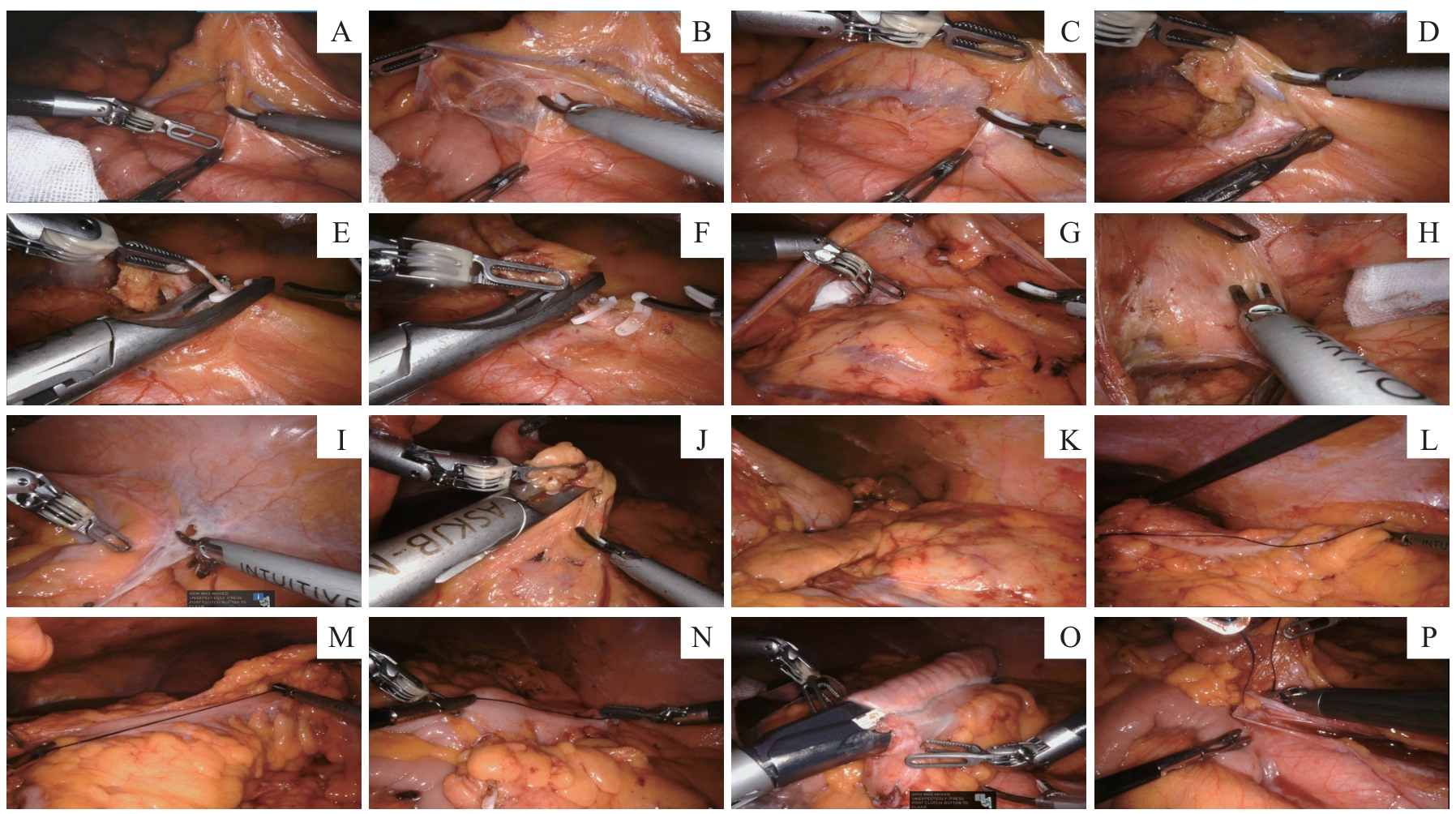
Fig 1 Key intraoperative steps in R-LCC
| Index | Total (n=105) |
|---|---|
| Age/year | 59.6±14.2 |
| Gender/n(%) | |
| Male | 72 (68.6) |
| Female | 33 (31.4) |
| Comorbidity/n(%) | 40 (38.1) |
| Hypertension | 26 (24.8) |
| Diabetes | 6 (5.7) |
| Hepatitis | 2 (1.9) |
| Cerebral infarction | 1 (1.0) |
| Coronary heart disease | 1 (1.0) |
| Multiple complications | 4 (3.8) |
| History of abdominal surgery/n(%) | 21 (20.0) |
| Appendectomy | 6 (5.7) |
| Cholecystectomy | 6 (5.7) |
| Hysterectomy | 3 (2.9) |
| Splenectomy | 1 (1.0) |
| Nephrectomy | 2 (1.9) |
| Laparoscopic inguinal hernia repair | 3 (2.9) |
Tab 1 Baseline data of 105 patients who underwent R-LCC
| Index | Total (n=105) |
|---|---|
| Age/year | 59.6±14.2 |
| Gender/n(%) | |
| Male | 72 (68.6) |
| Female | 33 (31.4) |
| Comorbidity/n(%) | 40 (38.1) |
| Hypertension | 26 (24.8) |
| Diabetes | 6 (5.7) |
| Hepatitis | 2 (1.9) |
| Cerebral infarction | 1 (1.0) |
| Coronary heart disease | 1 (1.0) |
| Multiple complications | 4 (3.8) |
| History of abdominal surgery/n(%) | 21 (20.0) |
| Appendectomy | 6 (5.7) |
| Cholecystectomy | 6 (5.7) |
| Hysterectomy | 3 (2.9) |
| Splenectomy | 1 (1.0) |
| Nephrectomy | 2 (1.9) |
| Laparoscopic inguinal hernia repair | 3 (2.9) |
| Index | Total (n=105) |
|---|---|
| Postoperative intestinal function recovery time/d | 2 (1‒7) |
| Time to first oral liquid intake/d | 2 (1‒50) |
| Postoperative hospital stay/d | 8 (5‒63) |
| Postoperative chemotherapy/n(%) | |
| Yes | 67 (63.8) |
| No | 38 (36.2) |
| Postoperative complication/n(%) | 17 (16.2) |
| Small bowel obstruction | 3 (2.9) |
| Postoperative bleeding | 2 (1.9) |
| Anastomotic leakage | 2 (1.9) |
| Surgical site infection | 7 (6.7) |
| Postsurgical gastroparesis syndrome | 1 (1.0) |
| Postoperative pancreatic fistula | 1 (1.0) |
| Postoperative pneumonia | 1 (1.0) |
Tab 2 Postoperative status of patients
| Index | Total (n=105) |
|---|---|
| Postoperative intestinal function recovery time/d | 2 (1‒7) |
| Time to first oral liquid intake/d | 2 (1‒50) |
| Postoperative hospital stay/d | 8 (5‒63) |
| Postoperative chemotherapy/n(%) | |
| Yes | 67 (63.8) |
| No | 38 (36.2) |
| Postoperative complication/n(%) | 17 (16.2) |
| Small bowel obstruction | 3 (2.9) |
| Postoperative bleeding | 2 (1.9) |
| Anastomotic leakage | 2 (1.9) |
| Surgical site infection | 7 (6.7) |
| Postsurgical gastroparesis syndrome | 1 (1.0) |
| Postoperative pancreatic fistula | 1 (1.0) |
| Postoperative pneumonia | 1 (1.0) |
| Index | Left colic flexure adjacent group (n=33) | Non-left colic flexure adjacent group (n=72) | P value |
|---|---|---|---|
| Tumor diameter/cm | 4.9±1.6 | 4.6±2.1 | 0.488 |
| Intraoperative complication/n(%) | 0.138 | ||
| Yes | 1 (3.0) | 0 (0) | |
| No | 32 (97.0) | 72 (100.0) | |
| Operative time/min | 165 (100‒330) | 168 (80‒300) | 0.738 |
| Intraoperative blood loss/mL | 50 (10‒1 200) | 50 (10‒400) | 0.530 |
| Histological type/n(%) | 0.697 | ||
| Ulcerative | 24 (72.7) | 49 (68.1) | |
| Uplifted | 9 (27.3) | 23 (31.9) | |
| Tumor stage/n(%) | 0.096 | ||
| Ⅰ | 2 (6.1) | 13 (18.0) | |
| Ⅱ | 20 (60.6) | 29 (40.3) | |
| Ⅲ | 11 (33.3) | 30 (41.7) | |
| Number of lymph nodes cleared/n | 13 (6‒42) | 15 (1‒41) | 0.285 |
| Number of metastatic lymph nodes/n | 0 (0‒9) | 0 (0‒13) | 0.714 |
| Postoperative intestinal function recovery time/d | 2 (1‒4) | 2 (1‒7) | 0.480 |
| Time to first oral liquid intake/d | 2 (1‒15) | 2 (1‒50) | 0.851 |
| Postoperative hospital stay/d | 8 (6‒20) | 10 (5‒63) | 0.952 |
| Postoperative chemotherapy/n(%) | 0.395 | ||
| Yes | 23 (69.7) | 44 (61.1) | |
| No | 10 (30.3) | 28 (38.9) | |
| Postoperative complication/n(%) | 0.130 | ||
| Yes | 8 (24.2) | 9 (12.5) | |
| No | 25 (75.8) | 63 (87.5) |
Tab 3 Comparison of tumors located at the left colic flexure and other regions of the left colon
| Index | Left colic flexure adjacent group (n=33) | Non-left colic flexure adjacent group (n=72) | P value |
|---|---|---|---|
| Tumor diameter/cm | 4.9±1.6 | 4.6±2.1 | 0.488 |
| Intraoperative complication/n(%) | 0.138 | ||
| Yes | 1 (3.0) | 0 (0) | |
| No | 32 (97.0) | 72 (100.0) | |
| Operative time/min | 165 (100‒330) | 168 (80‒300) | 0.738 |
| Intraoperative blood loss/mL | 50 (10‒1 200) | 50 (10‒400) | 0.530 |
| Histological type/n(%) | 0.697 | ||
| Ulcerative | 24 (72.7) | 49 (68.1) | |
| Uplifted | 9 (27.3) | 23 (31.9) | |
| Tumor stage/n(%) | 0.096 | ||
| Ⅰ | 2 (6.1) | 13 (18.0) | |
| Ⅱ | 20 (60.6) | 29 (40.3) | |
| Ⅲ | 11 (33.3) | 30 (41.7) | |
| Number of lymph nodes cleared/n | 13 (6‒42) | 15 (1‒41) | 0.285 |
| Number of metastatic lymph nodes/n | 0 (0‒9) | 0 (0‒13) | 0.714 |
| Postoperative intestinal function recovery time/d | 2 (1‒4) | 2 (1‒7) | 0.480 |
| Time to first oral liquid intake/d | 2 (1‒15) | 2 (1‒50) | 0.851 |
| Postoperative hospital stay/d | 8 (6‒20) | 10 (5‒63) | 0.952 |
| Postoperative chemotherapy/n(%) | 0.395 | ||
| Yes | 23 (69.7) | 44 (61.1) | |
| No | 10 (30.3) | 28 (38.9) | |
| Postoperative complication/n(%) | 0.130 | ||
| Yes | 8 (24.2) | 9 (12.5) | |
| No | 25 (75.8) | 63 (87.5) |
| [1] | Bray F, Laversanne M, Sung H, et al. Global cancer statistics 2022: GLOBOCAN estimates of incidence and mortality worldwide for 36 cancers in 185 countries[J]. CA Cancer J Clin, 2024, 74(3): 229-263. |
| [2] | 吴琪, 范伯男, 李岩. 2022全球癌症统计报告分析解读: 中国与世界癌症疾病负担与流行趋势[J]. 诊断学理论与实践, 2025, 24(2): 135-145. |
| Wu Q, Fan B N, Li Y. Analysis and interpretation of the 2022 Global Cancer Statistics Report: cancer burden and epidemiological trends in China and the world[J]. Journal of Diagnostics Concepts & Practice, 2025, 24(2): 135-145. | |
| [3] | Benson A B, Venook A P, Adam M, et al. Colon cancer, version 3.2024, NCCN clinical practice guidelines in oncology[J]. J Natl Compr Canc Netw, 2024, 22(2 D): e240029. |
| [4] | Cuk P, Kaalby L, Deding U, et al. Long-term outcomes of robot-assistedversus laparoscopic surgery for colon cancer: a nationwide register-based cohort study[J]. Ann Surg, 2024, 279(3): 456-461. |
| [5] | Zhang Y Q, Feng H R, Wang S D, et al. Short- and long-term outcomes of robotic-versus laparoscopic-assisted right hemicolectomy: a propensity score-matched retrospective cohort study[J]. Int J Surg, 2022, 105: 106855. |
| [6] | Feng Q Y, Yuan W T, Li T Y, et al. Robotic versus laparoscopic surgery for middle and low rectal cancer (REAL): short-term outcomes of a multicentre randomised controlled trial[J]. Lancet Gastroenterol Hepatol, 2022, 7(11): 991-1004. |
| [7] | Xu M L, Zhao Z M, Jia B Q, et al. Perioperative and long-term outcomes of robot-assisted versus laparoscopy-assisted hemicolectomy for left-sided colon cancers: a retrospective study[J]. Updates Surg, 2021, 73(3): 1049-1056. |
| [8] | Solaini L, Bocchino A, Avanzolini A, et al. Robotic versus laparoscopic left colectomy: a systematic review and meta-analysis[J]. Int J Colorectal Dis, 2022, 37(7): 1497-1507. |
| [9] | 谢礼锋, 贾静, 陈琦玮, 等. 腹腔镜左半结肠完整系膜切除术中“两翼齐飞”牵拉技术的临床应用研究[J]. 中华胃肠外科杂志, 2025, 28(4): 412-416. |
| Xie L F, Jia J, Chen Q W, et al. Clinical application study of the "two-winged" retraction technique in laparoscopic complete mesocolic resection for the left hemicolon[J]. Chinese Journal of Gastrointestinal Surgery, 2025, 28(4): 412-416. | |
| [10] | Bilgin I A, Bas M, Benlice C, et al. Totally laparoscopic and totally robotic surgery in patients with left-sided colonic diverticulitis[J]. Int J Med Robot, 2020, 16(1): e2068. |
| [11] | Zheng H C, Wang Q, Fu T, et al. Robotic versus laparoscopic left colectomy with complete mesocolic excision for left-sided colon cancer: a multicentre study with propensity score matching analysis[J]. Tech Coloproctol, 2023, 27(7): 569-578. |
| [12] | Rein L K L, Dohrn N, Gögenur I, et al. Robotic versus laparoscopic approach for left-sided colon cancer: a nationwide cohort study[J]. Colorectal Dis, 2023, 25(12): 2366-2377. |
| [13] | Dindo D, Demartines N, Clavien P A. Classification of surgical complications: a new proposal with evaluation in a cohort of 6336 patients and results of a survey[J]. Ann Surg, 2004, 240(2): 205-213. |
| [14] | Bassi C, Marchegiani G, Dervenis C, et al. The 2016 update of the International Study Group (ISGPS) definition and grading of postoperative pancreatic fistula: 11 years after[J]. Surgery, 2017, 161(3): 584-591. |
| [15] | Schol J, Huang I H, Carbone F, et al. Rome Foundation and international neurogastroenterology and motility societies' consensus on idiopathic gastroparesis[J]. Lancet Gastroenterol Hepatol, 2025, 10(1): 68-81. |
| [16] | Solis-Pazmino P, Oka K, La K, et al. Robotic right versus left colectomy for colorectal neoplasia: a systemic review and meta-analysis[J]. J Robot Surg, 2023, 17(5): 1907-1915. |
| [17] | Kim J C, Lee J L, Yoon Y S, et al. Robotic left colectomy with complete mesocolectomy for splenic flexure and descending colon cancer, compared with a laparoscopic procedure[J]. Int J Med Robot, 2018, 14(5): e1918. |
| [18] | Gass J M, Daume D, Schneider R, et al. Laparoscopic versus robotic-assisted, left-sided colectomies: intra- and postoperative outcomes of 683 patients[J]. Surg Endosc, 2022, 36(8): 6235-6242. |
| [1] | Shi Yan, Lu Changchuan, Li Zhengyan. Current status and prospects of robotic gastric cancer surgery based on clinical research [J]. Journal of Shanghai Jiao Tong University (Medical Science), 2026, 46(8): 1007-1014. |
| [2] | Chen Yi, Cai Duote, Xuan Xiaoxiao, Chen Sai, Chen Qingjiang, Gao Zhigang. Mesenteric cyst resection in children: a comparative analysis of the short-term effect of Da Vinci robotic system and laparoscopy [J]. Journal of Shanghai Jiao Tong University (Medical Science), 2026, 46(8): 1117-1123. |
| [3] | Liu Zhitong, Fan Zixu, Li Xiang, Zhang Min. Safety outcomes of immunotherapy continuation versus permanent discontinuation after immune checkpoint inhibitor-associated myocarditis in patients with lung cancer [J]. Journal of Shanghai Jiao Tong University (Medical Science), 2026, 46(5): 612-623. |
| [4] | Jiang Shuang, Yu Jiwei. Clinical efficacy of intra-abdominal anastomosis in laparoscopic right hemicolectomy [J]. Journal of Shanghai Jiao Tong University (Medical Science), 2026, 46(4): 502-508. |
| [5] | Jia Yuanwang, Qu Ming, Xin Ran, Liu Zinuan, Yang Shiyi, Kang Wen, Wang Weiran, Liu Xiao, Yang Junjie, Chen Yundai. Preliminary study on a mechanics-parameter-based strategy for real-time vascular angle prediction and safety warning in vascular interventional robots [J]. Journal of Shanghai Jiao Tong University (Medical Science), 2026, 46(3): 265-274. |
| [6] | AIMAITI Muerzhate, ZHANG Yeqian, LIU Tao, BAI Long, ZHANG Haoyu, NI Bo, GUAN Yujing, WANG Shuchang, GU Jiayi, ZHU Chunchao, XIA Xiang, ZHANG Zizhen. A comparative analysis of the short-term efficacy of robotic and laparoscopic proximal gastrectomy combined with double-flap anastomosis in the treatment of early upper gastric cancer [J]. Journal of Shanghai Jiao Tong University (Medical Science), 2025, 45(7): 874-882. |
| [7] | HU Jie, YANG Xianfeng. Effect of automatic tube current modulation on radiation dose and image quality of robotic-assisted hip CT [J]. Journal of Shanghai Jiao Tong University (Medical Science), 2025, 45(11): 1502-1506. |
| [8] | DUN Yiting, ZHAO Jing, FENG Chengling, LI Xingjian, CUI Di, HAN Bangmin. Online risk calculator and nomogram prediction model for urinary incontinence after robot-assisted laparoscopic radical prostatectomy [J]. Journal of Shanghai Jiao Tong University (Medical Science), 2025, 45(10): 1361-1371. |
| [9] | WU Lei, XIA Yimeng. Anesthetic application of PetCO2 monitoring nasopharyngeal airway to magnifying endoscopy in patients with obstructive sleep apnea syndrome [J]. Journal of Shanghai Jiao Tong University (Medical Science), 2023, 43(12): 1542-1547. |
| [10] | WEI Shan, JI Ouyang, CHEN Zhihao, HUANG Zehui, LI Pu, FANG Junyan, LIU Yingli. A prevalence study on knowledge, attitude, belief and practice of safe medication and analysis of related factors in dialysis patients [J]. Journal of Shanghai Jiao Tong University (Medical Science), 2023, 43(1): 88-94. |
| [11] | HUI Wenyu, WU Jinyang, HUANG Jianhua, LUAN Nan, ZHANG Zhiyuan, ZHANG Shilei. Experimental study on the accuracy evaluation of robot-assisted osteotomy of genioplasty [J]. Journal of Shanghai Jiao Tong University (Medical Science), 2022, 42(9): 1347-1352. |
| [12] | JIN Lei, XU Wenbin, YE Chenjing, YAN Hua. Prophylactic antifungal effect of posaconazole on patients with hematological malignant tumor undergoing chemotherapy [J]. Journal of Shanghai Jiao Tong University (Medical Science), 2022, 42(6): 792-796. |
| [13] | DENG Lu, LI Jiayi. Research progress of fractional CO2 laser therapy in female stress urinary incontinence [J]. Journal of Shanghai Jiao Tong University (Medical Science), 2022, 42(5): 685-689. |
| [14] | WANG Hui, ZHAO Ying, WEN Lirong, CAO Jun, YANG Jiping, YUAN Yongming. Diagnostic value of PSA, TAP and MACC1 expression in blood of patients with prostate cancer [J]. Journal of Shanghai Jiao Tong University (Medical Science), 2022, 42(4): 496-501. |
| [15] | WANG Yanhong, HAN Jiyu, WAN Daqian. Effect of lower limb exoskeleton robot on recovery of function in patients after arthroscopic meniscus repair [J]. Journal of Shanghai Jiao Tong University (Medical Science), 2022, 42(3): 337-343. |
| Viewed | ||||||
|
Full text |
|
|||||
|
Abstract |
|
|||||
