上海交通大学学报(医学版), 2024, 44(12): 1570-1578 doi: 10.3969/j.issn.1674-8115.2024.12.010

论著 · 公共卫生

出生前母体重(类)金属复合暴露与子代认知和气质发育的相关性研究

徐祖婧,1,2, 江怡宁1,2, 徐健,1,2,3

1.上海交通大学医学院附属国际和平妇幼保健院儿保康复科,上海 200030

2.上海市胚胎源性疾病重点实验室,上海 200030

3.上海交通大学医学院附属新华医院,教育部和上海市环境与儿童健康重点实验室,上海 200092

Relationship between prenatal mixed heavy metal/metalloid exposure and offspring cognitive and temperament development

XU Zujing,1,2, JIANG Yining1,2, XU Jian,1,2,3

1.The International Peace Maternity & Child Health Hospital, Shanghai Jiao Tong University School of Medicine, Shanghai 200030, China

2.Shanghai Key Laboratory of Embryo Original Diseases, Shanghai 200030, China

3.MOE-Shanghai Key Lab of Children's Environmental Health, Xinhua Hospital, Shanghai Jiao Tong University School of Medicine, Shanghai 200092, China

通讯作者: 徐 健,电子信箱:sonia0616@sjtu.edu.cn

编委: 瞿麟平

收稿日期: 2024-05-03   接受日期: 2024-09-30   网络出版日期: 2024-12-28

基金资助: 上海市卫生健康委员会卫生行业临床研究专项.  202240392

Corresponding authors: XU Jian, E-mail:sonia0616@sjtu.edu.cn.

Received: 2024-05-03   Accepted: 2024-09-30   Online: 2024-12-28

作者简介 About authors

徐祖婧(1999—),女,硕士生;电子信箱:tzxuzujing@163.com。 E-mail:tzxuzujing@163.com

摘要

目的·分析出生前母体重(类)金属复合暴露与子代认知和气质发育的相关性。方法·利用2010—2012年在上海开展的前瞻性出生队列,在妊娠28~36周采集孕妇静脉血,检测静脉血重(类)金属浓度。在幼儿24~36月龄时,使用格塞尔发育量表和幼儿气质量表分别评估幼儿的认知和气质发育。通过问卷及医院病历系统收集孕妇及幼儿的基本信息。使用贝叶斯核机器回归(Bayesian kernel machine regression,BKMR)模型评估出生前母体重(类)金属复合暴露对幼儿认知和气质发育的影响。结果·最终共纳入139对信息完整的母婴。入组时孕妇年龄为(29.39±3.41)岁,婴儿出生体质量为(3.47±0.42)kg,女性占59.71%,随访时幼儿月龄为(32.91±2.69)个月。根据以往研究证据和多元线性回归模型筛选出和幼儿认知和气质发展可能有关联的4种重(类)金属元素,分别为铬(Cr)、锰(Mn)、砷(As)和铅(Pb)。出生前母体静脉血Mn、Pb、As、Cr的浓度中位数分别为3.32、3.60、2.03、1.78 μg/dL。BKMR模型分析发现,矫正相关混杂因素后,当4种重(类)金属的整体浓度高于第50个百分位时,随着重(类)金属整体浓度的增加,幼儿的精细动作发育商呈下降趋势,且幼儿气质量表的适应性、坚持性和反应阈维度得分均呈下降趋势。其中出生前母体Mn暴露对幼儿精细动作发育影响的贡献最大[后验包含概率(posterior inclusion probabilities,PIP)=0.617],As暴露对幼儿坚持性维度影响的贡献最大(PIP=0.656),Cr暴露对幼儿反应阈维度影响的贡献最大(PIP=0.447),4种重(类)金属暴露对幼儿适应性维度影响的贡献相近。结论·出生前母体重(类)金属(Mn、As、Pb、Cr)复合暴露与幼儿的精细动作发育和气质的适应性、坚持性和反应阈维度发育之间可能存在相关性;尤其要重视Mn暴露与幼儿精细动作发育之间,以及As和Cr暴露与幼儿气质发育之间的关系。

关键词: 重金属暴露 ; 出生前暴露 ; 复合暴露 ; 认知 ; 气质

Abstract

Objective ·To analyze the relationship between prenatal mixed heavy metal/metalloid exposure and the cognitive and temperament development of the offspring. Methods ·A prospective birth cohort study was conducted in Shanghai from 2010 to 2012. Maternal venous blood samples were collected at 28‒36 weeks of gestation to measure prenatal maternal blood heavy metal/metalloid concentrations. At 24‒36 months of age, the cognitive and temperament development of the offspring were assessed by using Gesell Developmental Scale and Toddler Temperament Scale, respectively. Demographic and clinical information of mothers and children was collected via questionnaires and hospital medical records. Bayesian kernel machine regression (BKMR) models were employed to assess the effects of prenatal mixed heavy metal/metalloid exposure on toddlers' cognitive and temperament development. Results ·A total of 139 mother-child pairs with complete data were included in the study. At enrollment, the mean maternal age was (29.39±3.41) years, and the mean birth weight of the infants was (3.47±0.42) kg, with 59.71% female infants. At follow-up, the average age of the toddlers was (32.91±2.69) months. Based on prior research and multivariable linear regression models, four heavy metals/metalloid—chromium (Cr), manganese (Mn), arsenic (As), and lead (Pb)—were identified as potentially associated with cognitive and temperament development in children. The median concentrations of Mn, Pb, As, and Cr in the maternal venous blood during pregnancy were 3.32, 3.60, 2.03, and 1.78 μg/dL, respectively. After adjusting for related confounders, the BKMR analyses found that when the overall concentrations of the four heavy metals/metalloid (Cr, Mn, As, and Pb) were higher than the 50th percentile, children's fine motor development quotients showed a decreasing trend as the overall concentrations of the four heavy metals/metalloid increased. Scores for adaptability, persistence, and threshold of response on the temperament scale showed a decreasing trend as well. Prenatal Mn exposure levels made the greatest contribution to the effects on children's fine motor development [PIP (posterior inclusion probability)=0.617], prenatal As exposure levels made the greatest contribution to the effects on children's persistence trait (PIP=0.656), and prenatal Cr exposure levels made the greatest contribution to the effects on children's reaction threshold trait (PIP=0.447). The contribution of all four heavy metals/metalloid to the effects on children's adaptive dimension was similar. Conclusion ·Children's fine motor development and the adaptability, persistence, and threshold traits of temperament may be related to prenatal mixed exposure to heavy metals/metalloid (Mn, As, Pb, and Cr). Particular attention should be paid to the relationship between prenatal Mn exposure and children's fine motor development, and between prenatal As and Cr exposure and children's temperament development.

Keywords: heavy metal exposure ; prenatal exposure ; combined exposure ; cognition ; temperament

PDF (2576KB) 元数据 多维度评价 相关文章 导出 EndNote| Ris| Bibtex  收藏本文

本文引用格式

徐祖婧, 江怡宁, 徐健. 出生前母体重(类)金属复合暴露与子代认知和气质发育的相关性研究. 上海交通大学学报(医学版)[J], 2024, 44(12): 1570-1578 doi:10.3969/j.issn.1674-8115.2024.12.010

XU Zujing, JIANG Yining, XU Jian. Relationship between prenatal mixed heavy metal/metalloid exposure and offspring cognitive and temperament development. Journal of Shanghai Jiao Tong University (Medical Science)[J], 2024, 44(12): 1570-1578 doi:10.3969/j.issn.1674-8115.2024.12.010

环境污染已成为当代社会威胁人类生存和发展的严重问题之一,其中的重金属污染对人类健康造成了严重影响。由于铅(Pb)、锰(Mn)、铬(Cr)、砷(As)等重(类)金属元素广泛应用于工业、农业和生活领域,重金属暴露问题在日常生活中不可避免。空气、土壤、灰尘、水以及食物中的重金属可以通过多种途径(包括消化道摄入、呼吸道吸入和皮肤吸收等)进入人体1。出生前胎儿脑发育极不成熟,孕期或孕前进入母体的重金属可能通过母体代谢和母胎传递进入胎儿体内,影响发育中的胎儿脑组织2

既往研究2表明,出生前多种重(类)金属单一暴露都对儿童认知行为发育造成不良影响。如产前Pb暴露水平与儿童认知水平和精细动作发育呈负相关3-6;产前低浓度As暴露可能会对女童的操作智商和语言智力产生负面影响3;产前镉(Cd)暴露水平越高,儿童运动发育水平越差7;妊娠期(类)金属[As、Cd、铜(Cu)、汞(Hg)、Mn、镁和Pb]暴露与儿童自闭症和多动症之间存在关联8。既往也有少量研究评估了出生前重金属单一暴露对儿童气质行为的影响,如产前Pb暴露与幼儿气质行为发育的相关性(发现围生期母亲的胫骨骨铅水平与幼儿24月龄时的反应阈得分明显负相关,即胫骨骨铅水平越高,幼儿倾向于对环境刺激越不敏感)9

实际生活中,孕妇往往同时暴露于多种重金属元素,如吸入工业排放的粉尘或摄入的食物来自被重金属污染的土壤/水源。Mn、Pb、As和Cr这4种重(类)金属共暴露广泛存在于接触重金属矿库和煤矿周边土壤、各类生活或医疗垃圾中。因此单一重(类)金属暴露的效应研究无法准确评估复合暴露诱发的实际效应,需要探讨出生前重(类)金属复合暴露诱发的综合影响。但既往的流行病学研究鲜有关注出生前母体重金属复合暴露对儿童神经行为发育的影响,更缺乏探讨非职业人群或非污染地区中,出生前低水平重(类)金属复合暴露对儿童神经行为发育的影响。

本研究基于上海交通大学医学院附属新华医院(新华医院)及上海交通大学医学院附属国际和平妇幼保健院(国际和平妇幼保健院)开展的前瞻性出生队列,分析出生前母体多种重(类)金属元素暴露与幼儿认知和气质发育的影响。研究结果可能为今后出生前重(类)金属复合暴露诱发的神经发育毒性的防治提供参考依据。不同的重(类)金属可能在暴露途径、吸收代谢等过程中有相互作用。从而对儿童认知行为发育产生相加、协同或拮抗等联合作用。而传统效应研究的回归统计模型不能准确评估真实的效应影响,因此本研究拟采用贝叶斯核机器回归(Bayesian kernel machine regression,BKMR)10,分析出生前母体多种重(类)金属复合暴露对子代认知行为的联合效应。该BKMR分析方法目前已被广泛应用于多污染物联合作用的研究中11-13

1 对象和方法

1.1 研究对象及方案

研究对象来自新华医院及国际和平妇幼保健院2010—2012年开展的一项前瞻性出生队列研究。该队列于产前门诊招募孕28~36周孕妇,并随访至幼儿24~36月龄。通过问卷及医院病历系统收集孕妇基本信息,包括孕妇年龄、受教育程度、孕前职业、婚姻状况、家庭月收入等,以及幼儿的性别、出生时的相关信息和随访时的幼儿月龄。采集孕妇外周静脉血,检测重(类)金属水平。幼儿24~36月龄时,分别评估幼儿的认知水平和气质特征。孕妇纳入标准:①孕28~36周的孕妇。②计划在新华医院或国际和平妇幼保健院分娩。③孕妇或家属签署知情同意书。排除标准:①孕妇有相关精神心理疾病史或认知水平低下。②有严重的妊娠并发症(包括肝脏、肾脏或心脏疾病,妊娠糖尿病,高血压和先兆子痫)。③婴儿出生后5 min的Apgar评分在7分或以下。④双胎或多胎。

本研究共招募了398对母婴。有173对母婴失访,其中124对是由于随访时没时间参与、家里离医院太远或天气恶劣等,另外49对是由于无法联系到而失访。因此,共随访了225对母婴,其中139对母婴有产前母体重(类)金属暴露水平的数据,作为最终纳入研究的对象。在已随访和未随访的母婴对之间,未发现孕妇年龄、受教育程度、收入水平,以及婴儿性别、出生体质量等方面差异存在统计学意义。

1.2 出生前母体重(类)金属暴露和幼儿的认知行为发育评估

1.2.1 出生前母体重(类)金属水平的检测

在孕晚期采集孕妇5 mL外周静脉血,使用电感耦合等离子体质谱仪(安捷伦7500ce,美国)测定血清Cr、Mn、As、Hg、钴(Co)、镍(Ni)、Cd多种重(类)金属浓度,采用原子吸收光谱法(珀金埃尔默PinAAcle 900Z,美国)检测全血Pb水平。检测中均设置不同水平的质控对照样品。所有样本的重(类)金属含量均达到检测限。

1.2.2 幼儿认知水平的评估

幼儿的认知水平由2位经过统一培训的专业人员使用中文版的格塞尔发育量表(Gesell Developmental Schedule,GDS)进行评估。中文版GDS在中国得到了验证和广泛应用。该量表包括粗大运动、精细动作、适应性、语言和个人社交5个维度14,各维度的发育商(developmental quotient,DQ)数值越大,意味着幼儿在该维度的发育水平越高15。中文版GDS具有较高的信度和效度,特异性和阴性预测值较高,对于初级筛查小儿异常神经行为发育具有实用价值。本研究中GDS的Cronbach's α系数为0.820。

1.2.3 幼儿气质的评估

幼儿气质是幼儿在日常生活中不同条件下的行为反应方式。幼儿气质量表(Toddler Temperament Scale,TTS)中文版在国内广泛应用于幼儿气质特征的探究,具有较好的评估效能16。共涉及9个气质维度,即活动水平、节律性、趋避性、适应性、反应强度、情绪本质、坚持性、注意分散度和反应阈,包含97个条目17。9个维度的得分越高,分别表明身体活动的水平越高、生理活动越不规律、趋避性方面越趋向于回避和不接受、面对新环境或新刺激适应越慢、情绪反应越强烈、情绪本质方面表现越消极、执着于某项事务时间越短和不持久、注意力越不容易从正在进行的活动转移到其他活动、反应阈方面阈值越低(越敏感)。气质特点本身无好坏之分,但气质水平的变化常常与儿童的行为改变和行为发育相关。根据以往文献16,中文版TTS的重测系数为0.84~0.94,Cronbach's α系数为0.7。本研究中TTS的Cronbach's α系数为0.679。

1.3 统计学分析

应用SPSS 26.0.0.0和R 4.2.2软件进行统计分析。定量资料先进行正态性检验,对符合正态分布的数据用x±s表示;对不符合正态分布的数据用MP25P75)表示。将不符合正态分布的重(类)金属浓度进行对数转换,以实现符合线性模型的正态性。定性资料用频数(百分比)表示。

根据以往研究证据和本研究的统计筛选[采用多元线性回归模型,在矫正相关混杂因素以后,分析出生前母体单一重(类)金属暴露与子代认知和气质行为发育之间的关联],筛选出对幼儿认知和行为发育可能有较大影响的4种出生前母体重(类)金属暴露的元素Mn、Pb、As和Cr。采用BKMR模型分析出生前母体重(类)金属混合暴露对子代认知水平和气质发育的影响,具体包括:①采用BKMR模型中的多污染模型,分析出生前母体重(类)金属混合暴露对子代认知和气质发育影响的总效应。②通过BKMR计算每种重(类)金属的后验包含概率(posterior inclusion probability,PIP;PIP是基于BKMR模型对先验概率进行修正后得到的概率),以识别在对幼儿认知和气质行为发育的影响中何种重(类)金属占据主导作用。模型计算了4种重(类)金属的PIP,数值范围0~1,PIP越大表示该重(类)金属元素暴露对结局指标的影响效应越强。③通过绘制双变量暴露-反应曲线,分析出生前母体4种重(类)金属复合暴露对幼儿认知和气质发育的交互效应。以上数据分析过程中,校正因素包括招募时孕妇的年龄、受教育程度,幼儿出生时孕周、性别和年龄。

2 结果

2.1 研究对象的一般情况

本研究共纳入母婴139对,入组时孕妇年龄为(29.39±3.41)岁,其中大学本科及以上学历占88.49%,职业范围包括各类专业技术人员(32.37%)、行政办事或管理人员(21.58%)、商业工作人员(17.99%)等,家庭月均总收入超过1万元的占30.21%;幼儿出生体质量为(3.47±0.42)kg,男女占比分别为40.29%和59.71%,随访时幼儿月龄为(32.91±2.69)个月。出生前孕晚期血Mn、Pb、As、Cr的浓度中位数分别为3.32、3.60、2.03、1.78 μg/dL。详细结果如表1

表1   研究对象的人口学特征及临床特征

Tab 1  Demographic and clinical characteristics of participants

CharacteristicValue
Maternal age/year29.39±3.41
Maternal education level/n(%)
Senior high school or below16 (11.50)
University or college105 (75.54)
Postgraduate18 (12.95)
Marital status/n(%)
Married134 (96.40)
Single5 (3.60)
Occupation/n(%)
Professional and technical personnel45 (32.37)
Administrative or management personnel30 (21.58)
Commercial personnel25 (17.99)
Others39 (28.06)
Family monthly income/n(%)
<2 000 yuan6 (4.32)
2 000‒5 000 yuan37 (26.62)
5 000‒10 000 yuan54 (38.85)
>10 000 yuan42 (30.21)
Birth weight/kg3.47±0.42
Gestational age/week39.27±1.36
Child gender/n(%)
Male56 (40.29)
Female83 (59.71)
Child age/month32.91±2.69
DQ of GDS/score
Gross motor108.36±11.05
Fine motor100.47±13.32
Language111.48±12.40
Adaptive114.23±8.81
Personal-social105.38±11.01
Score of TTS/score
Activity3.23±0.57
Rhythm2.63±0.57
Withdrawal2.94±0.77
Adaptability2.90±0.58
Reaction3.85±0.60
Mood2.66±0.63
Persistence2.86±0.66
Attention3.72±0.53
Threshold3.89±0.75
Heavy metal/metalloid level/(μg·dL-1)
Mn3.32 (2.24, 4.63)
Pb3.60 (2.55, 4.35)
As2.03 (1.01, 3.35)
Cr1.78 (0.77, 2.52)

新窗口打开| 下载CSV


2.2 出生前母体4种重(类)金属复合暴露对幼儿认知和气质发育的总效应

以出生前母体4种重(类)金属(Mn、Cr、As、Pb)整体浓度处于第50个百分位(P50)水平时的DQ或得分为参照,比较不同百分位数水平下幼儿的神经行为发育水平得分改变的后验均值及其95%CI

2.2.1 对幼儿精细动作DQ水平的总效应

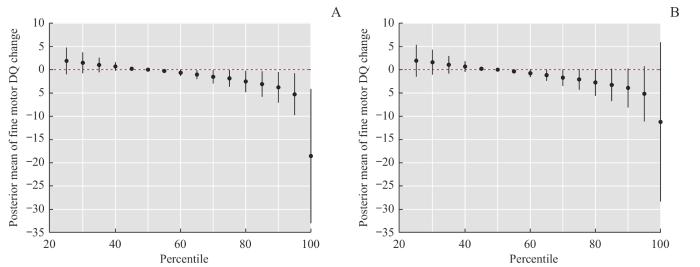
当4种重(类)金属的整体浓度高于P50时,随着重(类)金属整体浓度的增加,幼儿的精细动作DQ呈下降趋势。当校正混杂因素后,差异无统计学意义,下降趋势无明显变化;与P50时的DQ相比,4种重(类)金属的整体浓度上升至P75时幼儿的精细动作DQ平均下降了2.07(图1)。

图1

图1   通过BKMR模型分析出生前母体4种重(类)金属复合暴露对幼儿精细动作发育的总效应

Note: The overall concentration of the four heavy metals/metalloid (Mn, Cr, As, and Pb) at the P50 level was used as the reference (dashed lines). A. Without adjustment for confounders. B. After adjusting for maternal age, maternal education, gestational age, child age, and child gender.

Fig 1   Total effect of prenatal maternal exposure to a combination of four heavy metals/metalloid on the fine motor development of children by the BKMR model


2.2.2 对幼儿气质的适应性维度得分的总效应

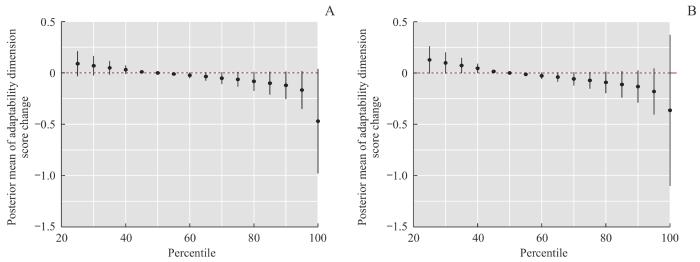
当4种重(类)金属的整体浓度高于P50时,随着重(类)金属整体浓度的增加,幼儿的适应性维度得分呈下降趋势,可能提示幼儿倾向于更急切地融入不熟悉的人或环境。当校正混杂因素后,差异无统计学意义,但下降趋势无明显变化;与P50时的得分相比,4种重(类)金属的整体浓度上升至P75时幼儿的适应性维度得分平均下降0.07(图2)。

图2

图2   通过BKMR模型分析出生前母体4种重(类)金属复合暴露对幼儿适应性维度的总效应

Note: The overall concentration of the four heavy metals/metalloid (Mn, Cr, As, and Pb) at the P50 level was used as the reference (dashed lines). A. Without adjustment for confounders. B. After adjusting for maternal age, maternal education, gestational age, child age, and child gender.

Fig 2   Total effect of prenatal maternal exposure to a combination of four heavy metals/metalloid on the adaptive dimension of the children by the BKMR model


2.2.3 对幼儿气质的坚持性维度得分的总效应

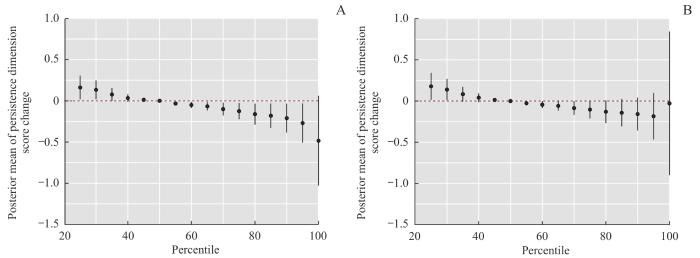
当4种重(类)金属的整体浓度高于P50时,随着重(类)金属整体浓度的增加,幼儿的坚持性维度得分呈下降趋势,提示幼儿倾向于坚持固有的行为方式。当校正混杂因素后,差异无统计学意义,下降趋势无明显变化;与P50时的得分相比,4种重(类)金属的整体浓度上升至P75时幼儿的坚持性维度得分平均下降0.10(图3)。

图3

图3   通过BKMR模型分析出生前母体4种重(类)金属复合暴露对幼儿坚持性维度的总效应

Note: The overall concentration of the four heavy metals/metalloid (Mn, Cr, As, and Pb) at the P50 level was used as the reference (dashed lines). A. Without adjustment for confounders. B. After adjusting for maternal age, maternal education, gestational age, child age, and child gender.

Fig 3   Total effect of prenatal maternal exposure to a combination of four heavy metals/metalloid on the persistence dimension of the children by the BKMR model


2.2.4 对幼儿气质的反应阈维度得分的总效应

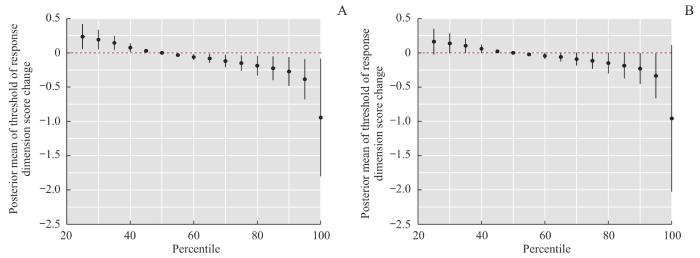
当4种重(类)金属的整体浓度高于P50时,随着重(类)金属整体浓度的增加,幼儿的反应阈维度得分呈下降趋势,提示幼儿倾向于对周围人或环境变化的感应或感受更不敏感。当校正混杂因素后,差异无统计学意义,下降趋势无明显变化;与P50时的得分相比,4种重(类)金属的整体浓度上升至P75时幼儿的反应阈维度得分平均下降0.12(图4)。

图4

图4   通过BKMR模型分析出生前母体4种重(类)金属复合暴露对幼儿反应阈维度的总效应

Note: The overall concentration of the four heavy metals/metalloid (Mn, Cr, As, and Pb) at the P50 level was used as the reference (dashed lines). A. Without adjustment for confounders. B. After adjusting for maternal age, maternal education, gestational age, child age, and child gender.

Fig 4   Total effect of prenatal maternal exposure to a combination of four heavy metals/metalloid on the threshold of response dimension of the children by the BKMR model


2.2.5 对幼儿其他认知维度和气质维度的总效应

在本研究对象的4种重(类)金属的整体浓度范围内,出生前母体的重(类)金属复合暴露水平对幼儿的其他认知维度和气质维度的影响未表现出浓度相关的变化趋势。

2.3 出生前母体重(类)金属复合暴露对幼儿认知和气质发育影响的主导性分析

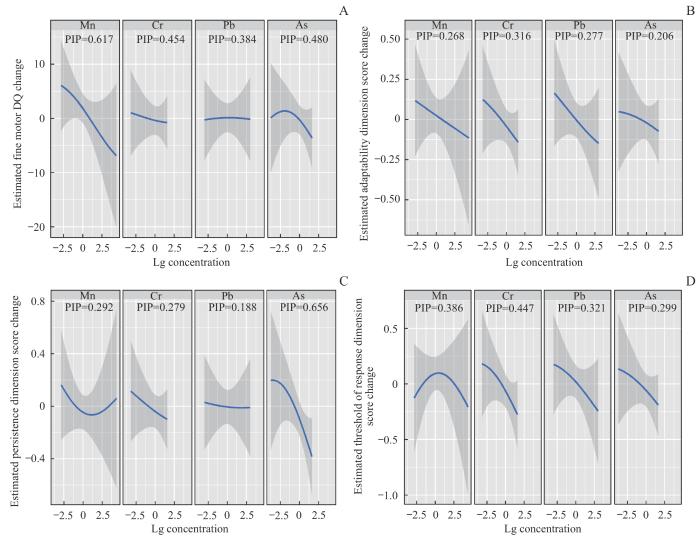
为探寻何种重(类)金属在影响幼儿精细动作和适应性、坚持性、反应阈值3个气质维度发展中占据主导,本研究基于BKMR模型计算了4种(类)重金属对于每个维度的PIP。结果显示,在出生前母体重(类)金属复合暴露对精细动作发育的影响中,Mn暴露的不利影响贡献最大(PIP=0.617),其次是As(PIP=0.480)(图5A)。在对适应性维度的影响中,4种重(类)金属暴露不利影响的贡献相近(图5B)。在对坚持性维度的影响中,出生前As暴露的贡献最大(PIP=0.656)(图5C)。在对反应阈维度的影响中,出生前Cr暴露的贡献最大(PIP=0.447)(图5D)。

图5

图5   基于BKMR模型分析出生前母体4种重(类)金属暴露对幼儿认知和气质发育影响的主导性

Note: The models were adjusted for maternal age, maternal education, gestational age, child age, and child sex. The impact of prenatal maternal exposure to various heavy metals/metalloid on the changes in fine motor DQ (A), and adaptability (B)/persistence (C)/threshold of response (D) dimension scores across different exposure levels was assessed. The figures illustrated the associations between the concentration of a specific heavy metal/metalloid and changes in the DQ value or dimension scores, while the concentration levels of the other three were fixed at the 50th percentile.

Fig 5   Analyses of the dominant effects of prenatal maternal exposure to the four heavy metals/metalloid on cognitive and temperament development in young children based on the BKMR model


2.4 出生前母体4种重(类)金属复合暴露对幼儿认知和气质发育的交互效应

本研究还利用BKMR模型分析了出生前母体双重(类)金属复合暴露对幼儿认知和气质发育的交互效应。结果提示在精细动作发育维度上,Cr、As之间及Cr、Mn之间可能存在一定交互作用;即与出生前较低水平As暴露相比,较高水平的As暴露对于出生前Cr暴露降低精细动作DQ水平可能有协同作用的趋势,Cr和Mn暴露之间的交互作用也与此类似。其余维度上没有发现存在交互作用。

3 讨论

目前关注出生前重金属复合暴露对子代神经行为发育影响的研究较少。本研究结果显示,出生前母体重(类)金属Mn、As、Pb、Cr复合暴露对子代认知和气质发育可能产生不利的影响。更具体地说,在精细动作发育方面,Mn暴露所致的不利影响贡献最大;而对幼儿气质的坚持性和反应阈维度影响方面,As和Cr暴露所致影响的贡献相对较大。

美国疾病控制预防中心在2010年发布的《孕期和哺乳期妇女铅暴露的识别和管理指南》18中指出,对静脉血血铅水平大于5 μg/dL的孕妇建议进行随访或干预管理;当孕妇静脉血血铅浓度达到45 μg/dL时建议要按照高危妊娠处理,并进行驱铅螯合治疗或给予其他治疗措施。在本研究中,出生前母亲静脉血全血Pb浓度中位数为3.60 μg/dL。一项2015—2019年韩国的出生队列研究结果19显示,孕早、晚期母亲静脉血Pb浓度中位数分别为0.67 μg/dL和0.62 μg/dL。沙特阿拉伯的研究20报道,妊娠晚期孕妇血Pb浓度中位数为2.54 μg/dL。墨西哥的研究21结果显示,脐带血Pb水平为(4.7±3.1)μg/dL,产后1个月母亲静脉血全血Pb水平为(7.5±4.6)μg/dL。江苏省的一项研究22结果显示,孕晚期母亲静脉血Pb中位数浓度为4.05 μg/dL。不同地区的孕期或围生期血铅水平的差异可能与地区经济发展、环境控制和调查人群的生活行为习惯有关。在本研究中,出生前母亲血Mn中位数浓度为3.32 μg/dL。日本的一项研究23中,孕中晚期母亲静脉血Mn浓度中位数为1.54 μg/dL。墨西哥的一项队列24研究中,孕晚期母亲静脉血Mn浓度中位数为0.99 μg/dL。Mn主要来自饮食摄入,谷物、豆类、茶叶和绿叶蔬菜等植物性食物中Mn的含量最为丰富25-26,锰铁矿开采、干电池加工与电子垃圾拆解等行业人群和周边地区的人群可能面临更高水平的Mn暴露27-29,各研究之间Mn水平的差异可能与各地区所调查人群的饮食倾向(如素食主义者)和环境污染控制(如长期接触高锰环境)有关。

既往研究30-31提示Mn影响儿童运动发育,并且影响程度可能与Mn的剂量密切相关。与这些既往研究类似,本研究也发现出生前母体Mn暴露对幼儿精细动作发育的不利影响贡献较大。另外,韩国的出生队列研究31结果显示母亲血Mn浓度与6月龄婴儿的神经发育指数之间呈现倒U形关系,当血Mn浓度范围在24~28 μg/L时,神经发育结果与血Mn的相关性从正相关变为负相关。这表明母体血Mn水平过低或过高均会对婴儿神经发育产生不利影响。

目前关于出生前Cr暴露对儿童认知行为发育影响的研究相对较少。本研究中,在4种重(类)金属复合暴露整体效应中,出生前母体Cr暴露对幼儿反应阈维度的效应最强,对精细动作发育的不利影响也较强。与本研究结果类似,西班牙的一项研究32发现,尿Cr水平与6~11岁男童总智商水平呈负相关。另一项广东省电子垃圾拆解区的调查研究33发现,儿童血Cr值与Conners教师评定量表(Teacher Rating Scale,TRS)中的品行问题、多动问题、不注意-被动、多动指数的得分呈正相关,提示Cr暴露与儿童更高水平的多动、冲动和不顾忌环境可能相关。这些研究均揭示Cr暴露,尤其是生命早期Cr暴露对儿童神经行为发育的影响。

本研究发现,出生前母体As暴露对幼儿坚持性维度影响的贡献最大,提示出生前As暴露可能诱发幼儿在活动内容和行为方式上有更高的坚持性;另外对幼儿精细动作不良影响的贡献也较高。与本研究类似,一项马鞍山出生队列研究34显示,孕早期和分娩时脐带血的As水平增加可能与子代的年龄与发育进程问卷的个人-社会能区发育损伤的风险增加有关。一项挪威的研究8结果显示,产前As暴露会增加儿童自闭症的风险,而刻板行为是儿童自闭症的重要表现。武汉的一项研究35结果也显示,出生前As暴露与儿童2岁时的神经发育水平呈负相关。

出生前母体Pb暴露与婴幼儿及儿童神经发育损伤密切相关。本研究发现,出生前Pb水平与幼儿神经认知损伤的关联不是最突出的,在对幼儿气质行为发育影响中的贡献也不是最大的,可能与本研究中孕妇血Pb水平相对较低有关。

本研究还提示出生前母体Cr与As双暴露及Cr与Mn双暴露对子代神经行为发育影响之间可能存在交互作用。这些结果尚未被其他研究报道过,还需进一步的研究探讨和验证。

本研究存在以下局限性:首先,本研究样本量相对较少,仅是2家医疗机构部分孕妇的数据,且失访人数较多,不能完全排除失访偏倚。第二,本研究仅测定了出生前母体静脉血中重(类)金属暴露水平,无法排除妊娠不同阶段和出生后重(类)金属复合暴露对幼儿神经认知行为发展影响的干扰。第三,与大多数儿童气质评估工具一样,TTS依赖于抚养人的主观报告,因此可能存在报告偏倚。第四,本研究未进一步探究复合暴露中各重(类)金属发挥效应的权重。

综上所述,出生前母体Cr、Mn、As、Pb 4种重(类)金属复合暴露会对子代认知行为发育造成影响,主要表现为影响精细动作发展和诱发儿童气质行为的改变。这些发现可能有助于加深我们对出生前重(类)金属复合暴露对儿童神经行为发育影响的理解,并可能促进对相关公共卫生政策的研究。

AUTHOR's CONTRIBUTIONS

The study was designed by XU Zujing, JIANG Yining and XU Jian. The manuscript was drafted and revised by XU Zujing and XU Jian. The data analysis was conducted by XU Zujing and JIANG Yining. All the authors have read the last version of paper and consented for submission.

作者贡献声明

徐祖婧、江怡宁、徐健参与研究设计;徐祖婧、徐健参与论文写作和修改;徐祖婧、江怡宁参与数据分析工作。所有作者均阅读并同意最终稿件的提交。

利益冲突声明

所有作者声明不存在利益冲突。

COMPETING INTERESTS

All authors disclose no relevant conflict of interests.

参考文献

WITKOWSKA D, SŁOWIK J, CHILICKA K. Heavy metals and human health: possible exposure pathways and the competition for protein binding sites[J]. Molecules, 2021, 26(19): 6060.

[本文引用: 1]

DÓREA J G. Exposure to environmental neurotoxic substances and neurodevelopment in children from Latin America and the Caribbean[J]. Environ Res, 2021, 192: 110199.

[本文引用: 2]

WANG Y H, WANG Y Q, YAN C H. Gender differences in trace element exposures with cognitive abilities of school-aged children: a cohort study in Wujiang city, China[J]. Environ Sci Pollut Res Int, 2022, 29(43): 64807-64821.

[本文引用: 2]

JIA Z X, ZHANG H L, YU L, et al. Prenatal lead exposure, genetic factors, and cognitive developmental delay[J]. JAMA Netw Open, 2023, 6(10): e2339108.

GUO J Q, WU C H, ZHANG J M, et al. Prenatal exposure to mixture of heavy metals, pesticides and phenols and IQ in children at 7 years of age: the SMBCS study[J]. Environ Int, 2020, 139: 105692.

KADAWATHAGEDARA M, MUCKLE G, QUÉNEL P, et al. Infant neurodevelopment and behavior in Guadeloupe after lead exposure and Zika maternal infection during pregnancy[J]. Neurotoxicology, 2023, 94: 135-146.

[本文引用: 1]

LIU J Y, MARTIN L J, DINU I, et al. Interaction of prenatal bisphenols, maternal nutrients, and toxic metal exposures on neurodevelopment of 2-year-olds in the APrON cohort[J]. Environ Int, 2021, 155: 106601.

[本文引用: 1]

SKOGHEIM T S, WEYDE K V F, ENGEL S M, et al. Metal and essential element concentrations during pregnancy and associations with autism spectrum disorder and attention-deficit/hyperactivity disorder in children[J]. Environ Int, 2021, 152: 106468.

[本文引用: 2]

STROUSTRUP A, HSU H H, SVENSSON K, et al. Toddler temperament and prenatal exposure to lead and maternal depression[J]. Environ Health, 2016, 15(1): 71.

[本文引用: 1]

BOBB J F, VALERI L, CLAUS HENN B, et al. Bayesian kernel machine regression for estimating the health effects of multi-pollutant mixtures[J]. Biostatistics, 2015, 16(3): 493-508.

[本文引用: 1]

ZHANG Y Q, DONG T Y, HU W Y, et al. Association between exposure to a mixture of phenols, pesticides, and phthalates and obesity: comparison of three statistical models[J]. Environ Int, 2019, 123: 325-336.

[本文引用: 1]

TAN Y X, FU Y Y, YAO H J, et al. Relationship between phthalates exposures and hyperuricemia in U.S. general population, a multi-cycle study of NHANES 2007‒2016[J]. Sci Total Environ, 2023, 859(Pt 1): 160208.

ZHAN W Q, QIU W, AO Y, et al. Environmental exposure to emerging alternatives of per- and polyfluoroalkyl substances and polycystic ovarian syndrome in women diagnosed with infertility: a mixture analysis[J]. Environ Health Perspect, 2023, 131(5): 57001.

[本文引用: 1]

YAO Q, VINTURACHE A, LEI X N, et al. Prenatal exposure to per- and polyfluoroalkyl substances, fetal thyroid hormones, and infant neurodevelopment[J]. Environ Res, 2022, 206: 112561.

[本文引用: 1]

JIANG Y Q, WEI Y Y, GUO W H, et al. Prenatal titanium exposure and child neurodevelopment at 1 year of age: a longitudinal prospective birth cohort study[J]. Chemosphere, 2023, 311(Pt 1): 137034.

[本文引用: 1]

洪琦, 周胜利, 姚凯南, 等. 幼儿气质量表的应用研究[J]. 中国儿童保健杂志, 2001, 9(3): 151-153.

[本文引用: 2]

HONG Q, ZHOU S L, YAO K N, et al. The assessment of Toddler Temperament Scale[J]. Chinese Journal of Child Health Care, 2001, 9(3): 151-153.

[本文引用: 2]

GIBBS M V, REEVES D, CUNNINGHAM C C. The application of temperament questionnaires to a British sample: issues of reliability and validity[J]. J Child Psychol Psychiatry, 1987, 28(1): 61-77.

[本文引用: 1]

ETTINGER A S, WENGROVITZ A G, PORTIE C, et al. Guidelines for the identification and management of lead exposure in pregnant and lactating women[S/OL]. Atlanta: U.S. Department of Health and Human Services, 2010[2024-09-19]. https://stacks.cdc.gov/view /cdc/147837.

[本文引用: 1]

ZINIA S S, YANG K H, LEE E J, et al. Effects of heavy metal exposure during pregnancy on birth outcomes[J]. Sci Rep, 2023, 13(1): 18990.

[本文引用: 1]

AL-SALEH I, SHINWARI N, MASHHOUR A, et al. Birth outcome measures and maternal exposure to heavy metals (lead, cadmium and mercury) in Saudi Arabian population[J]. Int J Hyg Environ Health, 2014, 217(2/3): 205-218.

[本文引用: 1]

CLAUS HENN B, SCHNAAS L, ETTINGER A S, et al. Associations of early childhood manganese and lead coexposure with neurodevelopment[J]. Environ Health Perspect, 2012, 120(1): 126-131.

[本文引用: 1]

SUN H, CHEN W, WANG D Y, et al. The effects of prenatal exposure to low-level cadmium, lead and selenium on birth outcomes[J]. Chemosphere, 2014, 108: 33-39.

[本文引用: 1]

MIYAZAKI J, IKEHARA S, TANIGAWA K, et al. Prenatal exposure to selenium, mercury, and manganese during pregnancy and allergic diseases in early childhood: the Japan environment and children's study[J]. Environ Int, 2023, 179: 108123.

[本文引用: 1]

FARÍAS P, HERNÁNDEZ-BONILLA D, MORENO-MACÍAS H, et al. Prenatal co-exposure to manganese, mercury, and lead, and neurodevelopment in children during the first year of life[J]. Int J Environ Res Public Health, 2022, 19(20): 13020.

[本文引用: 1]

MARTINS A C, KRUM B N, QUEIRÓS L, et al. Manganese in the diet: bioaccessibility, adequate intake, and neurotoxicological effects[J]. J Agric Food Chem, 2020, 68(46): 12893-12903.

[本文引用: 1]

MA C C, IWAI-SHIMADA M, TATSUTA N, et al. Health risk assessment and source apportionment of mercury, lead, cadmium, selenium, and manganese in Japanese women: an adjunct study to the Japan environment and children's study[J]. Int J Environ Res Public Health, 2020, 17(7): 2231.

[本文引用: 1]

HERNÁNDEZ-PELLÓN A, FERNÁNDEZ-OLMO I, LEDOUX F, et al. Characterization of manganese-bearing particles in the vicinities of a manganese alloy plant[J]. Chemosphere, 2017, 175: 411-424.

[本文引用: 1]

周燕婷. 广西锰暴露工人队列的随访及职业锰暴露对血液免疫学指标水平的影响[D]. 南宁: 广西医科大学, 2018.

ZHOU Y T. Follow-up of manganese-exposed workers cohort and effects of occupational manganese exposure on blood immunological indicators[D]. Nanning: Guangxi Medical University, 2018.

林鑫江, 杜登青, 陈思洽. 电子垃圾拆解区帕金森病患者血锰水平相关分析[J]. 中国现代药物应用, 2017, 11(18): 26-27.

[本文引用: 1]

LIN X J, DU D Q, CHEN S Q. Correlation analysis of blood manganese levels in Parkinson's disease patients in the electronic waste dismantling area[J]. Chinese Journal of Modern Drug Application, 2017, 11(18): 26-27.

[本文引用: 1]

RODRIGUES E G, BELLINGER D C, VALERI L, et al. Neurodevelopmental outcomes among 2- to 3-year-old children in Bangladesh with elevated blood lead and exposure to arsenic and manganese in drinking water[J]. Environ Health, 2016, 15: 44.

[本文引用: 1]

CHUNG S E, CHEONG H K, HA E H, et al. Maternal blood manganese and early neurodevelopment: the mothers and children's environmental health (MOCEH) study[J]. Environ Health Perspect, 2015, 123(7): 717-722.

[本文引用: 2]

CAPARROS-GONZALEZ R A, GIMÉNEZ-ASENSIO M J, GONZÁLEZ-ALZAGA B, et al. Childhood chromium exposure and neuropsychological development in children living in two polluted areas in southern Spain[J]. Environ Pollut, 2019, 252(Pt B): 1550-1560.

[本文引用: 1]

刘伟, 杨辉, 廖伟棠, 等. 电子垃圾拆解区儿童血铬水平与行为问题关系的研究[J]. 汕头大学医学院学报, 2011, 24(1): 26-29.

[本文引用: 1]

LIU W, YANG H, LIAO W T, et al. Study on blood chromium levels and behavior effects of children in electronic waste recycling area[J]. Journal of Shantou University Medical College, 2011, 24(1): 26-29.

[本文引用: 1]

伍晓艳. 孕期7种有害金属元素单独和联合暴露的母婴健康效应关联评价: 出生队列研究[D]. 合肥: 安徽医科大学, 2018.

[本文引用: 1]

WU X Y. The individual and combined effect of prenatal exposure to harmful metals on adverse maternal and infants outcomes: a birth-cohort study[D]. Hefei: Anhui Medical University, 2018.

[本文引用: 1]

CHEN H, ZHANG H L, WANG X, et al. Prenatal arsenic exposure, arsenic metabolism and neurocognitive development of 2-year-old children in low-arsenic areas[J]. Environ Int, 2023, 174: 107918.

[本文引用: 1]

/