Objective ·To explore the causal relationship between air pollution and the risk of Alzheimer′s disease (AD) by using two-sample Mendelian randomization (MR). Methods ·Based on the data from the genome-wide association study (GWAS), a two-sample MR analysis was conducted to evaluate the causal relationship between air pollution and the risk of AD. Air pollution indicators, including particulate matter 2.5 (PM2.5), particulate matter 2.5-10 (PM2.5-10), particulate matter 10 (PM10), nitrogen dioxide and nitrogen oxides, were used as exposure factors, and summarized data were aggregated from the UK Biobank database. The PM2.5 dataset included 423 796 cases, with correlation analysis conducted on 9 851 867 single nucleotide polymorphisms (SNPs); the PM2.5-10 dataset included 423 796 cases, with correlation analysis conducted on 9 851 867 SNPs; the PM10 dataset included 455 314 cases, with correlation analysis conducted on 9 851 867 SNPs; the nitrogen dioxide dataset included 456 380 cases, with correlation analysis conducted on 9 851 867 SNPs; the nitrogen oxides dataset included 456 380 cases, with correlation analysis conducted on 9 851 867 SNPs. AD was used as the outcome factor, and data were obtained from the International Genomics of Alzheimer′s Project (IGAP). The AD dataset included 25 580 cases and 48 466 controls, with correlation analysis of 7 067 513 SNPs. SNPs significantly associated with AD were used as instrumental variables. The main analysis was conducted by using the inverse variance weighted (IVW) method, and four methods including weighted median, MR-Egger regression, mode-based simple estimation and mode-based weighted estimation were used for quality control. Heterogeneity testing, gene pleiotropy testing and sensitivity analysis were conducted to assess the reliability of the study results. Results ·Heterogeneity testing indicated no evidence of heterogeneity among SNPs associated with air pollution indicators and AD (both IVW and MR-Egger results, P>0.05). Gene pleiotropy testing did not detect any pleiotropic effects (MR-Egger results, P>0.05). Sensitivity analysis confirmed the stability of the PM2.5 results. IVW analysis revealed a statistically significant association between PM2.5 and AD in European populations (P<0.001), while no statistically significant associations were observed between PM2.5-10 (P=0.664), PM10 (P=0.664), nitrogen dioxide (P=0.284), nitrogen oxides (P=0.567) and AD. Conclusion ·There is a significant causal relationship between PM2.5 exposure and the risk of AD, with PM2.5 exposure increasing the incidence of AD. However, no evidence has been found to suggest that PM2.5-10, PM10, nitrogen dioxide or nitrogen oxides cause an increased risk of AD.
ZHANG Yingying, ZHANG Junyao, SONG Jiwei, WANG Shengjie, YAO Junyan. Two-sample Mendelian randomization study on the causal association between air pollution and Alzheimer′s disease. Journal of Shanghai Jiao Tong University (Medical Science)[J], 2025, 45(1): 87-94 doi:10.3969/j.issn.1674-8115.2025.01.010
从英国生物银行(UK Biobank)数据库中获取空气污染物包括PM2.5、PM2.5-10、PM10、二氧化氮、氮氧化物等的全基因组关联研究(genome-wide association study,GWAS)数据,下载网址为https://www.gwas.mrcieu.ac.uk/。AD数据来自LAMBERT等[10]整合的AD病例数据集,由国际阿尔茨海默病基因组学项目(International Genomics of Alzheimer′s Project,IGAP)发布。空气污染物及AD数据的具体样本量、SNP数量等见表1。同时,为避免种族相关混杂因素对研究结果造成偏差,本研究选取的数据对应的人群均为欧洲人群,以确保遗传背景的统一。
Tab 1
表1
表1空气污染与AD因果关联研究的样本量、SNP数量及人群信息
Tab 1 Sample size, SNP counts and population information for causal association study between air pollution and AD
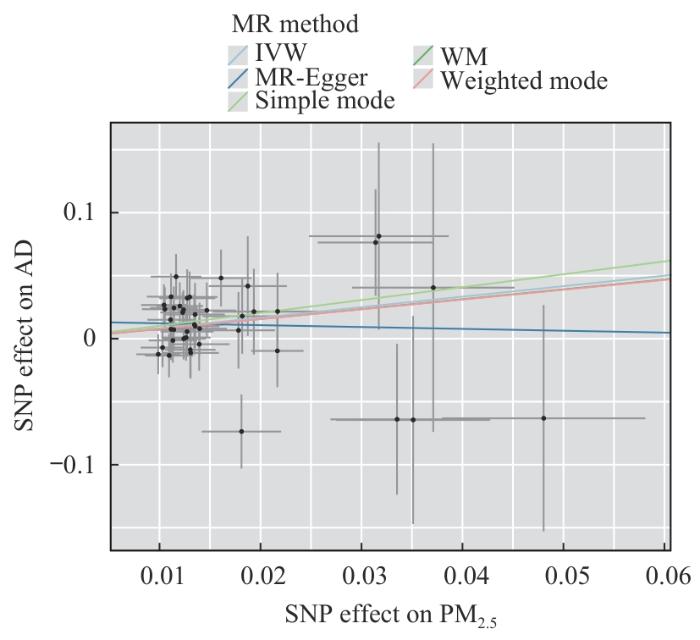
IVW法的分析结果显示,PM2.5与AD发病风险之间存在显著的因果关系,且PM2.5可增加AD的发病风险(OR=2.302,95% CI 1.421~3.729,P<0.001);WM的分析结果(OR=2.186,95% CI 1.073~4.453,P=0.031)亦支持上述结论;而其他3种分析方法得出的结果并不存在统计学意义。由于在该5种方法中,IVW法最为准确且其获得的分析结果最具判断价值,因此我们认为PM2.5与AD的发病风险相关。
Note: Each black point on the plot represents an individual SNP, with its position on the exposure (horizontal axis) and the outcome (vertical axis). Error bars indicate the standard error (SE) for each SNP.
Fig 2
Scatter plot analysis of SNP effects on PM2.5 and AD
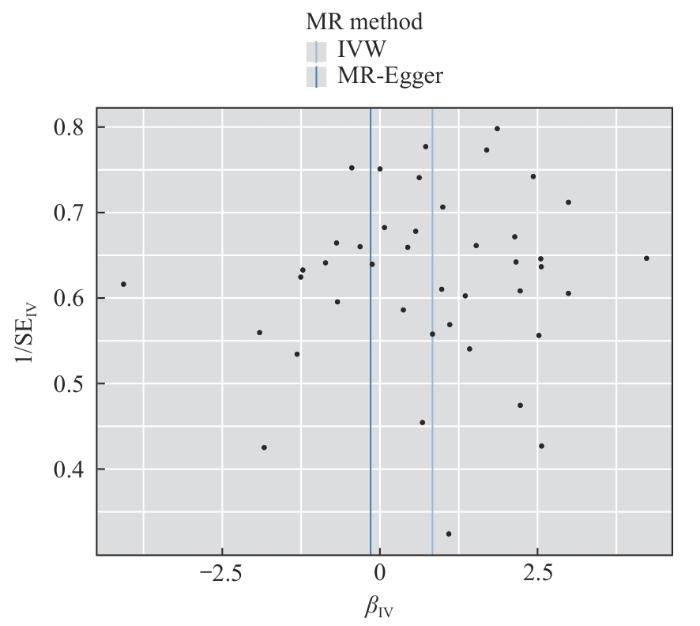
Note: Each black point on the plot represents an individual SNP, with the vertical axis displaying the effect size and the horizontal axis representing the standard error (SE). The central line indicates the overall estimated effect size. IV‒instrumental variable.
ZHANG Yingying was responsible for the conception and design of the study, as well as the writing of the paper. ZHANG Junyao, SONG Jiwei and WANG Shengjie were responsible for the data analysis and statistical analysis. YAO Junyan was responsible for paper conception, writing and final review. All the authors have read the final version of paper and consented to its submission.
利益冲突声明
所有作者声明不存在利益冲突。
COMPETING INTERESTS
All authors disclare no relevant conflict of interests.
THIANKHAW K, CHATTIPAKORN N, CHATTIPAKORN S C. PM2.5 exposure in association with AD-related neuropathology and cognitive outcomes[J]. Environ Pollut, 2022, 292(Pt A): 118320.
CHOI J, OH J Y, LEE Y S, et al. Harmful impact of air pollution on severe acute exacerbation of chronic obstructive pulmonary disease: particulate matter is hazardous[J]. Int J Chron Obstruct Pulmon Dis, 2018, 13: 1053-1059.
SHOU Y K, HUANG Y L, ZHU X Z, et al. A review of the possible associations between ambient PM2.5 exposures and the development of Alzheimer′s disease[J]. Ecotoxicol Environ Saf, 2019, 174: 344-352.
CHEN J C, SCHWARTZ J. Neurobehavioral effects of ambient air pollution on cognitive performance in US adults[J]. Neurotoxicology, 2009, 30(2): 231-239.
LIU X Q, HUANG J, SONG C, et al. Neurodevelopmental toxicity induced by PM2.5 exposure and its possible role in neurodegenerative and mental disorders[J]. Hum Exp Toxicol, 2023, 42: 9603271231191436.
KATIKIREDDI S V, GREEN M J, TAYLOR A E, et al. Assessing causal relationships using genetic proxies for exposures: an introduction to Mendelian randomization[J]. Addiction, 2018, 113(4): 764-774.
CHANG L, ZHOU G Y, XIA J G. mGWAS-explorer 2.0: causal analysis and interpretation of metabolite-phenotype associations[J]. Metabolites, 2023, 13(7): 826.
LAMBERT J C, IBRAHIM-VERBAAS C A, HAROLD D, et al. Meta-analysis of 74 046 individuals identifies 11 new susceptibility loci for Alzheimer′s disease[J]. Nat Genet, 2013, 45(12): 1452-1458.
SANDERSON E, DAVEY SMITH G, WINDMEIJER F, et al. An examination of multivariable Mendelian randomization in the single-sample and two-sample summary data settings[J]. Int J Epidemiol, 2019, 48(3): 713-727.
ZENG Y J, CAO S, YANG H. The causal role of gastroesophageal reflux disease in anxiety disorders and depression: a bidirectional Mendelian randomization study[J]. Front Psychiatry, 2023, 14: 1135923.
BOWDEN J, DAVEY SMITH G, HAYCOCK P C, et al. Consistent estimation in Mendelian randomization with some invalid instruments using a weighted Median estimator[J]. Genet Epidemiol, 2016, 40(4): 304-314.
BOWDEN J, DAVEY SMITH G, BURGESS S. Mendelian randomization with invalid instruments: effect estimation and bias detection through Egger regression[J]. Int J Epidemiol, 2015, 44(2): 512-525.
YAVORSKA O O, BURGESS S. MendelianRandomization: an R package for performing Mendelian randomization analyses using summarized data[J]. Int J Epidemiol, 2017, 46(6): 1734-1739.
PIERCE B L, BURGESS S. Efficient design for Mendelian randomization studies: subsample and 2-sample instrumental variable estimators[J]. Am J Epidemiol, 2013, 178(7): 1177-1184.
WU J, GRANDE G, STAFOGGIA M, et al. Air pollution as a risk factor for Cognitive Impairment no Dementia (CIND) and its progression to dementia: a longitudinal study[J]. Environ Int, 2022, 160: 107067.
SHI L H, WU X, DANESH YAZDI M, et al. Long-term effects of PM2.5 on neurological disorders in the American Medicare population: a longitudinal cohort study[J]. Lancet Planet Health, 2020, 4(12): e557-e565.
URBANO T, CHIARI A, MALAGOLI C, et al. Particulate matter exposure from motorized traffic and risk of conversion from mild cognitive impairment to dementia: an Italian prospective cohort study[J]. Environ Res, 2023, 222: 115425.
TZIVIAN L, DLUGAJ M, WINKLER A, et al. Long-term air pollution and traffic noise exposures and mild cognitive impairment in older adults: a cross-sectional analysis of the heinz nixdorf recall study[J]. Environ Health Perspect, 2016, 124(9): 1361-1368.
JUNG C R, LIN Y T, HWANG B F. Ozone, particulate matter, and newly diagnosed Alzheimer′s disease: a population-based cohort study in Taiwan[J]. J Alzheimers Dis, 2015, 44(2): 573-584.
POWER M C, WEISSKOPF M G, ALEXEEFF S E, et al. Traffic-related air pollution and cognitive function in a cohort of older men[J]. Environ Health Perspect, 2011, 119(5): 682-687.
OUDIN A, FORSBERG B, ADOLFSSON A N, et al. Traffic-related air pollution and dementia incidence in northern Sweden: a longitudinal study[J]. Environ Health Perspect, 2016, 124(3): 306-312.
WEUVE J, PUETT R C, SCHWARTZ J, et al. Exposure to particulate air pollution and cognitive decline in older women[J]. Arch Intern Med, 2012, 172(3): 219-227.
AILSHIRE J A, CRIMMINS E M. Fine particulate matter air pollution and cognitive function among older US adults[J]. Am J Epidemiol, 2014, 180(4): 359-366.
CACCIOTTOLO M, WANG X, DRISCOLL I, et al. Particulate air pollutants, APOE alleles and their contributions to cognitive impairment in older women and to amyloidogenesis in experimental models[J]. Transl Psychiatry, 2017, 7(1): e1022.
KILIAN J, KITAZAWA M. The emerging risk of exposure to air pollution on cognitive decline and Alzheimer′s disease: evidence from epidemiological and animal studies[J]. Biomed J, 2018, 41(3): 141-162.
COSTA L G, COLE T B, DAO K, et al. Effects of air pollution on the nervous system and its possible role in neurodevelopmental and neurodegenerative disorders[J]. Pharmacol Ther, 2020, 210: 107523.
CALDERÓN-GARCIDUEÑAS L, REED W, MARONPOT R R, et al. Brain inflammation and Alzheimer′s-like pathology in individuals exposed to severe air pollution[J]. Toxicol Pathol, 2004, 32(6): 650-658.
CASEY E, LI Z J, LIANG D H, et al. Association between fine particulate matter exposure and cerebrospinal fluid biomarkers of Alzheimer′s disease among a cognitively healthy population-based cohort[J]. Environ Health Perspect, 2024, 132(4): 47001.
KU T T, LI B, GAO R, et al. NF-κB-regulated microRNA-574-5p underlies synaptic and cognitive impairment in response to atmospheric PM2.5 aspiration[J]. Part Fibre Toxicol, 2017, 14(1): 34.
CALDERÓN-GARCIDUEÑAS L, AVILA-RAMÍREZ J, CALDERÓN-GARCIDUEÑAS A, et al. Cerebrospinal fluid biomarkers in highly exposed PM2.5 urbanites: the risk of Alzheimer′s and Parkinson′s diseases in young Mexico city residents[J]. J Alzheimers Dis, 2016, 54(2): 597-613.
CALDERÓN-GARCIDUEÑAS L, MUKHERJEE P S, WANIEK K, et al. Non-phosphorylated tau in cerebrospinal fluid is a marker of Alzheimer′s disease continuum in young urbanites exposed to air pollution[J]. J Alzheimers Dis, 2018, 66(4): 1437-1451.
SCHEFF S W, PRICE D A, SCHMITT F A, et al. Synaptic alterations in CA1 in mild Alzheimer disease and mild cognitive impairment[J]. Neurology, 2007, 68(18): 1501-1508.
... 从英国生物银行(UK Biobank)数据库中获取空气污染物包括PM2.5、PM2.5-10、PM10、二氧化氮、氮氧化物等的全基因组关联研究(genome-wide association study,GWAS)数据,下载网址为https://www.gwas.mrcieu.ac.uk/.AD数据来自LAMBERT等[10]整合的AD病例数据集,由国际阿尔茨海默病基因组学项目(International Genomics of Alzheimer′s Project,IGAP)发布.空气污染物及AD数据的具体样本量、SNP数量等见表1.同时,为避免种族相关混杂因素对研究结果造成偏差,本研究选取的数据对应的人群均为欧洲人群,以确保遗传背景的统一. ...