Mendelian randomization study of loneliness, subjective well-being, and frailty index
Aikeremu Aierken1, Chen Xingjuan2, Niu Yueyue,2
1.Chinese and Western Medicine Collaborative Diagnosis and Treatment Medical Center, People′s Hospital of Xinjiang Uygur Autonomous Region, Urumqi 830054, China
2.Cadres Health Protection Department, Guang′anmen Hospital, China Academy of Chinese Medical Sciences, Beijing 100053, China
First author contact:Aierken Aikeremu was responsible for the research design and the statistical analysis, and drafted the initial manuscript. Chen Xingjuan was responsible for data collection. Niu Yueyue reviewed and revised the manuscript. All authors have read the final version of manuscript and consented to its submission.
Received:2025-05-16Accepted:2025-10-20
Fund supported:
High Level Chinese Medical Hospital Promotion Project. HLCMHPP2023079
摘要
目的·采用双样本孟德尔随机化(Mendelian randomization,MR)方法验证孤独、主观幸福感与衰弱指数的关联是否反映了因果关系。方法·基于已发表的全基因组关联研究(genome-wide association studies,GWAS)的摘要数据,利用MR方法分析孤独感、主观幸福感与衰弱指数(作为衰弱的替代指标)的因果关系。孤独感数据来源于包含445 024名欧洲血统参与者的研究,包括80 134名欧洲血统病例和364 890名欧洲血统对照;主观幸福感数据来自298 420名欧洲血统参与者;衰弱的汇总数据来自英国生物银行和瑞典TwinGene GWAS的meta分析,包括175 226名欧洲血统的参与者。使用逆方差加权(inverse variance weighted,IVW)方法作为主要的MR分析方法确定估计值,加权中位数(weighted median estimator,WME)作为补充方法。采用Cochran′s Q检验检查IVW估计值中异质性,并使用MR Egger截距检验指示多效性的存在。存在异质性时使用异常值全局检测MR-PRESSO识别离群值,去除离群值后,重复MR分析。进行留一分析,以评估总体估计值是否由单一的单核苷酸多态性(single nucleotide polymorphism,SNP)驱动。在暴露和结局数据的效应方向校正过程中,剔除等位基因方向难以确定的回文SNP以确保数据的一致性和分析的可靠性。结果·通过IVW证实孤独感与衰弱指数呈显著正相关,OR为3.87(95% CI 2.33~6.46,P<0.001);WME进一步验证了这一结果,OR为2.81(95% CI 1.49~5.29,P<0.001)。主观幸福感与衰弱指数呈显著负相关,OR为0.80(95% CI 0.69~0.94,P=0.005);WME结果趋势一致,OR为0.86(95% CI 0.74~1.01,P=0.065)。未发现异质性(Cochran′s Q检验,P=0.054和P=0.074)或水平多效性(MR-Egger截距检验,P=0.470和P=0.260)。结论·通过MR方法强化了孤独感增加衰弱风险、主观幸福感对衰弱具有保护作用的因果证据。
关键词:孟德尔随机化
;
孤独感
;
主观幸福感
;
衰弱指数
;
因果推断
Abstract
Objective ·To employ a two-sample Mendelian randomization (MR) design to examine whether the associations between loneliness, subjective well-being, and the frailty index reflect causal relationships. Methods ·Summary data from published genome-wide association studies (GWAS) were utilized, and an MR approach was employed to analyze the causal relationships between loneliness, subjective well-being, and the frailty index (as a surrogate measure of frailty). Data on loneliness were derived from a study comprising 445 024 individuals of European ancestry, including 80 134 cases and 364 890 controls. Data for subjective well-being were obtained from 298 420 participants of European ancestry. Summary statistics for frailty were sourced from a meta-analysis of GWAS conducted within the UK Biobank and the Swedish TwinGene cohort, which included 175 226 individuals of European ancestry. The inverse variance weighted (IVW) method served as the primary MR analytical approach to derive causal estimates, with the weighted median estimator (WME) used as a supplementary approach. Cochran′s Q test was applied to assess heterogeneity in the IVW estimates. The presence of horizontal pleiotropy was evaluated using the MR-Egger intercept test. When significant heterogeneity was detected, the MR-PRESSO global test was utilized to identify and subsequently remove outlier variants. MR analyses were then repeated. A Leave-One-Out sensitivity analysis was conducted to evaluate whether the overall estimates were unduly influenced by any single nucleotide polymorphism (SNP). To ensure data consistency and analytical reliability during effect allele harmonization between exposure and outcome datasets, palindromic SNPs (for which the effect allele direction could not be definitively determined) were excluded. Results ·The IVW method revealed a significant positive association between loneliness and the frailty index, with an OR of 3.87 (95% CI 2.33‒6.46, P<0.001). This result was further confirmed by the WME, yielding an OR of 2.81 (95% CI 1.49‒5.29, P<0.001). Subjective well-being showed a significant negative association with the frailty index (OR=0.80, 95% CI 0.69‒0.94, P=0.005). The WME demonstrated a consistent direction of effect, though with borderline significance (OR=0.86, 95% CI 0.74‒1.01, P=0.065). The analysis revealed no significant heterogeneity (Cochran′s Q test, P=0.054 and P=0.074) or horizontal pleiotropy (MR-Egger intercept test, P=0.470 and P=0.260). Conclusion ·This study, supported by the MR methodology, indicates that loneliness is associated with an increased risk of frailty, while subjective well-being serves as a protective factor against frailty.
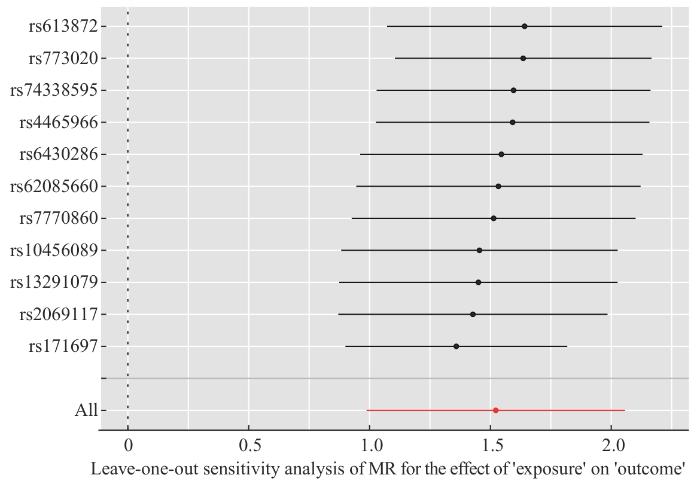
所有分析均采用R统计软件(版本4.2.3),使用R包“TwoSampleMR(0.6.20)”和“MRPRESSO(1.0)”完成。在筛选孤独感、主观幸福感和衰弱指数的GWAS之间的效应等位基因后,使用逆方差加权(inverse variance weighted,IVW)方法作为主要的MR分析方法确定估计值[13],加权中位数(weighted median estimator,WME)作为补充方法[14]。两种方式使用不同的假设评估暴露与结局的因果效应,可相互补充[15]。采用Cochran′s Q检验检查IVW估计值中异质性,同时使用MR Egger截距检验指示多效性的存在[16]。存在异质性时,使用异常值全局检测MR-PRESSO识别离群值,去除离群值后,重复MR分析[17]。进行留一分析,以评估总体估计值是否由单一的SNP驱动。在暴露和结局数据的效应方向校正过程中,剔除等位基因方向难以确定的回文SNP以确保数据的一致性和分析的可靠性。结果表示为OR及其95%CI,P<0.05表示差异具有统计学意义。
2 结果
2.1 孤独感与衰弱指数的MR分析
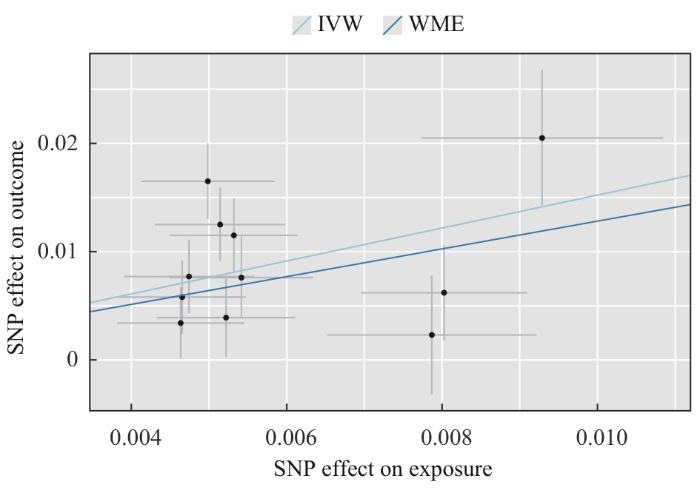
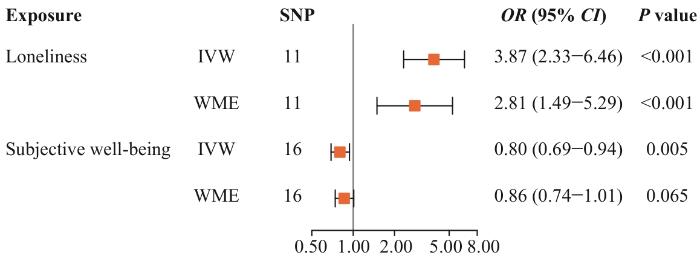
IVW结果显示,孤独感与衰弱呈显著正相关,OR为3.87(95% CI 2.33~6.46,P<0.001),提示孤独显著增加衰弱风险。WME方法得出一致结论,OR为2.81(95% CI 1.49~5.29,P<0.001),结果稳健。在SNP效果的散点图(图1)中,IVW法、WME法的回归斜率方向一致,证实随着暴露因素孤独感的上升,衰弱风险增大,两者呈正相关。
Fig 1
Scatter plot of effects of SNP on loneliness and the frailty index
2.2 主观幸福感与衰弱指数的MR分析
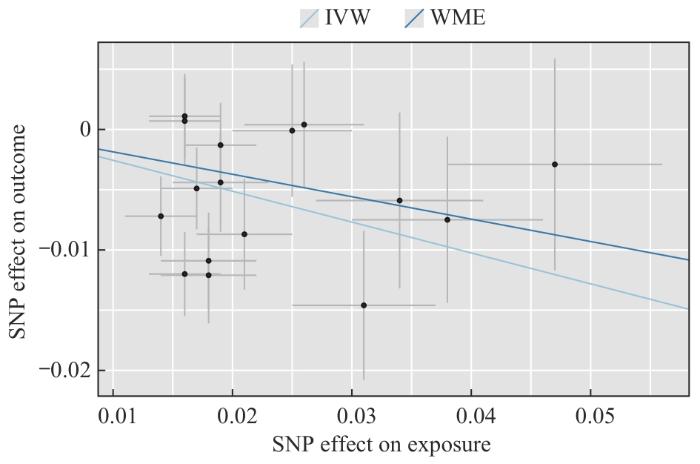
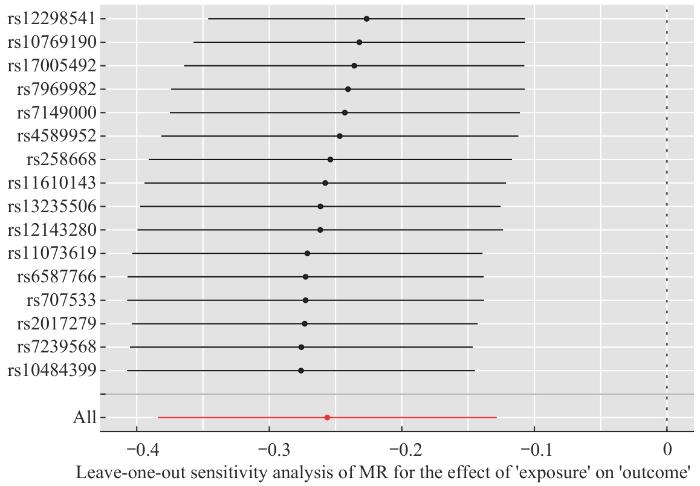
IVW结果显示主观幸福感与衰弱呈显著负相关,OR为0.80(95% CI 0.69~0.94,P=0.005);WME结果与其趋势一致,OR为0.86(95% CI 0.74~1.01,P=0.065)。在SNP对主观幸福感与衰弱指数效应的散点图(图2)中,IVW法、WME法的回归斜率方向一致,主观幸福感与衰弱指数呈负相关。未发现异质性(Cochran′s Q检验,P=0.054和P=0.074)或水平多效性(MR-Egger截距检验,P=0.470和P=0.260)。孤独感、主观幸福感与衰弱指数遗传风险预测的MR森林图见图3。
Sekula P, del Greco M F, Pattaro C, et al. Mendelian randomization as an approach to assess causality using observational data [J]. J Am Soc Nephrol, 2016, 27(11): 3253-3265.
Smith G D, Lawlor D A, Harbord R, et al. Clustered environments and randomized genes: a fundamental distinction between conventional and genetic epidemiology[J]. PLoS Med, 2007, 4(12): e352.
Gupta V, Walia G K, Sachdeva M P. ‘Mendelian randomization’: an approach for exploring causal relations in epidemiology[J]. Public Health, 2017, 145: 113-119.
Okbay A, Baselmans B M, De Neve J E, et al. Genetic variants associated with subjective well-being, depressive symptoms, and neuroticism identified through genome-wide analyses [J]. Nat Genet, 2016, 48(6): 624-633.
Kaskirbayeva D, West R, Jaafari H, et al. Progression of frailty as measured by a cumulative deficit index: a systematic review[J]. Ageing Res Rev, 2023, 84: 101789.
Atkins J L, JylhäVä J, Pedersen N L, et al. A genome-wide association study of the frailty index highlights brain pathways in ageing[J]. Aging Cell, 2021, 20(9): e13459.
Burgess S, Thompson S G, Collaboration C C G. Avoiding bias from weak instruments in Mendelian randomization studies[J]. Int J Epidemiol, 2011, 40(3): 755-764.
Hartwig F P, Davey Smith G, Bowden J. Robust inference in summary data Mendelian randomization via the zero modal pleiotropy assumption[J]. Int J Epidemiol, 2017, 46(6): 1985-1998.
Bowden J, Davey Smith G, Haycock P C, et al. Consistent estimation in mendelian randomization with some invalid instruments using a weighted Median estimator[J]. Genet Epidemiol, 2016, 40(4): 304-314.
Verbanck M, Chen C Y, Neale B, et al. Detection of widespread horizontal pleiotropy in causal relationships inferred from Mendelian randomization between complex traits and diseases[J]. Nat Genet, 2018, 50(5): 693-698.
Altintas H K, Coban S A, Cantekin I. Relationship between frailty and loneliness among community-dwelling Turkish older people[J]. Psychogeriatrics, 2023, 23(2): 243-251.
Gale C R, Westbury L, Cooper C. Social isolation and loneliness as risk factors for the progression of frailty: the English Longitudinal Study of Ageing[J]. Age Ageing, 2018, 47(3): 392-397.
Sha S, Pan Y, Xu Y B, et al. Associations between loneliness and frailty among older adults: evidence from the China Health and Retirement Longitudinal Study[J]. BMC Geriatr, 2022, 22(1): 537.
Kojima G, Taniguchi Y, Aoyama R, et al. Associations between loneliness and physical frailty in community-dwelling older adults: a systematic review and meta-analysis[J]. Ageing Res Rev, 2022, 81: 101705.
Tay L, Tan K, Diener E, et al. Social relations, health behaviors, and health outcomes: a survey and synthesis[J]. Applied Psych Health Well, 2013, 5(1): 28-78.
Kandola A, Solmi F, Ajnakina O, et al. The role of loneliness in the association between chronic physical illness and depressive symptoms among older adults: a prospective cohort study[J]. J Affect Disord, 2023, 334: 220-226.
Luo Y, Hawkley L C, Waite L J, et al. Loneliness, health, and mortality in old age: a national longitudinal study[J]. Soc Sci Med, 2012, 74(6): 907-914.
Koivumaa-Honkanen H, Honkanen R, Viinamäki H, et al. Life satisfaction and suicide: a 20-year follow-up study[J]. Am J Psychiatry, 2001, 158(3): 433-439.
Qazi S L, Koivumaa-Honkanen H, Rikkonen T, et al. Physical capacity, subjective health, and life satisfaction in older women: a 10-year follow-up study[J]. BMC Geriatr, 2021, 21(1): 658.
Stenlund S, Koivumaa-Honkanen H, Sillanmäki L, et al. Changed health behavior improves subjective well-being and vice versa in a follow-up of 9 years[J]. Health Qual Life Outcomes, 2022, 20(1): 66.
Koivumaa-Honkanen H, Kaprio J, Honkanen R J, et al. The stability of life satisfaction in a 15-year follow-up of adult Finns healthy at baseline[J]. BMC Psychiatry, 2005, 5(1): 4.
Khazaee-Pool M, Sadeghi R, Majlessi F, et al. Effects of physical exercise programme on happiness among older people[J]. Psychiatric Ment Health Nurs, 2015, 22(1): 47-57.
Li C, Ning G J, Xia Y X. Does exercise participation promote happiness: mediations and heterogeneities[J]. Front Public Health, 2023, 11: 1033157.
Wang D, Gao H X, Xu X, et al. Analysis of influence of physical health factors on subjective wellbeing of middle-aged and elderly women in China[J]. BMC Public Health, 2022, 22(1): 1127.
Zheng G H, Qiu P T, Xia R, et al. Effect of aerobic exercise on inflammatory markers in healthy middle-aged and older adults: a systematic review and meta-analysis of randomized controlled trials[J]. Front Aging Neurosci, 2019, 11: 98.
HernáNdez-Lepe M A, Ortiz-Ortiz M, HernáNdez-Ontiveros D A, et al. Inflammatory profile of older adults in response to physical activity and diet supplementation: a systematic review[J]. Int J Environ Res Public Health, 2023, 20(5): 4111.
Koelman L, Egea Rodrigues C, Aleksandrova K. Effects of dietary patterns on biomarkers of inflammation and immune responses: a systematic review and meta-analysis of randomized controlled trials[J]. Adv Nutr, 2022, 13(1): 101-115.