
上海交通大学学报(医学版) ›› 2026, Vol. 46 ›› Issue (7): 839-846.doi: 10.3969/j.issn.1674-8115.2026.07.002
• 前沿述评 • 上一篇
谢忻妮1,2, 吕言1, 李敏1, 王亚楠1( )
)
收稿日期:2025-12-05
接受日期:2026-02-24
出版日期:2026-07-28
发布日期:2026-07-28
通讯作者:
王亚楠,副研究员,博士;电子信箱:wangyn0819@126.com。基金资助:
Xie Xinni1,2, Lü Yan1, Li Min1, Wang Yanan1()
Received:2025-12-05
Accepted:2026-02-24
Online:2026-07-28
Published:2026-07-28
Contact:
Wang Yanan, E-mail: wangyn0819@126.com.Supported by:摘要:
毒素-抗毒素系统(toxin-antitoxin systems,TAS)广泛存在于细菌与古菌中,通常由抑制细菌生长的毒素及中和毒素毒性的抗毒素组成,是调控细菌生长代谢及致病过程的关键分子枢纽。金黄色葡萄球菌(Staphylococcus aureus,简称金葡菌)是临床重要病原菌,可引起从皮肤软组织感染至脓毒症、心内膜炎等多种疾病。研究显示,TAS在金葡菌抵抗外界压力、产生抗生素耐受、形成持留菌以及生物被膜发育等进程中发挥着重要作用,但相关分子机制尚未完全明确。深入阐明相关分子机制,是理解金葡菌致病特性以及开发新型抗菌策略的关键所在。该文综述了TAS的分型特征及其在金葡菌适应性生存与毒力调控方面的功能,重点探讨了TAS介导的持留菌形成、抗生素耐受及生物被膜发育机制。在营养缺乏或面临抗生素压力时,TAS通过干扰DNA复制、抑制蛋白质合成等核心代谢通路,诱导细菌进入代谢休眠状态,进而导致表型耐受以及持留菌的形成,帮助金葡菌实现适应性生存。该系统还能够通过全局调控网络影响毒力因子的表达,部分TAS编码的毒素具备直接破坏真核细胞膜的能力,可导致宿主细胞裂解,促进细菌的侵袭和扩散。此外,由Ⅶ型分泌系统介导的毒素分泌,还能为金葡菌在微生物群落中赋予竞争优势。该文系统梳理了金葡菌中不同类型TAS的结构特征与作用模式,旨在深化对金葡菌致病机制的认识,同时为开发以TAS为靶点的新型抗菌策略提供理论参考与研究方向。
中图分类号:
谢忻妮, 吕言, 李敏, 王亚楠. 金黄色葡萄球菌毒素-抗毒素系统的生存适应与致病机制研究进展[J]. 上海交通大学学报(医学版), 2026, 46(7): 839-846.
Xie Xinni, Lü Yan, Li Min, Wang Yanan. Research progress in adaptive survival and pathogenic mechanisms of toxin-antitoxin systems in Staphylococcus aureus[J]. Journal of Shanghai Jiao Tong University (Medical Science), 2026, 46(7): 839-846.
| Type | Toxin | Antitoxin | Characteristic | Representative TAS in S. aureus |
|---|---|---|---|---|
| Ⅰ | mRNA | Antisense RNA | The toxin is a small peptide encoded by an mRNA. A complementary antisense RNA antitoxin inhibits toxin translation through base pairing | sprG1/sprF1[ |
| Ⅱ | Protein | Protein | Both toxin and antitoxin are proteins. The antitoxin neutralizes the toxin through direct protein-protein interaction | MazEF[ |
| Ⅲ | Protein | RNA | A protein toxin is inactivated by an RNA antitoxin that binds to it, inducing conformational inactivation [ | TenpIN[ |
| Ⅳ | Protein | Protein | The protein antitoxin inhibits the toxin indirectly by blocking its interaction with the cellular target rather than by direct binding | Not reported |
| Ⅴ | Protein | Protein | The antitoxin acts as an RNase that specifically cleaves the toxin mRNA, thereby preventing toxin synthesis | Not reported |
| Ⅵ | Protein | Protein | The antitoxin promotes protease-mediated degradation of the toxin protein through direct interaction | Not reported |
| Ⅶ | Protein | Protein | The antitoxin inactivates the toxin by facilitating its post-translational modification | Not reported |
| Ⅷ | RNA | RNA | An RNA antitoxin inhibits either transcription of the toxin gene or neutralizes the toxin RNA through direct binding | Not reported |
表1 8种经典类型TAS的特征
Tab 1 Characteristics of the eight classical types of TAS
| Type | Toxin | Antitoxin | Characteristic | Representative TAS in S. aureus |
|---|---|---|---|---|
| Ⅰ | mRNA | Antisense RNA | The toxin is a small peptide encoded by an mRNA. A complementary antisense RNA antitoxin inhibits toxin translation through base pairing | sprG1/sprF1[ |
| Ⅱ | Protein | Protein | Both toxin and antitoxin are proteins. The antitoxin neutralizes the toxin through direct protein-protein interaction | MazEF[ |
| Ⅲ | Protein | RNA | A protein toxin is inactivated by an RNA antitoxin that binds to it, inducing conformational inactivation [ | TenpIN[ |
| Ⅳ | Protein | Protein | The protein antitoxin inhibits the toxin indirectly by blocking its interaction with the cellular target rather than by direct binding | Not reported |
| Ⅴ | Protein | Protein | The antitoxin acts as an RNase that specifically cleaves the toxin mRNA, thereby preventing toxin synthesis | Not reported |
| Ⅵ | Protein | Protein | The antitoxin promotes protease-mediated degradation of the toxin protein through direct interaction | Not reported |
| Ⅶ | Protein | Protein | The antitoxin inactivates the toxin by facilitating its post-translational modification | Not reported |
| Ⅷ | RNA | RNA | An RNA antitoxin inhibits either transcription of the toxin gene or neutralizes the toxin RNA through direct binding | Not reported |
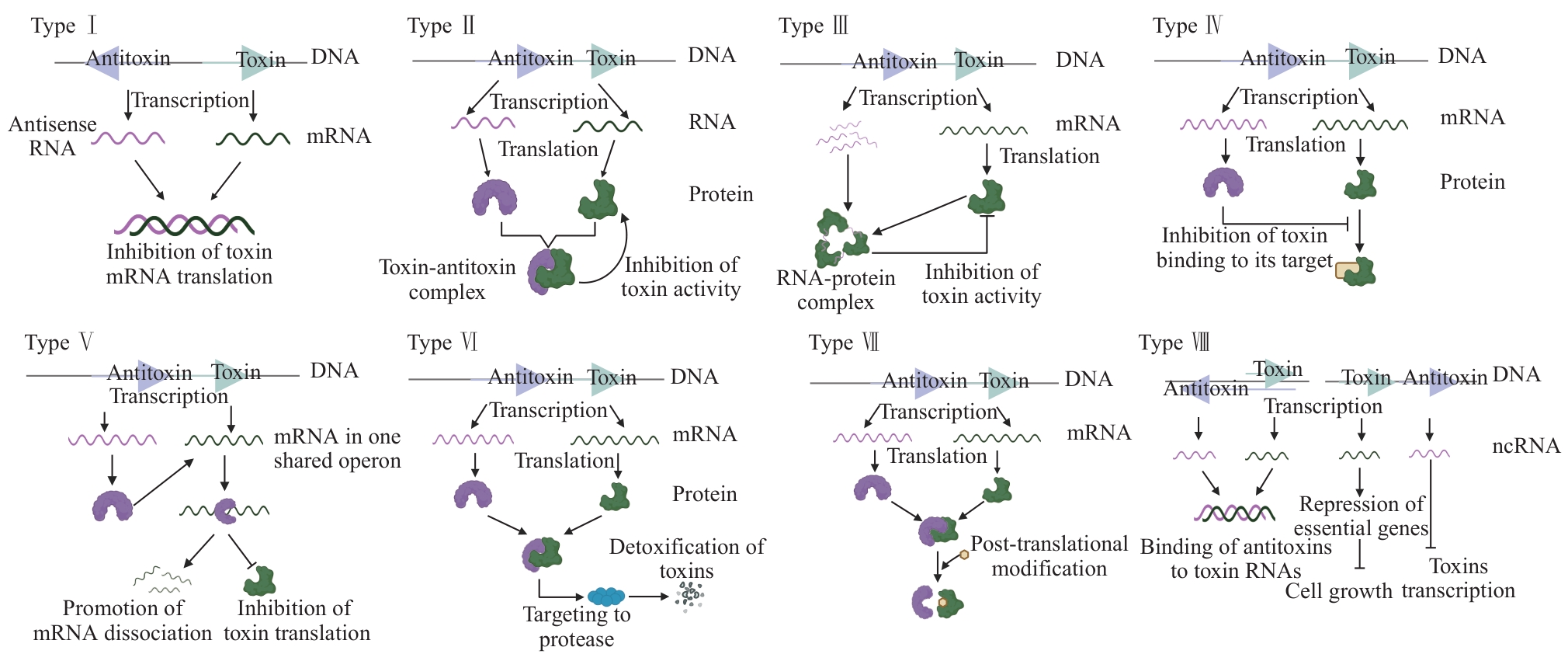
图1 8种TAS的特征示意图
Fig 1 Characteristics of the eight types of TAS
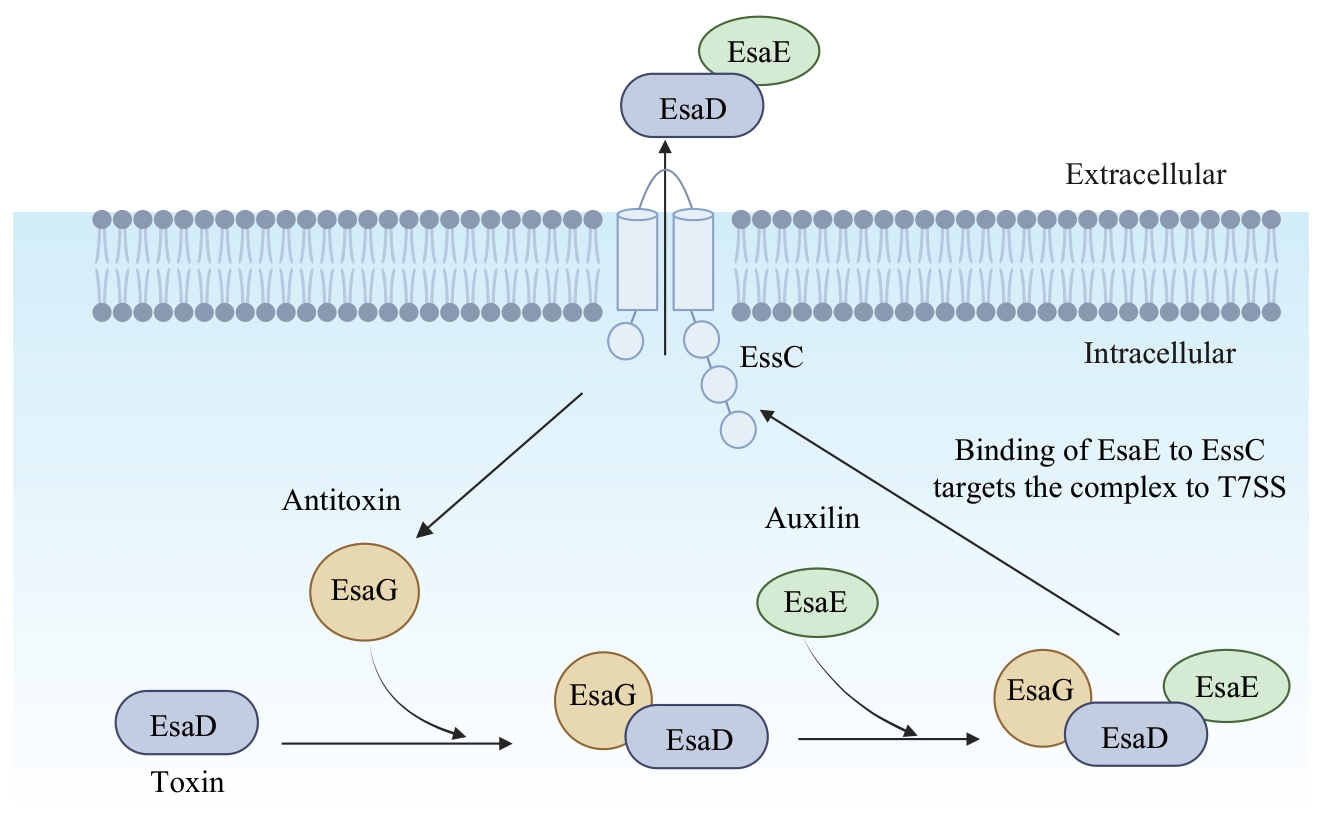
图2 T7SS介导的毒素分泌机制
Fig 2 T7SS-mediated toxin secretion mechanism
| [1] | Tong S Y C, Davis J S, Eichenberger E, et al. Staphylococcus aureus infections: epidemiology, pathophysiology, clinical manifestations, and management[J]. Clin Microbiol Rev, 2015, 28(3): 603-661. |
| [2] | Hassoun A, Linden P K, Friedman B. Incidence, prevalence, and management of MRSA bacteremia across patient populations: a review of recent developments in MRSA management and treatment[J]. Crit Care, 2017, 21(1): 211. |
| [3] | Selim S, Faried O A, Almuhayawi M S, et al. Incidence of vancomycin-resistant Staphylococcus aureus strains among patients with urinary tract infections[J]. Antibiotics (Basel), 2022, 11(3): 408. |
| [4] | Zhou S, Zhou K, Yang P H, et al. Molecular characteristics and antimicrobial resistance of linezolid-resistant Staphylococcus aureus in osteoarticular infections: a 11-year study from a hospital in Xi′an[J]. Infect Drug Resist, 2025, 18: 2987-2996. |
| [5] | Harms A, Brodersen D E, Mitarai N, et al. Toxins, targets, and triggers: an overview of toxin-antitoxin biology[J]. Mol Cell, 2018, 70(5): 768-784. |
| [6] | Unterholzner S J, Poppenberger B, Rozhon W. Toxin-antitoxin systems: biology, identification, and application[J]. Mob Genet Elements, 2013, 3(5): e26219. |
| [7] | van Gundy T, Martin E, Bono J, et al. An antisense RNA fine-tunes gene expression of the type Ⅱ MazEF toxin-antitoxin system[J]. mBio, 2022, 13(1): e0344321. |
| [8] | Karimaei S, Kazem Aghamir S M, Foroushani A R, et al. Antibiotic tolerance in biofilm persister cells of Staphylococcus aureus and expression of toxin-antitoxin system genes[J]. Microb Pathog, 2021, 159: 105126. |
| [9] | Bukowski M, Banasik M, Chlebicka K, et al. Analysis of co-occurrence of type Ⅱ toxin-antitoxin systems and antibiotic resistance determinants in Staphylococcus aureus[J]. mSystems, 2025, 10(3): e0095724. |
| [10] | Karimaei S, Kalani B S, Shahrokhi N, et al. Expression of type Ⅱ toxin-antitoxin systems and ClpP protease of methicillin-resistant Staphylococcus aureus under thermal and oxidative stress conditions[J]. Iran J Microbiol, 2021, 13(2): 204-211. |
| [11] | Peacock S J, Moore C E, Justice A, et al. Virulent combinations of adhesin and toxin genes in natural populations of Staphylococcus aureus[J]. Infect Immun, 2002, 70(9): 4987-4996. |
| [12] | Archer N K, Mazaitis M J, Costerton J W, et al. Staphylococcus aureus biofilms: properties, regulation, and roles in human disease[J]. Virulence, 2011, 2(5): 445-459. |
| [13] | Gerdes K, Rasmussen P B, Molin S. Unique type of plasmid maintenance function: postsegregational killing of plasmid-free cells[J]. Proc Natl Acad Sci U S A, 1986, 83(10): 3116-3120. |
| [14] | Ogura T, Hiraga S. Mini-F plasmid genes that couple host cell division to plasmid proliferation[J]. Proc Natl Acad Sci U S A, 1983, 80(15): 4784-4788. |
| [15] | Steif A, Meyer I M. The hok mRNA family[J]. RNA Biol, 2012, 9(12): 1399-1404. |
| [16] | Pandey D P, Gerdes K. Toxin-antitoxin loci are highly abundant in free-living but lost from host-associated prokaryotes[J]. Nucleic Acids Res, 2005, 33(3): 966-976. |
| [17] | Jurėnas D, Fraikin N, Goormaghtigh F, et al. Biology and evolution of bacterial toxin-antitoxin systems[J]. Nat Rev Microbiol, 2022, 20(6): 335-350. |
| [18] | Chlebicka K, Bonar E, Suder P, et al. Impacts of the type Ⅰ toxin-antitoxin system, SprG1/SprF1, on Staphylococcus aureus gene expression[J]. Genes, 2021, 12(5): 770. |
| [19] | Fermon L, Germain-Amiot N, Oriol C, et al. Membrane selectivity and pore formation of SprA1 and SprA2 hemolytic peptides from Staphylococcus aureus type Ⅰ toxin-antitoxin systems[J]. FEBS J, 2025, 292(17): 4555-4579. |
| [20] | Mandell J B, Gish C, Cappellini A J, et al. Methicillin resistant Staphylococcus aureus mazEF expression promotes infections by influencing cellular growth, antibiotic sensitivity, and formation of biofilms[J]. Sci Rep, 2024, 14(1): 21269. |
| [21] | Xue L, Khan M H, Yue J, et al. The two paralogous copies of the YoeB-YefM toxin-antitoxin module in Staphylococcus aureus differ in DNA binding and recognition patterns[J]. J Biol Chem, 2022, 298(1): 101457. |
| [22] | Habib G, Zhu Q, Sun B L. Bioinformatics and functional assessment of toxin-antitoxin systems in Staphylococcus aureus[J]. Toxins, 2018, 10(11): 473. |
| [23] | Short F L, Pei X Y, Blower T R, et al. Selectivity and self-assembly in the control of a bacterial toxin by an antitoxic noncoding RNA pseudoknot[J]. Proc Natl Acad Sci U S A, 2013, 110(3): E241-E249. |
| [24] | Blower T R, Short F L, Rao F, et al. Identification and classification of bacterial type Ⅲ toxin-antitoxin systems encoded in chromosomal and plasmid genomes[J]. Nucleic Acids Res, 2012, 40(13): 6158-6173. |
| [25] | Nadig K, Sandhya S, Singh M. Bioinformatic exploration reveals features of tenpIN family of type Ⅲ toxin-antitoxin systems in bacteria and viruses[J]. Sci Rep, 2025, 15(1): 26624. |
| [26] | Goeders N, Chai R, Chen B H, et al. Structure, evolution, and functions of bacterial type Ⅲ toxin-antitoxin systems[J]. Toxins, 2016, 8(10): 282. |
| [27] | Lechner S, Lewis K, Bertram R. Staphylococcus aureus persisters tolerant to bactericidal antibiotics[J]. J Mol Microbiol Biotechnol, 2012, 22(4): 235-244. |
| [28] | Keren I, Shah D, Spoering A, et al. Specialized persister cells and the mechanism of multidrug tolerance in Escherichia Coli[J]. J Bacteriol, 2004, 186(24): 8172-8180. |
| [29] | Pinel-Marie M L, Brielle R, Riffaud C, et al. RNA antitoxin SprF1 binds ribosomes to attenuate translation and promote persister cell formation in Staphylococcus aureus[J]. Nat Microbiol, 2021, 6(2): 209-220. |
| [30] | Habib G, Zhu J D, Sun B L. A novel type Ⅰ toxin-antitoxin system modulates persister cell formation in Staphylococcus aureus[J]. Int J Med Microbiol, 2020, 310(2): 151400. |
| [31] | Wang X X, Lord D M, Cheng H Y, et al. A new type Ⅴ toxin-antitoxin system where mRNA for toxin GhoT is cleaved by antitoxin GhoS[J]. Nat Chem Biol, 2012, 8(10): 855-861. |
| [32] | Kwan B W, Valenta J A, Benedik M J, et al. Arrested protein synthesis increases persister-like cell formation[J]. Antimicrob Agents Chemother, 2013, 57(3): 1468-1473. |
| [33] | Ma D Z, Mandell J B, Donegan N P, et al. The toxin-antitoxin MazEF drives Staphylococcus aureus biofilm formation, antibiotic tolerance, and chronic infection[J]. mBio, 2019, 10(6): e01658-e01619. |
| [34] | Qi X Y, Brothers K M, Ma D Z, et al. The Staphylococcus aureus toxin-antitoxin system YefM-YoeB is associated with antibiotic tolerance and extracellular dependent biofilm formation[J]. J Bone Jt Infect, 2021, 6(7): 241-253. |
| [35] | Tripathi A, Dewan P C, Ahmed S, et al. MazF-induced growth inhibition and persister generation in Escherichia Coli[J]. J Biol Chem, 2014, 289(7): 4191-4205. |
| [36] | Fluckiger U, Ulrich M, Steinhuber A, et al. Biofilm formation, icaADBC transcription, and polysaccharide intercellular adhesin synthesis by staphylococci in a device-related infection model[J]. Infect Immun, 2005, 73(3): 1811-1819. |
| [37] | Ma D M, Gu H J, Shi Y J, et al. Edwardsiella piscicida YefM-YoeB: a type Ⅱ toxin-antitoxin system that is related to antibiotic resistance, biofilm formation, serum survival, and host infection[J]. Front Microbiol, 2021, 12: 646299. |
| [38] | Wen W, Liu B H, Xue L, et al. Autoregulation and virulence control by the toxin-antitoxin system SavRS in Staphylococcus aureus[J]. Infect Immun, 2018, 86(5): e00032-e00018. |
| [39] | Sierra R, Prados J, Panasenko O O, et al. Insights into the global effect on Staphylococcus aureus growth arrest by induction of the endoribonuclease MazF toxin[J]. Nucleic Acids Res, 2020, 48(15): 8545-8561. |
| [40] | Bezrukov F, Prados J, Renzoni A, et al. MazF toxin causes alterations in Staphylococcus aureus transcriptome, translatome and proteome that underlie bacterial dormancy[J]. Nucleic Acids Res, 2021, 49(4): 2085-2101. |
| [41] | Germain-Amiot N, Augagneur Y, Camberlein E, et al. A novel Staphylococcus aureus cis-trans type Ⅰ toxin-antitoxin module with dual effects on bacteria and host cells[J]. Nucleic Acids Res, 2019, 47(4): 1759-1773. |
| [42] | Chaudhary K, Kumar R, Singh S, et al. A web server and mobile app for computing hemolytic potency of peptides[J]. Sci Rep, 2016, 6: 22843. |
| [43] | Chen Y X, Guarnieri M T, Vasil A I, et al. Role of peptide hydrophobicity in the mechanism of action of α-helical antimicrobial peptides[J]. Antimicrob Agents Chemother, 2007, 51(4): 1398-1406. |
| [44] | Hancock R E W, Rozek A. Role of membranes in the activities of antimicrobial cationic peptides[J]. FEMS Microbiol Lett, 2002, 206(2): 143-149. |
| [45] | Ravn P, Arnau J, Madsen S M, et al. Optimization of signal peptide SP310 for heterologous protein production in Lactococcus lactis[J]. Microbiology (Reading), 2003, 149(Pt 8): 2193-2201. |
| [46] | Pinel-Marie M L, Brielle R, Felden B. Dual toxic-peptide-coding Staphylococcus aureus RNA under antisense regulation targets host cells and bacterial rivals unequally[J]. Cell Rep, 2014, 7(2): 424-435. |
| [47] | Fermon L, Burel A, Ostyn E, et al. Mechanism of action of sprG1-encoded type Ⅰ toxins in Staphylococcus aureus: from membrane alterations to mesosome-like structures formation and bacterial lysis[J]. Front Microbiol, 2023, 14: 1275849. |
| [48] | Kato F, Bandou, Yamaguchi Y, et al. Characterization of a membrane toxin-antitoxin system, tsaAT, from Staphylococcus aureus[J]. FEBS J, 2024, 291(22): 5015-5036. |
| [49] | Cao Z P, Casabona M G, Kneuper H, et al. The type Ⅶ secretion system of Staphylococcus aureus secretes a nuclease toxin that targets competitor bacteria[J]. Nat Microbiol, 2016, 2: 16183. |
| [50] | Kato F, Yoshizumi S, Yamaguchi Y, et al. Genome-wide screening for identification of novel toxin-antitoxin systems in Staphylococcus aureus[J]. Appl Environ Microbiol, 2019, 85(20): e00915-e00919. |
| [51] | Warne B, Harkins C P, Harris S R, et al. The Ess/Type Ⅶ secretion system of Staphylococcus aureus shows unexpected genetic diversity[J]. BMC Genomics, 2016, 17: 222. |
| [52] | Williams J J, Hergenrother P J. Artificial activation of toxin-antitoxin systems as an antibacterial strategy[J]. Trends Microbiol, 2012, 20(6): 291-298. |
| [53] | Lee H T, Kim S K, Lee J B, et al. A novel peptide nucleic acid against the cytidine monophosphate kinase of S. aureus inhibits staphylococcal infection in vivo[J]. Mol Ther Nucleic Acids, 2019, 18: 245-252. |
| [54] | Luo F M, Xu C F, Zhang C W, et al. mRNA-based platform for preventing and treating Staphylococcus aureus by targeted staphylococcal enterotoxin B[J]. Front Immunol, 2024, 15: 1490044. |
| [55] | Xu W F, Yan P, Li Y J, et al. The toxin-antitoxin system SavRS contributes to vancomycin resistance in vancomycin-intermediate Staphylococcus aureus by mediating cell wall thickening[J]. J Antimicrob Chemother, 2025, 80(11): 2978-2988. |
| [56] | Sæbø I P,Dyhr E,Riisnæs I M M, et al. Rational design of synthetic antimicrobial peptides based on the Escherichia Coli ShoB toxin[J]. Sci Rep, 2025, 15(1): 14354. |
| [57] | Chen Z, Yao J Y, Zhang P J, et al. Minimized antibiotic-free plasmid vector for gene therapy utilizing a new toxin-antitoxin system[J]. Metab Eng, 2023, 79: 86-96. |
| [1] | 潘抒凡, 杨栋磊, 王鹏飞. 基于纳米孔Cas9靶向测序的金黄色葡萄球菌快速检测与分型[J]. 上海交通大学学报(医学版), 2025, 45(6): 774-783. |
| [2] | 娜迪拉·努尔夏提, 李敏, 刘倩. 特应性皮炎与葡萄球菌属细菌定植相关性的研究进展[J]. 上海交通大学学报(医学版), 2022, 42(11): 1605-1611. |
| [3] | 蔡骁垚, 林堃银, 孙涛, 张立, 闫佩毅, 金姝. 痰标本mecA和Sa442基因的定量PCR检测结果与MRSA培养结果的关联[J]. 上海交通大学学报(医学版), 2021, 41(3): 350-354. |
| [4] | 曾龙辉,蒙国宇. Saf 菌毛与生物被膜形成[J]. 上海交通大学学报(医学版), 2018, 38(2): 125-. |
| [5] | 王亚楠 李敏. 金黄色葡萄球菌ESAT-6分泌系统研究进展[J]. 上海交通大学学报(医学版), 2016, 36(8): 1210-. |
| [6] | 顾飞飞,蒋 婕,项 瑾,等. 利多卡因联合丙胺卡因对金黄色葡萄球菌抑菌效果的评价[J]. 上海交通大学学报(医学版), 2014, 34(10): 1485-. |
| [7] | 陈 旭, 王文奎, 孟志民, 等. 重组溶葡萄球菌素对烧伤创面分离的金黄色葡萄球菌的体外抗菌活性评估[J]. , 2012, 32(11): 1411-. |
| [8] | 俞 静, 刘 瑛, 陈 峰. 甲氧西林耐药的CO2依赖型金黄色葡萄球菌小菌落突变株的分离和鉴定[J]. , 2012, 32(10): 1338-. |
| [9] | 虞 敏, 毛建强, 孙菊芳, 等. 鼻腔金黄色葡萄球菌定植与心脏手术后院内感染的关系[J]. , 2011, 31(4): 473-. |
| [10] | 吴 晶, 应春妹, 汪雅萍, 等. 金黄色葡萄球菌耐药性监测分析[J]. , 2011, 31(12): 1754-. |
| 阅读次数 | ||||||
|
全文 |
|
|||||
|
摘要 |
|
|||||
