
上海交通大学学报(医学版) ›› 2026, Vol. 46 ›› Issue (11): 1573-1581.doi: 10.3969/j.issn.1674-8115.2026.11.014
何凯婷1, 胡逸君1, 李康帅1, 郑媛嘉1, 颜靖岚1, 陈永君1,2,3( )
收稿日期:2026-04-01
接受日期:2026-05-26
出版日期:2026-11-28
发布日期:2026-11-12
通讯作者:
陈永君,教授,博士;电子信箱:chenyongjun@sdutcm.edu.cn。基金资助:
He Kaiting1, Hu Yijun1, Li Kangshuai1, Zheng Yuanjia1, Yan Jinglan1, Chen Yongjun1,2,3()
Received:2026-04-01
Accepted:2026-05-26
Online:2026-11-28
Published:2026-11-12
Contact:
Chen Yongjun, E-mail: chenyongjun@sdutcm.edu.cn.Supported by:摘要:
针刺疗法作为中医药最具代表性的非药物干预手段,已在全球范围内得到广泛应用,但其生物学机制阐释缺乏统一的系统性理论框架。“脑-体轴”概念的提出,为理解针刺的外周-中枢-脏腑整体调节效应提供了全新的整合视角。该文系统梳理针刺以脑-体轴理论为核心靶点,在全身性炎症、胃肠疾病、神经精神疾病、神经退行性疾病等多种疾病的治疗中展现出的脑-体共治的整合优势;同时总结针刺调控肠-脑轴、皮肤-脑轴、脑-脾轴及脑-肾上腺轴的神经生物学证据,探究针刺信号从体表到脏腑功能调控的完整闭环路径;在脑-体轴视域下解析针刺发挥整体调节效应的神经生物学基础,为复杂疾病的系统调控提供新的思路与干预策略。
中图分类号:
何凯婷, 胡逸君, 李康帅, 郑媛嘉, 颜靖岚, 陈永君. 脑-体轴视域下针刺治疗效应的神经调控机制研究进展[J]. 上海交通大学学报(医学版), 2026, 46(11): 1573-1581.
He Kaiting, Hu Yijun, Li Kangshuai, Zheng Yuanjia, Yan Jinglan, Chen Yongjun. Research progress on neuroregulatory mechanisms underlying the therapeutic effects of acupuncture from the perspective of the brain-body axis[J]. Journal of Shanghai Jiao Tong University (Medical Science), 2026,(11): 1573-1581.
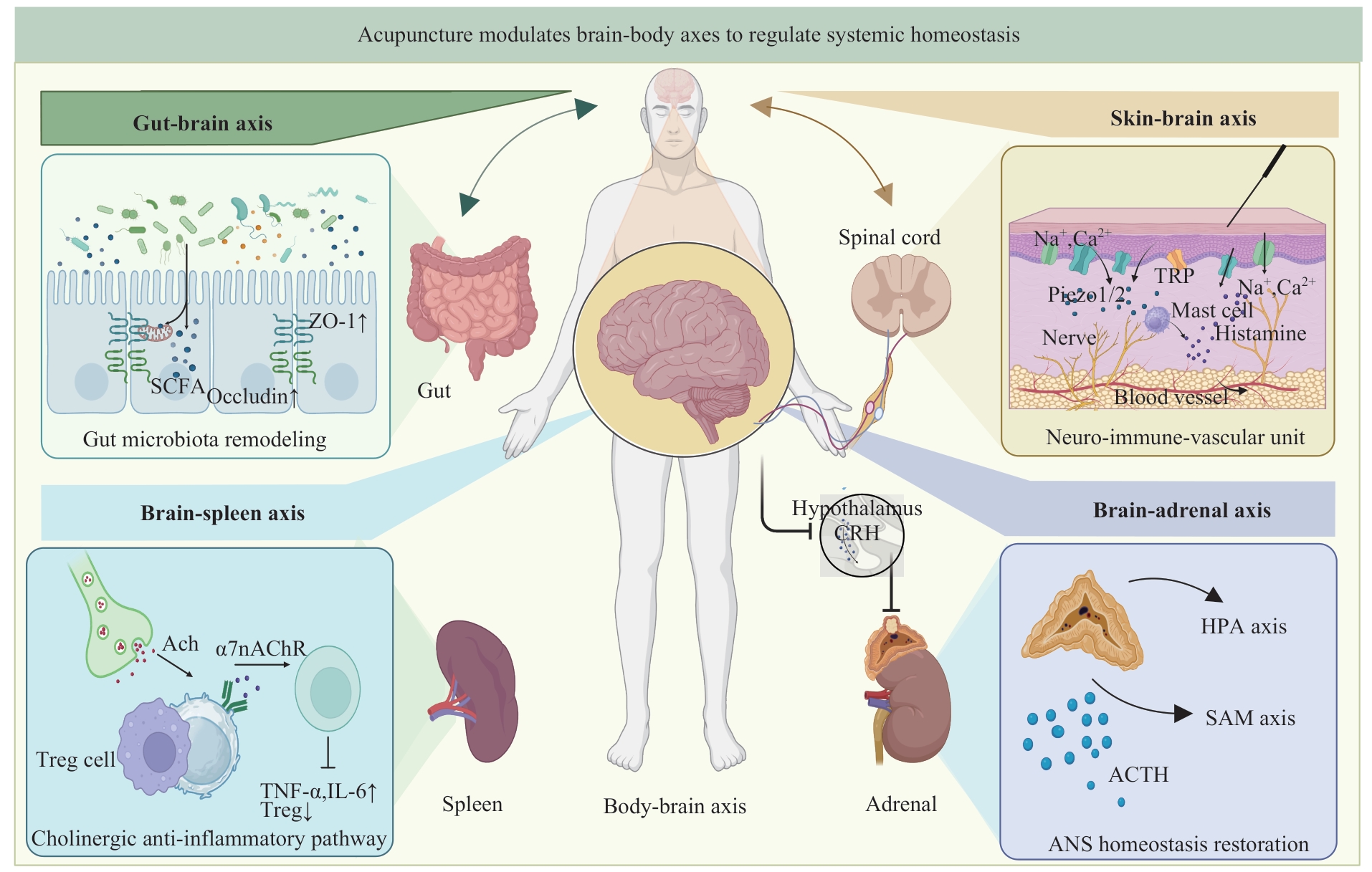
图1 针灸调控脑-体轴的多轴协作机制Note: ZO-1—zonula occludens-1; IL-6—interleukin-6; Piezo1/2—mechanosensitive ion channels Piezo1 and Piezo2; TRP—transient receptor potential channel; ANS—autonomic nervous system.
Fig 1 Multi-axis synergistic mechanisms of acupuncture in modulating brain-body axes
| [1] | Ma Y, Dong M, Zhou K H, et al. Publication trends in acupuncture research: a 20-year bibliometric analysis based on PubMed[J]. PLoS One, 2016, 11(12): e0168123. |
| [2] | Lu L M, Zhang Y Q, Tang X R, et al. Evidence on acupuncture therapies is underused in clinical practice and health policy[J]. BMJ, 2022, 376: e067475. |
| [3] | Hempen M, Hummelsberger J. The state of evidence in acupuncture: a review of metaanalyses and systematic reviews of acupuncture evidence (update 2017‒2022)[J]. Complement Ther Med, 2025, 89: 103149. |
| [4] | Wang X S, Wang J, Han R, et al. Neural circuit mechanisms of acupuncture effect: where are we now [J]. Front Neurol, 2024, 15: 1399925. |
| [5] | Yang N N, Xie X X, Yan W L, et al. The autonomic nervous system in acupuncture for gastrointestinal dysmotility: from anatomical insights to clinical medicine[J]. Int J Med Sci, 2025, 22(11): 2620-2636. |
| [6] | Zheng Y D, Bonfili L, Wei T, et al. Understanding the gut-brain axis and its therapeutic implications for neurodegenerative disorders[J]. Nutrients, 2023, 15(21): 4631. |
| [7] | Park J C, Chang L, Kwon H K, et al. Beyond the gut: decoding the gut-immune-brain axis in health and disease[J]. Cell Mol Immunol, 2025, 22(11): 1287-1312. |
| [8] | He T, Zheng Y J, Yan J L, et al. Skin-Brain Axis: neural pathways in acupuncture treatment[J]. Chin Med, 2025, 20(1): 163. |
| [9] | Hosang L, Flügel A, Odoardi F. Body-brain axis: orchestrating immune responses[J]. Cell Res, 2024, 34(11): 757-758. |
| [10] | Ashley N T, Demas G E. Neuroendocrine-immune circuits, phenotypes, and interactions[J]. Horm Behav, 2017, 87: 25-34. |
| [11] | Besedovsky H O, Del Rey A. Immune-neuro-endocrine interactions: facts and hypotheses[J]. Endocr Rev, 1996, 17(1): 64-102. |
| [12] | Mayer E A, Nance K, Chen S. The gut-brain axis[J]. Annu Rev Med, 2022, 73: 439-453. |
| [13] | Morais L H, Schreiber H L 4th, Mazmanian S K. The gut microbiota-brain axis in behaviour and brain disorders[J]. Nat Rev Microbiol, 2021, 19(4): 241-255. |
| [14] | Ahmed H, Leyrolle Q, Koistinen V, et al. Microbiota-derived metabolites as drivers of gut-brain communication[J]. Gut Microbes, 2022, 14(1): 2102878. |
| [15] | Shi Q, Wu W, Sun X Q, et al. Research progress on the interaction between multiple organ-brain axes and perioperative neurocognitive disorders: a narrative review[J]. Front Aging Neurosci, 2025, 17: 1710009. |
| [16] | Liu R X, Luo Y T, Ma J Y, et al. Traditional Chinese medicine for functional gastrointestinal disorders and inflammatory bowel disease: narrative review of the evidence and potential mechanisms involving the brain-gut axis[J]. Front Pharmacol, 2024, 15: 1444922. |
| [17] | Che H T, Gao Y D, Xu Y H, et al. Organ cross-talk: molecular mechanisms, biological functions, and therapeutic interventions for diseases[J]. Signal Transduct Target Ther, 2026, 11(1): 8. |
| [18] | Sammons M, Popescu M C, Chi J Y, et al. Brain-body physiology: local, reflex, and central communication[J]. Cell, 2024, 187(21): 5877-5890. |
| [19] | Jiang J, Xie H H, Cao S H, et al. Post-stroke depression: exploring gut microbiota-mediated barrier dysfunction through immune regulation[J]. Front Immunol, 2025, 16: 1547365. |
| [20] | Jin H, Li M T, Jeong E, et al. A body-brain circuit that regulates body inflammatory responses[J]. Nature, 2024, 630(8017): 695-703. |
| [21] | Xu Z W, Ning F L, Zhang X C, et al. Deciphering the brain-gut axis: elucidating the link between cerebral cortex structures and functional gastrointestinal disorders via integrated Mendelian randomization[J]. Front Neurosci, 2024, 18: 1398412. |
| [22] | Yuan Y, Wang X Y, Huang S, et al. Low-level inflammation, immunity, and brain-gut axis in IBS: unraveling the complex relationships[J]. Gut Microbes, 2023, 15(2): 2263209. |
| [23] | Li P, Zhao J N, Wei X X, et al. Acupuncture may play a key role in anti-depression through various mechanisms in depression[J]. Chin Med, 2024, 19(1): 135. |
| [24] | Zhao H, Tao L, Tang C, et al. Do immune system and microbiome-gut-brain axis interactions associate with major depressive disorder [J]. J Transl Med, 2025, 23(1): 1279. |
| [25] | Guo X, Li C, Zhang J, et al. Chiral nanoparticle-remodeled gut microbiota alleviates neurodegeneration via the gut-brain axis[J]. Nat Aging, 2023, 3(11): 1415-1429. |
| [26] | Jang J H, Yeom M J, Ahn S, et al. Acupuncture inhibits neuroinflammation and gut microbial dysbiosis in a mouse model of Parkinson′s disease[J]. Brain Behav Immun, 2020, 89: 641-655. |
| [27] | Liu S B, Wang Z F, Su Y S, et al. A neuroanatomical basis for electroacupuncture to drive the vagal-adrenal axis[J]. Nature, 2021, 598(7882): 641-645. |
| [28] | Liu S B, Wang Z F, Su Y S, et al. Somatotopic organization and intensity dependence in driving distinct NPY-expressing sympathetic pathways by electroacupuncture[J]. Neuron, 2020, 108(3): 436-450.e7. |
| [29] | Du L J, Cheng F L, Shen W D, et al. Microbial dysbiosis-associated NMDAR hyperfunction in post-infectious irritable bowel syndrome with visceral hypersensitivity[J]. Gastroenterol Rep, 2025, 13: goaf065. |
| [30] | Boku S, Nakagawa S, Toda H, et al. Neural basis of major depressive disorder: beyond monoamine hypothesis[J]. Psychiatry Clin Neurosci, 2018, 72(1): 3-12. |
| [31] | Bottaccioli A G, Bologna M, Bottaccioli F. Rethinking depression-beyond neurotransmitters: an integrated psychoneuroendocrineimmunology framework for depression′s pathophysiology and tailored treatment[J]. Int J Mol Sci, 2025, 26(6): 2759. |
| [32] | MahmoudianDehkordi S, Arnold M, Nho K, et al. Altered bile acid profile associates with cognitive impairment in Alzheimer′s disease: an emerging role for gut microbiome[J]. Alzheimers Dement, 2019, 15(1): 76-92. |
| [33] | Chen Y, Shen P H, Li Q, et al. Electroacupuncture and Tongbian decoction ameliorate CUMS-induced depression and constipation in mice via TPH2/5-HT pathway of the gut-brain axis[J]. Brain Res Bull, 2025, 221: 111207. |
| [34] | Zhang Y, Ding N, Hao X, et al. Manual acupuncture benignly regulates blood-brain barrier disruption and reduces lipopolysaccharide loading and systemic inflammation, possibly by adjusting the gut microbiota[J]. Front Aging Neurosci, 2022, 14: 1018371. |
| [35] | Yaklai K, Pattanakuhar S, Chattipakorn N, et al. The role of acupuncture on the gut-brain-microbiota axis in irritable bowel syndrome[J]. Am J Chin Med, 2021, 49(2): 285-314. |
| [36] | Feng W Y, Yang Z H, Liu Y X, et al. Gut microbiota: a new target of traditional Chinese medicine for insomnia[J]. Biomed Pharmacother, 2023, 160: 114344. |
| [37] | Sun Z Y, Wang X J, Feng S S, et al. A review of neuroendocrine immune system abnormalities in IBS based on the brain-gut axis and research progress of acupuncture intervention[J]. Front Neurosci, 2023, 17: 934341. |
| [38] | Lei W, Zhao C C, Sun J S, et al. Electroacupuncture ameliorates intestinal barrier destruction in mice with bile duct ligation-induced liver injury by activating the cholinergic anti-inflammatory pathway[J]. Neuromodulation, 2022, 25(8): 1122-1133. |
| [39] | Chen Y L, Meng L L, Wu J Y, et al. Electroacupuncture reprograms gut microbiota and confers cerebral protection after stroke through enhanced regulatory T cell response[J]. Am J Chin Med, 2025, 53(8): 2307-2330. |
| [40] | Celorrio M, Abellanas M A, Rhodes J, et al. Gut microbial dysbiosis after traumatic brain injury modulates the immune response and impairs neurogenesis[J]. Acta Neuropathol Commun, 2021, 9(1): 40. |
| [41] | Celorrio M, Shumilov K, Ni A, et al. Short-chain fatty acids are a key mediator of gut microbial regulation of T cell trafficking and differentiation after traumatic brain injury[J]. Exp Neurol, 2025, 392: 115349. |
| [42] | Davis B T 4th, Han H, Islam M B A R, et al. Short-chain fatty acid supplementation after traumatic brain injury attenuates neurologic injury via the gut-brain-microglia axis[J]. Shock, 2026, 65(2): 329-341. |
| [43] | Lv Z, Liu R D, Su K Q, et al. Acupuncture ameliorates breast cancer-related fatigue by regulating the gut microbiota-gut-brain axis[J]. Front Endocrinol, 2022, 13: 921119. |
| [44] | Nazarova L, Liu H, Xie H R, et al. Targeting gut-brain axis through scalp-abdominal electroacupuncture in Parkinson′s disease[J]. Brain Res, 2022, 1790: 147956. |
| [45] | Zhang Q Q, Deng P Y, Chen S H, et al. Electroacupuncture and human iPSC-derived small extracellular vesicles regulate the gut microbiota in ischemic stroke via the brain-gut axis[J]. Front Immunol, 2023, 14: 1107559. |
| [46] | Bae S J, Jang Y, Kim Y, et al. Gut microbiota regulation by acupuncture and moxibustion: a systematic review and meta-analysis[J]. Am J Chin Med, 2024, 52(5): 1245-1273. |
| [47] | Tang L, Zhang X J, Zhang B S, et al. Electroacupuncture remodels gut microbiota and metabolites in mice with perioperative neurocognitive impairment[J]. Exp Gerontol, 2024, 194: 112507. |
| [48] | Chen D, Yang X Y, Jiao D Y, et al. Electroacupuncture ameliorates Autism Spectrum Disorder via modulating the gut-brain axis depending on the integrity of vagus nerve[J]. Transl Psychiatry, 2025, 15(1): 428. |
| [49] | Yeom M, Ahn S, Hahm D H, et al. Acupuncture ameliorates atopic dermatitis by modulating gut barrier function in a gut microbiota-dependent manner in mice[J]. J Integr Med, 2024, 22(5): 600-613. |
| [50] | Wang Y N, Tan Q Q, Pan M D, et al. Minimally invasive vagus nerve stimulation modulates mast cell degranulation via the microbiota-gut-brain axis to ameliorate blood-brain barrier and intestinal barrier damage following ischemic stroke[J]. Int Immunopharmacol, 2024, 132: 112030. |
| [51] | Li W J, Gao C, An L X, et al. Perioperative transcutaneous electrical acupoint stimulation for improving postoperative gastrointestinal function: a randomized controlled trial[J]. J Integr Med, 2021, 19(3): 211-218. |
| [52] | Zhu Y, Xu F, Sun C, et al. Noninvasive transcutaneous auricular vagal nerve stimulation improves gastric slow waves impaired by cold stress in healthy subjects[J]. Neuromodulation, 2023, 26(8): 1851-1857. |
| [53] | Tian J H, Cao Y D, Li Y L, et al. A sympathetic-eosinophil axis orchestrates psychological stress to exacerbate skin inflammation[J]. Science, 2026, 391(6791): 1269-1277. |
| [54] | Wang Y L, Chen Y L, Meng L L, et al. Electro-acupuncture treatment inhibits the inflammatory response by regulating γδ T and Treg cells in ischemic stroke[J]. Exp Neurol, 2023, 362: 114324. |
| [55] | Chen Y L, Ouyang L, Yang X Y, et al. Electroacupuncture promotes the generation of intestinal Treg cells after ischemic stroke by Foxp3 acetylation regulation[J]. Mol Neurobiol, 2025, 62(3): 3697-3711. |
| [56] | Keever K R, Yakubenko V P, Hoover D B. Neuroimmune nexus in the pathophysiology and therapy of inflammatory disorders: role of α7 nicotinic acetylcholine receptors[J]. Pharmacol Res, 2023, 191: 106758. |
| [57] | Keever K R, Cui K, Casteel J L, et al. Cholinergic signaling via the α7 nicotinic acetylcholine receptor regulates the migration of monocyte-derived macrophages during acute inflammation[J]. J Neuroinflammation, 2024, 21(1): 3. |
| [58] | Zhang Z Q, Lin W P, Yan J L, et al. Prenatal electroacupuncture modulates maternal-fetal immune activation via a brain-to-splenic signal[J]. Cell Rep, 2025, 44(11): 116576. |
| [59] | Quan J Y, Liu X X, Liang S M, et al. Electroacupuncture suppresses motor impairments via microbiota-metabolized LPS/NLRP3 signaling in 6-OHDA induced Parkinson′s disease rats[J]. Int Immunopharmacol, 2025, 162: 115089. |
| [60] | Wu F Y, Zhu J, Wan Y, et al. Electroacupuncture ameliorates hypothalamic‒pituitary‒adrenal axis dysfunction induced by surgical trauma in mice through the hypothalamic oxytocin system[J]. Neurochem Res, 2023, 48(11): 3391-3401. |
| [61] | Li Y W, Li W, Wang S T, et al. The autonomic nervous system: a potential link to the efficacy of acupuncture[J]. Front Neurosci, 2022, 16: 1038945. |
| [62] | Zhang Z Y, Cui X, Liu K, et al. Adrenal sympathetic nerve mediated the anti-inflammatory effect of electroacupuncture at ST25 acupoint in a rat model of sepsis[J]. Anat Rec, 2023, 306(12): 3178-3188. |
| [63] | Ma H K, Zhu S L, Li X Y, et al. Electroacupuncture alleviates depression and gastrointestinal dysfunction by rebalancing GABAergic activity in the central amygdala[J]. World J Psychiatry, 2026, 16(2): 114736. |
| [64] | Yu X X, Wang S H, Ji Z J, et al. Ferroptosis: an important mechanism of disease mediated by the gut-liver-brain axis[J]. Life Sci, 2024, 347: 122650. |
| [65] | Shakya A, McKee N W, Dodson M, et al. Anti-ferroptotic effects of Nrf2: beyond the antioxidant response[J]. Mol Cells, 2023, 46(3): 165-175. |
| [66] | Cai R L, Shen G M, Wang H, et al. Brain functional connectivity network studies of acupuncture: a systematic review on resting-state fMRI[J]. J Integr Med, 2018, 16(1): 26-33. |
| [67] | Sun R R, Ma P H, He Z X, et al. Changed ACC-DMN functional connectivity after acupuncture with deqi for functional dyspepsia treatment[J]. World J Acupunct Moxibustion, 2021, 31(1): 6-15. |
| [68] | Fan Z Z, Dou B M, Wang J S, et al. Effects and mechanisms of acupuncture analgesia mediated by afferent nerves in acupoint microenvironments[J]. Front Neurosci, 2023, 17: 1239839. |
| [69] | Liu F J, Wu J, Gong L J, et al. Non-invasive vagus nerve stimulation in anti-inflammatory therapy: mechanistic insights and future perspectives[J]. Front Neurosci, 2024, 18: 1490300. |
| [70] | de Melo P S, Gianlorenco A C, Marduy A, et al. A mechanistic analysis of the neural modulation of the inflammatory system through vagus nerve stimulation: a systematic review and meta-analysis[J]. Neuromodulation, 2025, 28(1): 43-53. |
| [71] | Dong S, Zhao L J, Liu J, et al. Neuroanatomical organization of electroacupuncture in modulating gastric function in mice and humans[J]. Neuron, 2025, 113(19): 3243-3259.e11. |
| [72] | Wie H S, Kim S N. Therapeutic components of acupuncture stimulation based on characteristics of sensory nerve and nervous signaling pathway[J]. J Integr Med, 2025, 23(2): 106-112. |
| [73] | Fong H, Zheng J, Kurrasch D. The structural and functional complexity of the integrative hypothalamus[J]. Science, 2023, 382(6669): 388-394. |
| [74] | Zeng F, Qin W, Liang F R, et al. Abnormal resting brain activity in patients with functional dyspepsia is related to symptom severity[J]. Gastroenterology, 2011, 141(2): 499-506. |
| [75] | Aizawa E, Sato Y, Kochiyama T, et al. Altered cognitive function of prefrontal cortex during error feedback in patients with irritable bowel syndrome, based on FMRI and dynamic causal modeling[J]. Gastroenterology, 2012, 143(5): 1188-1198. |
| [76] | 柳钶, 姜劲峰, 卢圣锋. 针灸调节自主神经研究的效应特点及其途径分析[J]. 针刺研究, 2021, 46(4): 335-341. |
| Liu K, Jiang J F, Lu S F. Effect characteristics and mechanism of acupuncture in autonomic nerve regulation[J]. Acupuncture Research, 2021, 46(4): 335-341. | |
| [77] | Breit S, Kupferberg A, Rogler G, et al. Vagus nerve as modulator of the brain-gut axis in psychiatric and inflammatory disorders[J]. Front Psychiatry, 2018, 9: 44. |
| [78] | 朱兵. 论针灸的双向调节效应[J]. 针刺研究, 2025, 50(5): 485-497. |
| Zhu B. On the bidirectional regulation effect of acupuncture[J]. Acupuncture Research, 2025, 50(5): 485-497. | |
| [79] | Zheng J Y, Zhu J, Wang Y, et al. Effects of acupuncture on hypothalamic-pituitary-adrenal axis: current status and future perspectives[J]. J Integr Med, 2024, 22(4): 445-458. |
| [80] | 田嘉禾, 万红叶, 柳申滨. 针刺效应与神经免疫调控: “治病求本”的突破[J]. 针刺研究, 2025, 50(5): 538-552. |
| Tian J H, Wan H Y, Liu S B. Acupuncture effects and neuro-immune regulation: a breakthrough in “treating diseases at the root” [J]. Acupuncture Research, 2025, 50(5): 538-552. |
| [1] | 康飘, 张盈, 李华婷. 食物偏好机制及其对肥胖影响的研究进展[J]. 上海交通大学学报(医学版), 2024, 44(9): 1190-1196. |
| [2] | 杜亚格, 卢言慧, 安宇, 宋颖, 郑婕. 肠道菌群在糖尿病认知功能障碍中的作用机制及靶向干预的研究进展[J]. 上海交通大学学报(医学版), 2024, 44(4): 494-500. |
| [3] | 张瀛丹, 王振. 肠道微生物群在强迫症发病机制及治疗中的作用研究进展[J]. 上海交通大学学报(医学版), 2021, 41(7): 967-971. |
| [4] | 宋月红,江海峰,彭素芳,赵 敏. 肠道菌群在抑郁症、焦虑症及物质使用障碍中的作用[J]. 上海交通大学学报(医学版), 2019, 39(10): 1199-. |
| [5] | 张 轶,黄 霞. 250例医务人员职业暴露成因分析[J]. 上海交通大学学报(医学版), 2014, 34(12): 1816-. |
| [6] | 袁 民, 蒋 莹, 管 樑, 等. 五十营针刺疗法配合穴位注射治疗甲状腺功能减退的疗效观察[J]. , 2010, 30(9): 1156-. |
| 阅读次数 | ||||||
|
全文 |
|
|||||
|
摘要 |
|
|||||
