
上海交通大学学报(医学版) ›› 2025, Vol. 45 ›› Issue (10): 1271-1278.doi: 10.3969/j.issn.1674-8115.2025.10.002
宋毅杰1, 陈天真1, 钟娜1, 赵敏1,2( )
)
收稿日期:2025-01-15
接受日期:2025-04-07
出版日期:2025-10-28
发布日期:2025-10-14
通讯作者:
赵 敏,主任医师,教授,博士;电子信箱:drminzhao@smhc.org.cn。基金资助:
SONG Yijie1, CHEN Tianzhen1, ZHONG Na1, ZHAO Min1,2()
Received:2025-01-15
Accepted:2025-04-07
Online:2025-10-28
Published:2025-10-14
Contact:
ZHAO Min, E-mail: drminzhao@smhc.org.cn.Supported by:摘要:
精神障碍是全球公共卫生领域的重要挑战,影响大量人群的生活质量,也给社会带来沉重的卫生负担;然而当前社会提供精神障碍预防、诊断和治疗的能力与需求之间仍存在较大差距。近年来,人工智能(artificial intelligence,AI)技术的发展与应用为提高人类精神卫生服务水平带来契机。生成式AI作为近年来发展最快的AI领域之一,在分析各种形式的数据方面发挥了至关重要的作用,包括医学图像处理、蛋白质结构预测、临床文档生成、辅助诊断判别、临床决策支持等,增强了临床诊断、数据重建和辅助治疗的能力。该综述重点介绍生成式AI技术在促进精神医学基础研究突破、识别精神障碍早期风险因素、辅助临床医师诊断与治疗精神障碍等方面的潜在应用前景,同时讨论当前条件下生成式AI技术应用于精神卫生领域的过程中面临的偏见、隐私泄露、可解释性不足等挑战与局限性。最后,该综述总结了提升AI精神健康服务能力的方法,让新技术服务于降低全球精神卫生疾病负担,并改善精神障碍患者的生存质量。
中图分类号:
宋毅杰, 陈天真, 钟娜, 赵敏. 生成式人工智能在精神医学中的应用与挑战[J]. 上海交通大学学报(医学版), 2025, 45(10): 1271-1278.
SONG Yijie, CHEN Tianzhen, ZHONG Na, ZHAO Min. Applications and challenges of generative artificial intelligence in psychiatry[J]. Journal of Shanghai Jiao Tong University (Medical Science), 2025,(10): 1271-1278.
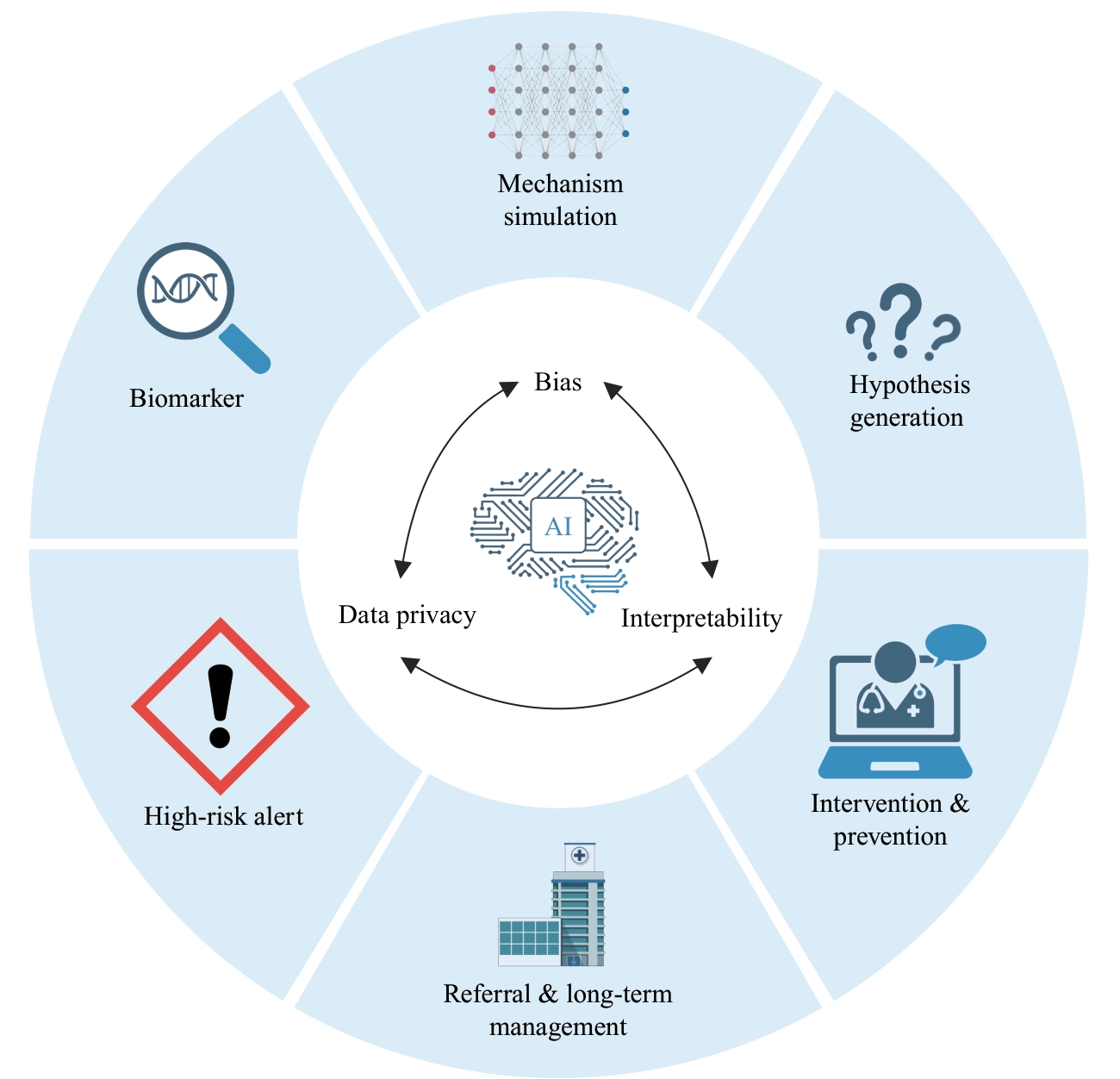
图1 生成式 AI在精神医学中的应用与挑战Note: In basic psychiatry, generative AI can help identify biomarkers, simulate pathogenesis, and generate mechanistic hypotheses through text learning. In clinical psychiatry, generative AI can help identify early risk factors associated with mental illness, enable rapid referral and long-term management through electronic assessments, and provide accessible psychological interventions and prevention through conversational agents. Despite these advantages, the application of generative AI in mental illness still faces problems such as bias, data privacy, and explainability. This figure was created with BioRender.com.
Fig 1 Applications and challenges of generative AI in psychiatry
| [1] | GBD 2019 Diseases and Injuries Collaborators. Global burden of 369 diseases and injuries in 204 countries and territories, 1990‒2019: a systematic analysis for the Global Burden of Disease Study 2019[J]. Lancet, 2020, 396(10258): 1204-1222. |
| [2] | GBD 2019 Diseases and Injuries Collaborators. Global, regional, and national burden of 12 mental disorders in 204 countries and territories, 1990‒2019: a systematic analysis for the Global Burden of Disease Study 2019[J]. Lancet Psychiatry, 2022, 9(2): 137-150. |
| [3] | INSEL T R, LANDIS S C. Twenty-five years of progress: the view from NIMH and NINDS[J]. Neuron, 2013, 80(3): 561-567. |
| [4] | KRYSTAL J H, STATE M W. Psychiatric disorders: diagnosis to therapy[J]. Cell, 2014, 157(1): 201-214. |
| [5] | KEYNEJAD R C, DUA T R, BARBUI C, et al. WHO Mental Health Gap Action Programme (mhGAP) Intervention Guide: a systematic review of evidence from low and middle-income countries[J]. Evid Based Ment Health, 2018, 21(1): 30-34. |
| [6] | KIRKBRIDE J B, ANGLIN D M, COLMAN I, et al. The social determinants of mental health and disorder: evidence, prevention and recommendations[J]. World Psychiatry, 2024, 23(1): 58-90. |
| [7] | PATHARE S, BRAZINOVA A, LEVAV I. Care gap: a comprehensive measure to quantify unmet needs in mental health[J]. Epidemiol Psychiatr Sci, 2018, 27(5): 463-467. |
| [8] | YENDURI G, RAMALINGAM M, SELVI G C, et al. GPT (generative pre-trained transformer): a comprehensive review on enabling technologies, potential applications, emerging challenges, and future directions[J]. IEEE Access, 2024, 12: 54608-54649. |
| [9] | CHEN L, WU P H, CHITTA K, et al. End-to-end autonomous driving: challenges and frontiers[J]. IEEE Trans Pattern Anal Mach Intell, 2024, 46(12): 10164-10183. |
| [10] | BARKE S, JAMES M B, POLIKARPOVA N. Grounded copilot: how programmers interact with code-generating models[J]. Proc ACM Program Lang, 2023, 7(OOPSLA1): 85-111. |
| [11] | SINGHAL K, TU T, GOTTWEIS J, et al. Toward expert-level medical question answering with large language models[J]. Nat Med, 2025, 31(3): 943-950. |
| [12] | REDDY S. Generative AI in healthcare: an implementation science informed translational path on application, integration and governance[J]. Implement Sci, 2024, 19(1): 27. |
| [13] | FEUERRIEGEL S, HARTMANN J, JANIESCH C, et al. Generative AI[J]. Bus Inf Syst Eng, 2024, 66(1): 111-126. |
| [14] | BALLARD J L, WANG Z, LI W, et al. Deep learning-based approaches for multi-omics data integration and analysis[J]. BioData Min, 2024, 17(1): 38. |
| [15] | PUGLISI L, ALEXANDER D C, RAVÌ D. Enhancing spatiotemporal disease progression models via latent diffusion and prior knowledge[C]//LINGURARU M G, DOU Q, FERAGEN A, et al. Medical image computing and computer assisted intervention—MICCAI 2024. Cham: Springer, 2024: 173-183. |
| [16] | JUNG E, LUNA M, PARK S H. Conditional GAN with 3D discriminator for MRI generation of Alzheimer's disease progression[J]. Pattern Recognit, 2023, 133: 109061. |
| [17] | STRACK C, POMYKALA K L, SCHLEMMER H P, et al. "A net for everyone": fully personalized and unsupervised neural networks trained with longitudinal data from a single patient[J]. BMC Med Imaging, 2023, 23(1): 174. |
| [18] | ELAZAB A, WANG C M, GARDEZI S J S, et al. GP-GAN: brain tumor growth prediction using stacked 3D generative adversarial networks from longitudinal MR Images[J]. Neural Netw, 2020, 132: 321-332. |
| [19] | XIA T, CHARTSIAS A, WANG C J, et al. Learning to synthesise the ageing brain without longitudinal data[J]. Med Image Anal, 2021, 73: 102169. |
| [20] | ZHANG K, CHEN G, HUANG S J, et al. Development-driven diffusion model for longitudinal prediction of fetal brain MRI with unpaired data[J]. IEEE Trans Med Imaging, 2025, 44(9): 3641-3653. |
| [21] | SEILER M, RITTER K. Pioneering new paths: the role of generative modelling in neurological disease research[J]. Pflugers Arch, 2025, 477(4): 571-589. |
| [22] | WEI W, POIRION E, BODINI B, et al. Predicting PET-derived myelin content from multisequence MRI for individual longitudinal analysis in multiple sclerosis[J]. Neuroimage, 2020, 223: 117308. |
| [23] | HUANG Q, QIAO C, JING K L, et al. Biomarkers identification for schizophrenia via VAE and GSDAE-based data augmentation[J]. Comput Biol Med, 2022, 146: 105603. |
| [24] | SOKOLOV A V, SCHIÖTH H B. Decoding depression: a comprehensive multi-cohort exploration of blood DNA methylation using machine learning and deep learning approaches[J]. Transl Psychiatry, 2024, 14(1): 287. |
| [25] | ALLESØE R L, NUDEL R, THOMPSON W K, et al. Deep learning-based integration of genetics with registry data for stratification of schizophrenia and depression[J]. Sci Adv, 2022, 8(26): eabi7293. |
| [26] | ZHAO J L, HUANG J J, ZHI D M, et al. Functional network connectivity (FNC)-based generative adversarial network (GAN) and its applications in classification of mental disorders[J]. J Neurosci Methods, 2020, 341: 108756. |
| [27] | FAN J T, FANG L, WU J M, et al. From brain science to artificial intelligence[J]. Engineering, 2020, 6(3): 248-252. |
| [28] | CUSHING C A, DAWES A J, HOFMANN S G, et al. A generative adversarial model of intrusive imagery in the human brain[J]. PNAS Nexus, 2023, 2(1): pgac265. |
| [29] | YAMAGUCHI H, SUGIHARA G, SHIMIZU M, et al. Generative artificial intelligence model for simulating structural brain changes in schizophrenia[J]. Front Psychiatry, 2024, 15: 1437075. |
| [30] | OQUENDO M A, BACA-GARCIA E, ARTÉS-RODRÍGUEZ A, et al. Machine learning and data mining: strategies for hypothesis generation[J]. Mol Psychiatry, 2012, 17(10): 956-959. |
| [31] | TONG S, MAO K, HUANG Z, et al. Automating psychological hypothesis generation with AI: when large language models meet causal graph[DB/OL]. (2024-07-16)[2024-12-30]. https://arxiv.org/abs/2402.14424. |
| [32] | BRIGANTI G, KORNREICH C, LINKOWSKI P. A network structure of manic symptoms[J]. Brain Behav, 2021, 11(3): e02010. |
| [33] | BRIGANTI G, FRIED E I, LINKOWSKI P. Network analysis of contingencies of Self-Worth Scale in 680 university students[J]. Psychiatry Res, 2019, 272: 252-257. |
| [34] | TLACHAC M, GERYCH W, AGRAWAL K, et al. Text generation to aid depression detection: a comparative study of conditional sequence generative adversarial networks[C]//2022 IEEE International Conference on Big Data (Big Data). Osaka: IEEE, 2022: 2804-2813. |
| [35] | KANCHARAPU R, AYYAGARI S N. Suicidal ideation prediction based on social media posts using a GAN-infused deep learning framework with genetic optimization and word embedding fusion[J]. Int J Inf Technol, 2024, 16(4): 2577-2593. |
| [36] | HASSANTABAR S, ZHANG J, YIN H X, et al. MHDeep: mental health disorder detection system based on wearable sensors and artificial neural networks[J]. ACM Trans Embed Comput Syst, 2022, 21(6): 1-22. |
| [37] | DAI R X, KANNAMPALLIL T, KIM S, et al. Detecting mental disorders with wearables: a large cohort study[C]//Proceedings of the 8th ACM/IEEE conference on internet of things design and implementation. New York: Association for Computing Machinery, 2023: 39-51. |
| [38] | WANG W, CHEN J, HU Y Z, et al. Integration of artificial intelligence and wearable Internet of Things for mental health detection[J]. Int J Cogn Comput Eng, 2024, 5: 307-315. |
| [39] | TANG J W, SHANG Y. Advancing mental health pre-screening: a new custom GPT for psychological distress assessment[C]//2024 IEEE 6th international conference on cognitive machine intelligence (CogMI). Washington, D.C.: IEEE, 2024: 162-171. |
| [40] | FU Y J, RAMACHANDRAN G K, DOBBINS N J, et al. Extracting social determinants of health from pediatric patient notes using large language models: novel corpus and methods[DB/OL]. (2024-04-04)[2024-12-30]. https://arxiv.org/abs/2404.00826. |
| [41] | HABICHT J, VISWANATHAN S, CARRINGTON B, et al. Closing the accessibility gap to mental health treatment with a personalized self-referral chatbot[J]. Nat Med, 2024, 30(2): 595-602. |
| [42] | ROLLWAGE M, HABICHT J, JUECHEMS K, et al. Using conversational AI to facilitate mental health assessments and improve clinical efficiency within psychotherapy services: real-world observational study[J]. JMIR AI, 2023, 2: e44358. |
| [43] | HABER Y, LEVKOVICH I, HADAR-SHOVAL D, et al. The artificial third: a broad view of the effects of introducing generative artificial intelligence on psychotherapy[J]. JMIR Ment Health, 2024, 11: e54781. |
| [44] | XIAO M X, XIE Q Q, KUANG Z Y, et al. HealMe: harnessing cognitive reframing in large language models for psychotherapy[DB/OL]. (2024-07-29)[2024-12-30]. https://arxiv.org/abs/2403.05574. |
| [45] | NIE J P, SHAO H Y, FAN Y A, et al. LLM-based conversational AI therapist for daily functioning screening and psychotherapeutic intervention via everyday smart devices[DB/OL]. (2024-03-16)[2024-12-30]. https://arxiv.org/abs/2403.10779. |
| [46] | NA H B. CBT-LLM: a Chinese large language model for cognitive behavioral therapy-based mental health question answering[DB/OL]. (2024-03-24)[2024-12-30]. https://arxiv.org/abs/2403.16008. |
| [47] | KIM T, BAE S, KIM H A, et al. MindfulDiary: harnessing large language model to support psychiatric patients' journaling[C]//Proceedings of the 2024 CHI conference on human factors in computing systems. New York: Association for Computing Machinery, 2024: 1-20. |
| [48] | HEINZ M V, BHATTACHARYA S, TRUDEAU B, et al. Testing domain knowledge and risk of bias of a large-scale general artificial intelligence model in mental health[J]. Digit Health, 2023, 9: 20552076231170499. |
| [49] | KING D R, NANDA G, STODDARD J, et al. An introduction to generative artificial intelligence in mental health care: considerations and guidance[J]. Curr Psychiatry Rep, 2023, 25(12): 839-846. |
| [50] | BLEASE C, TOROUS J. ChatGPT and mental healthcare: balancing benefits with risks of harms[J]. BMJ Ment Health, 2023, 26(1): e300884. |
| [51] | RAMACHANDRANPILLAI R, SIKDER M F, BERGSTRÖM D, et al. Bt-GAN: generating fair synthetic healthdata via bias-transforming generative adversarial networks[J]. J Artif Intell Res, 2024, 79: 1313-1341. |
| [52] | KTENA I, WILES O, ALBUQUERQUE I, et al. Generative models improve fairness of medical classifiers under distribution shifts[J]. Nat Med, 2024, 30(4): 1166-1173. |
| [53] | GOLDEN A, ABOUJAOUDE E. Describing the framework for AI tool assessment in mental health and applying it to a generative AI obsessive-compulsive disorder platform: tutorial[J]. JMIR Form Res, 2024, 8: e62963. |
| [54] | TORTORA L. Beyond discrimination: generative AI applications and ethical challenges in forensic psychiatry[J]. Front Psychiatry, 2024, 15: 1346059. |
| [55] | BAIRD A, XIA Y S. Applying analytics to sociodemographic disparities in mental health[J]. Nat Ment Health, 2025, 3: 124-138. |
| [56] | TOROUS J, BLEASE C. Generative artificial intelligence in mental health care: potential benefits and current challenges[J]. World Psychiatry, 2024, 23(1): 1-2. |
| [57] | DE FREITAS J, COHEN I G. The health risks of generative AI-based wellness apps[J]. Nat Med, 2024, 30(5): 1269-1275. |
| [58] | NGUYEN N B, CHANDRASEGARAN K, ABDOLLAHZADEH M, et al. Re-thinking model inversion attacks against deep neural networks[C]//2023 IEEE/CVF conference on computer vision and pattern recognition (CVPR). Vancouver: IEEE, 2023: 16384-16393. |
| [59] | HU H S, SALCIC Z, SUN L C, et al. Membership inference attacks on machine learning: a survey[J]. ACM Comput Surv, 2022, 54(11s): 1-37. |
| [60] | OROOJI M, RABBANIAN S S, KNAPP G M. Flexible adversary disclosure risk measure for identity and attribute disclosure attacks[J]. Int J Inf Secur, 2023, 22(3): 631-645. |
| [61] | BENOUIS M, ANDRE E, CAN Y S. Balancing between privacy and utility for affect recognition using multitask learning in differential privacy-added federated learning settings: quantitative study[J]. JMIR Ment Health, 2024, 11: e60003. |
| [62] | LI N, ZHOU C Y, GAO Y S, et al. Machine unlearning: taxonomy, metrics, applications, challenges, and prospects[J]. IEEE Trans Neural Netw Learn Syst, 2025, 36(8): 13709-13729. |
| [63] | HUANG K, GOERTZEL B, WU D, et al. GenAI model security[M]//HUANG K, WANG Y, GOERTZEL B, et al. Generative AI Security:Theories and Practices. Cham: Springer, 2024: 163-198. |
| [64] | WANG S Y, DU Y Q, GUO X J, et al. Controllable data generation by deep learning: a review[J]. ACM Comput Surv, 2024, 56(9): 1-38. |
| [65] | SHELAR H, KAUR G, HEDA N, et al. Named entity recognition approaches and their comparison for custom NER model[J]. Sci Technol Libr, 2020, 39(3): 324-337. |
| [66] | TURGAY S, İLTER İ. Perturbation methods for protecting data privacy: a review of techniques and applications[J]. Autom Mach Learn, 2023, 4(2): 31-41. |
| [67] | FAN T, KANG Y, CHEN W J, et al. PDSS: a privacy-preserving framework for step-by-step distillation of large language models[DB/OL]. (2024-06-18)[2025-02-20]. https://arxiv.org/abs/2406.12403. |
| [68] | MANDAL A, CHAKRABORTY T, GUREVYCH I. Towards privacy-aware mental health AI models: advances, challenges, and opportunities[DB/OL]. (2025-02-01)[2025-02-20]. https://arxiv.org/abs/2502.00451. |
| [69] | GAID M L, SALLOUM S A. Homomorphic encryption[C]//HASSANIEN A E, HAQIQ A, TONELLATO P J, et al. Proceedings of the international conference on artificial intelligence and computer vision (AICV2021). Cham: Springer, 2021: 634-642. |
| [70] | LETAFATI M, OTOUM S. On the privacy and security for e-health services in the metaverse: an overview[J]. Ad Hoc Netw, 2023, 150: 103262. |
| [71] | EBRAHIMI M, SAHAY R, HOSSEINALIPOUR S, et al. The transition from centralized machine learning to federated learning for mental health in education: a survey of current methods and future directions[DB/OL]. (2025-01-20)[2025-02-20]. https://arxiv.org/abs/2501.11714. |
| [72] | CHADDAD A, WU Y H, DESROSIERS C. Federated learning for healthcare applications[J]. IEEE Internet Things J, 2024, 11(5): 7339-7358. |
| [73] | GUJARATHI P, MENON K, PATEL J, et al. NeuroSafe-advancing mental health using AI, ML and blockchain[C]//2024 3rd international conference for innovation in technology (INOCON). Bangalore: IEEE, 2024: 1-5. |
| [74] | GAMI B, AGRAWAL M, MISHRA D K, et al. Artificial intelligence-based blockchain solutions for intelligent healthcare: a comprehensive review on privacy preserving techniques[J]. Trans Emerging Tel Tech, 2023, 34(9): e4824. |
| [75] | RASHEED K, QAYYUM A, GHALY M, et al. Explainable, trustworthy, and ethical machine learning for healthcare: a survey[J]. Comput Biol Med, 2022, 149: 106043. |
| [76] | BLEASE C, WORTHEN A, TOROUS J. Psychiatrists' experiences and opinions of generative artificial intelligence in mental healthcare: an online mixed methods survey[J]. Psychiatry Res, 2024, 333: 115724. |
| [77] | YANG K L, ZHANG T L, KUANG Z Y, et al. MentaLLaMA: interpretable mental health analysis on social media with large language models[C]//Proceedings of the ACM web conference 2024. New York: Association for Computing Machinery, 2024: 4489-4500. |
| [78] | ZHENG X W, ZHANG L F, XU C Y, et al. An attribution graph-based interpretable method for CNNs[J]. Neural Netw, 2024, 179: 106597. |
| [79] | CHEFER H, GUR S, WOLF L. Generic attention-model explainability for interpreting bi-modal and encoder-decoder transformers[C]//2021 IEEE/CVF international conference on computer vision (ICCV). Montreal: IEEE, 2021: 387-396. |
| [80] | PAREKH J, KHAYATAN P, SHUKOR M, et al. A concept-based explainability framework for large multimodal models[C]//Proceedings of the 38th international conference on neural information processing systems. New York: Curran Associates Inc., 2025: 135783-135818. |
| [81] | STAN G B M, AFLALO E, ROHEKAR R Y, et al. LVLM-interpret: an interpretability tool for large vision-language models[DB/OL]. (2024-06-24)[2025-02-20]. https://arxiv.org/abs/2404.03118. |
| [82] | LIU Y, YAO Y S, TON J-F, et al., Trustworthy LLMs: a survey and guideline for evaluating large language models' alignment[DB/OL]. (2024-03-21)[2025-02-20]. https://arxiv.org/abs/2308.05374. |
| [83] | SIROCCHI C, BOGLIOLO A, MONTAGNA S. Medical-informed machine learning: integrating prior knowledge into medical decision systems[J]. BMC Med Inform Decis Mak, 2024, 24(Suppl 4): 186. |
| [84] | SHNEIDERMAN B. Bridging the gap between ethics and practice: guidelines for reliable, safe, and trustworthy human-centered AI systems[J]. ACM Trans Interact Intell Syst, 2020, 10(4): 1-31. |
| [85] | MORLEY J, MACHADO C C V, BURR C, et al. The ethics of AI in health care: a mapping review[J]. Soc Sci Med, 2020, 260: 113172. |
| [86] | MONTEITH S, GLENN T, GEDDES J R, et al. Artificial intelligence and increasing misinformation[J]. Br J Psychiatry, 2024, 224(2): 33-35. |
| [87] | WANG C Y, LIU S R, YANG H, et al. Ethical considerations of using ChatGPT in health care[J]. J Med Internet Res, 2023, 25: e48009. |
| [1] | 江怡, 黄晨浩, 李祉良, 吴珺玮, 赵任, 张弢. 1例KRAS突变的结直肠癌患者术前接受化疗联合免疫治疗的效果报道[J]. 上海交通大学学报(医学版), 2025, 45(9): 1256-1260. |
| [2] | 张钲佳, 李小敏, 周鑫, 马海荣, 艾松涛. 高阶磁共振功能成像评估骨与软组织肿瘤价值初探[J]. 上海交通大学学报(医学版), 2025, 45(5): 585-596. |
| [3] | 吴其蓁, 刘启明, 柴烨子, 陶政宇, 王依楠, 郭欣宁, 姜萌, 卜军. 机器学习预测乳腺癌新辅助治疗后炎症代谢状态改变的模型评价[J]. 上海交通大学学报(医学版), 2024, 44(9): 1169-1181. |
| [4] | 李若楠, 陈小科, 许元元, 谭强. ⅠB~ⅢA期非小细胞肺癌患者术后辅助靶向治疗研究进展[J]. 上海交通大学学报(医学版), 2022, 42(11): 1612-1619. |
| [5] | 罗安玲,郑有丽,丛峰松. 低氘水生物学效应的研究进展[J]. 上海交通大学学报(医学版), 2018, 38(4): 467-. |
| 阅读次数 | ||||||
|
全文 |
|
|||||
|
摘要 |
|
|||||
