
Journal of Shanghai Jiao Tong University (Medical Science) ›› 2026, Vol. 46 ›› Issue (5): 665-671.doi: 10.3969/j.issn.1674-8115.2026.05.013
• Review • Previous Articles
Chen Jinquan, Wang Xiaoqiang( )
)
Received:2025-11-19
Accepted:2026-01-08
Online:2026-05-28
Published:2026-05-28
Contact:
Wang Xiaoqiang
E-mail:Wangxiaoqiang@xinhuamed.com.cn
Supported by:CLC Number:
Chen Jinquan, Wang Xiaoqiang. Analysis of surgical treatment and complications of non-syndromic craniosynostosis[J]. Journal of Shanghai Jiao Tong University (Medical Science), 2026, 46(5): 665-671.
Add to citation manager EndNote|Ris|BibTeX
URL: https://xuebao.shsmu.edu.cn/EN/10.3969/j.issn.1674-8115.2026.05.013
| Classification of NSC | Abnormal head shape |
|---|---|
| Sagittal synostosis | Scaphocephaly |
| Unicoronal synostosis | Anterior plagiocephaly |
| Bicoronal synostosis | Brachycephaly |
| Metopic synostosis | Trigonocephaly |
| Unilateral lambdoid synostosis | Posterior plagiocephaly |
| Bilateral lambdoid synostosis | Turricephaly |
Tab 1 Subtypes of NSC and corresponding cranial deformities
| Classification of NSC | Abnormal head shape |
|---|---|
| Sagittal synostosis | Scaphocephaly |
| Unicoronal synostosis | Anterior plagiocephaly |
| Bicoronal synostosis | Brachycephaly |
| Metopic synostosis | Trigonocephaly |
| Unilateral lambdoid synostosis | Posterior plagiocephaly |
| Bilateral lambdoid synostosis | Turricephaly |
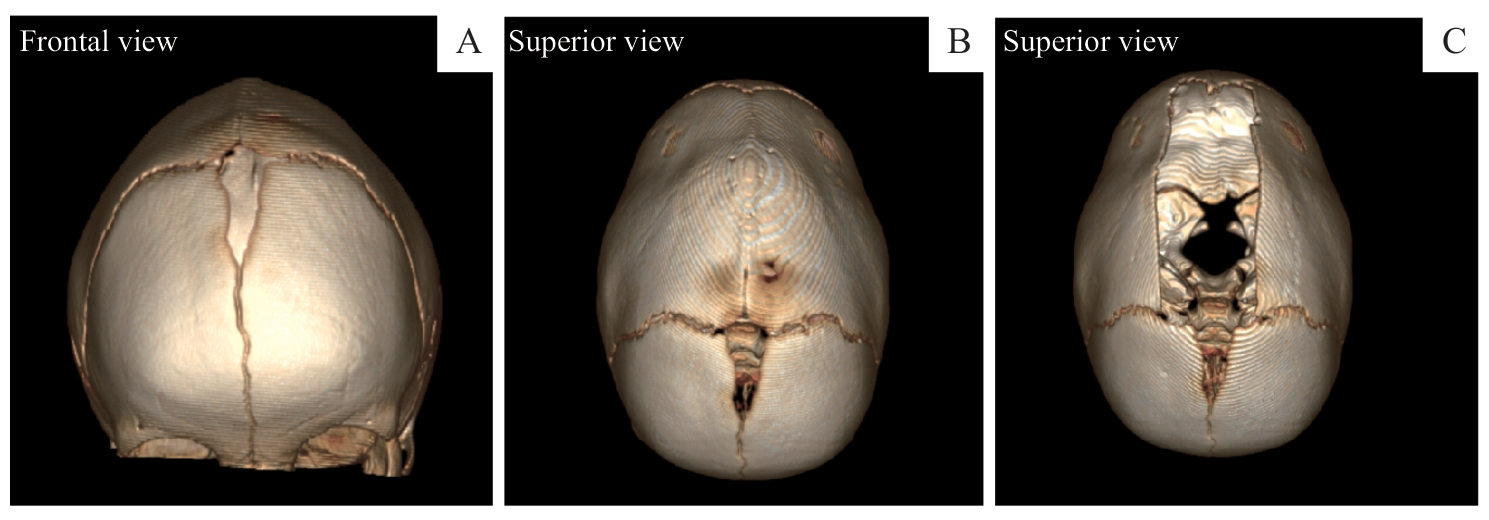
Fig 1 Schematic diagram of ESC
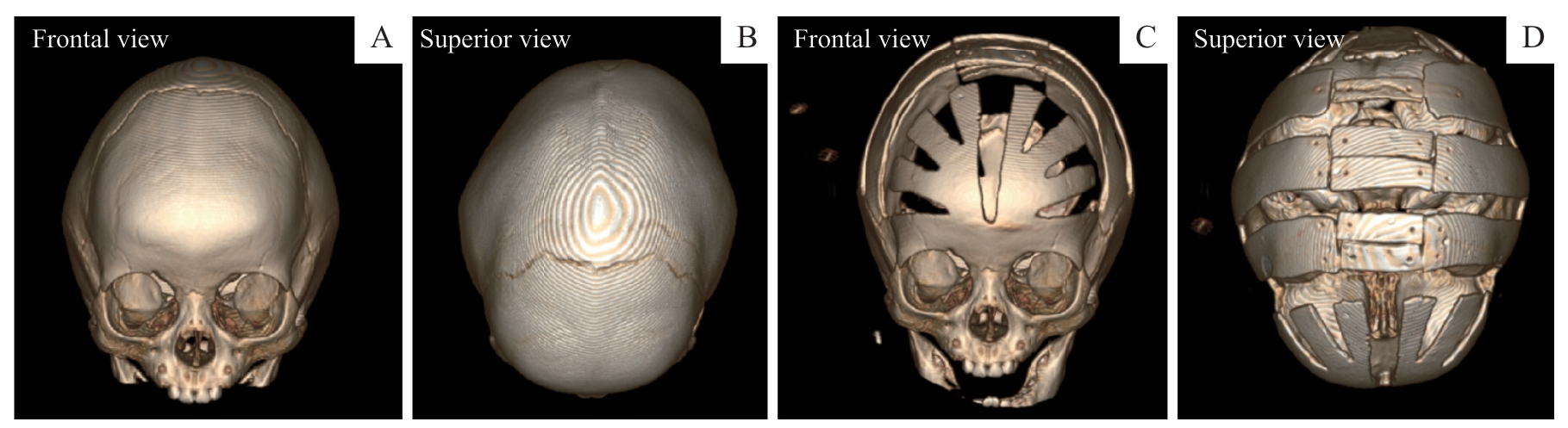
Fig 2 Schematic diagram of extensive cranial vault craniotomy, release, and remodeling
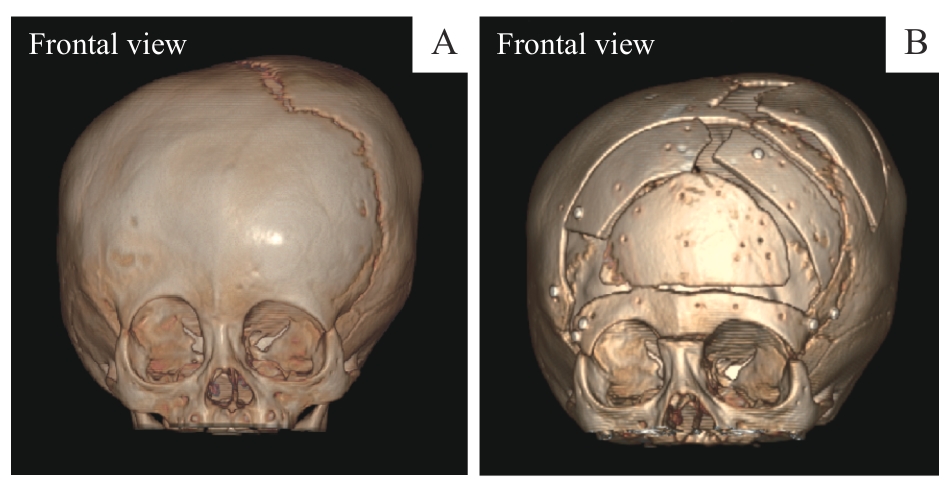
Fig 3 Schematic diagram of cranial vault remodeling combined with bilateral fronto-orbital advancement surgery
| [1] | Persing J A. MOC-PS(SM) CME article: management considerations in the treatment of craniosynostosis[J]. Plast Reconstr Surg, 2008, 121(4 Suppl): 1-11. |
| [2] | Shlobin N A, Baticulon R E, Ortega C A, et al. Global epidemiology of craniosynostosis: a systematic review and meta-analysis[J]. World Neurosurg, 2022, 164: 413-423.e3. |
| [3] | Stanton E, Urata M, Chen J F, et al. The clinical manifestations, molecular mechanisms and treatment of craniosynostosis[J]. Dis Model Mech, 2022, 15(4): dmm049390. |
| [4] | Roth D M, Souter K, Graf D. Craniofacial sutures: signaling centres integrating mechanosensation, cell signaling, and cell differentiation[J]. Eur J Cell Biol, 2022, 101(3): 151258. |
| [5] | 施诚仁, 蔡威, 吴晔明, 等. 新生儿外科学[M]. 2版. 上海: 世界图书出版公司, 2019. |
| Shi C R, Cai W, Wu Y M, et al. Neonatal Surgery[M]. 2nd ed. Shanghai: World Publishing Corporation, 2019. | |
| [6] | Frassanito P, di Rocco C. Depicting cranial sutures: a travel into the history[J]. Childs Nerv Syst, 2011, 27(8): 1181-1183. |
| [7] | Pontell M E, Barrero C E, Wagner C S, et al. Oxycephaly-systematic review, case presentation, and diagnostic clarification[J]. Childs Nerv Syst, 2023, 39(11): 3041-3049. |
| [8] | Virchow R. Uber den cretinismus, namentlich in Franken, und uber pathologische schadelformen[J]. Verh Phys Med Gesellsch Wurzburg,1851, 2: 230-270. |
| [9] | Iqbal J, Yangi K, Naseem A, et al. Surgery of craniosynostosis: a historical review[J]. Ann Med Surg (Lond), 2025, 87(4): 2234-2242. |
| [10] | Tessier P, Delaire J, Billet J, et al. Consid′erations sur le d′eveloppement de l′orbite; ses incidences sur la croissance faciale[J]. Revue Stomatol 1965, 66: 27-39. |
| [11] | Tessier P, Guiot G, Rougerie J, et al. Cranio-naso-orbito-facial osteotomies. hypertelorism[J]. Ann Chir Plast, 1967, 12(2): 103-118. |
| [12] | Arnaud É. L′innovation en chirurgie craniofaciale: depuis Tessier jusqu′aux perspectives futures. D′après les témoignages de F. Ortiz-Monasterio, D. Marchac, F. Firmin et T. Wolfe[J]. Ann Chir Plast Esthe, 2010, 55(5): 363-383. |
| [13] | Jimenez D F, Barone C M. Endoscopic craniectomy for early surgical correction of sagittal craniosynostosis[J]. J Neurosurg, 1998, 88(1): 77-81. |
| [14] | Delye H H K, Borstlap W A, van Lindert E J. Endoscopy-assisted craniosynostosis surgery followed by helmet therapy[J]. Surg Neurol Int, 2018, 9: 59. |
| [15] | Clayman M A, Murad G J, Steele M H, et al. History of craniosynostosis surgery and the evolution of minimally invasive endoscopic techniques: the University of Florida experience[J]. Ann Plast Surg, 2007, 58(3): 285-287. |
| [16] | Ko J M. Genetic syndromes associated with craniosynostosis[J]. J Korean Neurosurg Soc, 2016, 59(3): 187-191. |
| [17] | Jabs E W, Müller U, Li X, et al. A mutation in the homeodomain of the human MSX2 gene in a family affected with autosomal dominant craniosynostosis[J]. Cell, 1993, 75(3): 443-450. |
| [18] | Goovaerts S, Hoskens H, Eller R J, et al. Joint multi-ancestry and admixed GWAS reveals the complex genetics behind human cranial vault shape[J]. Nat Commun, 2023, 14(1): 7436. |
| [19] | Nicoletti P, Zafer S, Matok L, et al. Regulatory elements in SEM1-DLX5-DLX6 (7q21.3) locus contribute to genetic control of coronal nonsyndromic craniosynostosis and bone density-related traits[J]. Genet Med Open, 2024, 2: 101851. |
| [20] | Justice C M, Cuellar A, Bala K, et al. A genome-wide association study implicates the BMP7 locus as a risk factor for nonsyndromic metopic craniosynostosis[J]. Hum Genet, 2020, 139(8): 1077-1090. |
| [21] | Honeycutt J H. Endoscopic-assisted craniosynostosis surgery[J]. Semin Plast Surg, 2014, 28(3): 144-149. |
| [22] | Weinzweig J, Baker S B, Whitaker L A, et al. Delayed cranial vault reconstruction for sagittal synostosis in older children: an algorithm for tailoring the reconstructive approach to the craniofacial deformity[J]. Plast Reconstr Surg, 2002, 110(2): 397-408. |
| [23] | Persing J A, Babler W J, Nagorsky M J, et al. Skull expansion in experimental craniosynostosis[J]. Plast Reconstr Surg, 1986, 78(5): 594-603. |
| [24] | Lauritzen C G K, Davis C, Ivarsson A, et al. The evolving role of springs in craniofacial surgery: the first 100 clinical cases[J]. Plast Reconstr Surg, 2008, 121(2): 545-554. |
| [25] | Lee B S, Hwang L S, Doumit G D, et al. Management options of non-syndromic sagittal craniosynostosis[J]. J Clin Neurosci, 2017, 39: 28-34. |
| [26] | Isaac K V, Meara J G, Proctor M R. Analysis of clinical outcomes for treatment of sagittal craniosynostosis: a comparison of endoscopic suturectomy and cranial vault remodeling[J]. J Neurosurg Pediatr, 2018, 22(5): 467-474. |
| [27] | Ghenbot R G, Patel K B, Skolnick G B, et al. Effects of open and endoscopic surgery on skull growth and calvarial vault volumes in sagittal synostosis[J]. J Craniofac Surg, 2015, 26(1): 161-164. |
| [28] | Le M B, Patel K, Skolnick G, et al. Assessing long-term outcomes of open and endoscopic sagittal synostosis reconstruction using three-dimensional photography[J]. J Craniofac Surg, 2014, 25(2): 573-576. |
| [29] | Shah M N, Kane A A, Petersen J D, et al. Endoscopically assisted versus open repair of sagittal craniosynostosis: the St. Louis Children′s Hospital experience[J]. J Neurosurg Pediatr, 2011, 8(2): 165-170. |
| [30] | Nguyen D C, Farber S J, Skolnick G B, et al. One hundred consecutive endoscopic repairs of sagittal craniosynostosis: an evolution in care[J]. J Neurosurg Pediatr, 2017, 20(5): 410-418. |
| [31] | Massenburg B B, Tolley P D, Lee A, et al. Fronto-orbital advancement for metopic and unilateral coronal craniosynostoses[J]. Oral Maxillofac Surg Clin North Am, 2022, 34(3): 367-380. |
| [32] | Liang Q C, Chen X, Yang B, et al. Bilateral Fronto-orbital advancement combined with cranial vault release using a free-floating bone flap technique for nonsyndromic unilateral coronal synostosis[J]. Transl Pediatr, 2023, 12(12): 2213-2221. |
| [33] | Hansen M, Padwa B L, Scott R M, et al. Synostotic frontal plagiocephaly: anthropometric comparison of three techniques for surgical correction[J]. Plast Reconstr Surg, 1997, 100(6): 1387-1395. |
| [34] | Esparza J, Hinojosa J, García-Recuero I, et al. Surgical treatment of isolated and syndromic craniosynostosis. results and complications in 283 consecutive cases[J]. Neurocirugia (Astur), 2008, 19(6): 509-529. |
| [35] | Fearon J A, Yu J, Bartlett S P, et al. Infections in craniofacial surgery: a combined report of 567 procedures from two centers[J]. Plast Reconstr Surg, 1997, 100(4): 862-868. |
| [36] | Foster K A, Frim D M, McKinnon M. Recurrence of synostosis following surgical repair of craniosynostosis[J]. Plast Reconstr Surg, 2008, 121(3): 70e-76e. |
| [37] | McCarthy J G, Glasberg S B, Cutting C B, et al. Twenty-year experience with early surgery for craniosynostosis: Ⅰ. Isolated craniofacial synostosis: results and unsolved problems[J]. Plast Reconstr Surg, 1995, 96(2): 272-283. |
| [38] | Jubbal K T, Agrawal N, Hollier L H Jr. Analysis of morbidity, readmission, and reoperation after craniosynostosis repair in children[J]. J Craniofac Surg, 2017, 28(2): 401-405. |
| [39] | Branch L G, Crantford C, Cunningham T, et al. Long-term outcomes of pediatric cranial reconstruction using resorbable plating systems for the treatment of craniosynostosis[J]. J Craniofac Surg, 2017, 28(1): 26-29. |
| [40] | Skolnick G B, Murthy S, Patel K B, et al. Long-term characterization of cranial defects after surgical correction for single-suture craniosynostosis[J]. Ann Plast Surg, 2019, 82(6): 679-685. |
| [41] | Einhorn T A. The science of fracture healing[J]. J Orthop Trauma, 2005, 19(10 Suppl): S4-S6. |
| [42] | Chen D, Zhao M, Mundy G R. Bone morphogenetic proteins[J]. Growth Factors, 2004, 22(4): 233-241. |
| [43] | Prevost R, Keribin P, Batut C, et al. Management of non-syndromic craniosynostoses in France in 2015: a national survey[J]. J Craniomaxillofac Surg, 2019, 47(4): 556-560. |
| [44] | Noordzij N, Brouwer R, van der Horst C. Incomplete reossification after craniosynostosis surgery[J]. J Craniofac Surg, 2016, 27(1): e105-e108. |
| [45] | Thenier-Villa J L, Sanromán-Álvarez P, Miranda-Lloret P, et al. Incomplete reossification after craniosynostosis surgery-incidence and analysis of risk factors: a clinical-radiological assessment study[J]. J Neurosurg Pediatr, 2018, 22(2): 120-127. |
| [46] | Soldozy S, Yağmurlu K, Akyeampong D K, et al. Three-dimensional printing and craniosynostosis surgery[J]. Childs Nerv Syst, 2021, 37(8): 2487-2495. |
| [47] | Elkhill C, Liu J W, Linguraru M G, et al. Geometric learning and statistical modeling for surgical outcomes evaluation in craniosynostosis using 3D photogrammetry[J]. Comput Methods Programs Biomed, 2023, 240: 107689. |
| [48] | Uhl J F, Sufianov A, Ruiz C, et al. The use of 3D printed models for surgical simulation of cranioplasty in craniosynostosis as training and education[J]. Brain Sci, 2023, 13(6): 894. |
| [49] | da Costa A C, Anderson V A, Holmes A D, et al. Longitudinal study of the neurodevelopmental characteristics of treated and untreated nonsyndromic craniosynostosis in infancy[J]. Childs Nerv Syst, 2013, 29(6): 985-995. |
| [50] | Patel A, Yang J F, Hashim P W, et al. The impact of age at surgery on long-term neuropsychological outcomes in sagittal craniosynostosis[J]. Plast Reconstr Surg, 2014, 134(4): 608e-617e. |
| [51] | Alperovich M, Runyan C M, Gabrick K S, et al. Long-term neurocognitive outcomes of spring-assisted surgery versus cranial vault remodeling for sagittal synostosis[J]. Plast Reconstr Surg, 2021, 147(3): 661-671. |
| [52] | 蒋文怡, 董晨彬, 吴颖, 等. 颅缝早闭婴幼儿手术治疗前后发育筛查结果分析[J]. 中华小儿外科杂志, 2022, 43(10): 865-868. |
| Jiang W Y, Dong C B, Wu Y, et al. Developmental screening results of infants with craniosynostosis before and after operations[J]. Chinses Journal of Pediatric Surgery, 2022, 43(10): 865-868. |
| Viewed | ||||||
|
Full text |
|
|||||
|
Abstract |
|
|||||
