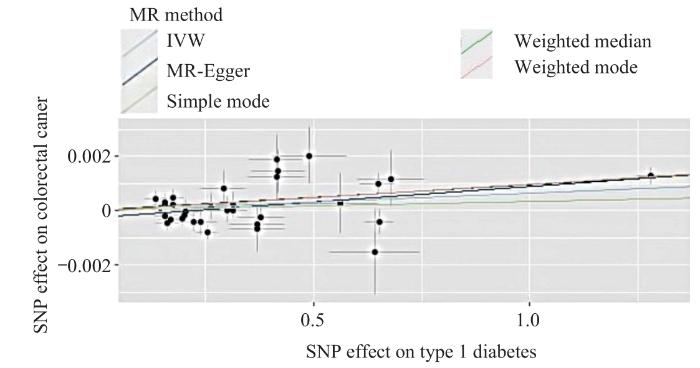
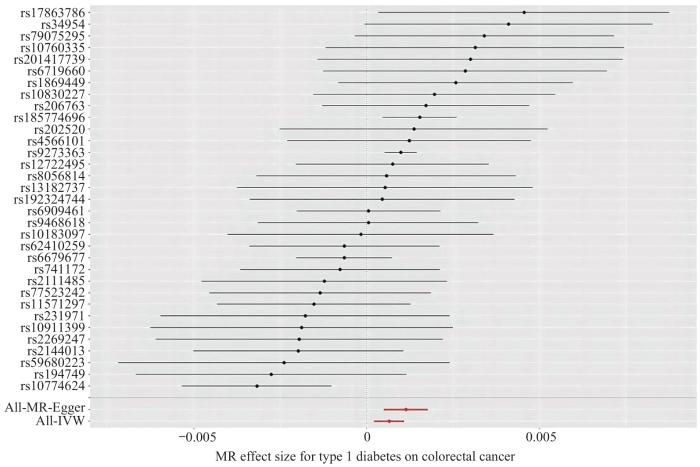
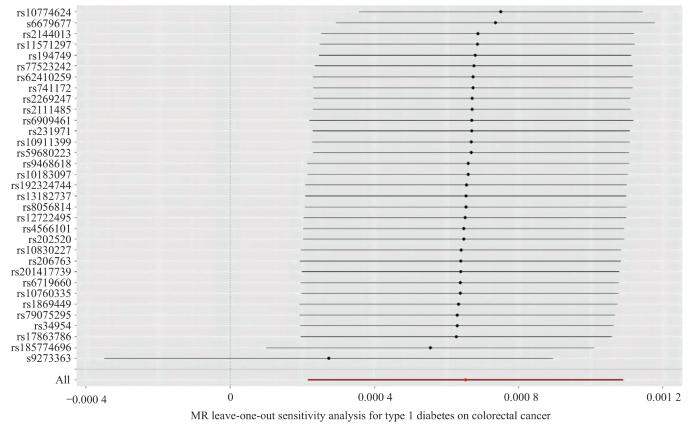
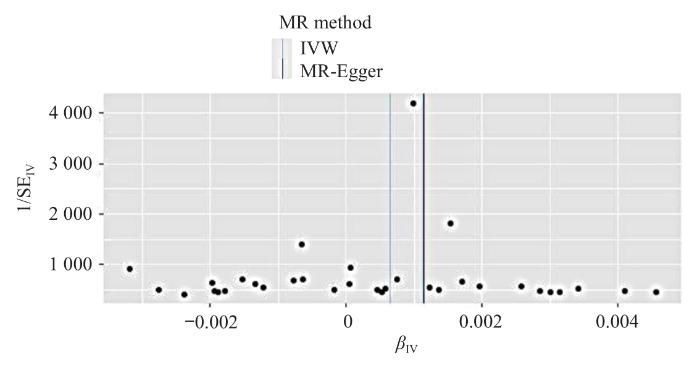
Objective ·To investigate the potential causal relationship between type 1 diabetes and colorectal cancer by using Mendelian randomization (MR). Methods ·Two-sample bidirectional MR was used to investigate the causal relationship between type 1 diabetes and colorectal cancer. All research data were collected from the IEU Open GWAS Project database. The dataset of type 1 diabetes included 9 266 cases and 15 574 controls, with correlation analysis in 12 783 129 single nucleotide polymorphisms (SNPs); the dataset of colorectal cancer included 5 657 cases and 372 016 controls, with correlation analysis in 29 999 696 SNPs. The instrumental variables SNPs were screened. The results derived from the inverse-variance weighted (IVW) method were used as the main indicator of effect. The results derived from other four methods, namely MR-Egger regression, weighted median, simple mode, and weighted mode, were used as reference. Sensitivity was analyzed with the leave-one-out method. Heterogeneity was analyzed with Cochran's Q test by using both IVW and MR-Egger methods. Pleiotropy was analyzed with MR-pleiotropy function, and Steiger test was used for directional research. The colocation analysis was used to find out whether the causal relationship between type 1 diabetes and colorectal cancer was caused by the same SNP. The genetic correlation between 2 diseases was analyzed by using the linkage disequilibrium score regression (LDSC). All tests were analyzed by using R language software (version 4.3.1). Results ·After being screened, a total of 33 instrumental variables (SNPs) were used. The heterogeneity test results showed that there was heterogeneity among the SNPs (IVW and MR-Egger: P<0.05), so the effect evaluation was based on the results of the random effect model. MR analysis showed that type 1 diabetes had a significant causal effect on colorectal cancer (P<0.05) by using IVW, MR-Egger, weighted median and weighted mode. Sensitivity analysis showed that the results were stable. Pleiotropy was not detected in pleiotropy test (P>0.05). Steiger test showed that the effect of type 1 diabetes on colorectal cancer was not interfered with by the reverse effect. Reverse MR analysis showed no causal effect of colorectal cancer on type 1 diabetes (P>0.05). The results of colocalization analysis showed that the probability of H4 hypothesis was 45.7%, and the causal relationship between the 2 diseases was not caused by the same SNP in the gene sequences. LDSC analysis demonstrated that there was no genetic correlation between the two diseases. Conclusion ·Type 1 diabetes may promote colorectal cancer, but colorectal cancer has no effect on type 1 diabetes.
Keywords:colorectal cancer
;
type 1 diabetes
;
Mendelian randomization
YU Yang, MENG Dan, QIU Yiwen, YUAN Jian, ZHU Yingjie. Analysis of impact of type 1 diabetes on colorectal cancer by using two-sample Mendelian randomization. Journal of Shanghai Jiao Tong University (Medical Science)[J], 2024, 44(6): 755-761 doi:10.3969/j.issn.1674-8115.2024.06.011
1型糖尿病(type 1 diabetes)是由自身免疫系统异常引起胰岛β细胞功能损伤,导致胰岛素生成减少而形成的糖尿病[1]。该病好发于婴儿、儿童和青少年,因此又称青少年糖尿病。近年来,我国的1型糖尿病逐渐呈现低龄化趋势[2]。结直肠癌(colorectal cancer)是一种胃肠道恶性肿瘤,好发于中老年,我国的结直肠癌新发病例和死亡人数均位列世界第一[3]。结直肠癌与2型糖尿病具有较强的相关性[4],结直肠癌多见于2型糖尿病患者。但1型糖尿病起病于青少年,其对结直肠癌的影响如何,研究较少。孟德尔随机化(Mendelian randomization,MR)是一种基于全基因组关联研究(genome-wide association study,GWAS)的数据,它的核心是利用与暴露因素具有强相关的遗传单核苷酸多态性(single nucleotide polymorphism,SNP)变异作为工具变量,研究外界暴露或者是一种疾病与另一种疾病的相关性,或者分析生物遗传相关性的流行病学方法。本研究拟采用MR探究1型糖尿病与结直肠癌之间的生物学关系。
1 资料与方法
1.1 实验设计与资料来源
本研究遵循MR研究规范化报告[5]进行相关分析。研究流程包括一个单变量两样本正向MR分析(1型糖尿病-结直肠癌),以及一个反向MR分析(结直肠癌-1型糖尿病),从而探索1型糖尿病与结直肠癌的关系。本研究所采用的数据均来自IEU Open GWAS Project数据库(https://gwas.mrcieu.ac.uk/),对象人群均为欧洲人群,暴露人群与结局人群不存在人种差异。
研究[20]证实,2型糖尿病是结肠发生癌变和淋巴结转移的可能影响因素。另一研究[21]中,患有2型糖尿病的结直肠癌患者与没有糖尿病的患者组比较,在病理分期、淋巴结转移、肝脏转移等方面存在明显差异,2型糖尿病是结直肠癌恶性程度增加的重要风险因素。甚至另有研究[22]显示复方中药葛根芩连汤可以对结直肠癌与2型糖尿病实现异病同治。与2型糖尿病类似,1型糖尿病与结直肠癌也存在一些共同的危险因素。首先是高糖摄入。JOH等[23]研究表明,青少年时期长期摄入含糖饮料或高糖食物,会增加罹患结直肠肿瘤的风险。青少年在13~18岁期间,含糖饮料每日摄入量每增加1份(1份相当于354.84 mL),早发性结直肠癌的风险就会增加约32%[24]。一项前瞻性的饮食调查[25]发现,高糖饮料的摄入可改变胰岛自身免疫反应,促进1型糖尿病发展,高糖饮料的摄入对1型糖尿病高遗传风险的儿童危害更大。同时,肠道微生物与1型糖尿病和结直肠癌之间均密切相关。1型糖尿病多伴随肠道微生态失调,而肠道微生态失调则会改变肠道微环境,诱导癌变的发生[26]。葡萄糖调节蛋白78(glucose-regulated protein 78,GRP78)对调节内质网应激引起的未折叠蛋白反应至关重要,这个蛋白在1型糖尿病及结直肠癌的病理进程中均发挥了重要作用[27]。本研究采用的数种MR分析方法结果均提示,1型糖尿病是结直肠癌的危险因素。
ZHU Yingjie designed this research. YU Yang, MENG Dan, QIU Yiwen and YUAN Jian participated in data collection and analysis. This article was written by YU Yang, and reviewed and revised by ZHU Yingjie. All authors have read the last version of paper and approved submission.
URBANO F, FARELLA I, BRUNETTI G, et al. Pediatric type 1 diabetes: mechanisms and impact of technologies on comorbidities and life expectancy[J]. Int J Mol Sci, 2023, 24(15): 11980.
MENG L H, CHANG K, WANG L H, et al. Correlation and clinical characteristics of colorectal cancer and type 2 diabetes[J]. Modern Journal of Integrated Traditional Chinese and Western Medicine, 2016, 25(9): 999-1000.
SKRIVANKOVA V W, RICHMOND R C, WOOLF B A R, et al. Strengthening the reporting of observational studies in epidemiology using Mendelian randomization: the STROBE-MR statement[J]. JAMA, 2021, 326(16): 1614-1621.
FORGETTA V, MANOUSAKI D, ISTOMINE R, et al. Rare genetic variants of large effect influence risk of type 1 diabetes[J]. Diabetes, 2020, 69(4): 784-795.
SEKULA P, DEL GRECO M F, PATTARO C, et al. Mendelian randomization as an approach to assess causality using observational data[J]. J Am Soc Nephrol, 2016, 27(11): 3253-3265.
LIU N Y, WANG G, LIU C, et al. Non-alcoholic fatty liver disease and complications in type 1 and type 2 diabetes: a Mendelian randomization study[J]. Diabetes Obes Metab, 2023, 25(2): 365-376.
LIU Z R, WANG H C, YANG Z K, et al. Causal associations between type 1 diabetes mellitus and cardiovascular diseases: a Mendelian randomization study[J]. Cardiovasc Diabetol, 2023, 22(1): 236.
KAMAT M A, BLACKSHAW J A, YOUNG R, et al. PhenoScanner V2: an expanded tool for searching human genotype-phenotype associations[J]. Bioinformatics, 2019, 35(22): 4851-4853.
BOWDEN J, DEL GRECO M F, MINELLI C, et al. A framework for the investigation of pleiotropy in two-sample summary data Mendelian randomization[J]. Stat Med, 2017, 36(11): 1783-1802.
BOWDEN J, DAVEY SMITH G, BURGESS S. Mendelian randomization with invalid instruments: effect estimation and bias detection through Egger regression[J]. Int J Epidemiol, 2015, 44(2): 512-525.
BOWDEN J, DAVEY SMITH G, HAYCOCK P C, et al. Consistent estimation in Mendelian randomization with some invalid instruments using a weighted median estimator[J]. Genet Epidemiol, 2016, 40(4): 304-314.
HARTWIG F P, DAVEY SMITH G, BOWDEN J. Robust inference in summary data Mendelian randomization via the zero modal pleiotropy assumption[J]. Int J Epidemiol, 2017, 46(6): 1985-1998.
HEMANI G, TILLING K, DAVEY SMITH G. Orienting the causal relationship between imprecisely measured traits using GWAS summary data[J]. PLoS Genet, 2017, 13(11): e1007081.
YUN Z J, GUO Z W, LI X, et al. Genetically predicted 486 blood metabolites in relation to risk of colorectal cancer: a Mendelian randomization study[J]. Cancer Med, 2023, 12(12): 13784-13799.
BULIK-SULLIVAN B K, LOH P R, FINUCANE H K, et al. LD Score regression distinguishes confounding from polygenicity in genome-wide association studies[J]. Nat Genet, 2015, 47(3): 291-295.
CHEN C, WANG P, ZHANG R D, et al. Mendelian randomization as a tool to gain insights into the mosaic causes of autoimmune diseases[J]. Autoimmun Rev, 2022, 21(12): 103210.
NIU X Y. Study on the relationship between type 2 diabetes mellitus and colorectal cancer in clinicopathological characteristics[D]. Yinchuan: Ningxia Medical University, 2020.
YANG Q H, LEI X J, LI F, et al. Correlation and clinical characteristics of colorectal cancer onset and type 2 diabetes mellitus[J]. China Health Standard Management, 2022, 13(24): 80-83.
ZHANG X Y, LIN X, LIU X Q, et al. Study on mechanism of treating different diseases with same method of Gegen Qinlian Decoction in treating colorectal cancer and type 2 diabetes mellitus based on network pharmacology and molecular docking[J]. Chinese Journal of Information on Traditional Chinese Medicine, 2022, 29(7): 24-32.
JOH H K, LEE D H, HUR J, et al. Simple sugar and sugar-sweetened beverage intake during adolescence and risk of colorectal cancer precursors[J]. Gastroenterology, 2021, 161(1): 128-142.e20.
HUR J, OTEGBEYE E, JOH H K, et al. Sugar-sweetened beverage intake in adulthood and adolescence and risk of early-onset colorectal cancer among women[J]. Gut, 2021, 70(12): 2330-2336.
LAMB M M, FREDERIKSEN B, SEIFERT J A, et al. Sugar intake is associated with progression from islet autoimmunity to type 1 diabetes: the Diabetes Autoimmunity Study in the Young[J]. Diabetologia, 2015, 58(9): 2027-2034.
LIU J, LIAO F, DONG W G, et al. Research progress on risk factors related to early-onset colorectal cancer[J]. Journal of Medical Research, 2022, 51(5): 26-29.
GONZALEZ-GRONOW M, PIZZO S V. Physiological roles of the autoantibodies to the 78-kilodalton glucose-regulated protein (GRP78) in cancer and autoimmune diseases[J]. Biomedicines, 2022, 10(6): 1222.