
上海交通大学学报(医学版) ›› 2026, Vol. 46 ›› Issue (6): 705-712.doi: 10.3969/j.issn.1674-8115.2026.06.002
• 前沿述评 • 上一篇
靳大卫1,2, 张欣欣1,2, 万紫琳1,2, 郭锦政1, 任丽丽1( )
)
收稿日期:2026-03-19
接受日期:2026-04-18
出版日期:2026-06-28
发布日期:2026-06-29
通讯作者:
任丽丽,研究员,博士;电子信箱:renliliipb@163.com。基金资助:
Jin Dawei1,2, Zhang Xinxin1,2, Wan Zilin1,2, Guo Jinzheng1, Ren Lili1()
Received:2026-03-19
Accepted:2026-04-18
Online:2026-06-28
Published:2026-06-29
Contact:
Ren Lili, E-mail: renliliipb@163.com.Supported by:摘要:
尼帕病毒(Nipah virus,NiV)是一种高致死性单股负链RNA病毒,被世界卫生组织列为防范大流行的优先关注病原体。NiV以果蝠为自然宿主,可通过直接接触、食用被污染食物及人际传播等多种途径感染人类,引发急性脑炎和呼吸窘迫综合征等重症疾病,病死率达40%~75%。基于全基因组序列同源性和地理分布特征,NiV分化为两大主要基因谱系:马来西亚型(NiV-Malaysia)和孟加拉型(NiV-Bangladesh)。马来西亚型主要通过中间宿主(猪、马)传播,可采用扑杀中间宿主实现疫情控制;孟加拉型能直接从果蝠溢出感染人类,具有更强的人际传播能力,呈现地方性流行特征。当前NiV防控面临病毒基因组持续演化、现有检测方法无法进行谱系区分、缺乏获批的人用疫苗等挑战。该文系统阐述了NiV的演化特征、跨种传播模式、疫苗与药物的研究进展,分析了病毒演化对监测策略的影响,从大流行防范角度为优化防控策略提供建议。
中图分类号:
靳大卫, 张欣欣, 万紫琳, 郭锦政, 任丽丽. 尼帕病毒演化特征及防控技术研究进展[J]. 上海交通大学学报(医学版), 2026, 46(6): 705-712.
Jin Dawei, Zhang Xinxin, Wan Zilin, Guo Jinzheng, Ren Lili. Research progress in the evolutionary characteristics and prevention and control of Nipah virus[J]. Journal of Shanghai Jiao Tong University (Medical Science), 2026, 46(6): 705-712.
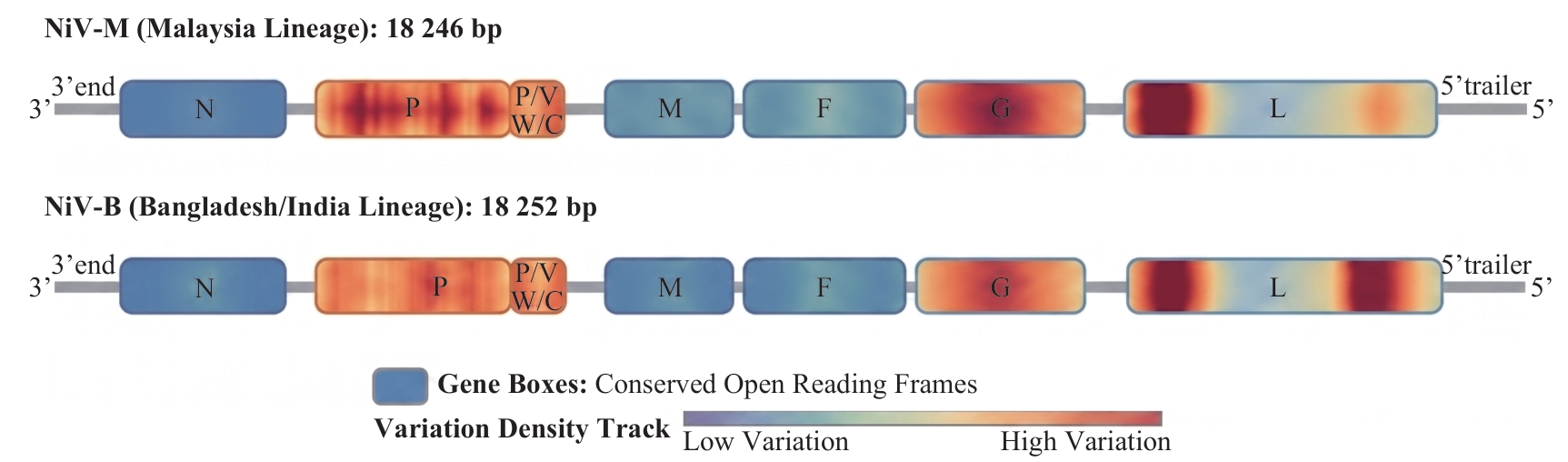
图1 尼帕病毒基因组结构图及主要谱系
Fig 1 Genomic structure of Nipah virus and its major lineages
| Country | Year | Case/n | Case fatality rate/% | Lineage | Primary transmission route | Main clinical feature |
|---|---|---|---|---|---|---|
| Malaysia | 1998—1999 | 283 | 40 | NiV-M | Pig→Human | Fever, acute encephalitis, impaired consciousness |
| Singapore | 1999 | 11 | 9 | NiV-M | Pig→Human | Acute encephalitis, mild respiratory involvement |
| Bangladesh | 2001—present | ≥348 | 77 (adjusted) | NiV-B (BD1/BD2)[ | Consumption of raw date palm sap, person-to-person transmission, nosocomial transmission | ARDS-predominant disease |
| India | 2001—present | ≈140 | 78 (adjusted) | NiV-B | Consumption of raw date palm sap, person-to-person transmission, nosocomial transmission | ARDS combined with encephalitis |
| Philippines | 2014 | 17 | 53 | NiV-M | Horse→Human | Encephalitis with respiratory symptoms |
表1 全球尼帕病毒导致的疫情概况(截至2026年2月)
Tab 1 Global overview of Nipah virus outbreaks (as of February 2026)
| Country | Year | Case/n | Case fatality rate/% | Lineage | Primary transmission route | Main clinical feature |
|---|---|---|---|---|---|---|
| Malaysia | 1998—1999 | 283 | 40 | NiV-M | Pig→Human | Fever, acute encephalitis, impaired consciousness |
| Singapore | 1999 | 11 | 9 | NiV-M | Pig→Human | Acute encephalitis, mild respiratory involvement |
| Bangladesh | 2001—present | ≥348 | 77 (adjusted) | NiV-B (BD1/BD2)[ | Consumption of raw date palm sap, person-to-person transmission, nosocomial transmission | ARDS-predominant disease |
| India | 2001—present | ≈140 | 78 (adjusted) | NiV-B | Consumption of raw date palm sap, person-to-person transmission, nosocomial transmission | ARDS combined with encephalitis |
| Philippines | 2014 | 17 | 53 | NiV-M | Horse→Human | Encephalitis with respiratory symptoms |
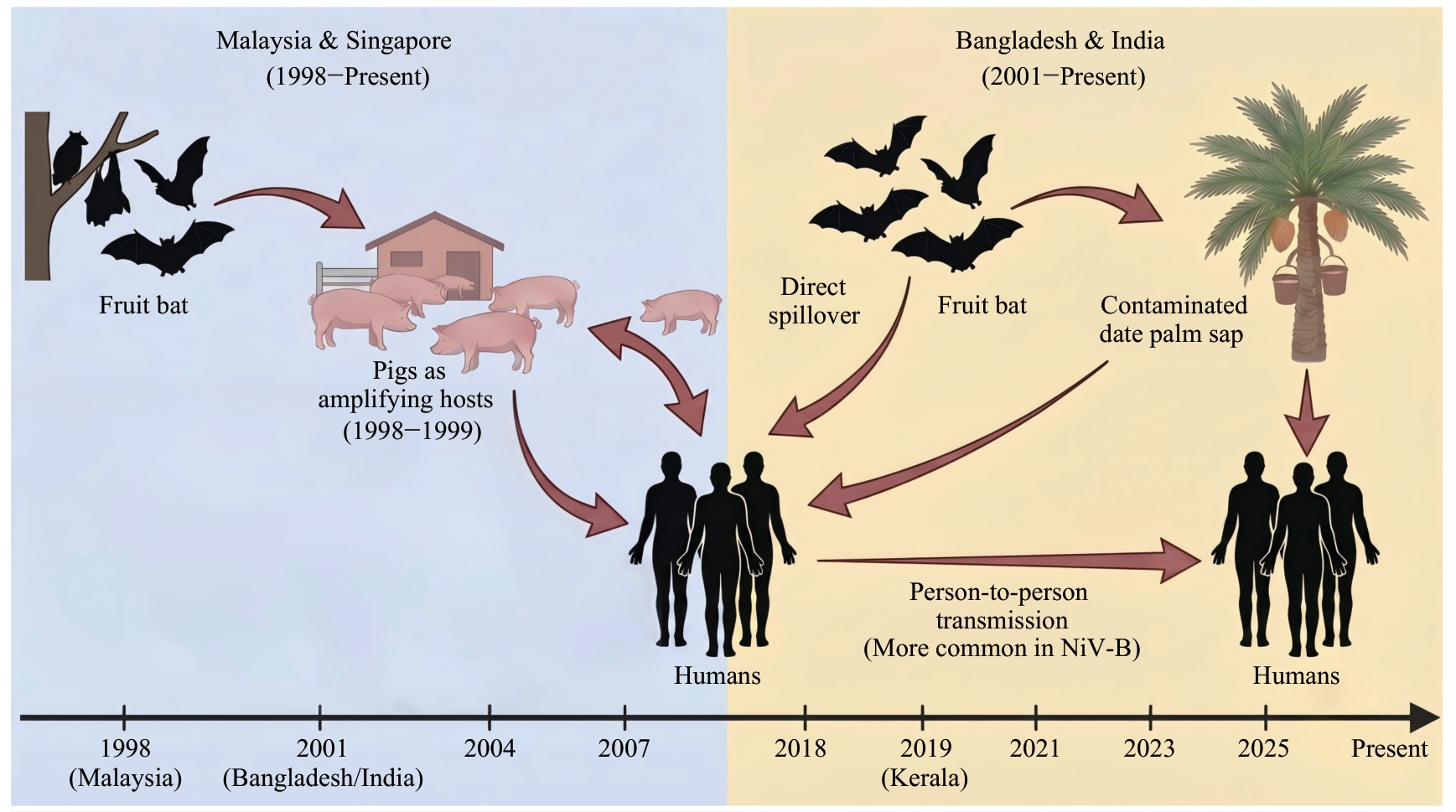
图2 尼帕病毒不同谱系跨种传播示意图
Fig 2 Schematic diagram of cross-species transmission of different Nipah virus lineages
| Vaccine vector | Candidate vaccine | Target antigen | Animal model | Immunization schedule (dose, route, frequency) | Clinical trial stage | Reference |
|---|---|---|---|---|---|---|
| rVSV viral vector | rVSV-∆G-EBOV GP/NiV G | NiV G | African green monkey | 107 PFU, IM, single dose | Phase Ⅰ completed | [ |
| rVSV expressing NiV G | NiV G | Hamster | 105 PFU, IM, single dose | Not yet initiated | [ | |
| rVSV-ΔG-NiVB/G | NiV G, F | Ferret | 107 PFU, IM, single dose | Not yet initiated | [ | |
| Replication-deficient VSV | NiV G | Syrian golden hamster | 106 PFU, IM, single dose | Not yet initiated | [ | |
| Adenoviral vector | ChAdOx1 Nipah B | NiV G | Syrian golden hamster | 108 PFU, IM, single dose | Phase Ⅱ ongoing | [ |
| Nucleic acid vaccine | mRNA-1215 | NiV M, F, G | Mouse | IM, two doses | Phase Ⅰ completed | [ |
| Subunit vaccine | HeV-sG-V | HeV sG | African green monkey | 50‒100 μg, IM, two doses | Phase Ⅰ ongoing | [ |
| Other | NiV-VLPs | NiV M, F, G | Syrian golden hamster | 20 μg, IM, three doses | Not yet initiated | [ |
| Canarypox virus vector | NiV G, F | Pig | 108 PFU, IM, two doses | Not yet initiated | [ | |
| Measles virus vector | NiV G | African green monkey/Hamster | 105 TCID50, SC/IP, two doses | Not yet initiated | [ | |
| Newcastle disease virus vector | NiV G, F | Mouse/Pig | 108‒109 EID50, IM, single dose | Not yet initiated | [ |
表2 尼帕病毒疫苗研发进展(截至2026年2月)
Tab 2 Progress in Nipah virus vaccine development (as of February 2026)
| Vaccine vector | Candidate vaccine | Target antigen | Animal model | Immunization schedule (dose, route, frequency) | Clinical trial stage | Reference |
|---|---|---|---|---|---|---|
| rVSV viral vector | rVSV-∆G-EBOV GP/NiV G | NiV G | African green monkey | 107 PFU, IM, single dose | Phase Ⅰ completed | [ |
| rVSV expressing NiV G | NiV G | Hamster | 105 PFU, IM, single dose | Not yet initiated | [ | |
| rVSV-ΔG-NiVB/G | NiV G, F | Ferret | 107 PFU, IM, single dose | Not yet initiated | [ | |
| Replication-deficient VSV | NiV G | Syrian golden hamster | 106 PFU, IM, single dose | Not yet initiated | [ | |
| Adenoviral vector | ChAdOx1 Nipah B | NiV G | Syrian golden hamster | 108 PFU, IM, single dose | Phase Ⅱ ongoing | [ |
| Nucleic acid vaccine | mRNA-1215 | NiV M, F, G | Mouse | IM, two doses | Phase Ⅰ completed | [ |
| Subunit vaccine | HeV-sG-V | HeV sG | African green monkey | 50‒100 μg, IM, two doses | Phase Ⅰ ongoing | [ |
| Other | NiV-VLPs | NiV M, F, G | Syrian golden hamster | 20 μg, IM, three doses | Not yet initiated | [ |
| Canarypox virus vector | NiV G, F | Pig | 108 PFU, IM, two doses | Not yet initiated | [ | |
| Measles virus vector | NiV G | African green monkey/Hamster | 105 TCID50, SC/IP, two doses | Not yet initiated | [ | |
| Newcastle disease virus vector | NiV G, F | Mouse/Pig | 108‒109 EID50, IM, single dose | Not yet initiated | [ |
| Category | Drug | Mechanism of action | Animal model | Clinical trial stage | Reference |
|---|---|---|---|---|---|
| Monoclonal antibodies | m102.4 | Targets the binding site of viral G glycoprotein with Ephrin B2/B3 receptor on host epithelial cells | Non-human primates | Phase Ⅰ completed | [ |
| h5B3.1 | Inhibits conformational change of NiV-F | Ferret | Not yet initiated | [ | |
| Nucleotides and nucleoside analogues | Remdesivir | Competitively binds viral RNA-dependent RNA polymerase (RdRp), inhibits RdRp activity | African green monkey | Not yet initiated | [ |
| Favipiravir | Competitively binds RdRp site, blocks viral genome replication | Hamster | Not yet initiated | [ | |
| Ribavirin | Broad-spectrum inhibitior of viral RNA synthesis | African green monkey | Not yet initiated | [ | |
| VV116 | Targets RdRp | Syrian golden hamster | Not yet initiated | [ | |
| 4'-fluorouridine | Broad-spectrum anti-RNA virus, inhibits RdRp and terminates viral RNA chain synthesis | Syrian golden hamster | Not yet initiated | [ | |
| Fusion inhibitory peptides | Cholesterol-tagged fusion inhibitory peptide | Alters F protein conformation, inhibits viral entry into host cells | African green monkey/hamster | Not yet initiated | [ |
表3 尼帕病毒感染药物研发进展
Tab 3 Progress in the development of therapeutics for Nipah virus infection
| Category | Drug | Mechanism of action | Animal model | Clinical trial stage | Reference |
|---|---|---|---|---|---|
| Monoclonal antibodies | m102.4 | Targets the binding site of viral G glycoprotein with Ephrin B2/B3 receptor on host epithelial cells | Non-human primates | Phase Ⅰ completed | [ |
| h5B3.1 | Inhibits conformational change of NiV-F | Ferret | Not yet initiated | [ | |
| Nucleotides and nucleoside analogues | Remdesivir | Competitively binds viral RNA-dependent RNA polymerase (RdRp), inhibits RdRp activity | African green monkey | Not yet initiated | [ |
| Favipiravir | Competitively binds RdRp site, blocks viral genome replication | Hamster | Not yet initiated | [ | |
| Ribavirin | Broad-spectrum inhibitior of viral RNA synthesis | African green monkey | Not yet initiated | [ | |
| VV116 | Targets RdRp | Syrian golden hamster | Not yet initiated | [ | |
| 4'-fluorouridine | Broad-spectrum anti-RNA virus, inhibits RdRp and terminates viral RNA chain synthesis | Syrian golden hamster | Not yet initiated | [ | |
| Fusion inhibitory peptides | Cholesterol-tagged fusion inhibitory peptide | Alters F protein conformation, inhibits viral entry into host cells | African green monkey/hamster | Not yet initiated | [ |
| [1] | Moore K A, Mehr A J, Ostrowsky J T, et al. Measures to prevent and treat Nipah virus disease: research priorities for 2024-29[J]. Lancet Infect Dis, 2024, 24(11): e707-e717. |
| [2] | Nikolay B, Salje H, Hossain M J, et al. Transmission of Nipah virus: 14 years of investigations in Bangladesh[J]. N Engl J Med, 2019, 380(19): 1804-1814. |
| [3] | Ker D S, Jenkins H T, Greive S J, et al. CryoEM structure of the Nipah virus nucleocapsid assembly[J]. PLoS Pathog, 2021, 17(7): e1009740. |
| [4] | Amaya M, Broder C C. Vaccines to emerging viruses: Nipah and hendra[J]. Annu Rev Virol, 2020, 7(1): 447-473. |
| [5] | Dsouza N N, Chellasamy S K. A comparative genomic approach to decipher the mutations associated with Nipah viral human isolates from Southeast Asia[J]. Iran J Microbiol, 2024, 16(1): 104-113. |
| [6] | Harcourt B H, Lowe L, Tamin A, et al. Genetic characterization of Nipah virus, Bangladesh, 2004[J]. Emerg Infect Dis, 2005, 11(10): 1594-1597. |
| [7] | Sun Y Q, Zhang Y Y, Liu M C, et al. Mapping the distribution of Nipah virus infections: a geospatial modelling analysis[J]. Lancet Planet Health, 2024, 8(7): e463-e475. |
| [8] | Rahman M M, Rahman S, Rahim S, et al. Mapping the geodispersal and evolutionary dynamics of regional Nipah virus strain in Bangladesh[J]. Microbiol Spectr, 2026, 14(4): e0231925. |
| [9] | Hoque A F, Rahman M M, Lamia A S, et al. In silico prediction of interaction between Nipah virus attachment glycoprotein and host cell receptors Ephrin-B2 and Ephrin-B3 in domestic and peridomestic mammals[J]. Infect Genet Evol, 2023, 116: 105516. |
| [10] | Chua K B, Bellini W J, Rota P A, et al. Nipah virus: a recently emergent deadly paramyxovirus[J]. Science, 2000, 288(5470): 1432-1435. |
| [11] | Bhowmik A, Hasan M, Redoy M M H, et al. Nipah virus outbreak trends in Bangladesh during the period 2001 to 2024: a brief review[J]. Sci One Health, 2025, 4: 100103. |
| [12] | Khan S, Akbar S M F, Mahtab M A, et al. Twenty-five years of Nipah outbreaks in Southeast Asia: a persistent threat to global health[J]. IJID Reg, 2024, 13: 100434. |
| [13] | Satter S M, Rahman D I, Sultana S, et al. Epidemiology, clinical characteristics, and genetic diversity of Nipah virus strains from Bangladesh: 2016-2023[J]. Int J Infect Dis, 2025, 159: 108010. |
| [14] | Yan X M, Liu Y, Hu T S, et al. A compendium of 8, 176 bat RNA viral metagenomes reveals ecological drivers and circulation dynamics[J]. Nat Microbiol, 2025, 10(2): 554-568. |
| [15] | Yadav P D, Shete A M, Kumar G A, et al. Nipah virus sequences from humans and bats during Nipah outbreak, Kerala, India, 2018[J]. Emerg Infect Dis, 2019, 25(5): 1003-1006. |
| [16] | Balasubramanian R, Mohandas S, Thankappan U P, et al. Surveillance of Nipah virus in Pteropus medius of Kerala state, India, 2023[J]. Front Microbiol, 2024, 15: 1342170. |
| [17] | Sudeep A B, Yadav P D, Gokhale M D, et al. Detection of Nipah virus in Pteropus medius in 2019 outbreak from Ernakulam district, Kerala, India[J]. BMC Infect Dis, 2021, 21(1): 162. |
| [18] | Sahay R R, Yadav P D, Gupta N, et al. Experiential learnings from the Nipah virus outbreaks in Kerala towards containment of infectious public health emergencies in India[J]. Epidemiol Infect, 2020, 148: e90. |
| [19] | Shete A M, Radhakrishnan C, Pardeshi P G, et al. Antibody response in symptomatic & asymptomatic Nipah virus cases from Kerala, India[J]. Indian J Med Res, 2021, 154(3): 533-535. |
| [20] | McKee C D, Islam A, Luby S P, et al. The ecology of Nipah virus in Bangladesh: a nexus of land-use change and opportunistic feeding behavior in bats[J]. Viruses, 2021, 13(2): 169. |
| [21] | Chandni R, Renjith T P, Fazal A, et al. Clinical manifestations of Nipah virus-infected patients who presented to the emergency department during an outbreak in Kerala State in India, May 2018[J]. Clin Infect Dis, 2020, 71(1): 152-157. |
| [22] | Hossain M J, Gurley E S, Montgomery J M, et al. Clinical presentation of Nipah virus infection in Bangladesh[J]. Clin Infect Dis, 2008, 46(7): 977-984. |
| [23] | Goh K J, Tan C T, Chew N K, et al. Clinical features of Nipah virus encephalitis among pig farmers in Malaysia[J]. N Engl J Med, 2000, 342(17): 1229-1235. |
| [24] | Aquib W R, Mondal U K, Nazneen A, et al. Long-term sequelae and functional outcomes in the largest cohort of Nipah virus survivors in Bangladesh[J]. Lancet Reg Health Southeast Asia, 2026, 45: 100729. |
| [25] | Vasudevan S S, Subash A, Mehta F, et al. Global and regional mortality statistics of Nipah virus from 1994 to 2023: a comprehensive systematic review and meta-analysis[J]. Pathog Glob Health, 2024, 118(6): 471-480. |
| [26] | Satter S M, Aquib W R, Sultana S, et al. Tackling a global epidemic threat: Nipah surveillance in Bangladesh, 2006—2021[J]. PLoS Negl Trop Dis, 2023, 17(9): e0011617. |
| [27] | Aquib W R, Rahman D I, Jahan F A, et al. Post-mortem surveillance: an innovative strategy to detect and prevent spread of Nipah virus infection in humans[J]. Emerg Microbes Infect, 2026, 15(1): 2613510. |
| [28] | Pollak N M, Olsson M, Marsh G A, et al. Evaluation of three rapid low-resource molecular tests for Nipah virus[J]. Front Microbiol, 2022, 13: 1101914. |
| [29] | Mazzola L T, Kelly-Cirino C. Diagnostics for Nipah virus: a zoonotic pathogen endemic to Southeast Asia[J]. BMJ Glob Health, 2019, 4(Suppl 2): e001118. |
| [30] | Rahman M M, Miah M, Hossain M E, et al. Development of a culture-independent whole-genome sequencing of Nipah virus using the MinION Oxford Nanopore platform[J]. Microbiol Spectr, 2025, 13(6): e0249224. |
| [31] | Miao J, Zuo L L, He D M, et al. Rapid detection of Nipah virus using the one-pot RPA-CRISPR/Cas13a assay[J]. Virus Res, 2023, 332: 199130. |
| [32] | Jensen K S, Adams R, Bennett R S, et al. Development of a novel real-time polymerase chain reaction assay for the quantitative detection of Nipah virus replicative viral RNA[J]. PLoS One, 2018, 13(6): e0199534. |
| [33] | World Health Organization. Priority diagnostics for Nipah: use cases and target product profiles[EB/OL]. (2019-01-07)[2026-03-01]. https://www.who.int/publications/m/item/priority-diagnostics-for-nipah-use-cases-and-target-product-profiles. |
| [34] | Mazzola L, Fru H C, Cherkaoui D, et al. Diagnostic tests for Nipah virus: a landscape analysis[J]. Diagn Microbiol Infect Dis, 2026, 114(1): 117101. |
| [35] | Arunkumar G, Devadiga S, McElroy A K, et al. Adaptive immune responses in humans during Nipah virus acute and convalescent phases of infection[J]. Clin Infect Dis, 69(10): 1752-1756. |
| [36] | Wylezich C, Calvelage S, Schlottau K, et al. Next-generation diagnostics: virus capture facilitates a sensitive viral diagnosis for epizootic and zoonotic pathogens including SARS-CoV-2[J]. Microbiome, 2021, 9(1): 51. |
| [37] | World Health Organization. Nipah research and development (R&D) roadmap[EB/OL]. (2019-01-10)[2026-03-01]. https://www.who.int/publications/m/item/nipah-research-and-development-(r-d)-roadmap. |
| [38] | Monath T P, Nichols R, Feldmann F, et al. Immunological correlates of protection afforded by PHV02 live, attenuated recombinant vesicular stomatitis virus vector vaccine against Nipah virus disease[J]. Front Immunol, 2023, 14: 1216225. |
| [39] | DeBuysscher B L, Scott D, Thomas T, et al. Peri-exposure protection against Nipah virus disease using a single-dose recombinant vesicular stomatitis virus-based vaccine[J]. NPJ Vaccines, 2016, 1: 16002-. |
| [40] | Mire C E, Versteeg K M, Cross R W, et al. Single injection recombinant vesicular stomatitis virus vaccines protect ferrets against lethal Nipah virus disease[J]. Virol J, 2013, 10: 353. |
| [41] | Lo M K, Bird B H, Chattopadhyay A, et al. Single-dose replication-defective VSV-based Nipah virus vaccines provide protection from lethal challenge in Syrian hamsters[J]. Antiviral Res, 2014, 101: 26-29. |
| [42] | van Doremalen N, Lambe T, Sebastian S, et al. A single-dose ChAdOx1-vectored vaccine provides complete protection against Nipah Bangladesh and Malaysia in Syrian golden hamsters[J]. PLoS Negl Trop Dis, 2019, 13(6): e0007462. |
| [43] | Ploquin A, Mason R D, Holman L A, et al. A structure-based mRNA vaccine for Nipah virus in healthy adults: a phase 1 trial[J]. Nat Med, 2026, 32(4): 1401-1410. |
| [44] | Frenck R W Jr, Naficy A, Feser J, et al. Safety and immunogenicity of a Nipah virus vaccine (HeV-sG-V) in adults: a single-centre, randomised, observer-blind, placebo-controlled, phase 1 study[J]. Lancet, 2025, 406(10521): 2792-2803. |
| [45] | Walpita P, Barr J, Sherman M, et al. Vaccine potential of Nipah virus-like particles[J]. PLoS One, 2011, 6(4): e18437. |
| [46] | Mungall B A, Middleton D, Crameri G, et al. Feline model of acute Nipah virus infection and protection with a soluble glycoprotein-based subunit vaccine[J]. J Virol, 2006, 80(24): 12293-12302. |
| [47] | Daniels P, Ksiazek T, Eaton B T. Laboratory diagnosis of Nipah and Hendra virus infections[J]. Microbes Infect, 2001, 3(4): 289-295. |
| [48] | Guillaume V, Contamin H, Loth P, et al. Nipah virus: vaccination and passive protection studies in a hamster model[J]. J Virol, 2004, 78(2): 834-840. |
| [49] | Hassan M Z, Ibrahim S K, Harriss E, et al. Interpreting the natural history and pathogenesis of Nipah virus disease through clinical data, to inform clinical trial design: a systematic review[J]. Lancet Microbe, 2026, 7(4): 101295. |
| [50] | Geisbert T W, Mire C E, Geisbert J B, et al. Therapeutic treatment of Nipah virus infection in nonhuman primates with a neutralizing human monoclonal antibody[J]. Sci Transl Med, 2014, 6(242): 242ra82. |
| [51] | Dang H V, Chan Y P, Park Y J, et al. An antibody against the F glycoprotein inhibits Nipah and Hendra virus infections[J]. Nat Struct Mol Biol, 2019, 26(10): 980-987. |
| [52] | Lo M K, Feldmann F, Gary J M, et al. Remdesivir (GS-5734) protects African green monkeys from Nipah virus challenge[J]. Sci Transl Med, 2019, 11(494): eaau9242. |
| [53] | Dawes B E, Kalveram B, Ikegami T, et al. Favipiravir (T-705) protects against Nipah virus infection in the hamster model[J]. Sci Rep, 2018, 8(1): 7604. |
| [54] | Rockx B, Bossart K N, Feldmann F, et al. A novel model of lethal Hendra virus infection in African green monkeys and the effectiveness of ribavirin treatment[J]. J Virol, 2010, 84(19): 9831-9839. |
| [55] | Zhang Y M, Yao Y F, Song S F, et al. The oral nucleoside drug VV116 is a promising candidate for treating Nipah virus infection[J]. Emerg Microbes Infect, 2025, 14(1): 2587983. |
| [56] | Cross R W, Pigeaud D D, Borisevich V, et al. Oral 4'fluorouridine provides postexposure protection against lethal Nipah virus infection[J]. bioRxiv, 2026: 2026.02.21.707194. |
| [57] | Porotto M, Rockx B, Yokoyama C C, et al. Inhibition of Nipah virus infection in vivo: targeting an early stage of paramyxovirus fusion activation during viral entry[J]. PLoS Pathog, 2010, 6(10): e1001168. |
| [1] | 张毓, 苑成梅, 肖泽萍. 矛盾性失眠脑电特征及治疗的研究进展[J]. 上海交通大学学报(医学版), 2024, 44(5): 658-662. |
| [2] | 吴雷, 夏一梦. PetCO2监测型鼻咽通气道在阻塞型睡眠呼吸暂停综合征患者胃镜精查麻醉中的应用研究[J]. 上海交通大学学报(医学版), 2023, 43(12): 1542-1547. |
| [3] | 贾伟平. 血糖监测技术的进步与展望[J]. 上海交通大学学报(医学版), 2022, 42(9): 1171-1175. |
| [4] | 李国栋, 颜少华, 张秋霞, 雷力, 张新禄, 梁鸿彬, 卢俊颜, 肖敏, 罗玮, 卜军, 修建成. 基于“互联网+”的心脑血管疾病“协防共管”健康管理模式对社区重点监测人群血压改善的效果评价[J]. 上海交通大学学报(医学版), 2022, 42(6): 797-804. |
| [5] | 林羿. 中国高危妊娠研究的现状、问题和方向[J]. 上海交通大学学报(医学版), 2022, 42(4): 403-408. |
| [6] | 田婷婷, 侯雅宣, 李雨晴, 祁鸿姣, 陈默, 吕美霞. 中国梅毒发病率的时空分布特征分析[J]. 上海交通大学学报(医学版), 2021, 41(5): 648-652. |
| [7] | 李成, 张明亮, 应令雯, 苏娇溶, 陶睿, 于霞, 包玉倩, 周健. 小鼠持续葡萄糖监测技术的建立及其血糖时间序列的多尺度熵分析[J]. 上海交通大学学报(医学版), 2021, 41(2): 134-139. |
| [8] | 陈黎明,于布为. 全身麻醉术中伤害性刺激监测的研究进展[J]. 上海交通大学学报(医学版), 2020, 40(2): 271-. |
| [9] | 徐正鹏 1,王粟 2,糜琛蓉 3,韩立中 2,王文奎 1. 烧伤患者感染病原菌的分布及耐药性分析[J]. 上海交通大学学报(医学版), 2019, 39(3): 292-. |
| [10] | 符浩,赵雅娟,王勇. 基于心电信号的心肺耦合技术在睡眠相关疾病中的应用[J]. 上海交通大学学报(医学版), 2018, 38(4): 450-. |
| [11] | 徐梦丹,戴秋艳. 血压变异性与脉搏波传导速度及左心室质量指数的相关性[J]. 上海交通大学学报(医学版), 2018, 38(2): 184-. |
| [12] | 黄晓虹,严彬,刘佳,王晓宁. 颈椎术中体感诱发电位监测与术后疗效分析[J]. 上海交通大学学报(医学版), 2017, 37(12): 1674-. |
| [13] | Olivier VYUNGURA,王祥慧. 肾移植受者肾功能及免疫状态监测与评价研究进展[J]. 上海交通大学学报(医学版), 2017, 37(12): 1702-. |
| [14] | 郭芊卉 王飞 程艾邦 张冬燕 李菲卡 李燕. 清晨高血压与心率及心率变异的关系研究[J]. 上海交通大学学报(医学版), 2016, 36(8): 1181-. |
| [15] | 刘慧明,李国红,赵列宾,董斌,陆骆,周莹霞. 电子监测与量表评估2型糖尿病患者服药依从性的研究[J]. 上海交通大学学报(医学版), 2016, 36(6): 901-. |
| 阅读次数 | ||||||
|
全文 |
|
|||||
|
摘要 |
|
|||||
