上海交通大学学报(医学版) ›› 2026, Vol. 46 ›› Issue (6): 693-704.doi: 10.3969/j.issn.1674-8115.2026.06.001

• 创新团队成果专栏 •    下一篇

单磷酸腺苷脱氨酶3通过CREB/ADCY10信号通路调控造血干细胞骨髓重建能力

张悦1, 夏一秋1, 赫肖肖2, 陈迟琪1, 张亚萍1, 王宇1, 郑俊克1(), 谢莉1(), 于卓1()   

  1. 1.上海交通大学基础医学院病理生理学系,细胞分化与凋亡教育部重点实验室,上海 201318
    2.上海交通大学医学院附属新华医院血液内科,上海 200092
  • 收稿日期:2026-02-28 接受日期:2026-03-30 出版日期:2026-06-28 发布日期:2026-06-29
  • 通讯作者: 于 卓,研究员,博士;电子信箱:yuzhuo78@aliyun.com
    谢 莉,实验师,博士;电子信箱:xieli100@126.com
    郑俊克,研究员,博士;电子信箱:zhengjunke@shsmu.edu.cn
  • 基金资助:
    国家自然科学基金(82570151;82430007;82470121;82370180;32571298;32371160);国家重点研发计划(2024YFA1803500)

Adenosine monophosphate deaminase 3 regulates the bone marrow reconstitution ability of hematopoietic stem cells through the CREB/ADCY10 signaling pathway

Zhang Yue1, Xia Yiqiu1, He Xiaoxiao2, Chen Chiqi1, Zhang Yaping1, Wang Yu1, Zheng Junke1(), Xie Li1(), Yu Zhuo1()   

  1. 1.Key Laboratory of Cell Differentiation and Apoptosis of National Ministry of Education, Department of Pathophysiology, Shanghai Jiao Tong University School of Medicine, Shanghai 201318, China
    2.Department of Hematology, Xinhua Hospital, Shanghai Jiao Tong University School of Medicine, Shanghai 200092, China
  • Received:2026-02-28 Accepted:2026-03-30 Online:2026-06-28 Published:2026-06-29
  • Contact: Yu Zhuo, E-mail: yuzhuo78@aliyun.com
    Xie Li, E-mail: xieli100@126.com
    Zheng Junke, E-mail: zhengjunke@shsmu.edu.cn.
  • Supported by:
    National Natural Science Foundation of China(82570151;82430007;82470121;82370180;32571298;32371160);National Key Research and Development Program of China(2024YFA1803500)

摘要:

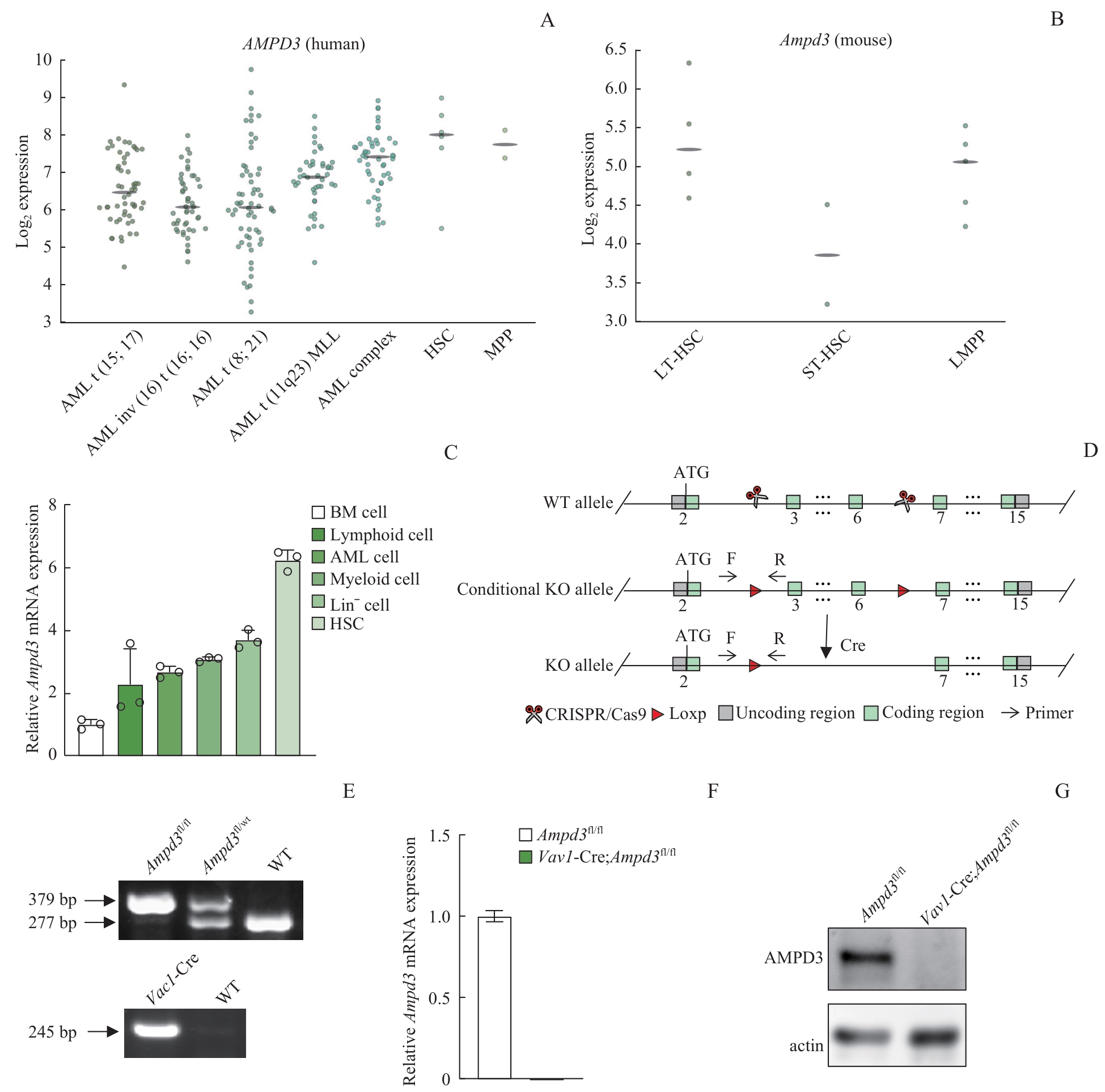
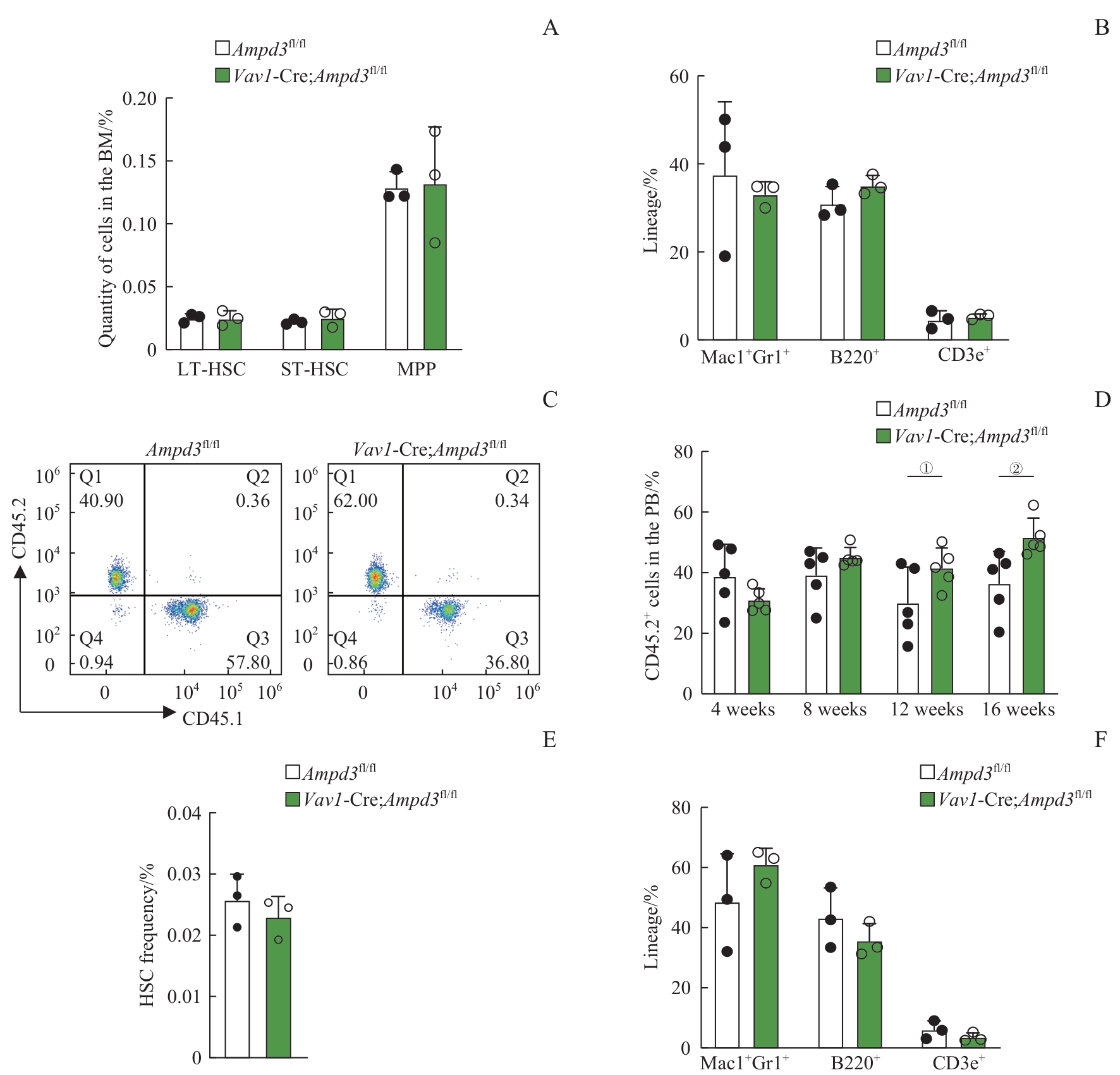
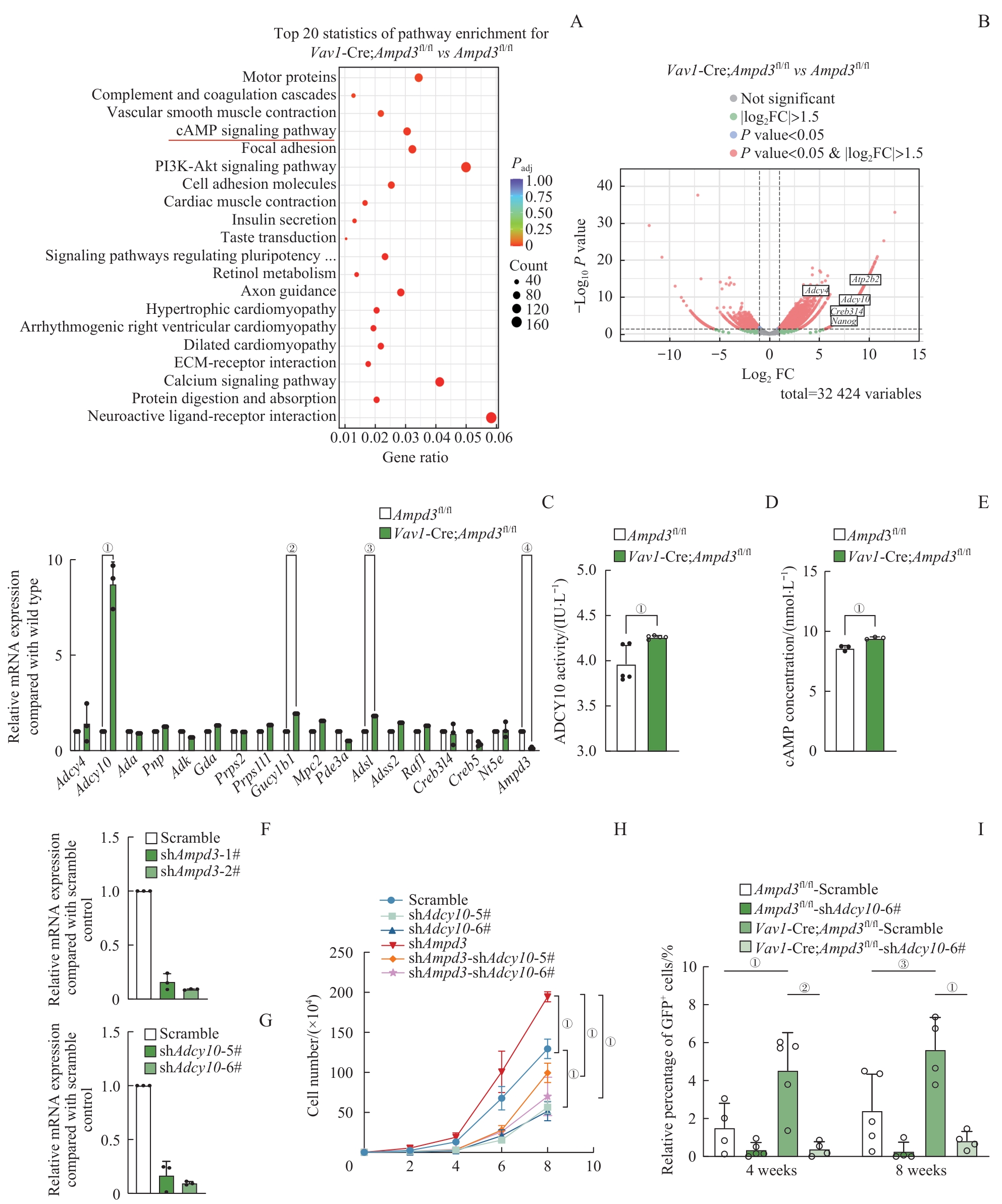
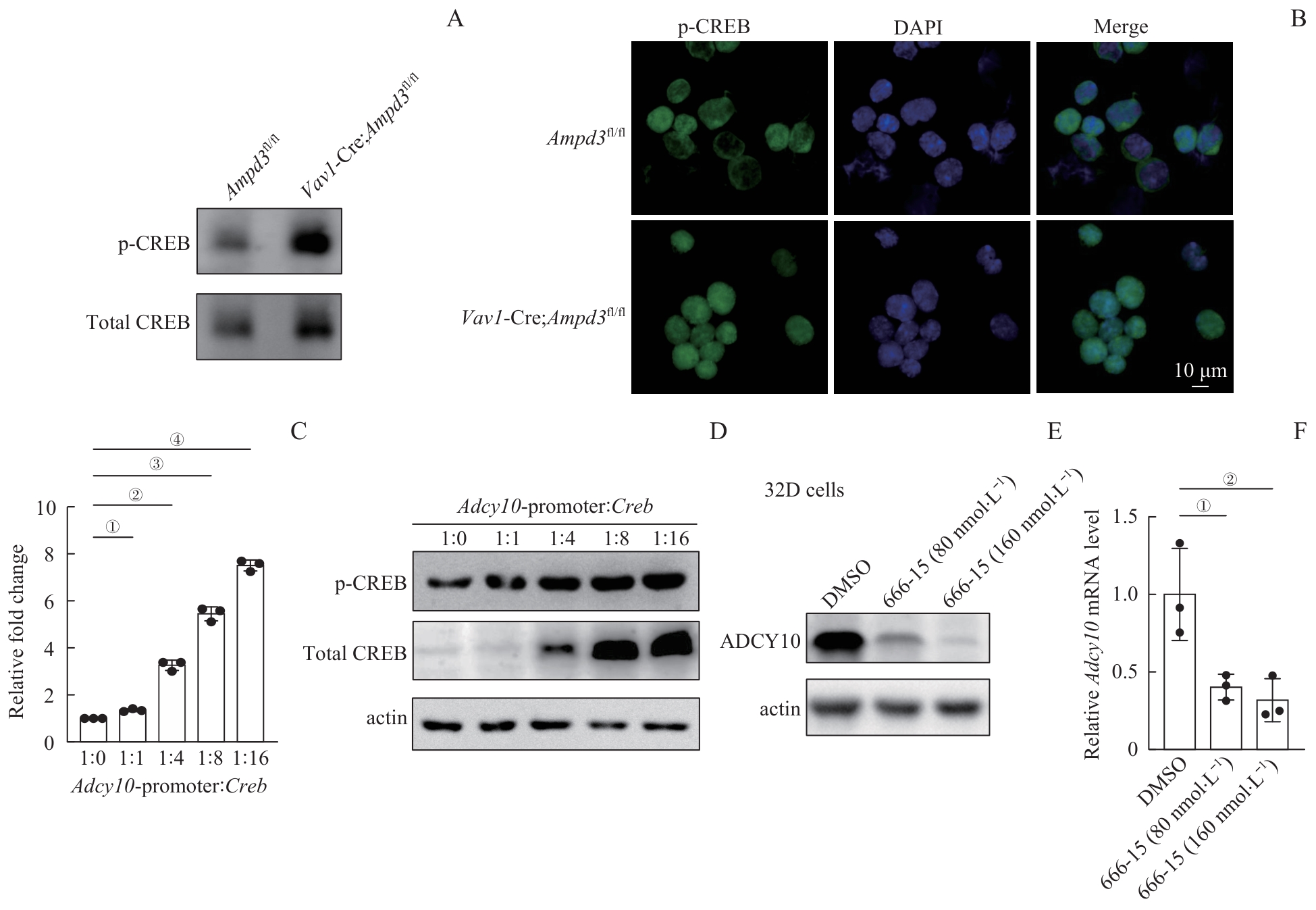
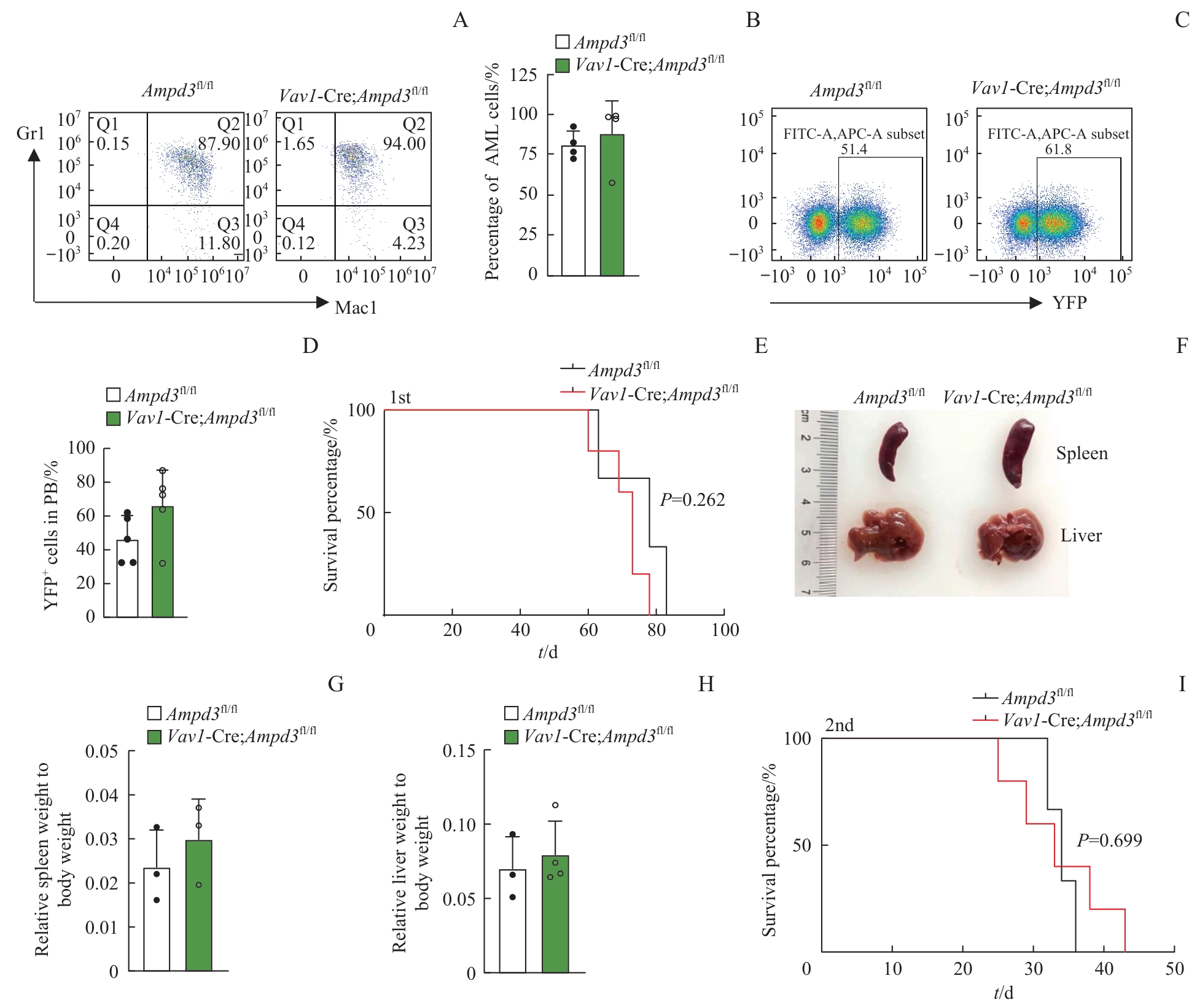
目的·探究单磷酸腺苷脱氨酶3(adenosine monophosphate deaminase 3,AMPD3)在造血干细胞(hematopoietic stem cell,HSC)中的功能和对急性髓系白血病(acute myeloid leukemia,AML)的影响。方法·通过Cre/LoxP系统繁育造血系统条件性敲除Ampd3的小鼠(Vav1-Cre;Ampd3fl/fl)和对照组小鼠(Ampd3fl/fl)。体内骨髓竞争性移植实验检测Ampd3对HSC骨髓重建和谱系分化能力的影响。转录组测序(RNA sequencing,RNA-seq)比较Vav1-Cre;Ampd3fl/flAmpd3fl/fl小鼠HSC差异基因和通路。实时反转录定量PCR(real-time reverse transcription quantitative PCR,RT-qPCR)验证差异基因并确定潜在靶点,构建潜在靶点的短发夹RNA(short hairpin RNA,shRNA),体内、外挽救实验验证相关靶点的功能,并通过Western blotting、免疫荧光染色和双荧光素酶报告基因实验等探究其上游调控因子。构建MLL-AF9诱导的AML模型并进行体内系列移植实验观察Ampd3对疾病进展的影响。结果·在骨髓竞争性移植实验中,Vav1-Cre;Ampd3fl/fl小鼠骨髓重建能力显著高于Ampd3fl/fl组,但其向髓系细胞、T淋巴细胞、B淋巴细胞谱系分化比例没有差异。RNA-seq分析发现Vav1-Cre;Ampd3fl/fl小鼠HSC中环磷酸腺苷(cyclic adenosine monophosphate,cAMP)信号通路等显著富集,差异基因中腺苷酸环化酶10(adenylate cyclase 10,Adcy10)显著上调。在32D细胞中敲低Ampd3后细胞增殖速度显著增加,但同时敲低Adcy10后细胞增殖速度显著减慢;体内挽救实验显示,在敲除Ampd3的造血干祖细胞中进一步敲低Adcy10,可显著降低造血干祖细胞的骨髓重建能力,提示Adcy10Ampd3的下游调控靶点。此外,Vav1-Cre;Ampd3fl/fl小鼠HSC中磷酸化的环磷酸腺苷反应元件结合蛋白(phosphorylated cAMP response element-binding protein,p-CREB)表达水平相对于Ampd3fl/fl小鼠显著增加,免疫荧光染色也观察到p-CREB在Vav1-Cre;Ampd3fl/fl小鼠HSC细胞核中表达更强;同时双荧光素酶报告基因实验证实CREB能够激活Adcy10转录,且伴随着p-CREB和总CREB表达的增加;CREB抑制剂666-15能够显著下调Adcy10的mRNA和蛋白表达水平。但是在造血系统敲除Ampd3不影响AML进展。结论·在小鼠造血系统敲除Ampd3后,p-CREB的表达增高,激活Adcy10转录,从而促进HSC的骨髓重建能力;而Ampd3对AML的进展并无影响,提示Ampd3主要参与应激状态下HSC功能的调控。

关键词: 造血干细胞, 单磷酸腺苷脱氨酶3, 骨髓重建, 腺苷酸环化酶10, 环磷酸腺苷反应元件结合蛋白, 急性髓系白血病

Abstract:

Objective ·To investigate the role of adenosine monophosphate deaminase 3 (AMPD3) in hematopoietic stem cells (HSCs) and acute myeloid leukemia (AML). Methods ·Hematopoietic system-specific Ampd3 knockout mice (Vav1-Cre;Ampd3fl/fl) and control mice (Ampd3fl/fl) were generated using the Cre/LoxP system. An in vivo competitive bone marrow transplantation assay was performed to examine the effects of Ampd3 on the bone marrow reconstitution and lineage differentiation capacities of HSCs. RNA sequencing (RNA-seq) was performed to compare differentially expressed genes and enriched pathways in HSCs from Vav1-Cre;Ampd3fl/fl and Ampd3fl/fl mice. Real-time reverse transcription quantitative PCR (RT-qPCR) was used to validate differentially expressed genes and identify potential targets. Short hairpin RNAs (shRNAs) targeting the identified geneswere constructed, and in vivo and in vitro rescue experiments were conducted to validate their functions. Western blotting, immunofluorescence staining, and dual-luciferase reporter assays were then employed to explore the upstream regulatory factors. An MLL-AF9-induced AML model was established, and serial in vivo transplantation experiments were performed to observe the impact of Ampd3 on disease progression. Results ·In the competitive bone marrow transplantation assay, Vav1-Cre;Ampd3fl/fl mice exhibited significantly higher bone marrow reconstitution ability than the Ampd3fl/fl mice, but no differences were observed in myeloid, T lymphocyte, or B lymphocyte lineage differentiation. RNA-seq analysis revealed significant enrichment of the cyclic adenosine monophosphate (cAMP) signaling pathway and other pathways in HSCs from Vav1-Cre;Ampd3fl/fl mice, and among the differentially expressed genes, adenylate cyclase 10 (Adcy10) was significantly upregulated. Knockdown of Ampd3 in 32D cells significantly accelerated cell proliferation, whereas simultaneous knockdown of Adcy10 markedly slowed the proliferation. In vivo rescue experiments showed that further knockdown of Adcy10 in Ampd3-deficient hematopoietic stem and progenitor cells significantly reduced their bone marrow reconstitution capacity, suggesting that Adcy10 was a downstream target of Ampd3. Furthermore, the expression level of phosphorylated cAMP response element-binding protein (p-CREB) in HSCs from Vav1-Cre;Ampd3fl/fl mice was significantly increased compared with that in Ampd3fl/fl mice. Immunofluorescence staining also revealed stronger nuclear localization of p-CREB in HSCs from Vav1-Cre;Ampd3fl/fl mice. Dual-luciferase reporter assays confirmed that CREB was able to activate the transcription of Adcy10, accompanied by increased expression of both p-CREB and total CREB. The CREB inhibitor 666-15 significantly downregulated the mRNA and protein expression levels of Adcy10. However, hematopoietic-specific knockout of Ampd3 did not affect AML progression. Conclusion ·Hematopoietic-specific deletion of Ampd3 in mice leads to elevated p-CREB expression, which activates Adcy10 transcription and thereby enhances the bone marrow reconstitution capacity of HSCs. Ampd3 does not affect AML progression, suggesting that Ampd3 is mainly involved in regulating HSC function under stress conditions.

Key words: hematopoietic stem cell (HSC), adenosine monophosphate deaminase 3 (AMPD3), bone marrow reconstitution, adenylate cyclase 10 (ADCY10), cAMP response element-binding protein (CREB), acute myeloid leukemia (AML)

中图分类号: