
Journal of Shanghai Jiao Tong University (Medical Science) ›› 2026, Vol. 46 ›› Issue (4): 496-501.doi: 10.3969/j.issn.1674-8115.2026.04.009
• Clinical research • Previous Articles
Wang Shaoyan, Li Chao, Huang Shuo, Wu Shuqi, Chen Suyun( )
)
Received:2025-07-14
Accepted:2025-11-10
Online:2026-04-10
Published:2026-04-10
Contact:
Chen Suyun
E-mail:nuyus@outlook.com
CLC Number:
Wang Shaoyan, Li Chao, Huang Shuo, Wu Shuqi, Chen Suyun. Physiological distribution characteristics and influencing factors of hepatic background and mediastinal blood pool on 18F-FDG PET/CT in children and adolescents of different ages[J]. Journal of Shanghai Jiao Tong University (Medical Science), 2026, 46(4): 496-501.
Add to citation manager EndNote|Ris|BibTeX
URL: https://xuebao.shsmu.edu.cn/EN/10.3969/j.issn.1674-8115.2026.04.009
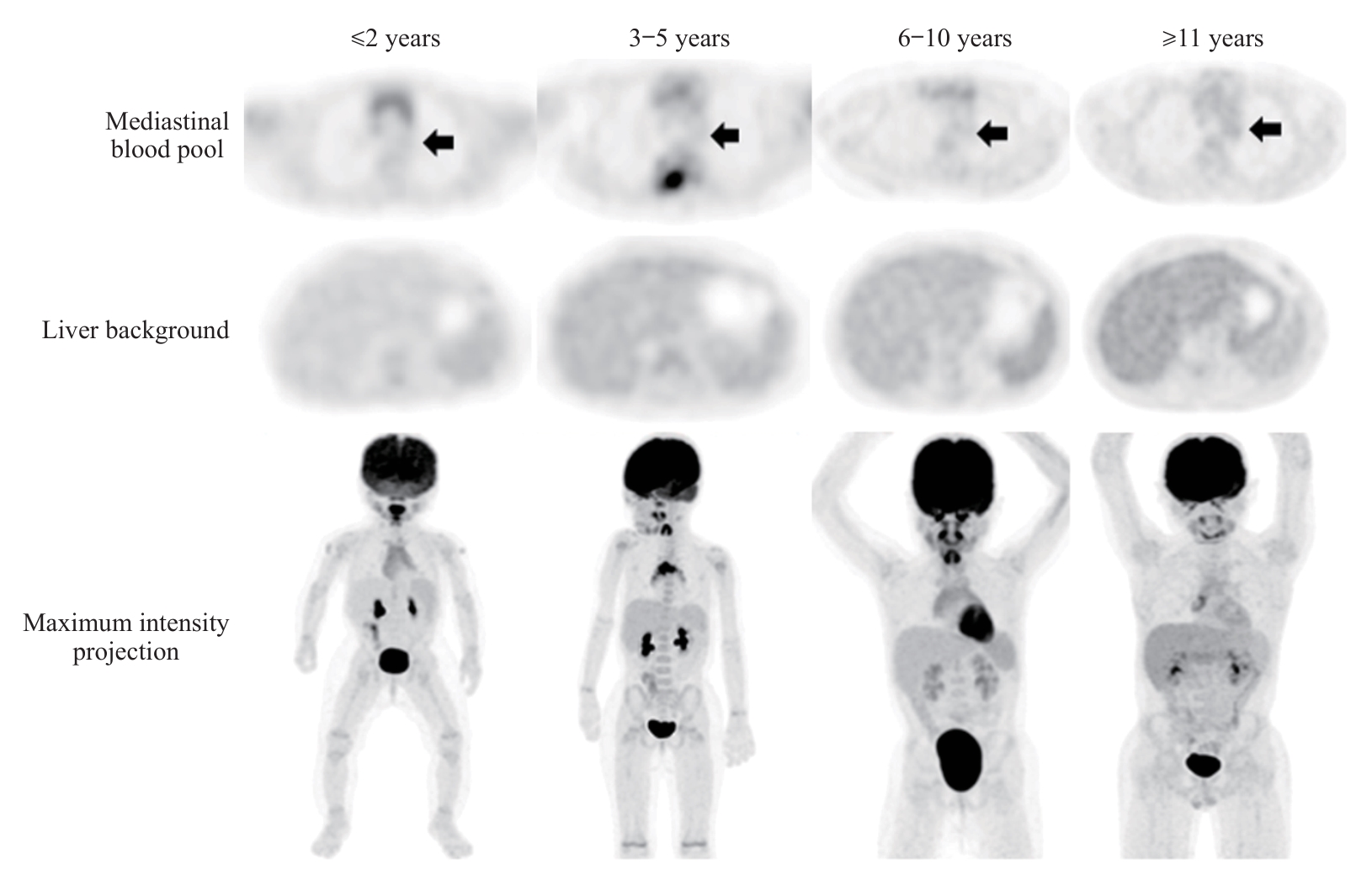
Fig 1 Transverse PET images of the mediastinal blood pool and liver, and whole-body maximum intensity projection images in different age groups
| SUV | ≤2 years | 3‒5 years | 6‒10 years | ≥11 years | F value | P value |
|---|---|---|---|---|---|---|
| Hepatic SUVmax | 1.41±0.32 | 1.60±0.39 | 2.04±0.49 | 2.57±0.60 | 69.42 | <0.001 |
| Hepatic SUVmean | 1.06±0.25 | 1.17±0.31 | 1.45±0.39 | 1.80±0.46 | 46.78 | <0.001 |
| Mediastinal blood pool SUVmax | 0.91±0.27 | 0.95±0.28 | 1.18±0.31 | 1.42±0.41 | 31.95 | <0.001 |
| Mediastinal blood pool SUVmean | 0.84±0.19 | 0.85±0.26 | 1.04±0.28 | 1.23±0.36 | 26.41 | <0.001 |
Tab 1 SUVmax and SUVmean of the liver and mediastinal blood pool in different age groups
| SUV | ≤2 years | 3‒5 years | 6‒10 years | ≥11 years | F value | P value |
|---|---|---|---|---|---|---|
| Hepatic SUVmax | 1.41±0.32 | 1.60±0.39 | 2.04±0.49 | 2.57±0.60 | 69.42 | <0.001 |
| Hepatic SUVmean | 1.06±0.25 | 1.17±0.31 | 1.45±0.39 | 1.80±0.46 | 46.78 | <0.001 |
| Mediastinal blood pool SUVmax | 0.91±0.27 | 0.95±0.28 | 1.18±0.31 | 1.42±0.41 | 31.95 | <0.001 |
| Mediastinal blood pool SUVmean | 0.84±0.19 | 0.85±0.26 | 1.04±0.28 | 1.23±0.36 | 26.41 | <0.001 |
| Liver function | Hepatic SUVmax | Hepatic SUVmean | Mediastinal blood pool SUVmax | Mediastinal blood pool SUVmean |
|---|---|---|---|---|
| Normal (n=227) | 1.93±0.61 | 1.39±0.45 | 1.12±0.36 | 0.99±0.32 |
| Abnormal (n=44) | 1.71±0.61 | 1.24±0.42 | 1.04±0.38 | 0.94±0.32 |
| t | 2.13 | 2.03 | 1.22 | 0.99 |
| P value | 0.034 | 0.043 | 0.226 | 0.325 |
Tab 2 Effect of liver function on SUVmax and SUVmean of the liver and mediastinal blood pool
| Liver function | Hepatic SUVmax | Hepatic SUVmean | Mediastinal blood pool SUVmax | Mediastinal blood pool SUVmean |
|---|---|---|---|---|
| Normal (n=227) | 1.93±0.61 | 1.39±0.45 | 1.12±0.36 | 0.99±0.32 |
| Abnormal (n=44) | 1.71±0.61 | 1.24±0.42 | 1.04±0.38 | 0.94±0.32 |
| t | 2.13 | 2.03 | 1.22 | 0.99 |
| P value | 0.034 | 0.043 | 0.226 | 0.325 |
| SUV | Indicator | B value | β | t | P value | 95% CI | F | Adjusted R2 |
|---|---|---|---|---|---|---|---|---|
| Hepatic SUVmax | Weight | 0.02 | 0.54 | 6.93 | <0.001 | 0.014‒0.025 | 311.4 | 0.54 |
| Age | 0.03 | 0.22 | 2.85 | <0.001 | 0.010‒0.055 | 163.9 | 0.55 | |
| Hepatic SUVmean | Weight | 0.01 | 0.44 | 4.96 | <0.001 | 0.007‒0.016 | 185.8 | 0.41 |
| Age | 0.03 | 0.23 | 2.64 | 0.010 | 0.006‒0.043 | 96.5 | 0.42 | |
| Mediastinal blood pool SUVmax | Weight | 0.01 | 0.54 | 10.68 | <0.001 | 0.010‒0.014 | 113.2 | 0.29 |
| Mediastinal blood pool SUVmean | Weight | 0.01 | 0.51 | 9.70 | <0.001 | 0.008‒0.011 | 95.9 | 0.26 |
Tab 3 Multivariate regression analysis of factors associated with SUVmax and SUVmean in the liver and mediastinal blood pool
| SUV | Indicator | B value | β | t | P value | 95% CI | F | Adjusted R2 |
|---|---|---|---|---|---|---|---|---|
| Hepatic SUVmax | Weight | 0.02 | 0.54 | 6.93 | <0.001 | 0.014‒0.025 | 311.4 | 0.54 |
| Age | 0.03 | 0.22 | 2.85 | <0.001 | 0.010‒0.055 | 163.9 | 0.55 | |
| Hepatic SUVmean | Weight | 0.01 | 0.44 | 4.96 | <0.001 | 0.007‒0.016 | 185.8 | 0.41 |
| Age | 0.03 | 0.23 | 2.64 | 0.010 | 0.006‒0.043 | 96.5 | 0.42 | |
| Mediastinal blood pool SUVmax | Weight | 0.01 | 0.54 | 10.68 | <0.001 | 0.010‒0.014 | 113.2 | 0.29 |
| Mediastinal blood pool SUVmean | Weight | 0.01 | 0.51 | 9.70 | <0.001 | 0.008‒0.011 | 95.9 | 0.26 |
| [1] | Kluge R, Kurch L, Georgi T, et al. Current role of FDG-PET in pediatric Hodgkin's lymphoma[J]. Semin Nucl Med, 2017, 47(3): 242-257. |
| [2] | Baum S H, Frühwald M, Rahbar K, et al. Contribution of PET/CT to prediction of outcome in children and young adults with rhabdomyosarcoma[J]. J Nucl Med, 2011, 52(10): 1535-1540. |
| [3] | Lee J W, Cho A, Yun M J, et al. Prognostic value of pretreatment FDG PET in pediatric neuroblastoma[J]. Eur J Radiol, 2015, 84(12): 2633-2639. |
| [4] | Boktor R R, Omar W S, Mousa E, et al. A preliminary report on the impact of 18F-FDG PET/CT in the management of paediatric head and neck cancer[J]. Nucl Med Commun, 2012, 33(1): 21-28. |
| [5] | Kubota K, Watanabe H, Murata Y, et al. Effects of blood glucose level on FDG uptake by liver: a FDG-PET/CT study[J]. Nucl Med Biol, 2011, 38(3): 347-351. |
| [6] | Shiono S, Abiko M, Okazaki T, et al. Positron emission tomography for predicting recurrence in stage I lung adenocarcinoma: standardized uptake value corrected by mean liver standardized uptake value[J]. Eur J Cardiothorac Surg, 2011, 40(5): 1165-1169. |
| [7] | Ozcan Kara P, Kara T, Kara Gedik G, et al. The role of fluorodeoxyglucose-positron emission tomography/computed tomography in differentiating between benign and malignant adrenal lesions[J]. Nucl Med Commun, 2011, 32(2): 106-112. |
| [8] | Wahl R L, Jacene H, Kasamon Y, et al. From RECIST to PERCIST: evolving Considerations for PET response criteria in solid tumors[J]. J Nucl Med, 2009, 50(Suppl 1): 122S-150S. |
| [9] | Okuyama C, Matsushima S, Nishimura M, et al. Increased 18F-FDG accumulation in the tonsils after chemotherapy for pediatric lymphoma: a common physiological phenomenon[J]. Ann Nucl Med, 2019, 33(5): 368-373. |
| [10] | Kumbhar S S, Qi J. Normal FDG uptake in the adenoids and palatine tonsils in children on PET/MRI[J]. Pediatr Radiol, 2020, 50(7): 958-965. |
| [11] | Vali R, Bakari A A, Marie E, et al. FDG uptake in cervical lymph nodes in children without head and neck cancer[J]. Pediatr Radiol, 2017, 47(7): 860-867. |
| [12] | Taralli S, Leccisotti L, Mattoli M V, et al. Physiological activity of spinal cord in children: an 18F-FDG PET-CT study[J]. Spine, 2015, 40(11): E647-E652. |
| [13] | Brink I, Reinhardt M J, Hoegerle S, et al. Increased metabolic activity in the thymus gland studied with 18F-FDG PET: age dependency and frequency after chemotherapy[J]. J Nucl Med, 2001, 42(4): 591-595. |
| [14] | Meier J M, Alavi A, Iruvuri S, et al. Assessment of age-related changes in abdominal organ structure and function with computed tomography and positron emission tomography[J]. Semin Nucl Med, 2007, 37(3): 154-172. |
| [15] | Sedig L K, Bailey J J, Wong K K, et al. Do Deauville scores improve the clinical utility of end-of-therapy FDG PET scans for pediatric Hodgkin lymphoma?[J]. AJR Am J Roentgenol, 2019, 212(2): 456-460. |
| [16] | Jorgov L, Montravers F, Balogova S, et al. Paediatric and adolescent Hodgkin lymphoma: information derived from diffuse organ uptake of 18 F-fluorodeoxyglucose on pre-treatment and on interim PET/CT[J]. Eur J Nucl Med Mol Imaging, 2016, 43(7): 1220-1230. |
| [17] | Beath S V. Hepatic function and physiology in the newborn[J]. Semin Neonatol, 2003, 8(5): 337-346. |
| [18] | Suchy F L, Sokol R J, Balistreri W F, et al. Functional development of liver[M]//Suchy F J. Liver disease in children.4th ed. Cambridge: Cambridge University Press,2014: 10-23. |
| [19] | Iozzo P, Geisler F, Oikonen V, et al. Insulin stimulates liver glucose uptake in humans: an 18F-FDG PET Study[J]. J Nucl Med, 2003, 44(5): 682-689. |
| [20] | Sprinz C, Zanon M, Altmayer S, et al. Effects of blood glucose level on 18F fluorodeoxyglucose (18F-FDG) uptake for PET/CT in normal organs: an analysis on 5623 patients[J]. Sci Rep, 2018, 8(1): 2126. |
| [21] | Webb R L, Landau E, Klein D, et al. Effects of varying serum glucose levels on 18F-FDG biodistribution[J]. Nucl Med Commun, 2015, 36(7): 717-721. |
| [22] | Peters A M, Keramida G, Pencharz D. Assessment of alteration in liver 18F-FDG uptake due to steatosis in lymphoma patients and its impact on the Deauville score[J]. Eur J Nucl Med Mol Imaging, 2018, 45(12): 2231-2232. |
| [23] | Viglianti B L, Wong K K, Wimer S M, et al. Effect of hyperglycemia on brain and liver 18F-FDG standardized uptake value (FDG SUV) measured by quantitative positron emission tomography (PET) imaging[J]. Biomedecine Pharmacother, 2017, 88: 1038-1045. |
| [24] | Eskian M, Alavi A, Khorasanizadeh M, et al. Effect of blood glucose level on standardized uptake value (SUV) in 18F-FDG PET-scan: a systematic review and meta-analysis of 20, 807 individual SUV measurements[J]. Eur J Nucl Med Mol Imaging, 2019, 46(1): 224-237. |
| [1] | LI Lulu, WU Jianyong. A cone-beam computed tomographic study comparing characteristics of maxillary anterior regional alveolar bone remodeling under two reference systems [J]. Journal of Shanghai Jiao Tong University (Medical Science), 2025, 45(11): 1507-1514. |
| [2] | LUO Rui, YANG Gongxin, SHI Huimin, HAN Yongshun, HE Yining, TIAN Zhen, WU Yingwei. Study of imaging characteristics of Kimura disease in the head and neck [J]. Journal of Shanghai Jiao Tong University (Medical Science), 2024, 44(9): 1182-1189. |
| [3] | REN Yixuan, CHEN Cheng, CAI Mingci, CHEN Jiamin, YANG Xinxin, WANG Chao, LIN Xiaozhu, CHENG Shu, JIANG Xufeng, CHEN Dongxu. Research on the characteristics of 18F-FDG PET/CT in mantle cell lymphoma and the discrimination between cellular morphological variants [J]. Journal of Shanghai Jiao Tong University (Medical Science), 2024, 44(12): 1561-1569. |
| [4] | CHENG Ran, HU Jiajia, LI Biao. Advances in the application of 18F-FDG PET/CT radiomics for diagnosis, treatment and prognosis prediction of lymphoma [J]. Journal of Shanghai Jiao Tong University (Medical Science), 2023, 43(6): 781-787. |
| [5] | LIU Chenjun, YIN Bohao, SUN Hui, ZHANG Wei. Application of non-invasive methods of radiology to the osteoporosis [J]. Journal of Shanghai Jiao Tong University (Medical Science), 2023, 43(3): 385-390. |
| [6] | GU Wenxi, JIA Huan, WU Hao. Clinical values and advances in computed tomography evaluation after cochlear implantation [J]. Journal of Shanghai Jiao Tong University (Medical Science), 2023, 43(12): 1463-1469. |
| [7] | Xiang LIU, Hui-hui XIE, Yu-feng XU, Xiao-feng TAO, Lin LIU, Di-jia WU, Xiao-ying WANG. Application of artificial intelligence to CT diagnosis of thoracic traumatic rib sites: a preliminary study [J]. JOURNAL OF SHANGHAI JIAOTONG UNIVERSITY (MEDICAL SCIENCE), 2021, 41(7): 920-925. |
| [8] | Zi-hao LIU, Wen-fang TANG, Hui WANG. Research progress in amino acid PET imaging of pediatric brain tumors [J]. JOURNAL OF SHANGHAI JIAOTONG UNIVERSITY (MEDICAL SCIENCE), 2021, 41(7): 949-952. |
| [9] | Jian-ming YUAN, Bin WEI, Wei-xing XU, Lei ZHANG. CBCT effects of different abutment angles on alveolar bone changes in maxillary anterior teeth [J]. JOURNAL OF SHANGHAI JIAOTONG UNIVERSITY (MEDICAL SCIENCE), 2021, 41(3): 339-343. |
| [10] | WANG Hai-yan, YOU Zhi-wen, SHOU Yi, MENG Qing-yuan, CHEN Hui-qian, ZHAO Jun. Application of 18F-FDG PET/CT-guided percutaneous biopsy to differential diagnosis of peritoneal thickening diseases [J]. JOURNAL OF SHANGHAI JIAOTONG UNIVERSITY (MEDICAL SCIENCE), 2020, 40(5): 646-650. |
| [11] | WAN Liang-rong, HUANG Gan, LIU Jian-jun. Application of quantitative 99mTcO4- SPECT/CT in determination of thyroid volume and SUV in Graves' disease [J]. JOURNAL OF SHANGHAI JIAOTONG UNIVERSITY (MEDICAL SCIENCE), 2020, 40(12): 1637-1640. |
| [12] | LUO Gang, CUI Yong-chen, CAO Yue, ZHANG Jun-feng. Effect of surgical trauma on postoperative cognitive function and cerebral glucose metabolism in type 2 diabetic mice [J]. JOURNAL OF SHANGHAI JIAOTONG UNIVERSITY (MEDICAL SCIENCE), 2020, 40(11): 1468-1472. |
| [13] | WANG Tao, ZHANG Chen-cheng, LI Dian-you, SUN Bo-min, FU Meng. Imaging law of postoperative electrode locations in deep brain stimulation for Parkinsons disease [J]. , 2020, 40(1): 64-. |
| [14] | JIANG Bei-bei, ZHANG Ya-ping, ZHANG Lin, LIU Gui-xue, XIE Xue-qian. A visualization study of deep convolutional neural network to classify the pathological type of sub-soild pulmonary adenocarcinoma of ≤ 3 cm based on CT images [J]. , 2019, 39(9): 1045-. |
| [15] | ZHU Yin-jie, WANG Yan-qing, PAN Jia-hua, DONG Bai-jun, XUE Wei. PET/CT for guidance of lymphadenectomy of high-risk prostate cancer in patients with chronic lymphocytic leukemia: 1 case report [J]. , 2019, 39(4): 440-. |
| Viewed | ||||||
|
Full text |
|
|||||
|
Abstract |
|
|||||
