
Journal of Shanghai Jiao Tong University (Medical Science) ›› 2024, Vol. 44 ›› Issue (4): 482-493.doi: 10.3969/j.issn.1674-8115.2024.04.009
• Evidence-based medicine • Previous Articles Next Articles
FU Yiling( ), WU Qian, LUO Xiaoqing, WU Aihong, XIA Xuelan, ZHENG Min()
Received:2023-11-01
Accepted:2024-02-06
Online:2024-04-28
Published:2024-04-28
Contact:
ZHENG Min
E-mail:1715757154@qq.com;1287285766@qq.com
CLC Number:
FU Yiling, WU Qian, LUO Xiaoqing, WU Aihong, XIA Xuelan, ZHENG Min. Factors influencing advance care planning engagement behavior in patients with advanced cancer: a systematic review[J]. Journal of Shanghai Jiao Tong University (Medical Science), 2024,(4): 482-493.
Add to citation manager EndNote|Ris|BibTeX
URL: https://xuebao.shsmu.edu.cn/EN/10.3969/j.issn.1674-8115.2024.04.009
| Step | Strategy |
|---|---|
| #1 | "advance care planning" [MeSH Terms] |
| #2 | "advance care planning" [Title/Abstract] OR "advance directives" [Title/Abstract] OR "living wills" [Title/Abstract]) OR "medical power of attorney" [Title/Abstract] |
| #3 | #1 OR #2 |
| #4 | "terminal" [Title/Abstract] OR "advanced" [Title/Abstract] OR "end-stage" [Title/Abstract] OR "end-of-life" [Title/Abstract] |
| #5 | "neoplasms" [MeSH Terms] |
| #6 | "neoplasms" [Title/Abstract] OR "cancer"[Title/Abstract] OR "tumor" [Title/Abstract] OR "oncology" [Title/Abstract] OR "malignancy" [Title/Abstract] |
| #7 | #5 OR #6 |
| #8 | #4 AND #7 |
| #9 | #3 AND #8 |
Tab 1 Searching strategy for searching in PubMed
| Step | Strategy |
|---|---|
| #1 | "advance care planning" [MeSH Terms] |
| #2 | "advance care planning" [Title/Abstract] OR "advance directives" [Title/Abstract] OR "living wills" [Title/Abstract]) OR "medical power of attorney" [Title/Abstract] |
| #3 | #1 OR #2 |
| #4 | "terminal" [Title/Abstract] OR "advanced" [Title/Abstract] OR "end-stage" [Title/Abstract] OR "end-of-life" [Title/Abstract] |
| #5 | "neoplasms" [MeSH Terms] |
| #6 | "neoplasms" [Title/Abstract] OR "cancer"[Title/Abstract] OR "tumor" [Title/Abstract] OR "oncology" [Title/Abstract] OR "malignancy" [Title/Abstract] |
| #7 | #5 OR #6 |
| #8 | #4 AND #7 |
| #9 | #3 AND #8 |
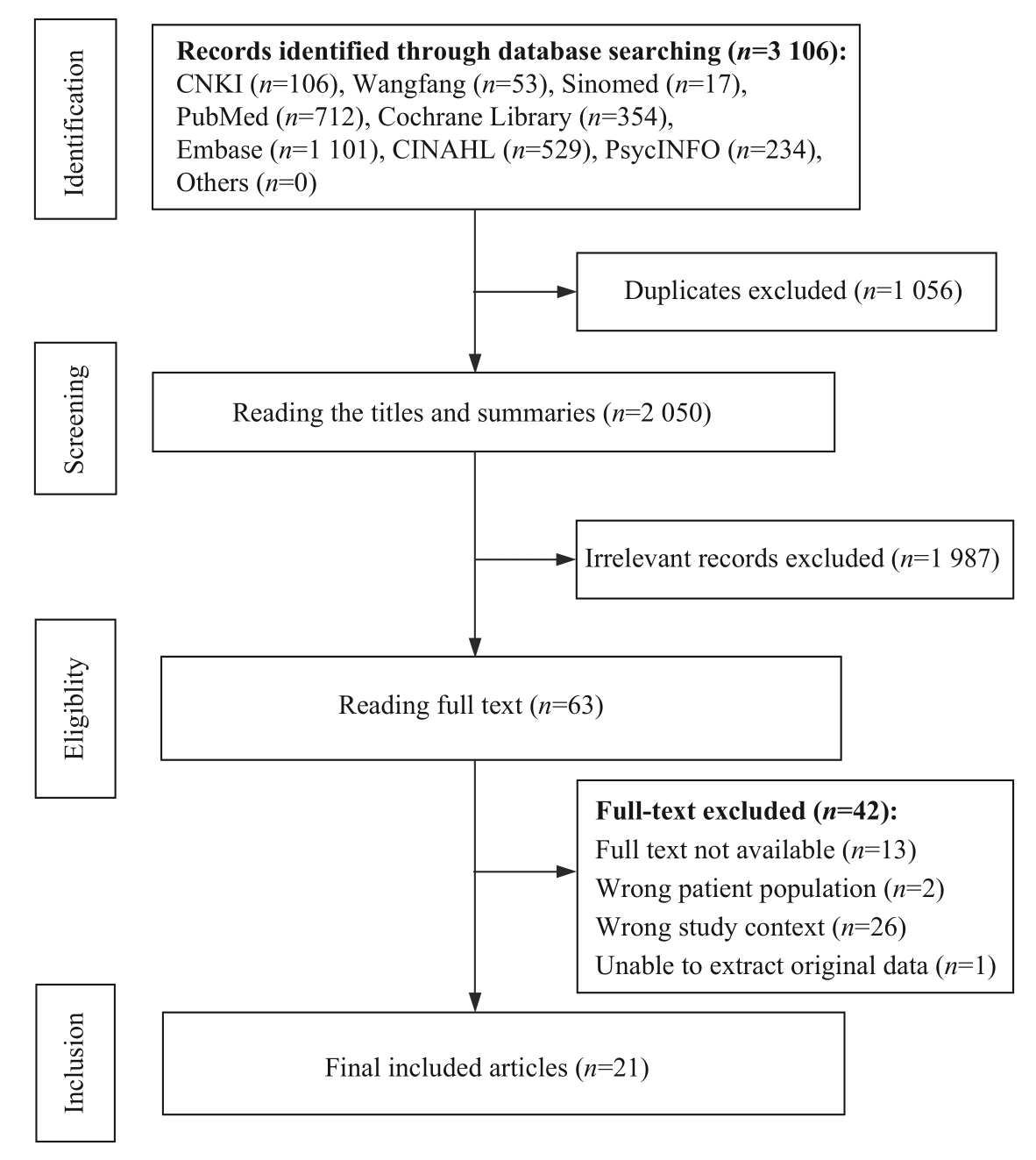
Fig 1 Process of study selection
| Author | Year | Area | Design | Research method | Sample size | Influencing factor | Quality rating |
|---|---|---|---|---|---|---|---|
| QU X L, et al | 2020 | Beijing, China | Qualitative study | Phenomenological study | 17 | Ⅰ: ①② | 80% |
| BAR-SELA G, et al | 2021 | Israel | Mixed studies | Phenomenological study Questionnaire investigation | 109 | Ⅰ: ①②⑧⑨⑩⑪ Ⅱ: ⑥⑦ | QN: 73% QL: 80% |
| WANG Y X, et al | 2019 | Hefei, China | Cross-sectional study | Questionnaire investigation | 520 | Ⅰ: ⑧⑨ Ⅱ: ④⑤⑥⑦⑫ ⑭⑮ | 64% |
| WANG L, et al | 2021 | Xi'an, China | Cross-sectional study | Questionnaire investigation | 72 | Ⅱ: ③⑤⑭⑯17 Ⅲ: 18 | 91% |
| YAN C X, et al | 2022 | Tianjin, China | Cross-sectional study | Questionnaire investigation | 206 | Ⅰ: ① Ⅲ: ②④⑭ | 86% |
| CHEN Y Z, et al | 2022 | Guangzhou, China | Cross-sectional study | Questionnaire investigation | 120 | Ⅲ: ③④⑪19 | 86% |
| TANG S T, et al | 2014 | Taiwan, China | Cross-sectional study | Questionnaire investigation | 2 450 | Ⅲ: ⑭2021 | 86% |
| WONG S Y, et al | 2012 | Hong Kong, China | Cohort study | Questionnaire investigation | 191 | Ⅲ: 20 Ⅳ: ⑩ | 77% |
| HOU X T, et al | 2021 | Beijing, China | Cross-sectional study | Questionnaire investigation | 264 | Ⅲ: ⑤⑥⑫⑬ | 73% |
| KIERNER K A, et al | 2010 | Austria | Cohort study | Questionnaire investigation | 108 | Ⅱ: 22 | 64% |
| RODENBACH R A, et al | 2021 | America | Cross-sectional study | Questionnaire investigation | 672 | Ⅲ: 19 | 86% |
| GARRIDO M M, et al | 2014 | America | Cross-sectional study | Questionnaire investigation | 606 | Ⅲ: 23 | 82% |
| NILSSON M E, et al | 2009 | America | Cohort study | Questionnaire investigation | 668 | Ⅲ: 24 | 86% |
| TRUE G, et al | 2005 | America | Longitudinal study | Questionnaire investigation | 68 | Ⅲ: ④23 | 73% |
| YOO S H, et al | 2020 | South Korea | Cohort study | Questionnaire investigation | 150 | Ⅰ: 25 Ⅳ: 20 | 86% |
| BROWN A J, et al | 2016 | America | Cross-sectional study | Questionnaire investigation | 110 | Ⅲ: ③⑥1926 | 77% |
| ZHU M L, et al | 2019 | Zunyi, China | Cross-sectional study | Questionnaire investigation | 90 | Ⅱ: ③⑯ | 59% |
| WANG Y L | 2021 | Shandong, China | Cross-sectional study | Questionnaire investigation | 145 | Ⅲ: ⑬⑭19 | 91% |
| SHEN M J, et al | 2018 | America | Cohort study | Questionnaire investigation | 279 | Ⅲ: 20 | 77% |
| SHEN M J, et al | 2020 | America | Qualitative study | Phenomenological study | 20 | Ⅰ: ④⑩⑪1823 | 55% |
| JIA Z M, et al | 2022 | America | Qualitative study | Phenomenological study | 21 | Ⅰ: ②⑪27 | 90% |
Tab 2 Characteristics of the included literature
| Author | Year | Area | Design | Research method | Sample size | Influencing factor | Quality rating |
|---|---|---|---|---|---|---|---|
| QU X L, et al | 2020 | Beijing, China | Qualitative study | Phenomenological study | 17 | Ⅰ: ①② | 80% |
| BAR-SELA G, et al | 2021 | Israel | Mixed studies | Phenomenological study Questionnaire investigation | 109 | Ⅰ: ①②⑧⑨⑩⑪ Ⅱ: ⑥⑦ | QN: 73% QL: 80% |
| WANG Y X, et al | 2019 | Hefei, China | Cross-sectional study | Questionnaire investigation | 520 | Ⅰ: ⑧⑨ Ⅱ: ④⑤⑥⑦⑫ ⑭⑮ | 64% |
| WANG L, et al | 2021 | Xi'an, China | Cross-sectional study | Questionnaire investigation | 72 | Ⅱ: ③⑤⑭⑯17 Ⅲ: 18 | 91% |
| YAN C X, et al | 2022 | Tianjin, China | Cross-sectional study | Questionnaire investigation | 206 | Ⅰ: ① Ⅲ: ②④⑭ | 86% |
| CHEN Y Z, et al | 2022 | Guangzhou, China | Cross-sectional study | Questionnaire investigation | 120 | Ⅲ: ③④⑪19 | 86% |
| TANG S T, et al | 2014 | Taiwan, China | Cross-sectional study | Questionnaire investigation | 2 450 | Ⅲ: ⑭2021 | 86% |
| WONG S Y, et al | 2012 | Hong Kong, China | Cohort study | Questionnaire investigation | 191 | Ⅲ: 20 Ⅳ: ⑩ | 77% |
| HOU X T, et al | 2021 | Beijing, China | Cross-sectional study | Questionnaire investigation | 264 | Ⅲ: ⑤⑥⑫⑬ | 73% |
| KIERNER K A, et al | 2010 | Austria | Cohort study | Questionnaire investigation | 108 | Ⅱ: 22 | 64% |
| RODENBACH R A, et al | 2021 | America | Cross-sectional study | Questionnaire investigation | 672 | Ⅲ: 19 | 86% |
| GARRIDO M M, et al | 2014 | America | Cross-sectional study | Questionnaire investigation | 606 | Ⅲ: 23 | 82% |
| NILSSON M E, et al | 2009 | America | Cohort study | Questionnaire investigation | 668 | Ⅲ: 24 | 86% |
| TRUE G, et al | 2005 | America | Longitudinal study | Questionnaire investigation | 68 | Ⅲ: ④23 | 73% |
| YOO S H, et al | 2020 | South Korea | Cohort study | Questionnaire investigation | 150 | Ⅰ: 25 Ⅳ: 20 | 86% |
| BROWN A J, et al | 2016 | America | Cross-sectional study | Questionnaire investigation | 110 | Ⅲ: ③⑥1926 | 77% |
| ZHU M L, et al | 2019 | Zunyi, China | Cross-sectional study | Questionnaire investigation | 90 | Ⅱ: ③⑯ | 59% |
| WANG Y L | 2021 | Shandong, China | Cross-sectional study | Questionnaire investigation | 145 | Ⅲ: ⑬⑭19 | 91% |
| SHEN M J, et al | 2018 | America | Cohort study | Questionnaire investigation | 279 | Ⅲ: 20 | 77% |
| SHEN M J, et al | 2020 | America | Qualitative study | Phenomenological study | 20 | Ⅰ: ④⑩⑪1823 | 55% |
| JIA Z M, et al | 2022 | America | Qualitative study | Phenomenological study | 21 | Ⅰ: ②⑪27 | 90% |
COM-B component | TDF | Original definition | Application of TDF to the connotation of ACP engagement behavior in patients with advanced cancer |
|---|---|---|---|
| Capability | |||
| Psychological capability | Knowledge | An awareness of the existence of something | Understanding and being familiar with ACP-related knowledge |
| Memory, attention and decision processes | The ability to retain information, selectively focus on aspects of the environment and choose between two or more alternatives | Ability to remember, focus, and select ACP | |
| Behavioural regulation | Anything aiming at managing or changing objectively observed or measured actions | Using healthy behaviors to manage emotions and pursue goals | |
| Physical capability | Skills | An ability or proficiency acquired through practice | Acquiring the ability or skill to engage in ACP through practice, including physiological and cognitive skills |
| Opportunity | |||
| Social opportunity | Social influences | Those interpersonal processes that can cause individuals to change their thoughts, feelings, or behaviors | The process of social activities that enable individuals to change their cognition and behavior about ACP |
| Physical opportunity | Environmental context and resources | Any circumstance of a person's situation or environment that discourages or encourages the development of skills and abilities, independence, social competence, and adaptive behavior | Personal conditions and environments that influence ACP engagement |
| Motivation | |||
| Reflective motivation | Beliefs about capabilities | Acceptance of the truth, reality, or validity about an ability, talent, or facility that a person can put to constructive use | Believing that individuals have enough knowledge about ACP and can participate in ACP discussions |
| Goals | Mental representations of outcomes or end states that an individual wants to achieve | The psychological outcomes that individuals want to achieve | |
| Intentions | A conscious decision to perform a behavior or a resolve to act in a certain way | Identifying the skills that are needed to engage in ACP | |
| Beliefs about consequences | Acceptance of the truth, reality, or validity about outcomes of a behavior in a given situation | The degree to which the individuals accept the facts or believe that ACP's involvement in the behavior will lead to specific results | |
| Automatic motivation | Social/professional role and identity | A coherent set of behaviors and displayed personal qualities of an individual in a social or work setting | Self-perception based on social or professional identity |
| Optimism | The confidence that things will happen for the best or that desired goals will be attained | Confidence that the desired goal will be achieved | |
| Reinforcement | Increasing the probability of a response by arranging a dependent relationship, or contingency, between the response and a given stimulus | Promoting and strengthening support for ACP participation | |
| Emotion | A complex reaction pattern, involving experiential, behavioural, and physiological elements, by which the individual attempts to deal with a personally significant matter or event | A mental state or emotional response that is determined by an individual's environment |
Tab 3 Connotation of the COM-B model in the ACP engagement behavior of advanced cancer patients
COM-B component | TDF | Original definition | Application of TDF to the connotation of ACP engagement behavior in patients with advanced cancer |
|---|---|---|---|
| Capability | |||
| Psychological capability | Knowledge | An awareness of the existence of something | Understanding and being familiar with ACP-related knowledge |
| Memory, attention and decision processes | The ability to retain information, selectively focus on aspects of the environment and choose between two or more alternatives | Ability to remember, focus, and select ACP | |
| Behavioural regulation | Anything aiming at managing or changing objectively observed or measured actions | Using healthy behaviors to manage emotions and pursue goals | |
| Physical capability | Skills | An ability or proficiency acquired through practice | Acquiring the ability or skill to engage in ACP through practice, including physiological and cognitive skills |
| Opportunity | |||
| Social opportunity | Social influences | Those interpersonal processes that can cause individuals to change their thoughts, feelings, or behaviors | The process of social activities that enable individuals to change their cognition and behavior about ACP |
| Physical opportunity | Environmental context and resources | Any circumstance of a person's situation or environment that discourages or encourages the development of skills and abilities, independence, social competence, and adaptive behavior | Personal conditions and environments that influence ACP engagement |
| Motivation | |||
| Reflective motivation | Beliefs about capabilities | Acceptance of the truth, reality, or validity about an ability, talent, or facility that a person can put to constructive use | Believing that individuals have enough knowledge about ACP and can participate in ACP discussions |
| Goals | Mental representations of outcomes or end states that an individual wants to achieve | The psychological outcomes that individuals want to achieve | |
| Intentions | A conscious decision to perform a behavior or a resolve to act in a certain way | Identifying the skills that are needed to engage in ACP | |
| Beliefs about consequences | Acceptance of the truth, reality, or validity about outcomes of a behavior in a given situation | The degree to which the individuals accept the facts or believe that ACP's involvement in the behavior will lead to specific results | |
| Automatic motivation | Social/professional role and identity | A coherent set of behaviors and displayed personal qualities of an individual in a social or work setting | Self-perception based on social or professional identity |
| Optimism | The confidence that things will happen for the best or that desired goals will be attained | Confidence that the desired goal will be achieved | |
| Reinforcement | Increasing the probability of a response by arranging a dependent relationship, or contingency, between the response and a given stimulus | Promoting and strengthening support for ACP participation | |
| Emotion | A complex reaction pattern, involving experiential, behavioural, and physiological elements, by which the individual attempts to deal with a personally significant matter or event | A mental state or emotional response that is determined by an individual's environment |
| COM-B | TDF | Influencing factor | Specific description |
|---|---|---|---|
| Capability | |||
| Psychological capability | Knowledge | Knowledge of ACP | →Getting more information about ACP can help patients to understand its significance[ →Patients do not know, do not understand or misunderstand the related concepts of ACP[ |
| Education level | →Cultural education can help patients engage in discussion APC[ | ||
| Behavioural regulation | Prior experience | →Patients with disease experience are more likely to discuss ACP[ | |
| Physical capability | Skills | Cancer site | →Lung cancer patients are more likely to complete advanced directives/Durable Power of Attorney (DPOA) than brain cancer patients[ |
| Opportunity | |||
| Social opportunity | Social influences | Race/ethnicity | →Hispanic patients prefer a family-centered, physician-informed approach to discussing ACP with consideration and incorporation of their religious medical beliefs about end-of-life care[ |
| Religious belief | →Overly optimistic religious beliefs will affect patients' discussion about ACP[ | ||
| Family support | →Patients hope to have open communication with family members[ →Involving family in conversations about end-of-life care can help Latinos to communicate[ →No close relatives agree to take responsibility for preventing patients from engaging in ACP[ →No close relatives can be trusted for preventing patients from engaging in ACP[ | ||
| Doctor-patient relationship | →Patients prefer for the trusted doctors to initiate ACP conversations[ →Patients hope to have open communication with physician[ →Patients' preconceived notions of clinicians' professional responsibility may hinder public discussion of future health care goals and values[ | ||
| Social support | →Providing culturally counseling services and educational materials can help patients learn how to communicate information about ACP[ | ||
| Acculturation | →A key regulator of how patients view ACP is their cultural adaptation to local norms of care, behavior, and communication[ | ||
| Physical opportunity | Environmental context and resources | Place of living | →Living in rural areas has a positive impact on patients' willingness to participate in ACP[ |
| Motivation | |||
| Reflective motivation | Intentions | ACP attitude | →Uncertainty about the timing of patients' engagement in ACP[ →Patients believe that engagement in ACP increases negative emotions[ →Patients question whether ACP itself can be carried out smoothly[ →Patients' belief in an uncertain future may hinder public discussion of future health care goals and values[ |
| Goals | ACP belief | →Patients hope to make the best medical decisions and avoid unnecessary medical measures[ | |
| Beliefs about capabilities | ACP motivation | →Having the opportunity to discuss disease information openly with families and doctors will increase patients' willingness to engage in ACP[ |
Tab 4 Integration results of qualitative study of influencing factors
| COM-B | TDF | Influencing factor | Specific description |
|---|---|---|---|
| Capability | |||
| Psychological capability | Knowledge | Knowledge of ACP | →Getting more information about ACP can help patients to understand its significance[ →Patients do not know, do not understand or misunderstand the related concepts of ACP[ |
| Education level | →Cultural education can help patients engage in discussion APC[ | ||
| Behavioural regulation | Prior experience | →Patients with disease experience are more likely to discuss ACP[ | |
| Physical capability | Skills | Cancer site | →Lung cancer patients are more likely to complete advanced directives/Durable Power of Attorney (DPOA) than brain cancer patients[ |
| Opportunity | |||
| Social opportunity | Social influences | Race/ethnicity | →Hispanic patients prefer a family-centered, physician-informed approach to discussing ACP with consideration and incorporation of their religious medical beliefs about end-of-life care[ |
| Religious belief | →Overly optimistic religious beliefs will affect patients' discussion about ACP[ | ||
| Family support | →Patients hope to have open communication with family members[ →Involving family in conversations about end-of-life care can help Latinos to communicate[ →No close relatives agree to take responsibility for preventing patients from engaging in ACP[ →No close relatives can be trusted for preventing patients from engaging in ACP[ | ||
| Doctor-patient relationship | →Patients prefer for the trusted doctors to initiate ACP conversations[ →Patients hope to have open communication with physician[ →Patients' preconceived notions of clinicians' professional responsibility may hinder public discussion of future health care goals and values[ | ||
| Social support | →Providing culturally counseling services and educational materials can help patients learn how to communicate information about ACP[ | ||
| Acculturation | →A key regulator of how patients view ACP is their cultural adaptation to local norms of care, behavior, and communication[ | ||
| Physical opportunity | Environmental context and resources | Place of living | →Living in rural areas has a positive impact on patients' willingness to participate in ACP[ |
| Motivation | |||
| Reflective motivation | Intentions | ACP attitude | →Uncertainty about the timing of patients' engagement in ACP[ →Patients believe that engagement in ACP increases negative emotions[ →Patients question whether ACP itself can be carried out smoothly[ →Patients' belief in an uncertain future may hinder public discussion of future health care goals and values[ |
| Goals | ACP belief | →Patients hope to make the best medical decisions and avoid unnecessary medical measures[ | |
| Beliefs about capabilities | ACP motivation | →Having the opportunity to discuss disease information openly with families and doctors will increase patients' willingness to engage in ACP[ |
| COM-B | TDF | Influencing factor | Specific description |
|---|---|---|---|
| Capability | |||
| Psychological capability | Knowledge | Knowledge of ACP | →The percentage of patients willing to engage in ACP increased after understanding the concept, process, and importance of advance directive[ |
| Behavioural regulation | Knowledge of the time of disease diagnosis | →Patients who know about the diagnosis of the disease for longer are more likely to engage in ACP[ | |
| Subjective life expectancy | →Patients who are expected to live only a few months are less likely to prefer aggressive treatment[ | ||
| Physical capability | Skills | Disease symptom burden | →The greater the burden of symptoms, the less likely patients are to sign advance directives or health care powers of attorney[ |
| Opportunity | |||
| Social opportunity | Social influences | Family support | →Family members not objecting is an important factor in discussing ACP[ |
| Social support | →Patients with higher social support are more willing to engage in ACP[ | ||
| Doctor-patient relationship | →Poor doctor-patient relationship leads to low acceptance of ACP[ | ||
| Dependent children | →Patients with dependent children are more likely to prefer aggressive treatment and less likely to engage in ACP[ | ||
| Physical opportunity | Environmental context and resources | Housing type | →Patients without private housing are more willing to engage in ACP[ |
| Hospice service center | →Whether or not to establish a hospice service center is a factor influencing whether or not patients choose to participate in ACP[ | ||
| Motivation | |||
| Reflective motivation | Intentions | ACP attitude | →The sense of life meaning is the main factor influencing patients' attitude towards ACP[ |
| Goals | ACP belief | →Patients want to ensure a comfortable end-of-life and avoid pain[ | |
| Beliefs about capabilities | ACP motivation | →The reason that hinders patients from engaging in ACP is that patients think that their relatives can make decisions for them or that their wishes may change in the future[ | |
| Automatic motivation | Emotion | Anxiety and depression | →Patients who participated in ACP had significantly higher anxiety and depression scores than those who did not participate in ACP[ |
Tab 5 Descriptive analysis results of quantitative study
| COM-B | TDF | Influencing factor | Specific description |
|---|---|---|---|
| Capability | |||
| Psychological capability | Knowledge | Knowledge of ACP | →The percentage of patients willing to engage in ACP increased after understanding the concept, process, and importance of advance directive[ |
| Behavioural regulation | Knowledge of the time of disease diagnosis | →Patients who know about the diagnosis of the disease for longer are more likely to engage in ACP[ | |
| Subjective life expectancy | →Patients who are expected to live only a few months are less likely to prefer aggressive treatment[ | ||
| Physical capability | Skills | Disease symptom burden | →The greater the burden of symptoms, the less likely patients are to sign advance directives or health care powers of attorney[ |
| Opportunity | |||
| Social opportunity | Social influences | Family support | →Family members not objecting is an important factor in discussing ACP[ |
| Social support | →Patients with higher social support are more willing to engage in ACP[ | ||
| Doctor-patient relationship | →Poor doctor-patient relationship leads to low acceptance of ACP[ | ||
| Dependent children | →Patients with dependent children are more likely to prefer aggressive treatment and less likely to engage in ACP[ | ||
| Physical opportunity | Environmental context and resources | Housing type | →Patients without private housing are more willing to engage in ACP[ |
| Hospice service center | →Whether or not to establish a hospice service center is a factor influencing whether or not patients choose to participate in ACP[ | ||
| Motivation | |||
| Reflective motivation | Intentions | ACP attitude | →The sense of life meaning is the main factor influencing patients' attitude towards ACP[ |
| Goals | ACP belief | →Patients want to ensure a comfortable end-of-life and avoid pain[ | |
| Beliefs about capabilities | ACP motivation | →The reason that hinders patients from engaging in ACP is that patients think that their relatives can make decisions for them or that their wishes may change in the future[ | |
| Automatic motivation | Emotion | Anxiety and depression | →Patients who participated in ACP had significantly higher anxiety and depression scores than those who did not participate in ACP[ |
| COM-B | TDF | Facilitator | Barrier |
|---|---|---|---|
| Capability | |||
| Psychological capability | Knowledge | Knowledge of ACP[ Education level[ Accurate knowledge of prognosis[ | Knowledge of ACP[ |
| Behavioural regulation | Knowledge of the time of disease diagnosis[ Prior experience[ | Subjective life expectancy[ | |
| Physical capability | Skills | Age[ Cancer site[ | Disease symptom burden[ |
| Opportunity | |||
| Social opportunity | Social influences | Marital status[ Race/ethnicity[ Family support[ Doctor-patient relationship[ Religious belief[ Gender[ Social support[ Dependent children[ Acculturation[ | Marital status[ Race/ethnicity[ Family support[ Doctor-patient relationship[ Religious belief[ |
| Physical opportunity | Environmental context and resources | Family economic condition[ Place of living[ Housing type[ | Hospice service center[ Place of living[ |
| Motivation | |||
| Reflective motivation | Intentions | ‒ | ACP attitude[ |
| Goals | ACP belief[ | ‒ | |
| Beliefs about capabilities | ACP motivation[ | ACP motivation[ | |
| Automatic motivation | Emotion | Anxiety and depression[ | Death attitude[ |
Tab 6 Factors influencing ACP engagement behavior of advanced cancer patients coded according to COM-B model
| COM-B | TDF | Facilitator | Barrier |
|---|---|---|---|
| Capability | |||
| Psychological capability | Knowledge | Knowledge of ACP[ Education level[ Accurate knowledge of prognosis[ | Knowledge of ACP[ |
| Behavioural regulation | Knowledge of the time of disease diagnosis[ Prior experience[ | Subjective life expectancy[ | |
| Physical capability | Skills | Age[ Cancer site[ | Disease symptom burden[ |
| Opportunity | |||
| Social opportunity | Social influences | Marital status[ Race/ethnicity[ Family support[ Doctor-patient relationship[ Religious belief[ Gender[ Social support[ Dependent children[ Acculturation[ | Marital status[ Race/ethnicity[ Family support[ Doctor-patient relationship[ Religious belief[ |
| Physical opportunity | Environmental context and resources | Family economic condition[ Place of living[ Housing type[ | Hospice service center[ Place of living[ |
| Motivation | |||
| Reflective motivation | Intentions | ‒ | ACP attitude[ |
| Goals | ACP belief[ | ‒ | |
| Beliefs about capabilities | ACP motivation[ | ACP motivation[ | |
| Automatic motivation | Emotion | Anxiety and depression[ | Death attitude[ |
| 1 | SUNG H, FERLAY J, SIEGEL R L, et al. Global Cancer Statistics 2020: GLOBOCAN estimates of incidence and mortality worldwide for 36 cancers in 185 countries[J]. CA Cancer J Clin, 2021, 71(3): 209-249. |
| 2 | COSTA A R, LUNET N, MARTINS-BRANCO D, et al. Hospitalizations at the end of life among chronic obstructive pulmonary disease and lung cancer patients: a nationwide study[J]. J Pain Symptom Manage, 2021, 62(1): 48-57. |
| 3 | 龚婷. 基于预立医疗照护计划癌症患者决策辅助工具的原型设计研究[D]. 成都: 成都医学院, 2023. |
| GONG T. Prototyping study of decision aid tools for cancer patients based on advance care planning[D]. Chengdu: Chengdu Medical College, 2023. | |
| 4 | LIN C P, EVANS C J, KOFFMAN J, et al. The conceptual models and mechanisms of action that underpin advance care planning for cancer patients: a systematic review of randomised controlled trials[J]. Palliat Med, 2019, 33(1): 5-23. |
| 5 | 李嘉音. 预立医疗照护计划参与问卷汉化及在社区老年慢病患者中的应用研究[D]. 郑州: 郑州大学, 2021. |
| LI J Y. The Chinese localization of Advance Care Planning Engagement Survey and the application in community elderly chronic patients[D]. Zhengzhou: Zhengzhou University, 2021. | |
| 6 | DUNCAN E, O'CATHAIN A, ROUSSEAU N, et al. Guidance for reporting intervention development studies in health research (GUIDED): an evidence-based consensus study[J]. BMJ Open, 2020, 10(4): e033516. |
| 7 | MICHIE S, van STRALEN M M, WEST R. The behaviour change wheel: a new method for characterising and designing behaviour change interventions[J]. Implement Sci, 2011, 6: 42. |
| 8 | ATKINS L, FRANCIS J, ISLAM R, et al. A guide to using the theoretical domains framework of behaviour change to investigate implementation problems[J]. Implement Sci, 2017, 12: 77. |
| 9 | 郭慧琦, 沈蕴之, 施海明, 等. 医护人员心脏康复推荐决策行为的障碍因素分析: 基于能力、机会、动机-行动模型和理论域框架的质性研究[J]. 军事护理, 2023, 40(12): 60-63. |
| GUO H Q, SHEN Y Z, SHI H M, et al. Analysis of obstacles to decision-making behavior cardiac rehabilitation recommendation among medical staff: a qualitative study based on COM-B Model and Theoretical Domain Framework[J]. Military Nursing, 2023, 40(12): 60-63. | |
| 10 | 董安红. 基于COM-B模型的类风湿关节炎患者服药依从性阻碍与促进因素研究[D]. 武汉: 华中科技大学, 2021. |
| DONG A H. Barriers and enablers to medication adherence of patients with rheumatoid arthritis based on COM-B model[D]. Wuhan: Huazhong University of Science and Technology, 2021. | |
| 11 | 仇如霞, 顾艳荭. 范围综述报告规范(PRISMA-ScR)的解读[J]. 中国循证医学杂志, 2022, 22(6): 722-730. |
| QIU R X, GU Y H. Interpretation of the PRISMA extension for scoping review (PRISMA-ScR)[J]. Chinese Journal of Evidence-Based Medicine, 2022, 22(6): 722-730. | |
| 12 | KISHINO M, ELLIS-SMITH C, AFOLABI O, et al. Family involvement in advance care planning for people living with advanced cancer: a systematic mixed-methods review[J]. Palliat Med, 2022, 36(3): 462-477. |
| 13 | MICHIE S, JOHNSTON M, ABRAHAM C, et al. Making psychological theory useful for implementing evidence based practice: a consensus approach[J]. Qual Saf Health Care, 2005, 14(1): 26-33. |
| 14 | 邱均平, 邹菲. 关于内容分析法的研究[J]. 中国图书馆学报, 2004, 30(2): 12-17. |
| QIU J P, ZOU F. A study of content analysis methods[J]. Journal of Library Science in China, 2004, 30(2): 12-17. | |
| 15 | 陈颖珍, 邬丽满, 李红霞, 等. 晚期癌症患者预立医疗照护计划接受现状及影响因素分析[J]. 护理实践与研究, 2022, 19(21): 3192-3197. |
| CHEN Y Z, WU L M, LI H X, et al. Statue quo and influencing factors of advance care plan acceptance in advanced cancer patients[J]. Nursing Practice and Research, 2022, 19(21): 3192-3197. | |
| 16 | 闫春旭, 张倩, 武文婧, 等. 老年晚期肿瘤患者预先指示态度的调查研究[J]. 军事护理, 2022, 39(8): 69-72. |
| YAN C X, ZHANG Q, WU W J, et al. Survey on the attitudes to advance directives in elderly patients with advanced cancer[J]. Military Nursing, 2022, 39(8): 69-72. | |
| 17 | 王雅莉. 肺癌患者及照护者对“预立医疗照护计划”认知影响因素的二元关系模型构建[D]. 济南: 山东大学, 2021. |
| WANG Y L. Construction of the dyadic relationship model for influencing factors of perception to "advance care planning" among lung cancer patients and caregivers[D]. Jinan: Shandong University, 2021. | |
| 18 | 王力, 赵芳, 李小宁, 等. 晚期乳腺肿瘤患者对预立医疗照护计划的接受程度及影响因素分析[J]. 中华现代护理杂志, 2021, 27(34): 4694-4699. |
| WANG L, ZHAO F, LI X N, et al. Acceptance of advanced breast cancer patients to the advance care planning and its influencing factors[J]. Chinese Journal of Modern Nursing, 2021, 27(34): 4694-4699. | |
| 19 | 屈小伶, 张炜, 张晓颖, 等. 终末期肺癌患者预立医疗照护计划的认知和态度的质性研究[J]. 中华现代护理杂志, 2020, 26(35): 4944-4948. |
| QU X L, ZHANG W, ZHANG X Y, et al. Qualitative research on cognition and attitude of patients with end-stage lung cancer towards advance care planning[J]. Chinese Journal of Modern Nursing, 2020, 26(35): 4944-4948. | |
| 20 | 王毅欣, 王秀敏, 焦丽, 等. 晚期肿瘤患者对生前预嘱及临终关怀的认知及影响因素研究[J]. 医学与哲学, 2019, 40(5): 30-34. |
| WANG Y X, WANG X M, JIAO L, et al. Cognition and the influencing factors of advance directives and end-of-life care of patients with advanced tumors[J]. Medicine & Philosophy, 2019, 40(5): 30-34. | |
| 21 | 朱明兰, 蒋本利, 崔伟, 等. 终末期恶性肿瘤患者及家属对预先指示认知的现况调查[J]. 长治医学院学报, 2019, 33(1): 19-22. |
| ZHU M L, JIANG B L, CUI W, et al. Investigation and analysis of pre-indicated cognition status of patients with end-stage maglignant tumor and their families[J]. Journal of Changzhi Medical College, 2019, 33(1): 19-22. | |
| 22 | JIA Z M, YEH I M, LEE C H, et al. Barriers and facilitators to advance care planning among Chinese patients with advanced cancer and their caregivers[J]. J Palliat Med, 2022, 25(5): 774-782. |
| 23 | BAR-SELA G, BAGON S, MITNIK I, et al. The perception and attitudes of Israeli cancer patients regarding advance care planning[J]. J Geriatr Oncol, 2021, 12(8): 1181-1185. |
| 24 | HOU X T, LU Y H, YANG H, et al. The knowledge and attitude towards advance care planning among Chinese patients with advanced cancer[J]. J Cancer Educ, 2021, 36(3): 603-610. |
| 25 | RODENBACH R A, ALTHOUSE A D, SCHENKER Y, et al. Relationships between advanced cancer patients' worry about dying and illness understanding, treatment preferences, and advance care planning[J]. J Pain Symptom Manage, 2021, 61(4): 723-731.e1. |
| 26 | SHEN M J, GONZALEZ C, LEACH B, et al. An examination of Latino advanced cancer patients' and their informal caregivers' preferences for communication about advance care planning: a qualitative study[J]. Palliat Support Care, 2020, 18(3): 277-284. |
| 27 | YOO S H, LEE J, KANG J H, et al. Association of illness understanding with advance care planning and end-of-life care preferences for advanced cancer patients and their family members[J]. Support Care Cancer, 2020, 28(6): 2959-2967. |
| 28 | SHEN M J, TREVINO K M, PRIGERSON H G. The interactive effect of advanced cancer patient and caregiver prognostic understanding on patients' completion of Do Not Resuscitate orders[J]. Psycho-oncology, 2018, 27(7): 1765-1771. |
| 29 | BROWN A J, SHEN M J, URBAUER D, et al. Room for improvement: an examination of advance care planning documentation among gynecologic oncology patients[J]. Gynecol Oncol, 2016, 142(3): 525-530. |
| 30 | TANG S T, LIU T W, LIU L N, et al. Physician-patient end-of-life care discussions: correlates and associations with end-of-life care preferences of cancer patients: a cross-sectional survey study[J]. Palliat Med, 2014, 28(10): 1222-1230. |
| 31 | GARRIDO M M, HARRINGTON S T, PRIGERSON H G. End-of-life treatment preferences: a key to reducing ethnic/racial disparities in advance care planning?[J]. Cancer, 2014, 120(24): 3981-3986. |
| 32 | WONG S Y, LO S H, CHAN C H, et al. Is it feasible to discuss an advance directive with a Chinese patient with advanced malignancy? A prospective cohort study[J]. Hong Kong Med J, 2012, 18(3): 178-185. |
| 33 | KIERNER K A, HLADSCHIK-KERMER B, GARTNER V, et al. Attitudes of patients with malignancies towards completion of advance directives[J]. Support Care Cancer, 2010, 18(3): 367-372. |
| 34 | NILSSON M E, MACIEJEWSKI P K, ZHANG B H, et al. Mental health, treatment preferences, advance care planning, location, and quality of death in advanced cancer patients with dependent children[J]. Cancer, 2009, 115(2): 399-409. |
| 35 | TRUE G, PHIPPS E J, BRAITMAN L E, et al. Treatment preferences and advance care planning at end of life: the role of ethnicity and spiritual coping in cancer patients[J]. Ann Behav Med, 2005, 30(2): 174-179. |
| 36 | 邢淑君, 陈鹤方, 胡梦蝶, 等. 肿瘤患者参与药物临床试验现状及影响因素研究[J]. 中国新药杂志, 2022, 31(12): 1201-1208. |
| XING S J, CHEN H F, HU M D, et al. Study on the current situation and influencing factors of tumor patients participating in drug clincal trials[J]. Chinese Journal of New Drugs, 2022, 31(12): 1201-1208. | |
| 37 | 尹晓彤, 朱蓝玉, 王幽, 等. 中青年癌症患者预立医疗照护计划接受度现状及影响因素研究[J]. 中华护理杂志, 2022, 57(7): 834-840. |
| YIN X T, ZHU L Y, WANG Y, et al. Status quo and influencing factors of acceptance of advance care planning for young and middle-aged cancer patients[J]. Chinese Journal of Nursing, 2022, 57(7): 834-840. | |
| 38 | 缪佳芮, 陈柳柳, 张江辉, 等. 晚期癌症患者预立医疗照护计划质性研究进展[J]. 医学与哲学(B), 2018, 39(1): 61-64. |
| MIAO J R, CHEN L L, ZHANG J H, et al. Advances on qualitative research about advance care planning in patients with advanced cancer[J]. Medicine & Philosophy(B), 2018, 39(1): 61-64. | |
| 39 | 宫伟利, 赵涓旭, 韩玉香, 等. 基于跨理论模型的预立医疗照护计划干预在晚期癌症患者中的应用效果研究[J]. 军事护理, 2023, 40(8): 14-17. |
| GONG W L, ZHAO J X, HAN Y X, et al. Application effect of advanced care planning intervention on patients with advanced cancer based on cross-thoretical model[J]. Military Nursing, 2023, 40(8): 14-17. | |
| 40 | FESTINGER L. A theory of cognitive dissonance[M]. Stanford: Stanford University Press, 1962. |
| 41 | 周佳. 癌症患者死亡威胁及其防御机制研究[D]. 重庆: 西南大学, 2019. |
| ZHOU J. Research on death threat and defense mechanisms of cancer patients[D]. Chongqing: Southwest University, 2019. |
| [1] | Ding Xinyi, Zhu Yi, Wang Jingyi, Deng Jiali, Wang Zhongling. 4T1 cell membrane-biomimetic nanoprobe based on glutathione depletion for inducing tumor ferroptosis and MR imaging [J]. Journal of Shanghai Jiao Tong University (Medical Science), 2026, 46(7): 906-915. |
| [2] | Tang Qiuyi, Dong Wenjun, Hu Chunnan, Gong Wei. Identification of risk biomarkers of gallbladder cancer through plasma proteome-wide Mendelian randomization analysis [J]. Journal of Shanghai Jiao Tong University (Medical Science), 2026, 46(7): 972-980. |
| [3] | Tong Youhua, Guo Sinan, Nie Yu, Gao Yaxuan, Liu Shiyan, Zhang Haohao, Hou Yinghao, Zhi Hui. Effects of triclosan exposure on the invasion ability of triple-negative breast cancer cells [J]. Journal of Shanghai Jiao Tong University (Medical Science), 2026, 46(4): 442-450. |
| [4] | Peng Qianqian, Song Jinghan, Xu Xingyi, Xiao Hui. Bioinformatic analysis and validation of the RNA-binding protein HuR promoting non-small cell lung cancer progression via ITGB1 [J]. Journal of Shanghai Jiao Tong University (Medical Science), 2026, 46(4): 451-466. |
| [5] | Jiang Shuang, Yu Jiwei. Clinical efficacy of intra-abdominal anastomosis in laparoscopic right hemicolectomy [J]. Journal of Shanghai Jiao Tong University (Medical Science), 2026, 46(4): 502-508. |
| [6] | Zhang Yue, Chen Qingjian. Mass cytometry reveals prognostic immune microenvironment features in breast cancer [J]. Journal of Shanghai Jiao Tong University (Medical Science), 2026, 46(1): 34-42. |
| [7] | PAERHATI Nadina, ZHANG Pengshan, XU Yitian, CHEN Yunqi, HUANG Chen. Construction of a truncated cylindromatosis tumor suppressor deubiquitinase plasmid and its regulation of the phenotypes of gastric cancer cells [J]. Journal of Shanghai Jiao Tong University (Medical Science), 2025, 45(9): 1149-1160. |
| [8] | WANG Jingyi, DENG Jiali, ZHU Yi, DING Xinyi, GUO Jiajing, WANG Zhongling. Experimental study on novel pH-responsive manganese-based nanoprobes for ferroptosis and magnetic resonance imaging in breast cancer [J]. Journal of Shanghai Jiao Tong University (Medical Science), 2025, 45(9): 1183-1193. |
| [9] | YIN Ziming, WANG Rongqin, YANG Ziyi, LIU Yingbin, CHEN Tao, SHU Yijun, GONG Wei. Graph neural network-based auxiliary diagnostic model for gallbladder cancer on CT imaging [J]. Journal of Shanghai Jiao Tong University (Medical Science), 2025, 45(9): 1221-1231. |
| [10] | JIANG Yi, HUANG Chenhao, LI Zhiliang, WU Junwei, ZHAO Ren, ZHANG Tao. Effect of preoperative chemotherapy combined with immunotherapy in a colorectal cancer patient with KRAS mutation [J]. Journal of Shanghai Jiao Tong University (Medical Science), 2025, 45(9): 1256-1260. |
| [11] | HUANG Xin, LIU Jiahui, YE Jingwen, QIAN Wenli, XU Wanxing, WANG Lin. Development and clinical application of a machine learning-driven model for metabolite-based diagnosis of small cell lung cancer [J]. Journal of Shanghai Jiao Tong University (Medical Science), 2025, 45(8): 1009-1016. |
| [12] | ZHANG Yuqin, AIHEMAITI Yilixiati, WANG Yanli, YANG Zhi, HUANG Jian. Ubiquitination and degradation of RPTPα mediated by MARCH9 [J]. Journal of Shanghai Jiao Tong University (Medical Science), 2025, 45(8): 957-968. |
| [13] | AIMAITI Muerzhate, ZHANG Yeqian, LIU Tao, BAI Long, ZHANG Haoyu, NI Bo, GUAN Yujing, WANG Shuchang, GU Jiayi, ZHU Chunchao, XIA Xiang, ZHANG Zizhen. A comparative analysis of the short-term efficacy of robotic and laparoscopic proximal gastrectomy combined with double-flap anastomosis in the treatment of early upper gastric cancer [J]. Journal of Shanghai Jiao Tong University (Medical Science), 2025, 45(7): 874-882. |
| [14] | WANG Rui, YUAN Ying, TAO Xiaofeng. Application value of synthetic magnetic resonance imaging in predicting cervical lymph node metastasis of oral cancer [J]. Journal of Shanghai Jiao Tong University (Medical Science), 2025, 45(7): 900-909. |
| [15] | YANG Na, LIU Junli, BAI Jing, YANG Siyi, HAN Jiming, ZHANG Huahua. HENMT1 promotes the proliferation and migration of gastric cancer by activating the PI3K-AKT-mTOR signaling pathway [J]. Journal of Shanghai Jiao Tong University (Medical Science), 2025, 45(6): 717-726. |
| Viewed | ||||||
|
Full text |
|
|||||
|
Abstract |
|
|||||
