
Journal of Shanghai Jiao Tong University (Medical Science) ›› 2026, Vol. 46 ›› Issue (10): 1383-1391.doi: 10.3969/j.issn.1674-8115.2026.10.008
• Clinical research • Previous Articles
Ruan Shunyi1, Sun Yi2, Wang Qiong1, Chang Yujie1, Gu Yifeng3, Xu Yongming4, Wang Zhiyu1,5( ), Zhao Hui1,5()
Received:2026-04-01
Accepted:2026-05-18
Online:2026-10-28
Published:2026-10-28
Contact:
Wang Zhiyu, Zhao Hui
E-mail:areyouwangzhiyu@163.com;zhao-hui@sjtu.edu.cn
Supported by:CLC Number:
Ruan Shunyi, Sun Yi, Wang Qiong, Chang Yujie, Gu Yifeng, Xu Yongming, Wang Zhiyu, Zhao Hui. Risk factors for venous thromboembolism in patients with metastatic bone tumors: development and validation of a machine learning-based prediction model[J]. Journal of Shanghai Jiao Tong University (Medical Science), 2026,(10): 1383-1391.
Add to citation manager EndNote|Ris|BibTeX
URL: https://xuebao.shsmu.edu.cn/EN/10.3969/j.issn.1674-8115.2026.10.008
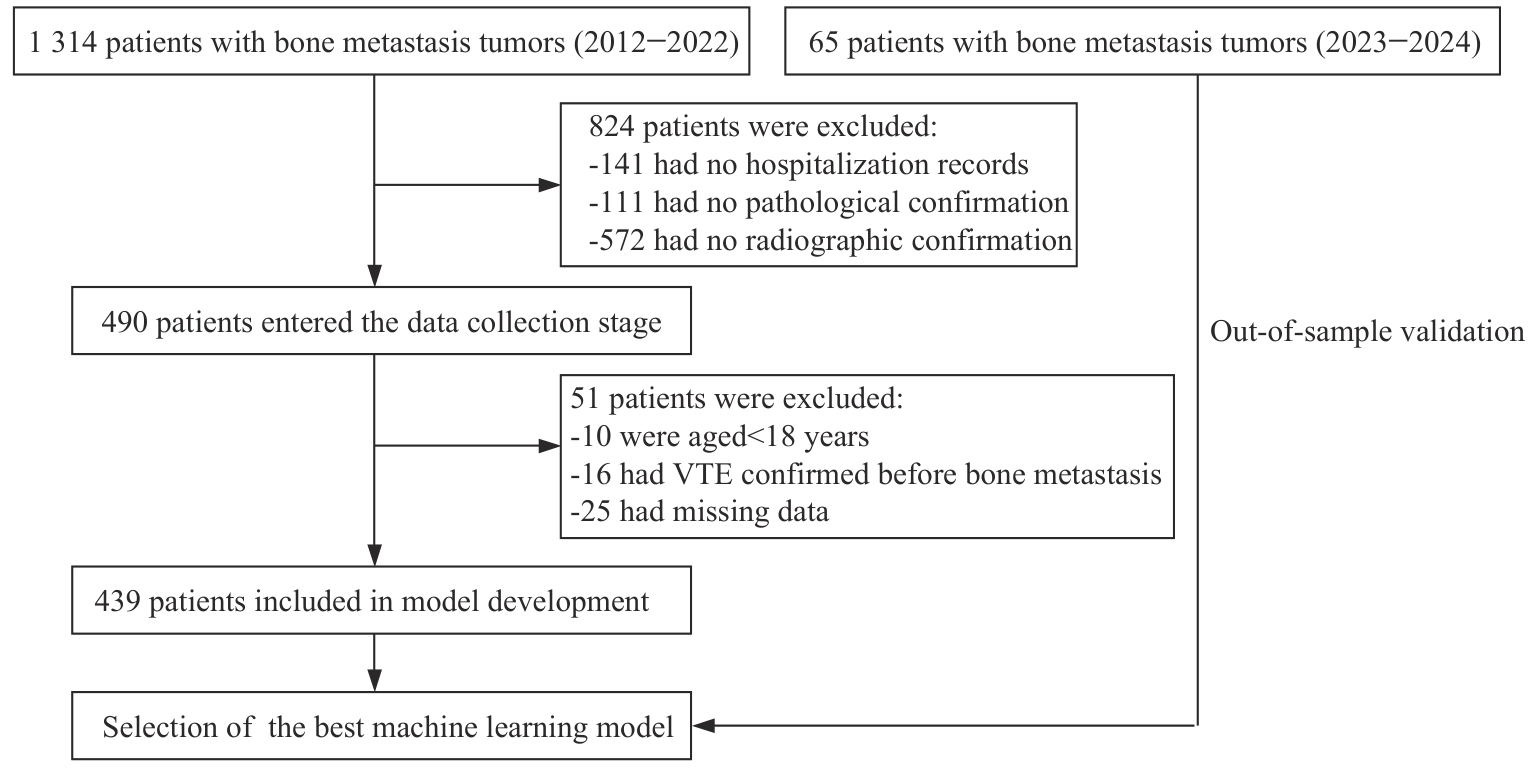
Fig 1 Flowchart of patient selection
| Variable | Total (n=439) | Without VTE (n=286) | With VTE (n=153) | P value |
|---|---|---|---|---|
| Gender/n(%) | 0.117 | |||
| Female | 176 (40.1) | 107 (37.4) | 69 (45.1) | |
| Male | 263 (59.9) | 179 (62.6) | 84 (54.9) | |
| Age/year | 61.9±11.4 | 61.3±12.1 | 63.0±10.1 | 0.155 |
| Karnofsky performance status/score | 73.5±8.2 | 73.7±8.0 | 73.1±8.5 | 0.465 |
Tab 1 Baseline characteristics stratified by VTE status
| Variable | Total (n=439) | Without VTE (n=286) | With VTE (n=153) | P value |
|---|---|---|---|---|
| Gender/n(%) | 0.117 | |||
| Female | 176 (40.1) | 107 (37.4) | 69 (45.1) | |
| Male | 263 (59.9) | 179 (62.6) | 84 (54.9) | |
| Age/year | 61.9±11.4 | 61.3±12.1 | 63.0±10.1 | 0.155 |
| Karnofsky performance status/score | 73.5±8.2 | 73.7±8.0 | 73.1±8.5 | 0.465 |
| Variable | Total (n=439) | Without VTE (n=286) | With VTE (n=153) | P value |
|---|---|---|---|---|
| Primary tumor site/n(%) | 0.062 | |||
| Breast | 54 (12.3) | 35 (12.2) | 19 (12.4) | 0.956 |
| Lung | 177 (40.3) | 99 (34.6) | 78 (51.0) | <0.001 |
| Kidney | 21 (4.8) | 17 (5.9) | 4 (2.6) | 0.119 |
| Esophagus and stomach | 21 (4.8) | 14 (4.9) | 7 (4.6) | 0.881 |
| Colon and rectum | 25 (5.7) | 17 (5.9) | 8 (5.2) | 0.758 |
| Other abdominal | 26 (5.9) | 22 (7.7) | 4 (2.6) | 0.032 |
| Head and neck | 21 (4.8) | 18 (6.3) | 3 (2.0) | 0.043 |
| Prostate | 32 (7.3) | 21 (7.3) | 11 (7.2) | 0.953 |
| Ovary and cervix | 17 (3.9) | 12 (4.2) | 5 (3.3) | 0.631 |
| Nasopharynx | 10 (2.3) | 9 (3.1) | 1 (0.7) | 0.176 |
| Pancreas | 6 (1.4) | 4 (1.4) | 2 (1.3) | 0.992 |
| Sarcoma | 6 (1.4) | 5 (1.7) | 1 (0.7) | 0.669 |
| Bladder | 5 (1.1) | 3 (1.0) | 2 (1.3) | 0.997 |
| Skin | 8 (1.8) | 4 (1.4) | 4 (2.6) | 0.458 |
| Thymus | 3 (0.7) | 1 (0.3) | 2 (1.3) | 0.279 |
| Other | 7 (1.6) | 5 (1.7) | 2 (1.3) | 0.996 |
| Bone metastasis site/n(%) | ||||
| Skull | 15 (3.4) | 9 (3.1) | 6 (3.9) | 0.670 |
| Spine | 284 (64.7) | 190 (66.4) | 94 (61.4) | 0.297 |
| Ribs and clavicle | 149 (33.9) | 103 (36.0) | 46 (30.1) | 0.210 |
| Upper limbs | 39 (8.9) | 30 (10.5) | 9 (5.9) | 0.106 |
| Pelvis | 235 (53.5) | 137 (47.9) | 98 (64.1) | 0.195 |
| Lower limbs | 126 (28.7) | 65 (22.7) | 61 (39.9) | <0.001 |
| SREs/n(%) | ||||
| Radiotherapy | 102 (23.2) | 62 (21.7) | 40 (26.1) | 0.291 |
| Operation | 167 (38.0) | 98 (34.3) | 69 (45.1) | 0.026 |
| Bone fractures | 121 (27.6) | 73 (25.5) | 48 (31.4) | 0.191 |
| Spinal cord compression | 41 (9.3) | 30 (10.5) | 11 (7.2) | 0.258 |
| Laboratory finding | ||||
| White blood cell/(×109·L-1) | 7.6 ± 3.5 | 7.3 ± 3.3 | 8.2 ± 3.6 | 0.008 |
| Red blood cell/(×1012·L-1) | 3.9 ± 0.7 | 4.0 ± 0.7 | 3.8 ± 0.6 | 0.014 |
| Hemoglobin/(g·L-1) | 116.9 ± 29.5 | 119.3 ± 33.2 | 112.2 ± 20.1 | 0.015 |
| Platelet/(×109·L-1) | 228.7 ± 107.1 | 230.9 ± 110.7 | 224.6 ± 100.0 | 0.555 |
| Fibrinogen/(g·L-1) | 3.8 ± 1.4 | 3.8 ± 1.4 | 3.8 ± 1.3 | 0.844 |
| Prothrombin time/s | 12.4 ± 3.4 | 12.0 ± 2.0 | 13.1 ± 4.9 | <0.001 |
| D-dimer/(μg·mL-1) | 1.9 (0.5, 7.1) | 0.9 (0.2, 3.1) | 6.4 (2.4, 11.2) | <0.001 |
Tab 2 Comparison of demographic and clinical baseline characteristics between patients with and without VTE
| Variable | Total (n=439) | Without VTE (n=286) | With VTE (n=153) | P value |
|---|---|---|---|---|
| Primary tumor site/n(%) | 0.062 | |||
| Breast | 54 (12.3) | 35 (12.2) | 19 (12.4) | 0.956 |
| Lung | 177 (40.3) | 99 (34.6) | 78 (51.0) | <0.001 |
| Kidney | 21 (4.8) | 17 (5.9) | 4 (2.6) | 0.119 |
| Esophagus and stomach | 21 (4.8) | 14 (4.9) | 7 (4.6) | 0.881 |
| Colon and rectum | 25 (5.7) | 17 (5.9) | 8 (5.2) | 0.758 |
| Other abdominal | 26 (5.9) | 22 (7.7) | 4 (2.6) | 0.032 |
| Head and neck | 21 (4.8) | 18 (6.3) | 3 (2.0) | 0.043 |
| Prostate | 32 (7.3) | 21 (7.3) | 11 (7.2) | 0.953 |
| Ovary and cervix | 17 (3.9) | 12 (4.2) | 5 (3.3) | 0.631 |
| Nasopharynx | 10 (2.3) | 9 (3.1) | 1 (0.7) | 0.176 |
| Pancreas | 6 (1.4) | 4 (1.4) | 2 (1.3) | 0.992 |
| Sarcoma | 6 (1.4) | 5 (1.7) | 1 (0.7) | 0.669 |
| Bladder | 5 (1.1) | 3 (1.0) | 2 (1.3) | 0.997 |
| Skin | 8 (1.8) | 4 (1.4) | 4 (2.6) | 0.458 |
| Thymus | 3 (0.7) | 1 (0.3) | 2 (1.3) | 0.279 |
| Other | 7 (1.6) | 5 (1.7) | 2 (1.3) | 0.996 |
| Bone metastasis site/n(%) | ||||
| Skull | 15 (3.4) | 9 (3.1) | 6 (3.9) | 0.670 |
| Spine | 284 (64.7) | 190 (66.4) | 94 (61.4) | 0.297 |
| Ribs and clavicle | 149 (33.9) | 103 (36.0) | 46 (30.1) | 0.210 |
| Upper limbs | 39 (8.9) | 30 (10.5) | 9 (5.9) | 0.106 |
| Pelvis | 235 (53.5) | 137 (47.9) | 98 (64.1) | 0.195 |
| Lower limbs | 126 (28.7) | 65 (22.7) | 61 (39.9) | <0.001 |
| SREs/n(%) | ||||
| Radiotherapy | 102 (23.2) | 62 (21.7) | 40 (26.1) | 0.291 |
| Operation | 167 (38.0) | 98 (34.3) | 69 (45.1) | 0.026 |
| Bone fractures | 121 (27.6) | 73 (25.5) | 48 (31.4) | 0.191 |
| Spinal cord compression | 41 (9.3) | 30 (10.5) | 11 (7.2) | 0.258 |
| Laboratory finding | ||||
| White blood cell/(×109·L-1) | 7.6 ± 3.5 | 7.3 ± 3.3 | 8.2 ± 3.6 | 0.008 |
| Red blood cell/(×1012·L-1) | 3.9 ± 0.7 | 4.0 ± 0.7 | 3.8 ± 0.6 | 0.014 |
| Hemoglobin/(g·L-1) | 116.9 ± 29.5 | 119.3 ± 33.2 | 112.2 ± 20.1 | 0.015 |
| Platelet/(×109·L-1) | 228.7 ± 107.1 | 230.9 ± 110.7 | 224.6 ± 100.0 | 0.555 |
| Fibrinogen/(g·L-1) | 3.8 ± 1.4 | 3.8 ± 1.4 | 3.8 ± 1.3 | 0.844 |
| Prothrombin time/s | 12.4 ± 3.4 | 12.0 ± 2.0 | 13.1 ± 4.9 | <0.001 |
| D-dimer/(μg·mL-1) | 1.9 (0.5, 7.1) | 0.9 (0.2, 3.1) | 6.4 (2.4, 11.2) | <0.001 |
| Variable | OR (95%CI) | P value |
|---|---|---|
| Lower limb metastasis | 1.89 (1.17‒3.07) | 0.010 |
| White blood cell | 1.05 (0.99‒1.11) | 0.137 |
| Red blood cell | 0.80 (0.59‒1.09) | 0.163 |
| Prothrombin time | 1.09 (1.01‒1.17) | 0.034 |
| D-dimer | 1.06 (1.02‒1.09) | <0.001 |
| Operation | 1.49 (0.87‒2.56) | 0.149 |
Tab 3 Multivariable Logistic regression analysis of VTE in patients with metastatic bone tumors
| Variable | OR (95%CI) | P value |
|---|---|---|
| Lower limb metastasis | 1.89 (1.17‒3.07) | 0.010 |
| White blood cell | 1.05 (0.99‒1.11) | 0.137 |
| Red blood cell | 0.80 (0.59‒1.09) | 0.163 |
| Prothrombin time | 1.09 (1.01‒1.17) | 0.034 |
| D-dimer | 1.06 (1.02‒1.09) | <0.001 |
| Operation | 1.49 (0.87‒2.56) | 0.149 |
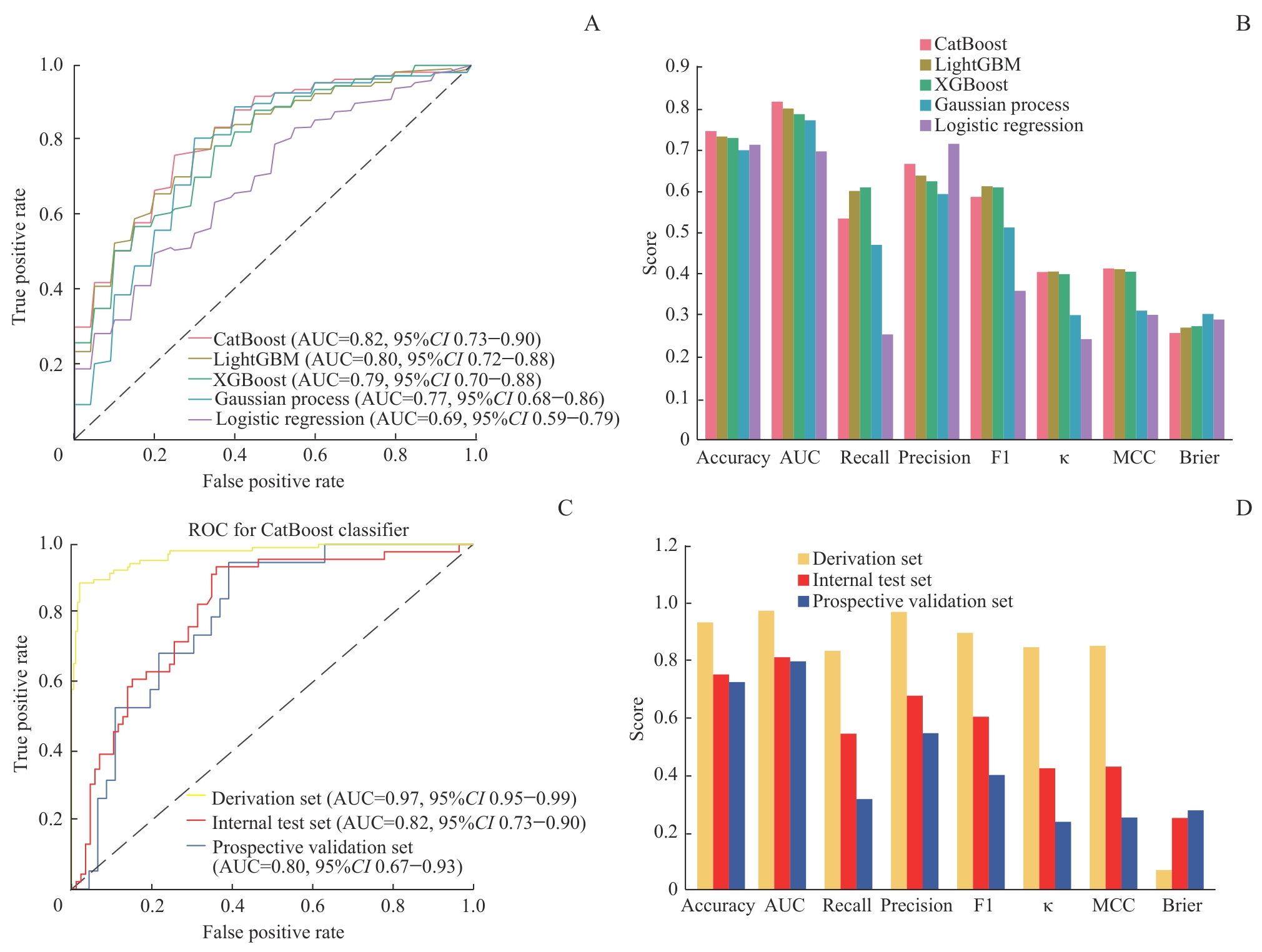
Fig 2 Comparison of the performance of different prediction models
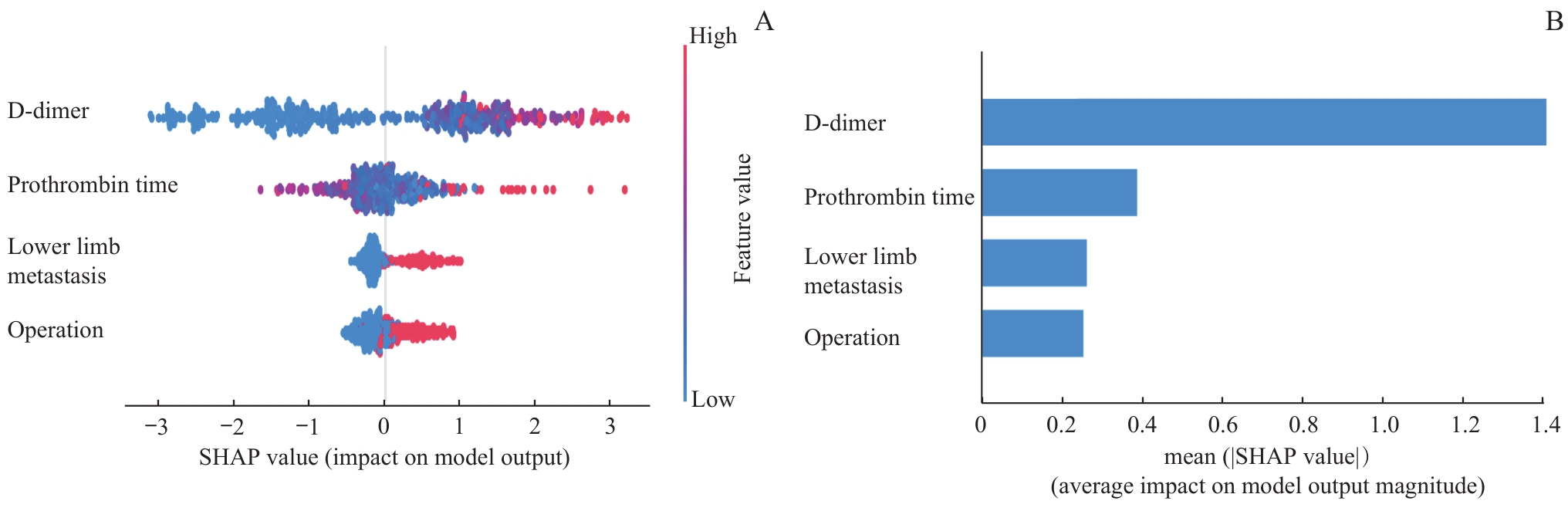
Fig 3 Feature importance analysis of the model based on SHAP algorithm
| [1] | Ashrani A A, Gullerud R E, Petterson T M, et al. Risk factors for incident venous thromboembolism in active cancer patients: a population based case-control study[J]. Thromb Res, 2016, 139: 29-37. |
| [2] | Khorana A A, Francis C W, Culakova E, et al. Thromboembolism is a leading cause of death in cancer patients receiving outpatient chemotherapy[J]. J Thromb Haemost, 2007, 5(3): 632-634. |
| [3] | Sørensen H T, Mellemkjær L, Olsen J H, et al. Prognosis of cancers associated with venous thromboembolism[J]. N Engl J Med, 2000, 343(25): 1846-1850. |
| [4] | Chew H K, Wun T, Harvey D J, et al. Incidence of venous thromboembolism and the impact on survival in breast cancer patients[J]. J Clin Oncol, 2007, 25(1): 70-76. |
| [5] | Pfaundler N, Limacher A, Stalder O, et al. Prognosis in patients with cancer-associated venous thromboembolism: comparison of the RIETE-VTE and modified Ottawa score[J]. J Thromb Haemost, 2020, 18(5): 1154-1161. |
| [6] | Mundy G R. Metastasis to bone: causes, consequences and therapeutic opportunities[J]. Nat Rev Cancer, 2002, 2(8): 584-593. |
| [7] | Brodowicz T, O'Byrne K, Manegold C. Bone matters in lung cancer[J]. Ann Oncol, 2012, 23(9): 2215-2222. |
| [8] | 齐典文, 张国川, 扈文海, 等. 骨转移癌患者下肢深静脉血栓形成的危险因素分析[J]. 中华肿瘤杂志, 2014, 36(6): 469-472. |
| Qi D W, Zhang G C, Hu W H, et al. Analysis of risk factors for deep vein thrombosis of the lower extremity in patients with bone metastase[J]. Chinese Journal of Oncology, 2014, 36(6): 469-472. | |
| [9] | Mioc M L, Prejbeanu R, Vermesan D, et al. Deep vein thrombosis following the treatment of lower limb pathologic bone fractures: a comparative study[J]. BMC Musculoskelet Disord, 2018, 19(1): 213. |
| [10] | Walker M S, Miller P J E, Namjoshi M, et al. Relationship between incidence of fracture and health-related quality-of-life in metastatic breast cancer patients with bone metastases[J]. J Med Econ, 2013, 16(1): 179-189. |
| [11] | Garcia-Garcia V, Barca-Hernando M, Lopez-Ruz S, et al. Relevance of recurrent venous thromboembolism according to location of metastasis in patients with cancer-associated thrombosis. A cohort study[J]. Thromb Res, 2025, 245: 109228. |
| [12] | Khorana A A, DeSancho M T, Liebman H, et al. Prediction and prevention of cancer-associated thromboembolism[J]. Oncologist, 2021, 26(1): e2-e7. |
| [13] | Cella C A, Djulbegovic B, Hozo I, et al. Comparison of Khorana vs. ONKOTEV predictive score to individualize anticoagulant prophylaxis in outpatients with cancer[J]. Eur J Cancer, 2024, 209: 114234. |
| [14] | Abdul Aziz N I, Palaniappan S, Kamal Rodin N S, et al. Incidence of venous thromboembolism and its associated risk factors in newly diagnosed multiple myeloma patients in the Klang Valley, Malaysia[J]. J Clin Med, 2025, 14(3): 759. |
| [15] | 马军, 秦叔逵, 吴一龙, 等. 肿瘤相关静脉血栓栓塞症预防与治疗指南(2019版)[J]. 中国肿瘤临床, 2019, 46(13): 653-660. |
| Ma J, Qin S K, Wu Y L, et al. Guidelines on prevention and treatment of tumor-associated venous thromboembolism (Version 2019) [J]. Chinese Journal of Clinical Oncology, 2019, 46(13): 653-660. | |
| [16] | Asdahl P H, Sundbøll J, Adelborg K, et al. Cardiovascular events in cancer patients with bone metastases: a Danish population-based cohort study of 23, 113 patients[J]. Cancer Med, 2021, 10(14): 4885-4895. |
| [17] | Lei H K, Tao D, Zhang N N, et al. Nomogram prediction for the risk of venous thromboembolism in patients with lung cancer[J]. Cancer Cell Int, 2023, 23(1): 40. |
| [18] | Chen F J, Sun Y X, Zhang C, et al. Risk factors of venous thromboembolism in inpatients with colorectal cancer in China[J]. Clin Appl Thromb Hemost, 2023, 29: 10760296231221133. |
| [19] | ten Wolde M, Kraaijenhagen R A, Prins M H, et al. The clinical usefulness of D-dimer testing in cancer patients with suspected deep venous thrombosis[J]. Arch Intern Med, 2002, 162(16): 1880. |
| [20] | Jin S, Qin D, Liang B S, et al. Machine learning predicts cancer-associated deep vein thrombosis using clinically available variables[J]. Int J Med Inform, 2022, 161: 104733. |
| [21] | Pabinger I, van Es N, Heinze G, et al. A clinical prediction model for cancer-associated venous thromboembolism: a development and validation study in two independent prospective cohorts[J]. Lancet Haematol, 2018, 5(7): e289-e298. |
| [22] | Takada T, van Doorn S, Parpia S, et al. Diagnosing deep vein thrombosis in cancer patients with suspected symptoms: an individual participant data meta-analysis[J]. J Thromb Haemost, 2020, 18(9): 2245-2252. |
| [23] | Izuegbuna O O, Agodirin O S, Olawumi H O, et al. Plasma D-dimer and fibrinogen levels correlates with tumor size and disease progression in Nigerian breast cancer patients[J]. Cancer Invest, 2021, 39(8): 597-606. |
| [24] | Huang X, Chen H X, Meng S, et al. External validation of the Khorana score for the prediction of venous thromboembolism in cancer patients: a systematic review and meta-analysis[J]. Int J Nurs Stud, 2024, 159: 104867. |
| [25] | Chen K Y, Zhang Y, Zhang L F, et al. Machine learning models for risk prediction of cancer-associated thrombosis: a systematic review and meta-analysis[J]. J Thromb Haemost, 2025, 23(2): 610-626. |
| [26] | Bulut H, Maestre M J, Tomey D. A comprehensive evaluation of intramedullary devices in the management of femoral metastasis: 30-day outcomes[J]. Proc (Bayl Univ Med Cent), 2025, 38(3): 247-252. |
| [1] | Feng Linhong, Wu Di, Zhu Yingchun, Xu Jiarui, Zhang Chong, Wang Yakun. Clinical benefits of icodextrin-based peritoneal dialysis solution and its impact on cardiovascular risk in patients undergoing peritoneal dialysis [J]. Journal of Shanghai Jiao Tong University (Medical Science), 2026, 46(6): 759-769. |
| [2] | Deng Yincan, Chen Jing, Wang Linying, Guo Xuejing, Qian Xubo, Zhu Dan. Value of T-cell mitochondrial damage index in predicting the risk of acute exacerbation of chronic obstructive pulmonary disease [J]. Journal of Shanghai Jiao Tong University (Medical Science), 2026, 46(5): 633-641. |
| [3] | Zhu Menglin, Liu Xiao, Xu Xiaodan, Wang Ganhong, Xia Kaijian, Chen Jian. Prediction of delayed post-polypectomy bleeding using a multimodal model [J]. Journal of Shanghai Jiao Tong University (Medical Science), 2026, 46(4): 509-520. |
| [4] | HUANG Xin, LIU Jiahui, YE Jingwen, QIAN Wenli, XU Wanxing, WANG Lin. Development and clinical application of a machine learning-driven model for metabolite-based diagnosis of small cell lung cancer [J]. Journal of Shanghai Jiao Tong University (Medical Science), 2025, 45(8): 1009-1016. |
| [5] | CHEN Rong, ZHANG Meng, ZHU Diqi, GUO Ying, SHEN Jie. Nomogram for predicting the risk of coronary artery lesions in patients with Kawasaki disease based on anti-neutrophil cytoplasmic antibodies [J]. Journal of Shanghai Jiao Tong University (Medical Science), 2025, 45(4): 459-467. |
| [6] | RUAN Qingqing, SU Shuzhi, LI Yanting, REN Yuan, DAI Yong, QIAO Zengyong. Intraoperative complications in percutaneous coronary intervention for acute myocardial infarction: development of a risk prediction model [J]. Journal of Shanghai Jiao Tong University (Medical Science), 2025, 45(12): 1589-1597. |
| [7] | YU Zhiyuan, DONG Haiping, GAO Nan, MA Ke. Identification and mechanistic analysis of core genes associated with morphine tolerance in dorsal root ganglion: an integrative transcriptomics approach using WGCNA and machine learning algorithms [J]. Journal of Shanghai Jiao Tong University (Medical Science), 2025, 45(10): 1308-1319. |
| [8] | WU Qizhen, LIU Qiming, CHAI Yezi, TAO Zhengyu, WANG Yinan, GUO Xinning, JIANG Meng, PU Jun. Evaluation of machine learning prediction of altered inflammatory metabolic state after neoadjuvant therapy for breast cancer [J]. Journal of Shanghai Jiao Tong University (Medical Science), 2024, 44(9): 1169-1181. |
| [9] | XU Wanxing, WANG Lin, GUO Qiaomei, WANG Xueqing, LOU Jiatao. Clinical validation and application value exploration of multi-modal pulmonary nodule diagnosis model [J]. Journal of Shanghai Jiao Tong University (Medical Science), 2024, 44(8): 1030-1036. |
| [10] | LI Yu, ZHANG Yu. Analysis of risk factors of adverse pregnancy outcomes in patients with chronic kidney disease [J]. Journal of Shanghai Jiao Tong University (Medical Science), 2024, 44(5): 560-566. |
| [11] | LI Ping, JIANG Huiru, YE Mengyue, WANG Yayu, CHEN Xiaoyu, YUAN Ancai, XU Wenjie, DAI Huimin, CHEN Xi, YAN Xiaoxiang, TU Shengxian, ZHENG Yuanqi, ZHANG Wei, PU Jun. Analysis of epidemiological characteristics of risk factors for cardiovascular diseases and malignant tumors based on the Shanghai community elderly cohort [J]. Journal of Shanghai Jiao Tong University (Medical Science), 2024, 44(5): 617-625. |
| [12] | WU Lirong, CHEN Ruihua, CHAO Xiaowen, GUO Yuhuai, SUN Tao, LI Mengci, CHEN Tianlu. Study of metabolic association between elevated fasting blood glucose and cognitive deterioration [J]. Journal of Shanghai Jiao Tong University (Medical Science), 2024, 44(2): 212-222. |
| [13] | MA Ben, ZHAO Cheng, SHU Yijun, DONG Ping. Application progress of CT radiomics in gastrointestinal stromal tumor [J]. Journal of Shanghai Jiao Tong University (Medical Science), 2023, 43(7): 923-930. |
| [14] | TIAN Xiaofan, DONG Yi, LOU Wenhui, ZHANG Qi, QIU Yijie, ZUO Dan, WANG Wenping. A modified clinically relevant post-operative pancreatic fistula risk evaluation model based on ultrasound shear wave elastography: a prospective study [J]. Journal of Shanghai Jiao Tong University (Medical Science), 2023, 43(4): 437-444. |
| [15] | SHEN Li, HUANG Hengye, YU Guangjun. Current status of neurodevelopmental outcomes and its influencing factors of early-to-moderate preterm infants at corrected age of 18 months [J]. Journal of Shanghai Jiao Tong University (Medical Science), 2023, 43(4): 445-452. |
| Viewed | ||||||
|
Full text |
|
|||||
|
Abstract |
|
|||||
