
Journal of Shanghai Jiao Tong University (Medical Science) ›› 2026, Vol. 46 ›› Issue (2): 248-255.doi: 10.3969/j.issn.1674-8115.2026.02.015
• Review • Previous Articles Next Articles
Lin Chao1,2, Zou Qingsong1,2, Qian Mingyang1,2, Cheng Qian2( )
)
Received:2025-09-07
Accepted:2025-10-09
Online:2026-02-28
Published:2026-03-05
Contact:
Cheng Qian
E-mail:chengqian@shsmu.edu.cn
Supported by:CLC Number:
Lin Chao, Zou Qingsong, Qian Mingyang, Cheng Qian. Advances in oxygen microenvironment-modulating hydrogel systems for bone regeneration[J]. Journal of Shanghai Jiao Tong University (Medical Science), 2026,(2): 248-255.
Add to citation manager EndNote|Ris|BibTeX
URL: https://xuebao.shsmu.edu.cn/EN/10.3969/j.issn.1674-8115.2026.02.015
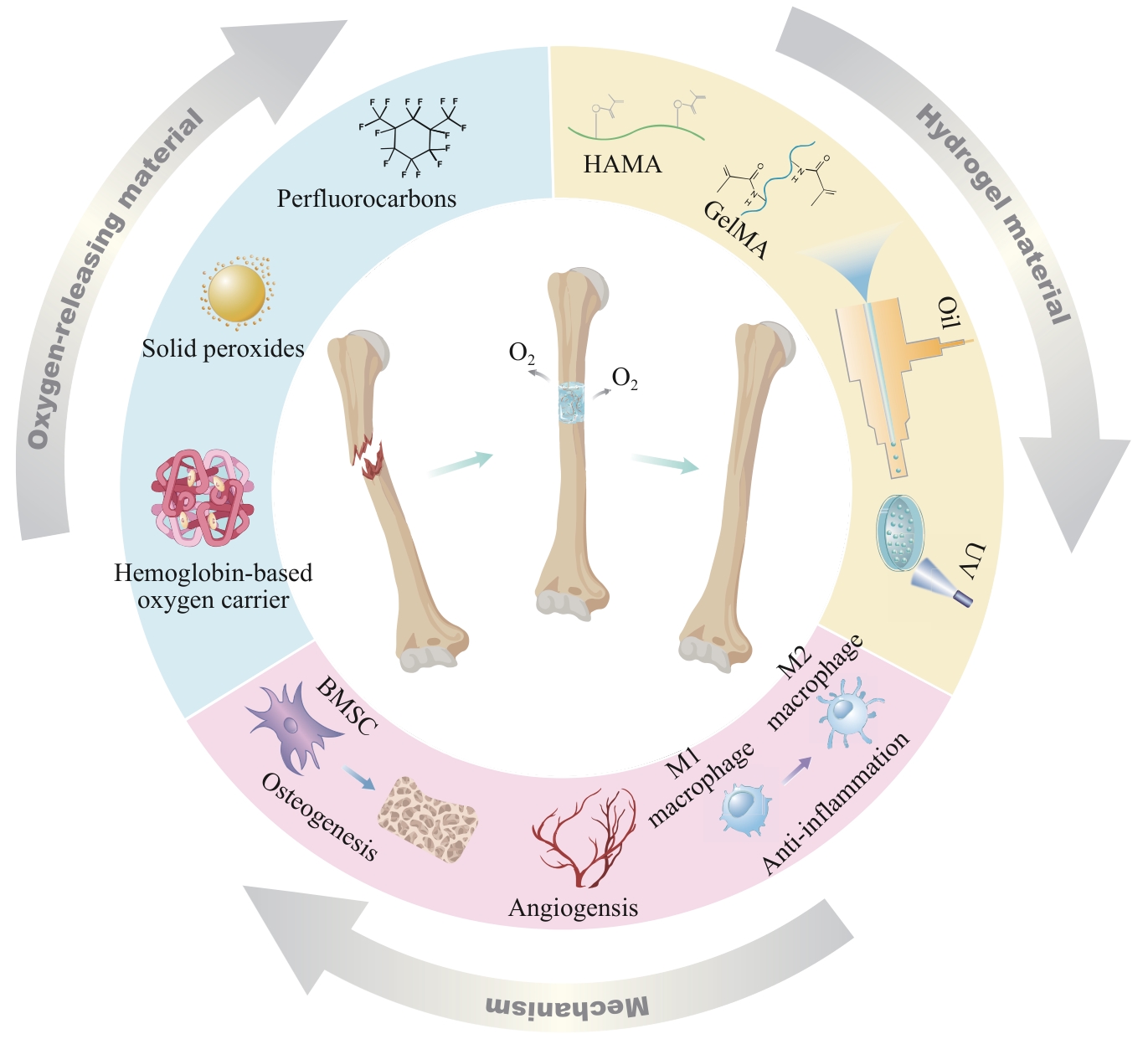
Fig 1 Schematic illustration of the design and functions of oxygen-microenvironment-modulating oxygen-carrying hydrogel systems
| [1] | Hart N H, Newton R U, Tan J, et al. Biological basis of bone strength: anatomy, physiology and measurement[J]. J Musculoskelet Neuronal Interact, 2020, 20(3): 347-371. |
| [2] | Lin C, He J, Li J, et al. Metal coordination-based double-network microsphere scaffolds facilitate bone regeneration via oxygen-driven mitochondrial oxidative phosphorylation[J]. Chem Eng J, 2025, 512: 162233. |
| [3] | Garimella A, Ghosh S B, Bandyopadhyay-Ghosh S. Biomaterials for bone tissue engineering: achievements to date and future directions[J]. Biomed Mater, 2024, 20(1): 1-38. |
| [4] | Tang X, Zhou F, Wang S, et al. Bioinspired injectable hydrogels for bone regeneration[J]. J Adv Res, 2025, 75: 163-188. |
| [5] | Jagadale S, Damle M, Joshi M G. Bone tissue engineering: from biomaterials to clinical trials[J]. Adv Exp Med Biol, 2025, 1479: 73-115. |
| [6] | Zhao J, Sarkar N, Ren Y, et al. Engineering next-generation oxygen-generating scaffolds to enhance bone regeneration[J]. Trends Biotechnol, 2025, 43(3): 540-554. |
| [7] | Malda J, Klein T J, Upton Z. The roles of hypoxia in the in vitro engineering of tissues[J]. Tissue Eng, 2007, 13(9): 2153-2162. |
| [8] | Fu L, Zhang L, Zhang X, et al. Roles of oxygen level and hypoxia-inducible factor signaling pathway in cartilage, bone and osteochondral tissue engineering[J]. Biomed Mater, 2021, 16(2): 022006. |
| [9] | Suvarnapathaki S, Wu X, Zhang T, et al. Oxygen generating scaffolds regenerate critical size bone defects[J]. Bioact Mater, 2022, 13: 64-81. |
| [10] | Li G, Gao F, Yang D, et al. ECM-mimicking composite hydrogel for accelerated vascularized bone regeneration[J]. Bioact Mater, 2024, 42: 241-256. |
| [11] | Ding Q, Zhang S, Liu X, et al. Hydrogel tissue bioengineered scaffolds in bone repair: a review[J]. Molecules, 2023, 28(20): 7039. |
| [12] | Sun H, Xu J, Wang Y, et al. Bone microenvironment regulative hydrogels with ROS scavenging and prolonged oxygen-generating for enhancing bone repair[J]. Bioact Mater, 2023, 24: 477-496. |
| [13] | Wang C, Min S, Tian Y. Injectable and cell-laden hydrogel in the contained bone defect animal model: a systematic review[J]. Tissue Eng Regen Med, 2023, 20(6): 829-837. |
| [14] | Lukin I, Errezuma I, Garcia-Garcia P, et al. Sumecton reinforced gelatin-based scaffolds for cell-free bone regeneration[J]. Int J Biol Macromol, 2023, 249: 126023. |
| [15] | Wang C, Xu H, Liu C, et al. CaO2/gelatin oxygen slow-releasing microspheres facilitate tissue engineering efficiency for the osteonecrosis of femoral head by enhancing the angiogenesis and survival of grafted bone marrow mesenchymal stem cells[J]. Biomater Sci, 2021, 9(8): 3005-3018. |
| [16] | Zhang Y, Fang M, Zhu J, et al. Exosome-loaded hyaluronic acid hydrogel composite with oxygen-producing 3D printed polylactic acid scaffolds for bone tissue repair and regeneration[J]. Int J Biol Macromol, 2024, 274(Pt 1): 132970. |
| [17] | Ming L, Qu Y, Wang Z, et al. Small extracellular vesicles laden oxygen-releasing thermosensitive hydrogel for enhanced antibacterial therapy against anaerobe-induced periodontitis alveolar bone defect[J]. ACS Biomater Sci Eng, 2024, 10(2): 932-945. |
| [18] | Kim M J, Yoon S B, Ji H B, et al. In situ hydrogel with immobilized Mn-porphyrin for reactive oxygen species scavenging, oxygen generation, and risedronate delivery in bone defect treatment[J]. ACS Appl Mater Interfaces, 2024, 16(31): 40682-40694. |
| [19] | Lin S J, Huang C C. Strontium peroxide-loaded composite scaffolds capable of generating oxygen and modulating behaviors of osteoblasts and osteoclasts[J]. Int J Mol Sci, 2022, 23(11): 6322. |
| [20] | Xu Y, Zheng S, Tang Z, et al. Injectable, oxygen-releasing, thermosensitive hydrogel promotes vascularized bone formation with prolonged oxygen delivery and improved osteoinductivity[J]. Mater Today Bio, 2024, 29: 101267. |
| [21] | Yang Y, Wang W, Zeng Q, et al. Fabricating oxygen self-supplying 3D printed bioactive hydrogel scaffold for augmented vascularized bone regeneration[J]. Bioact Mater, 2024, 40: 227-243. |
| [22] | Augustine R, Nikolopoulos V K, Camci-Unal G. Hydrogel-impregnated self-oxygenating electrospun scaffolds for bone tissue engineering[J]. Bioengineering (Basel), 2023, 10(7): 854. |
| [23] | Huang B, Chen M, Tian J, et al. Oxygen-carrying and antibacterial fluorinated nano-hydroxyapatite incorporated hydrogels for enhanced bone regeneration[J]. Adv Healthc Mater, 2022, 11(12): e2102540. |
| [24] | Nejati S, Karimi Soflou R, Khorshidi S, et al. Development of an oxygen-releasing electroconductive in-situ crosslinkable hydrogel based on oxidized pectin and grafted gelatin for tissue engineering applications[J]. Colloids Surf B Biointerfaces, 2020, 196: 111347. |
| [25] | Rui M, Mao J, Wu H, et al. Implantable multifunctional micro-oxygen reservoir system for promoting vascular-osteogenesis via remodeling regenerative microenvironment[J]. Adv Sci (Weinh), 2025, 12(3): e2409636. |
| [26] | Gao C, Huang Y, Zhang L, et al. Self-reinforcement hydrogel with sustainable oxygen-supply for enhanced cell ingrowth and potential tissue regeneration[J]. Biomater Adv, 2022, 141: 213105. |
| [27] | Chin K, Khattak S F, Bhatia S R, et al. Hydrogel-perfluorocarbon composite scaffold promotes oxygen transport to immobilized cells[J]. Biotechnol Prog, 2008, 24(2): 358-366. |
| [28] | Kimelman-Bleich N, Pelled G, Sheyn D, et al. The use of a synthetic oxygen carrier-enriched hydrogel to enhance mesenchymal stem cell-based bone formation in vivo[J]. Biomaterials, 2009, 30(27): 4639-4648. |
| [29] | Faithfull N S. Oxygen delivery from fluorocarbon emulsions: aspects of convective and diffusive transport[J]. Biomater Artif Cells Immobilization Biotechnol, 1992, 20(2-4): 797-804. |
| [30] | Liu W, Fang Y, Xu P, et al. Cu-Fe bimetallic peroxide-based nanozyme with microenvironment-triggered cascade catalysis for synergistic hydroxyl radical, nitric oxide, and oxygen generation in trimodal wound infection therapy[J]. Mater Today Bio, 2025, 32: 101912. |
| [31] | Aleemardani M, Solouk A, Akbari S, et al. A hydrogel-fiber-hydrogel composite scaffold based on silk fibroin with the dual-delivery of oxygen and quercetin[J]. Biotechnol Bioeng, 2023, 120(1): 297-311. |
| [32] | Mohammed A A, Li S, Sang T, et al. Nanocomposite hydrogels with polymer grafted silica nanoparticles, using glucose oxidase[J]. Gels, 2023, 9(6): 486. |
| [33] | Hui Y, Mao J, Rui M, et al. Hydrogel microsphere-encapsulated bimetallic nanozyme for promoting diabetic bone regeneration via glucose consumption and ROS scavenging[J]. Adv Healthc Mater, 2024, 13(32): e2402596. |
| [34] | Mavris S M, Hansen L M. Optimization of oxygen delivery within hydrogels[J]. J Biomech Eng, 2021, 143(10): 101004. |
| [35] | Yang Z, Ren K, Chen Y, et al. Oxygen-generating hydrogels as oxygenation therapy for accelerated chronic wound healing[J]. Adv Healthc Mater, 2024, 13(3): e2302391. |
| [36] | Ke D X, Kengla C, Lee S J, et al. Release kinetics and in vitro characterization of sodium percarbonate and calcium peroxide to oxygenate bioprinted tissue models[J]. Int J Mol Sci, 2022, 23(12): 6842. |
| [37] | Haki M, Shafaei N, Moeini M. In situ gelling silk fibroin/ECM hydrogel with sustained oxygen release for neural tissue engineering applications[J]. J Biomed Mater Res A, 2025, 113(1): e37837. |
| [38] | Guan Y, Niu H, Liu Z, et al. Sustained oxygenation accelerates diabetic wound healing by promoting epithelialization and angiogenesis and decreasing inflammation[J]. Sci Adv, 2021, 7(35): eabj0153. |
| [39] | Li N, Lu X, Yang Y, et al. Calcium peroxide-based hydrogel patch with sustainable oxygenation for diabetic wound healing[J]. Adv Healthc Mater, 2024, 13(16): e2303314. |
| [40] | Wang K, Yin C, Ye X, et al. A metabolic driven bio-responsive hydrogel loading psoralen for therapy of rheumatoid arthritis[J]. Small, 2023, 19(21): e2207319. |
| [41] | Stegen S, Van Gastel N, Carmeliet G. Bringing new life to damaged bone: the importance of angiogenesis in bone repair and regeneration[J]. Bone, 2015, 70: 19-27. |
| [42] | Chen P, Liu Y, Liu W, et al. Impact of high-altitude hypoxia on bone defect repair: a review of molecular mechanisms and therapeutic implications[J]. Front Med (Lausanne), 2022, 9: 842800. |
| [43] | Zhang X, Wang H, Hao Z. A numerical bone regeneration model incorporating angiogenesis, considering oxygen-induced secretion of vascular endothelial growth factor and vascular remodeling[J]. J Biomech, 2021, 127: 110656. |
| [44] | Lv N, Hou M, Deng L, et al. A sponge-like nanofiber melatonin-loaded scaffold accelerates vascularized bone regeneration via improving mitochondrial energy metabolism[J]. Mater Today Bio, 2024, 26: 101078. |
| [45] | Yin X, Wei Y, Qin H, et al. Oxygen tension regulating hydrogels for vascularization and osteogenesis via sequential activation of HIF-1α and ERK1/2 signaling pathways in bone regeneration[J]. Biomater Adv, 2024, 161: 213893. |
| [46] | Bryniarska N, Kubiak A, Łabędź-Masłowska A, et al. Impact of developmental origin, niche mechanics and oxygen availability on osteogenic differentiation capacity of mesenchymal stem/stromal cells[J]. Acta Biochim Pol, 2019, 66(4): 491-498. |
| [47] | Hassan S, Wang T, Shi K, et al. Self-oxygenation of engineered living tissues orchestrates osteogenic commitment of mesenchymal stem cells[J]. Biomaterials, 2023, 300: 122179. |
| [48] | Farris A L, Lambrechts D, Zhou Y X, et al. 3D-printed oxygen-releasing scaffolds improve bone regeneration in mice[J]. Biomaterials, 2022, 280: 121318. |
| [49] | Lee C S, Fan J B, Hwang H S, et al. Oxygen-enriched osteoinductive nanoerythrocytes augment cell survival and osteogenic differentiation for bone regeneration[J]. Chem Mater, 2022, 34(13): 5808-5820. |
| [50] | Touri M, Moztarzadeh F, Abu Osman N A, et al. Oxygen-releasing scaffolds for accelerated bone regeneration[J]. ACS Biomater Sci Eng, 2020, 6(5): 2985-2994. |
| [51] | Volkmer E, Drosse I, Otto S, et al. Hypoxia in static and dynamic 3D culture systems for tissue engineering of bone[J]. Tissue Eng Part A, 2008, 14(8): 1331-1340. |
| [52] | Claes L, Recknagel S, Ignatius A. Fracture healing under healthy and inflammatory conditions[J]. Nat Rev Rheumatol, 2012, 8(3): 133-143. |
| [53] | Chen Q, Li J, Han F, et al. A multifunctional composite hydrogel that rescues the ROS microenvironment and guides the immune response for repair of osteoporotic bone defects[J]. Adv Funct Mater, 2022, 32(27): 2201067. |
| [54] | Xie Y, Hu C, Feng Y, et al. Osteoimmunomodulatory effects of biomaterial modification strategies on macrophage polarization and bone regeneration[J]. Regen Biomater, 2020, 7(3): 233-245. |
| [55] | Ashammakhi N, Darabi M A, Kehr N S, et al. Advances in controlled oxygen generating biomaterials for tissue engineering and regenerative therapy[J]. Biomacromolecules, 2020, 21(1): 56-72. |
| [56] | Du J, Chen T, Yu J, et al. Construction of nanohydroxyapatite/poly(sodium lipoate)-based bioactive hydrogels for cranial bone regeneration[J]. Biomacromolecules, 2025, 26(1): 705-714. |
| [57] | Wang Z, Chen T, Li X, et al. Oxygen-releasing biomaterials for regenerative medicine[J]. J Mater Chem B, 2023, 11(31): 7300-7320. |
| [1] | HUANG Zihan, HUANG Xinzhi. Application of single-cell RNA sequencing in bone regeneration [J]. Journal of Shanghai Jiao Tong University (Medical Science), 2025, 45(8): 1053-1058. |
| [2] | LU Jiayi, LIU Jinzhe, GUO Shangchun, TAO Shicong. Advances in nanomaterials for promoting bone tissue regeneration by reducing reactive oxygen species levels [J]. Journal of Shanghai Jiao Tong University (Medical Science), 2025, 45(4): 487-492. |
| [3] | WU Jing, ZHAO Zhengyi, ZOU Duohong, YANG Chi, ZHANG Zhiyuan. Application of a tent-pole screw technology in reconstruction of severe alveolar bone defect: a retrospective study of 30 patients [J]. Journal of Shanghai Jiao Tong University (Medical Science), 2022, 42(6): 768-777. |
| [4] | Qing WANG, Wei WANG, Da-jun JIANG, Wei-tao JIA. Evaluation of JDBM porous scaffold coated with DCPD in promoting angiogenesis and repairing bone defects [J]. JOURNAL OF SHANGHAI JIAOTONG UNIVERSITY (MEDICAL SCIENCE), 2021, 41(6): 732-740. |
| [5] | LI Yuan, SHI Jun-yu, ZHANG Xiao, LAI Hong-chang. Correlation between the morphology of alveolar bone defect in the maxillary anterior region and the outcome of guided bone regeneration [J]. JOURNAL OF SHANGHAI JIAOTONG UNIVERSITY (MEDICAL SCIENCE), 2020, 40(10): 1414-1419. |
| [6] | CHENG Ruo-yu, YAN Yu-fei, CHEN Hao, QI Jin, DENG Lian-fu, CUI Wen-guo. Fabrication of dual-functional organic/inorganic osteogenetic hydrogel for bone regeneration [J]. , 2018, 38(8): 900-. |
| Viewed | ||||||
|
Full text |
|
|||||
|
Abstract |
|
|||||
