目的·采用两样本孟德尔随机化(two-sample Mendelian randomization,TSMR)方法,以遗传变异作为工具变量,评估血浆磷脂酰乙醇胺(phosphatidylethanolamine,PE)水平与结直肠腺癌发病风险之间的因果关系。方法·PE与结直肠癌相关的单核苷酸多态性(single-nucleotide polymorphism,SNP)数据分别来自布里斯托大学MRC综合流行病学小组(The Medical Research Council Integrative Epidemiology Unit,MRC-IEU)和芬兰生物银行。对基于全基因组关联研究(genome-wide association study,GWAS)的所有汇总数据进行二次数据分析,选择与PE密切关联的遗传位点作为工具变量,采用4种孟德尔随机化(Mendelian randomization,MR)方法,包括逆方差加权法(inverse-variance weighted,IVW)、孟德尔随机化Egger回归法(Mendelian randomization-Egger,MR-Egger回归)、加权中位数法(weighted median,WME)和加权众数法(weighted mode,WM)分析评估因果效应。IVW作为主要统计方法,MR-Egger、WME和WM作为辅助方法。采用MR-Egger回归截距和MR-PRESSO检验评估水平多效性全局检验是否违反MR假设。Cochran′s Q检验用于评估异质性。结果·筛选出10个工具变量,Steiger检验显示全部PE相关SNP对结直肠癌因果关系方向一致。10个SNP中rs102275和rs9393903位点与结直肠癌风险正相关,关联度分别为0.45(P=8.01×10⁻⁵)和0.82(P=2.31×10⁻²)。4种MR分析的结果一致,均显示血浆PE水平与结直肠腺癌的发病风险存在正向关联。IVW中OR为1.36,95%CI 1.17~1.59,P=7.24×10⁻⁵;MR-Egger回归OR为1.44,95%CI 0.97~2.14,P=1.12×10⁻¹;WME中OR为1.33,95%CI 1.07~1.65,P=8.81×10⁻³;WM中OR为1.41,95%CI 1.12~1.77,P=1.70×10⁻²。Cochran′s Q检验结果显示10个SNP对结直肠腺癌估计值无异质性。MR-Egger回归截距和MR-PRESSO检验表明全部SNP无水平多效性。采用留一法在剔除任一个SNP后,总体置信区间重叠,表明结果对单个SNP不敏感,具有较高的稳健性。结论·血浆PE水平与结直肠腺癌风险之间存在因果关联,遗传预测的血浆PE每增加1个标准差,结直肠腺癌发生风险就会增加0.36倍(95%CI 1.17~1.59,P=7.24×10⁻⁵)。
关键词:结直肠腺癌
;
磷脂酰乙醇胺
;
两样本孟德尔随机化
;
因果关联
;
全基因组关联研究
Abstract
Objective ·To employ the two-sample Mendelian randomization (TSMR) method, using genetic variants as instrumental variables, to investigate the causal relationship between phosphatidylethanolamine (PE) and the risk of colorectal adenocarcinoma. Methods ·The single-nucleotide polymorphism (SNP) data associated with PE and colorectal adenocarcinoma were obtained from the Medical Research Council Integrative Epidemiology Unit (MRC IEU) at the University of Bristol and the Finnish Biobank, respectively. A secondary data analysis was conducted using summary statistics from genome-wide association studies (GWAS), and genetic loci strongly associated with PE were selected as instrumental variables. Four Mendelian randomization (MR) methods, inverse-variance weighted (IVW) method, MR-Egger regression, weighted median (WME) method, and weighted mode (WM) method, were employed to assess the causal effect. The IVW method was used as the primary statistical approach, while MR-Egger, WME, and WM served as supplementary methods. Rigorous assessments for robustness included MR-Egger regression, MR-PRESSO global tests for horizontal pleiotropy, and Cochran′s Q test to evaluate heterogeneity. Results ·Ten instrumental variables were selected, and the Steiger test indicated that all PE-associated SNPs exhibited a consistent direction of causal effect on colorectal cancer. Among the 10 SNPs, rs102275 and rs9393903 showed the strongest positive associations with colorectal adenocarcinoma risk, with effect sizes of 0.45 (P=8.01×10⁻⁵) and 0.82 (P=2.31×10⁻²), respectively. Consistent findings from MR analyses demonstrated that PE elevated the risk of colorectal adenocarcinoma across all four methods. In the IVW analysis, the OR was 1.36 (95%CI 1.17‒1.59, P=7.24×10⁻⁵). In the MR-Egger regression, the OR was 1.44 (95%CI 0.97‒2.14, P=1.12×10⁻¹). In the WEM analysis, the OR was 1.33 (95%CI 1.07‒1.65, P=8.81×10⁻³). In the WM analysis, the OR was 1.41 (95%CI 1.12‒1.77, P=1.70×10⁻²). Cochran′s Q test revealed no heterogeneity among the effect estimates of the 10 SNPs on colorectal adenocarcinoma. Both MR-Egger regression intercept and MR-PRESSO test indicated no evidence of horizontal pleiotropy among the SNPs. Leave-one-out analysis showed overlapping confidence intervals after excluding any single SNP, indicating that the results were not sensitive to individual SNPs and were highly robust. Conclusions ·There is a causal association between circulating PE levels and the risk of colorectal adenocarcinoma. A genetically predicted increase of one standard deviation in plasma PE levels is associated with a 1.36-fold higher risk of developing colorectal adenocarcinoma (95%CI 1.17‒1.59, P=7.24×10⁻⁵).
Keywords:colorectal adenocarcinoma
;
phosphatidylethanolamine
;
two-sample mendelian randomization
;
causal association
;
genome-wide association study
XU Ling, HUANGFU Yuchan, SHEN Lisong, MA Yanhui. Causal association between plasma phosphatidylethanolamine and risk of colorectal adenocarcinoma: a two-sample Mendelian randomization study. Journal of Shanghai Jiao Tong University (Medical Science)[J], 2025, 45(5): 605-613 doi:10.3969/j.issn.1674-8115.2025.05.009
磷脂酰乙醇胺(phosphatidylethanolamine,PE)作为细胞膜的重要组成部分,主要通过乙醇胺途径(Kennedy途径)和Lands循环进行生物合成[4]。这些途径的调节异常与多种疾病密切相关[5],例如恶性肿瘤[6]、自身免疫性疾病[7]、遗传性疾病[8-9],以及胰岛素抵抗和肥胖等代谢紊乱[10]等。PE和磷脂酰胆碱(phosphatidylcholine,PC)水平的改变,以及磷脂代谢物和脂肪酸谱的变化,被认为是肿瘤发生和发展的标志性特征[3]。脂质组学作为研究脂质代谢的重要工具,拓宽了我们对肿瘤组织中脂质组成的了解。例如,在结肠肿瘤细胞球状体(colon cancer cell spheroids,CCS)[11]和非转移性及转移性结直肠肿瘤患者血浆中分离出的外泌体[12]中观察到PE水平异常升高。一项巢式病例对照研究[6]发现包括PE在内的43种脂质与胰腺导管腺癌的发病风险相关。此外,也有研究[13]表明,结直肠肿瘤组织中存在脂质代谢的重编程,其主要特征是PE水平的上调和甘油三酯水平的下降,从而促进了肿瘤细胞的快速增殖。
本研究采用具有公开可用汇总层面数据的TSMR设计。PE的全基因组关联研究(genome-wide association study,GWAS)数据来自布里斯托大学MRC综合流行病学小组(The Medical Research Council Integrative Epidemiology Unit,MRC-IEU)[20-21](https://gwas.mrcieu.ac.uk/datasets/ebi-a-GCST9006 0313/),为暴露因素。结直肠腺癌数据来自芬兰生物银行,包括5 378例结直肠腺癌和287 137例非肿瘤对照(https://risteys.finregistry.fi/endpoints/C3_COLORECTAL_ADENO_EXALLC)。本研究全部数据来自欧洲人群。
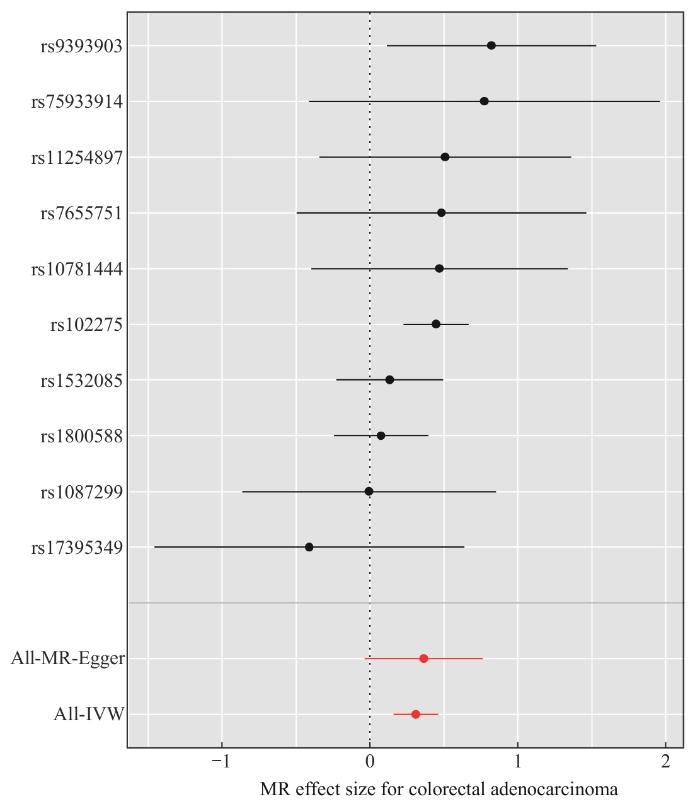
Note: The black dots represent the log ORs for colorectal adenocarcinoma using each PE-associated SNP as an instrumental variable, corresponding to the risk per one standard deviation increase in PE levels. The red dots represent the combined causal estimates, derived using all SNPs as instrumental variables, based on the MR-Egger regression and IVW methods. The horizontal lines represent the 95%CI of the estimates.
Fig 1
Forest plot of the association of PE-associated SNPs with risk of colorectal adenocarcinoma
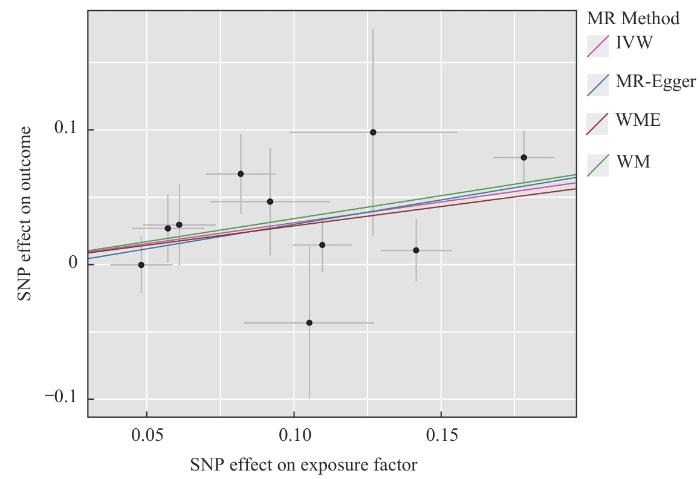
Note: Each dot in this graph represents an instrumental variable; the lines at each dot reflect the 95%CI. The x-axis represents the effect of each SNP on the exposure factor (PE), and the y-axis represents the effect on the outcome (colorectal adenocarcinoma). The colored lines represent the Mendelian randomization fit (MR Fit).
Fig 2
Scatter plot of summary data estimates for the associations of 10 SNPs with PE and colorectal adenocarcinoma
Tab 3
表3
表3TSMR估计血浆PE相关SNP与结直肠腺癌发生风险的因果关系
Tab 3 Causal relationship between SNPs associated with plasma PE and the risk of colorectal adenocarcinoma estimated by TSMR
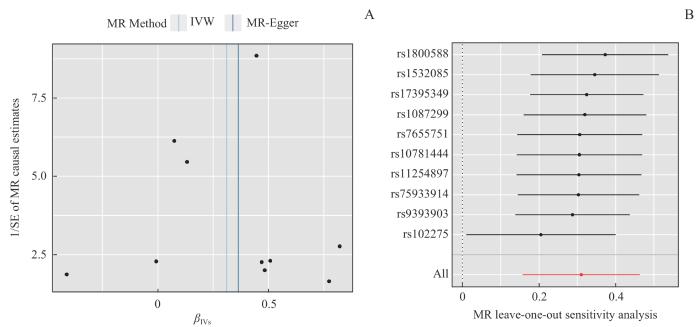
Note: A. The funnel plot visualized the heterogeneity of each genetic variant. B. Leave-one-out plots for sensitivity analysis of the association between PE and colorectal adenocarcinoma.
MA Yanhui designed this research. XU Ling and HUANGFU Yuchan participated in data collection and analysis. This article was written by XU Ling, and reviewed and revised by SHEN Lisong and MA Yanhui. All authors have read the last version of the paper and consented to its submission.
利益冲突声明
所有作者声明不存在利益冲突。
COMPETING INTERESTS
All authors disclose no relevant conflict of interests.
HOFMANOVÁ J, SLAVÍK J, OVESNÁ P, et al. Phospholipid profiling enables to discriminate tumor- and non-tumor-derived human colon epithelial cells: phospholipidome similarities and differences in colon cancer cell lines and in patient-derived cell samples[J]. PLoS One, 2020, 15(1): e0228010.
VAN DER VEEN J N, KENNELLY J P, WAN S, et al. The critical role of phosphatidylcholine and phosphatidylethanolamine metabolism in health and disease[J]. Biochim Biophys Acta Biomembr, 2017, 1859(9 Pt B): 1558-1572.
WANG Y Z, GUO F, GUO Y K, et al. Untargeted lipidomics reveals specific lipid abnormalities in systemic lupus erythematosus[J]. Clin Exp Rheumatol, 2022, 40(5): 1011-1018.
BUTLER F M, UTT J, MATHEW R O, et al. Plasma metabolomics profiles in Black and White participants of the Adventist Health Study-2 cohort[J]. BMC Med, 2023, 21(1): 408.
JEZIORNY K, PIETROWSKA K, SIEMINSKA J, et al. Serum metabolomics identified specific lipid compounds which may serve as markers of disease progression in patients with Alström and Bardet-Biedl syndromes[J]. Front Mol Biosci, 2023, 10: 1251905.
XIE P S, ZHANG H N, WU P F, et al. Three-dimensional mass spectrometry imaging reveals distributions of lipids and the drug metabolite associated with the enhanced growth of colon cancer cell spheroids treated with triclosan[J]. Anal Chem, 2022, 94(40): 13667-13675.
ELMALLAH M I Y, ORTEGA-DEBALLON P, HERMITE L, et al. Lipidomic profiling of exosomes from colorectal cancer cells and patients reveals potential biomarkers[J]. Mol Oncol, 2022, 16(14): 2710-2718.
MIKA A, PAKIET A, CZUMAJ A, et al. Decreased triacylglycerol content and elevated contents of cell membrane lipids in colorectal cancer tissue: a lipidomic study[J]. J Clin Med, 2020, 9(4): 1095.
CHEN Y Q, TORTA F, KOH H W L, et al. Metabolomics profiling in multi-ancestral individuals with type 2 diabetes in Singapore identified metabolites associated with renal function decline[J]. Diabetologia, 2025, 68(3): 557-575.
HUANG Y, STINSON S E, THODBERG M, et al. Genetic factors shaping the plasma lipidome and the relations to cardiometabolic risk in children and adolescents[J]. EBioMedicine, 2025, 112: 105537.
BURGESS S, DAVEY SMITH G, DAVIES N M, et al. Guidelines for performing mendelian randomization investigations: update for summer 2023[J]. Wellcome Open Res, 2023, 4: 186.
ELSWORTH B, LYON M, ALEXANDER T, et al. The MRC IEU OpenGWAS data infrastructure[DB/OL]. (2020-08-10)[2024-12-26]. https://www.biorxiv.org/content/10.1101/2020.08.10.244293v1.
WOOTTON R E, LAWN R B, MILLARD L A C, et al. Evaluation of the causal effects between subjective wellbeing and cardiometabolic health: mendelian randomisation study[J]. BMJ, 2018, 362: k3788.
LIU M, GAO Y, YANG K L, et al. Interpretation of STROBE-MR: a statement for strengthening the reporting of observational studies in epidemiology using Mendelian randomization[J]. Chinese Journal of Evidence-Based Medicine, 2022, 22(8): 978-987.
BURGESS S, THOMPSON S G, CHD GENETICS COLLABORATION C R P. Avoiding bias from weak instruments in Mendelian randomization studies[J]. Int J Epidemiol, 2011, 40(3): 755-764.
BOWDEN J, DAVEY SMITH G, HAYCOCK P C, et al. Consistent estimation in mendelian randomization with some invalid instruments using a weighted Median estimator[J]. Genet Epidemiol, 2016, 40(4): 304-314.
PETKEVICIUS K, PALMGREN H, GLOVER M S, et al. TLCD1 and TLCD2 regulate cellular phosphatidylethanolamine composition and promote the progression of non-alcoholic steatohepatitis[J]. Nat Commun, 2022, 13(1): 6020.
BARTOLACCI C, ANDREANI C, VALE G, et al. Targeting de novo lipogenesis and the Lands cycle induces ferroptosis in KRAS-mutant lung cancer[J]. Nat Commun, 2022, 13(1): 4327.
FU G T, GUY C S, CHAPMAN N M, et al. Metabolic control of Tfh cells and humoral immunity by phosphatidylethanolamine[J]. Nature, 2021, 595(7869): 724-729.
PING Y, SHAN J Q, QIN H M, et al. PD-1 signaling limits expression of phospholipid phosphatase 1 and promotes intratumoral CD8+ T cell ferroptosis[J]. Immunity, 2024, 57(9): 2122-2139.e9.
LAINS I, ZHU S J, HAN X K, et al. Genomic-metabolomic associations support the role of LIPC and glycerophospholipids in age-related macular degeneration[J]. Ophthalmol Sci, 2021, 1(1): 100017.
GUERRA R, WANG J, GRUNDY S M, et al. A hepatic lipase (LIPC) allele associated with high plasma concentrations of high density lipoprotein cholesterol[J]. Proc Natl Acad Sci USA, 1997, 94(9): 4532-4537.
KANG Y P, YOON J H, LONG N P, et al. Spheroid-induced epithelial-mesenchymal transition provokes global alterations of breast cancer lipidome: a multi-layered omics analysis[J]. Front Oncol, 2019, 9: 145.
JEONG D, HAM J, KIM H W, et al. ELOVL2: a novel tumor suppressor attenuating tamoxifen resistance in breast cancer[J]. Am J Cancer Res, 2021, 11(6): 2568-2589.
DE ANTUENO R J, KNICKLE L C, SMITH H, et al. Activity of human Delta5 and Delta6 desaturases on multiple n-3 and n-6 polyunsaturated fatty acids[J]. FEBS Lett, 2001, 509(1): 77-80.
COLTELL O, SORLÍ J V, ASENSIO E M, et al. Genome-wide association study for serum omega-3 and omega-6 polyunsaturated fatty acids: exploratory analysis of the sex-specific effects and dietary modulation in Mediterranean subjects with metabolic syndrome[J]. Nutrients, 2020, 12(2): 310.
SAJUTHI S P, SHARMA N K, COMEAU M E, et al. Genetic regulation of adipose tissue transcript expression is involved in modulating serum triglyceride and HDL-cholesterol[J]. Gene, 2017, 632: 50-58.
KOLODZIEJSKI P A, PRUSZYNSKA-OSZMALEK E, SASSEK M, et al. Changes in obestatin gene and GPR39 receptor expression in peripheral tissues of rat models of obesity, type 1 and type 2 diabetes[J]. J Diabetes, 2017, 9(4): 353-361.
DOBOSZEWSKA U, MARET W, WLAŹ P. GPR39 deorphanization: the long and winding road to eicosanoids and a crosstalk between GPR39 and hedgehog signaling in angiogenesis[J]. Proc Natl Acad Sci USA, 2023, 120(28): e2308227120.
FAN H, WANG R, WEN B, et al. Biomarkers and potential therapeutic targets driving progression of non-alcoholic steatohepatitis to hepatocellular carcinoma predicted through transcriptomic analysis[J]. Front Immunol, 2024, 15: 1502263.
SKRIVANKOVA V W, RICHMOND R C, WOOLF B A R, et al. Strengthening the reporting of observational studies in epidemiology using mendelian randomization: the STROBE-MR statement[J]. JAMA, 2021, 326(16): 1614-1621.
... 本研究采用具有公开可用汇总层面数据的TSMR设计.PE的全基因组关联研究(genome-wide association study,GWAS)数据来自布里斯托大学MRC综合流行病学小组(The Medical Research Council Integrative Epidemiology Unit,MRC-IEU)[20-21](https://gwas.mrcieu.ac.uk/datasets/ebi-a-GCST9006 0313/),为暴露因素.结直肠腺癌数据来自芬兰生物银行,包括5 378例结直肠腺癌和287 137例非肿瘤对照(https://risteys.finregistry.fi/endpoints/C3_COLORECTAL_ADENO_EXALLC).本研究全部数据来自欧洲人群. ...
1
... 本研究采用具有公开可用汇总层面数据的TSMR设计.PE的全基因组关联研究(genome-wide association study,GWAS)数据来自布里斯托大学MRC综合流行病学小组(The Medical Research Council Integrative Epidemiology Unit,MRC-IEU)[20-21](https://gwas.mrcieu.ac.uk/datasets/ebi-a-GCST9006 0313/),为暴露因素.结直肠腺癌数据来自芬兰生物银行,包括5 378例结直肠腺癌和287 137例非肿瘤对照(https://risteys.finregistry.fi/endpoints/C3_COLORECTAL_ADENO_EXALLC).本研究全部数据来自欧洲人群. ...