
上海交通大学学报(医学版) ›› 2026, Vol. 46 ›› Issue (10): 1412-1419.doi: 10.3969/j.issn.1674-8115.2026.10.011
• 综述 • 上一篇
罗骥1, 赵志颖2, 杨谦梓2, 罗艳1,2( )
收稿日期:2026-02-12
接受日期:2026-04-28
出版日期:2026-10-19
发布日期:2026-10-19
通讯作者:
罗 艳,主任医师,博士;电子信箱:ly11087@rjh.com.cn。基金资助:
Luo Ji1, Zhao Zhiying2, Yang Qianzi2, Luo Yan1,2()
Received:2026-02-12
Accepted:2026-04-28
Online:2026-10-19
Published:2026-10-19
Contact:
Luo Yan, E-mail: ly11087@rjh.com.cn.Supported by:摘要:
全身麻醉苏醒期躁动(emergence agitation,EA)是一种常见的术后并发症,以定向障碍、意识与行为分离及非目的性躁动为主要表现。它不仅显著增加意外拔管、手术部位出血等围手术期不良事件风险,增加医疗护理负担,还可能对患者远期神经认知功能造成损害。EA的发生是患者自身因素、麻醉用药与手术相关刺激共同作用的结果,病因复杂,增加了临床管理难度。传统手段多为右美托咪定、丙泊酚等药物的经验性防治,尚缺乏针对高危人群的早期识别与个体化用药方案。近年来,针对EA的研究已取得一定进展。在发病机制方面,多维度探索为临床精准干预提供了潜在靶点。同时,代谢与炎症标志物以及脑电特征等客观指标,在一定程度上提升了风险预测的能力。此外,部分非药物措施也展现出良好的应用前景。该文系统梳理EA的危险因素、病理生理机制、预测指标、评估工具及防治策略,并整合循证医学证据,明确不同人群、不同手术类型的个体化管理要点,为临床麻醉医师制定EA防控方案提供参考,以期推动EA防治向精准化、标准化方向发展。
中图分类号:
罗骥, 赵志颖, 杨谦梓, 罗艳. 全身麻醉苏醒期躁动研究进展[J]. 上海交通大学学报(医学版), 2026, 46(10): 1412-1419.
Luo Ji, Zhao Zhiying, Yang Qianzi, Luo Yan. Research progress in emergence agitation during general anesthesia[J]. Journal of Shanghai Jiao Tong University (Medical Science), 2026,(10): 1412-1419.
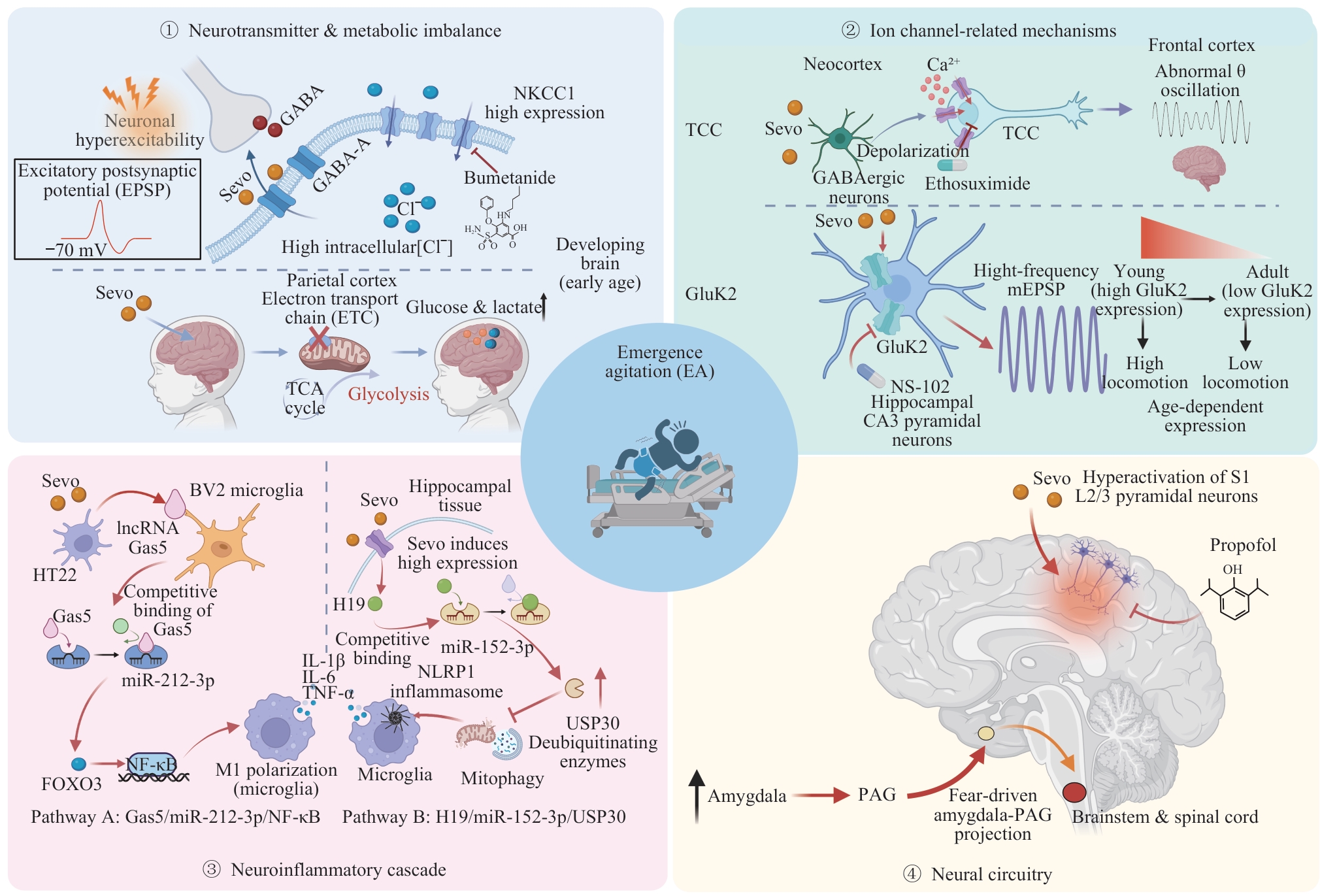
图1 EA发生的可能机制Note: Sevo—sevoflurane; PAG—periaqueductal gray; NKCC1—Na+-K+-2Cl– cotransporter 1; TCC—T-type calcium channel; NF-κB—nuclear factor-κB; GABA—γ-aminobutyric acid; TCA cycle—tricarboxylic acid cycle; GluK2—glutamate receptor ionotropic, kainate 2; FOXO3—forkhead box O3.
Fig 1 Proposed pathophysiological mechanisms of EA
| [1] | Eckenhoff J E, Kneale D H, Dripps R D. The incidence and etiology of postanesthetic excitement. A clinical survey[J]. Anesthesiology, 1961, 22: 667-673. |
| [2] | Wei B, Feng Y, Chen W J, et al. Risk factors for emergence agitation in adults after general anesthesia: a systematic review and meta-analysis[J]. Acta Anaesthesiol Scand, 2021, 65(6): 719-729. |
| [3] | Jen C K, Lu K C, Chen K W, et al. Oral dexmedetomidine achieves superior effects in mitigating emergence agitation and demonstrates comparable sedative effects to oral midazolam for pediatric premedication: a systematic review and meta-analysis of randomized controlled studies[J]. J Clin Med, 2024, 13(4): 1174. |
| [4] | Yang Z J, Ning L, Tan H, et al. Efficacy of transcranial direct current stimulation on emergence agitation in patients undergoing transurethral resection of the prostate: a double-blind, randomized, sham-controlled study[J]. Chin Med J, 2025. DOI: 10.1097/CM9. 0000000000003882. |
| [5] | Haile S, Girma T, Akalu L. Effectiveness of propofol on incidence and severity of emergence agitation on pediatric patients undergo ENT and ophthalmic surgery: prospective cohort study design[J]. Ann Med Surg (Lond), 2021, 69: 102765. |
| [6] | Do W, Kim H S, Kim S H, et al. Sleep quality and emergence delirium in children undergoing strabismus surgery: a comparison between preschool- and school-age patients[J]. BMC Anesthesiol, 2021, 21(1): 290. |
| [7] | Pu Y T, Geng X Y, Wang M S, et al. Effects of preoperative magnesium sulphate infusion on emergence agitation and postoperative quality of recovery in patients undergoing thoracoscopic lobectomy[J]. Drug Des Devel Ther, 2025, 19: 4517-4525. |
| [8] | Jiang P P, Liu W X, Peng Q M, et al. Compare the effects of 0 mg/kg, 0.1 mg/kg, 0.3 mg/kg and 0.5 mg/kg esketamine on emergence agitation after tonsillectomy and adenoidectomy in children: a randomized control trial[J]. Drug Des Devel Ther, 2025, 19: 6543-6552. |
| [9] | Chen J X, Shi X L, Hu W, et al. Comparing different administration methods of subanaesthetic propofol to mitigate emergence agitation in preschool children undergoing day surgery: a double-blind, randomised controlled study[J]. BMJ Paediatr Open, 2025, 9(1): e002376. |
| [10] | Li J J, Jia G L, Wang R X, et al. The impact of intranasal esketamine on emergence agitation in children undergoing adenotonsillectomy: a randomized controlled study[J]. Drug Des Devel Ther, 2025, 19: 10109-10117. |
| [11] | Lu X X, Zhou M Y, Lu Y, et al. The efficacy and safety of remimazolam for the management of emergence agitation: a randomized, double-blind, placebo-controlled study[J]. Front Med, 2025, 12: 1612779. |
| [12] | Cho S A, Ahn S M, Kwon W, et al. Comparison of remimazolam and desflurane in emergence agitation after general anesthesia for nasal surgery: a prospective randomized controlled study[J]. Korean J Anesthesiol, 2024, 77(4): 432-440. |
| [13] | Aniley H T, Mekuria S T, Kebede M A, et al. Magnitude of emergence agitation, its interventions and associated factors among paediatric surgical patients[J]. BMC Anesthesiol, 2024, 24(1): 236. |
| [14] | Wan Y Y, Ye H T, Liu K. Analysis of influencing factors and clinical application of a predictive model for emergence agitation from general anesthesia after abdominal surgery[J]. Am J Transl Res, 2025, 17(3): 1742-1755. |
| [15] | Wang L, Luo X X, Yang M N, et al. Development and validation of a predictive model for emergence agitation after general anesthesia in total knee arthroplasty patients[J]. Medicine, 2025, 104(46): e45401. |
| [16] | Wang N G, Hao J H, Zhang J, et al. Risk factors for emergence agitation during the awakening period in elderly patients after total joint arthroplasty: a retrospective cohort study[J]. BMJ Open, 2023, 13(5): e068284. |
| [17] | Wang W L, Zhang C, Zhou Q, et al. Comparison between butorphanol and nalbuphine for alleviation of catheter-related bladder discomfort and emergence agitation in patients undergoing open spinal surgery: a randomized clinical trial[J]. Ann Med, 2025, 57(1): 2534853. |
| [18] | Kim Y S, Cha J R, Lee Y S, et al. Sugammadex affects emergence agitation in children undergoing strabismus surgery[J]. J Int Med Res, 2018, 46(9): 3861-3872. |
| [19] | Yu H, Sun X H, Li P, et al. Prevalence and risk factors of emergence agitation among pediatric patients undergo ophthalmic and ENT surgery: a cross-sectional study[J]. BMC Pediatr, 2023, 23(1): 598. |
| [20] | Moon S H, Hwang S Y. Risk factors for emergence agitation in the postanesthesia care unit: a propensity score-matched analysis[J]. J Perianesth Nurs, 2026, 41(1): 191-198. |
| [21] | Afandy M E, Abd Elghafar M S, Shoukr T G, et al. Efficacy of ultrasound-guided suprazygomatic maxillary nerve block on emergence agitation and postoperative analgesia after septorhinoplasty: a prospective randomized trial[J]. J Anaesthesiol Clin Pharmacol, 2024, 40(4): 679-685. |
| [22] | Xu Y L, Ding K, Zhao X M, et al. The effects of alfentanil on emergence agitation in children under general anesthesia: a meta-analysis of randomized controlled trials[J]. Front Pediatr, 2025, 13: 1607279. |
| [23] | Farag R S, Spicer A C, Iyer G, et al. Incidence of emergence agitation in children undergoing sevoflurane anesthesia compared to isoflurane anesthesia: an updated systematic review and meta-analysis[J]. Pediatr Anesth, 2024, 34(4): 304-317. |
| [24] | Cai Y H, Zhong J W, Ma H Y, et al. Effect of remimazolam on emergence delirium in children undergoing laparoscopic surgery: a double-blinded randomized trial[J]. Anesthesiology, 2024, 141(3): 500-510. |
| [25] | Somaini M, Engelhardt T, Ingelmo P. Emergence from general anaesthesia: can we discriminate between emergence delirium and postoperative pain?[J]. J Pers Med, 2023, 13(3): 435. |
| [26] | Yan F, Yuan L H, He X, et al. Correlation between pre-anesthesia anxiety and emergence agitation in non-small cell lung cancer surgery patients[J]. World J Psychiatry, 2024, 14(6): 930-937. |
| [27] | Liang Y Y, Huang W J, Hu X Y, et al. Preoperative anxiety in children aged 2–7 years old: a cross-sectional analysis of the associated risk factors[J]. Transl Pediatr, 2021, 10(8): 2024-2034. |
| [28] | Liu W, Sun R Q, Gao X S, et al. Effects of preoperative nasal spray esketamine on separation anxiety and emergence agitation in pediatric strabismus surgery: a randomized clinical trial[J]. Medicine, 2022, 101(51): e32280. |
| [29] | Tosun Söner H, Haznedar B, Söner S, et al. Effect of non-invasive bilateral sphenopalatine ganglion block on postoperative pain in patients undergoing septorhinoplasty surgery: a randomized controlled study[J]. Minerva Anestesiol, 2024, 90(11): 989-996. |
| [30] | Si S K, Zhao X H, Mu Y J, et al. The effect of transcutaneous electrical acupoint stimulation on postoperative awakening after general anaesthesia: a systematic review and meta-analysis[J]. Front Med, 2024, 11: 1347641. |
| [31] | Kucukosman S S, Akdogan A, Uzlu D, et al. Retrospective evaluation of the effects of different anesthesia methods on emergence agitation in patients undergoing vitreoretinal surgery[J]. Cir Cir, 2025. DOI: 10.24875/CIRU.23000484. |
| [32] | Wang Y T, Liu C C, Wang P, et al. Effect of dexmedetomidine combined with remifentanil on emergence agitation during awakening from sevoflurane anesthesia for pediatric liver surgery[J]. Ann Transplant, 2024, 29: e943281. |
| [33] | Jung J Y, You H J, Kwon W, et al. Comparison of emergence agitation between sevoflurane and desflurane in elderly orthopedic patients: a retrospective cohort study[J]. Minerva Anestesiol, 2026, 92(5): 399-408. |
| [34] | Zhang R, Huang T, Fan P T, et al. Efficacy of light-transmitting eye shields for wound dressing in preventing pediatric emergence agitation following bilateral strabismus surgeries: a randomized clinical trial[J]. Korean J Anesthesiol, 2025, 78(4): 331-340. |
| [35] | Han W D, Cai J J, Zhang W P, et al. Effects of prophylactic nalbuphine on emergence agitation and postoperative pain in pediatric patients undergoing ENT surgery with sevoflurane anesthesia[J]. Front Pediatr, 2024, 12: 1353027. |
| [36] | Lu Y F, Xu Q M, Dai H, et al. Remimazolam for the prevention of emergence agitation in adults following nasal surgery under general anesthesia: a prospective randomized clinical controlled trial[J]. BMC Anesthesiol, 2025, 25(1): 8. |
| [37] | Chen X, Zhao W, Yu B B, et al. Comparison of remimazolam and dexmedetomidine on postoperative delirium and emergence agitation in elderly patients undergoing thoracoscopic surgery: a randomized, double-blind, non-inferiority trial[J]. Drug Des Devel Ther, 2025, 19: 9671-9681. |
| [38] | Li Y B, Yang H L, Liu L, et al. From neurotoxicity to neuroprotection: rethinking GABAAR-targeting anesthetics[J]. Cell Biol Toxicol, 2025, 41(1): 104. |
| [39] | Lim B G, Shen F Y, Kim Y B, et al. Possible role of GABAergic depolarization in neocortical neurons in generating hyperexcitatory behaviors during emergence from sevoflurane anesthesia in the rat[J]. ASN Neuro, 2014, 6(2): e00141. |
| [40] | Jacob Z, Li H F, Makaryus R, et al. Metabolomic profiling of children´s brains undergoing general anesthesia with sevoflurane and propofol[J]. Anesthesiology, 2012, 117(5): 1062-1071. |
| [41] | Mi X N, Hong J S, Li Z Q, et al. Identification of serum biomarkers associated with emergence agitation after general anesthesia in adult patients: a metabolomics analysis[J]. Front Med, 2022, 9: 828867. |
| [42] | Shen F Y, Lim B G, Wen W, et al. Role of T-type calcium channels in generating hyperexcitatory behaviors during emergence from sevoflurane anesthesia in neonatal rats[J]. Neurosci Bull, 2020, 36(5): 519-529. |
| [43] | Liang P, Li F, Liu J, et al. Sevoflurane activates hippocampal CA3 kainate receptors (GluK2) to induce hyperactivity during induction and recovery in a mouse model[J]. Br J Anaesth, 2017, 119(5): 1047-1054. |
| [44] | Xu L L, Xie J Q, Shen J J, et al. Neuron-derived exosomes mediate sevoflurane-induced neurotoxicity in neonatal mice via transferring lncRNA Gas5 and promoting M1 polarization of microglia[J]. Acta Pharmacol Sin, 2024, 45(2): 298-311. |
| [45] | Gao T T, Huang Z Q. Novel insights into sevoflurane-induced developmental neurotoxicity mechanisms[J]. Epigenomics, 2024, 16(18): 1231-1252. |
| [46] | McLott J, Jurecic J, Hemphill L, et al. Development of an amygdalocentric neurocircuitry-reactive aggression theoretical model of emergence delirium in posttraumatic stress disorder: an integrative literature review[J]. AANA J, 2013, 81(5): 379-384. |
| [47] | Yang L, Ton H, Zhao R H, et al. Sevoflurane induces neuronal activation and behavioral hyperactivity in young mice[J]. Sci Rep, 2020, 10(1): 11226. |
| [48] | İlyas Y, Beşïr A, Karademir E, et al. Emergence agitation in open rhinoplasty operations: neutrophil/lymphocyte and platelet/lymphocyte ratio as a predictive marker[J]. Cir Cir, 2025, 93(5): 556-562. |
| [49] | Wang Q, Zhou J S, Liu T T, et al. Predictive value of preoperative profiling of serum metabolites for emergence agitation after general anesthesia in adult patients[J]. Front Mol Biosci, 2021, 8: 739227. |
| [50] | Li Y Y, Li J J, Shi Y H, et al. Urinary aromatic amino acid metabolites associated with postoperative emergence agitation in paediatric patients after general anaesthesia: urine metabolomics study[J]. Front Pharmacol, 2022, 13: 932776. |
| [51] | Dragovic S, Schneider G, García P S, et al. Predictors of low risk for delirium during anesthesia emergence[J]. Anesthesiology, 2023, 139(6): 757-768. |
| [52] | Li L, Meng Q H, Tian A P, et al. Correlation analysis between real-time cerebral state parameters and emergence agitation in children undergoing decayed tooth surgery under general anaesthesia: exploring dental-related influencing factors[J]. Int J Gen Med, 2025, 18: 7049-7057. |
| [53] | Song Y. Age-specific electroencephalography dynamics during anesthesia: monitoring and neurocognitive implications[J]. Anesth Pain Med, 2025, 20(4): 289-300. |
| [54] | Lao H C, Huang C W, Wang S H, et al. Dexmedetomidine mitigates sevoflurane-induced neurodevelopmental effects in paediatric anaesthesia: a meta-analysis and preclinical study[J]. J Neuroimmune Pharmacol, 2026, 21(1): 5. |
| [55] | Kim Y S, Chae Y K, Choi Y S, et al. A comparative study of emergence agitation between sevoflurane and propofol anesthesia in adults after closed reduction of nasal bone fracture[J]. Korean J Anesthesiol, 2012, 63(1): 48-53. |
| [56] | Vincent J L. Harmful effects of propofol? The editor's standpoint[J]. Crit Care, 2023, 27(1): 279. |
| [57] | Duan J J, Ju X, Wang X, et al. Effects of remimazolam and propofol on emergence agitation in elderly patients undergoing hip replacement: a clinical, randomized, controlled study[J]. Drug Des Devel Ther, 2023, 17: 2669-2678. |
| [58] | Abdelaziz T S A, Mohammed Elsayed H E, Kamal Eldin D M, et al. The effect of intramuscular dexmedetomidine versus oral gabapentin premedication on the emergence agitation after rhinoplasty: a prospective, randomized, double-blind controlled trial[J]. BMC Anesthesiol, 2025, 25(1): 50. |
| [59] | Khajavi M R, Saffarian A, Majidi F, et al. Prophylactic administration of diphenhydramine/paracetamol reduced emergence agitation and postoperative pain following maxillofacial surgeries: a randomized controlled trial[J]. Eur Arch Otorhinolaryngol, 2022, 279(3): 1467-1471. |
| [60] | Zhang D N, Jia X T, Lin D M, et al. Melatonin or its analogs as premedication to prevent emergence agitation in children: a systematic review and meta-analysis[J]. BMC Anesthesiol, 2023, 23(1): 392. |
| [61] | Tan F, Lu W S, Li S S, et al. Discharge under sedated status can decrease postoperative emergence agitation in pediatric patients undergoing strabismus surgery: a prospective randomized controlled trial[J]. J Perianesth Nurs, 2024, 39(6): 985-989. |
| [62] | Wang Z Y, Wang X H, Yang Y, et al. The effect of repeated maternal voice orientation on postoperative emergence agitation in children following tonsillectomy and adenoidectomy: a randomized controlled trial[J]. J Clin Anesth, 2025, 104: 111851. |
| [63] | Lee S, Sohn J Y, Hwang I E, et al. Effect of a repeated verbal reminder of orientation on emergence agitation after general anaesthesia for minimally invasive abdominal surgery: a randomised controlled trial[J]. Br J Anaesth, 2023, 130(4): 439-445. |
| [64] | Mo X F, Zeng J Q, Wu X Y, et al. Sucking lollipop after awakening from sevoflurane anesthesia reduces the degree of emergence agitation in children undergoing ambulatory surgery: a prospective randomized controlled trial[J]. Medicine, 2023, 102(44): e35651. |
| [65] | Liang H H, Lu Y W, Ou X X, et al. Effect of ice popsicle treatment on emergence agitation in children undergoing oral surgery with sevoflurane anaesthesia: a prospective randomized controlled study[J]. J Pediatr Nurs, 2023, 72: 9-15. |
| [1] | 卢悦, 颜伟康, 刘颖斌, 何勇宁. 靶向VEGFA结合蛋白的设计与功能表征[J]. 上海交通大学学报(医学版), 2026, 46(9): 1212-1221. |
| [2] | 石彦, 卢长川, 李政焰. 基于临床研究的机器人胃癌手术发展现况与展望[J]. 上海交通大学学报(医学版), 2026, 46(8): 1007-1014. |
| [3] | 吴康卉, 吴烁, 罗成, 张元元, 李光明. KDM4B在结直肠癌中调控抗肿瘤免疫的机制研究[J]. 上海交通大学学报(医学版), 2026, 46(8): 1053-1066. |
| [4] | 王涛, 赵梦晴, 屈春瑾, 王琳. 中青年胃肠道癌症化学治疗患者抗逆力的潜在剖面及相关因素分析[J]. 上海交通大学学报(医学版), 2026, 46(8): 1134-1142. |
| [5] | 安益冉, 冯宝怡, 孙怡琳, 吴皓, 陶永. 不同血清型腺相关病毒经枕大池注射转染小鼠内毛细胞的比较[J]. 上海交通大学学报(医学版), 2026, 46(7): 896-905. |
| [6] | 沈雨潇, 李晓光, 巴乾. SHP2抑制类药物的开发及在肿瘤治疗中的应用研究进展[J]. 上海交通大学学报(医学版), 2026, 46(6): 713-720. |
| [7] | 李梦如, 王海强. 白细胞介素调控网络在炎症性肠病中的作用机制综述[J]. 上海交通大学学报(医学版), 2026, 46(6): 801-809. |
| [8] | 陈云生, 邓丹, 原博, 刘琰. 《儿童瘢痕预防与治疗临床实践指南(2025版)》解读[J]. 上海交通大学学报(医学版), 2026, 46(5): 561-567. |
| [9] | 刘亚东, 董金伟, 王子慧, 吕泽坤, 丁宝志, 马辉. 硫氧还蛋白相互作用蛋白:椎间盘退变的潜在新治疗靶点[J]. 上海交通大学学报(医学版), 2026, 46(5): 568-575. |
| [10] | 陈毓涵, 艾志宏. 子宫内膜癌的免疫微环境及免疫治疗研究进展[J]. 上海交通大学学报(医学版), 2026, 46(5): 656-664. |
| [11] | 刘莉, 范海霞, 耿海霞. 颞下颌关节紊乱病多学科联合诊治的临床研究进展[J]. 上海交通大学学报(医学版), 2026, 46(4): 529-536. |
| [12] | 周欣雨, 仇剑崟. 神经生物学与计算机科学融合视角下的共情研究进展[J]. 上海交通大学学报(医学版), 2026, 46(4): 545-554. |
| [13] | 钱亦乐, 姚赛, 陈思锋, 李全富, 赵猛. 巨噬细胞介导心肌纤维化的分子机制及靶向干预研究进展[J]. 上海交通大学学报(医学版), 2026, 46(3): 348-357. |
| [14] | 徐蕊, 郭嘉城, 谢诗瑶, 韩德恒, 岳修勤. 纳米材料应用于心脏纤维化修复的研究进展:从精准治疗到组织重塑[J]. 上海交通大学学报(医学版), 2026, 46(3): 377-384. |
| [15] | 张叶婷, 郑雨轩, 陶鹏杰, 周文琴, 吕东潮. 环状RNA应用于心肌损伤治疗的新进展[J]. 上海交通大学学报(医学版), 2026, 46(3): 391-399. |
| 阅读次数 | ||||||
|
全文 |
|
|||||
|
摘要 |
|
|||||
