
上海交通大学学报(医学版) ›› 2025, Vol. 45 ›› Issue (12): 1694-1700.doi: 10.3969/j.issn.1674-8115.2025.12.016
• 综述 • 上一篇
薄一鸣, 崔庆桓, 李立亮( )
)
收稿日期:2025-07-29
接受日期:2025-10-13
出版日期:2025-12-28
发布日期:2025-12-28
通讯作者:
李立亮,副教授,博士;电子信箱:liliang_li@fudan.edu.cn。
BO Yiming, CUI Qinghuan, LI Liliang()
Received:2025-07-29
Accepted:2025-10-13
Online:2025-12-28
Published:2025-12-28
Contact:
LI Liliang, E-mail: liliang_li@fudan.edu.cn.摘要:
药物的心脏毒性作为全球公共卫生的重要挑战,已造成显著的医疗资源与经济损失。近年研究发现,1型大麻素受体(cannabinoid type 1 receptor,CB1R)在多种药物诱导的心脏损伤中发挥重要作用。该文系统梳理了CB1R的分子特征及其在心血管生理与病理生理中的双重角色,并重点探讨其在抗精神病药、抗肿瘤药物、大麻及合成大麻素心脏毒性中的分子机制。CB1R作为内源性大麻素系统的关键组分,广泛分布于心肌细胞、内皮细胞及免疫细胞中,在正常生理条件下对心率、血压以及心血管收缩活动等发挥稳态调控的功能,并可通过调控离子通道活性、炎症因子释放以及氧化/硝化应激参与心脏电生理紊乱、炎症反应和心肌纤维化等病理过程,同时也参与了药物心脏毒性的发生机制。CB1R是多种药物心脏毒性中的共性通路,可能成为防治药物心脏毒性的重要靶点。未来研究需进一步解析CB1R在不同病理条件下的调节机制,并探索靶向CB1R的精准干预手段,以平衡药物治疗获益与心血管风险。
中图分类号:
薄一鸣, 崔庆桓, 李立亮. 1型大麻素受体在药物心脏毒性中作用的研究进展[J]. 上海交通大学学报(医学版), 2025, 45(12): 1694-1700.
BO Yiming, CUI Qinghuan, LI Liliang. Advances in effects of cannabinoid receptor type 1 on drug-induced cardiotoxicity[J]. Journal of Shanghai Jiao Tong University (Medical Science), 2025, 45(12): 1694-1700.
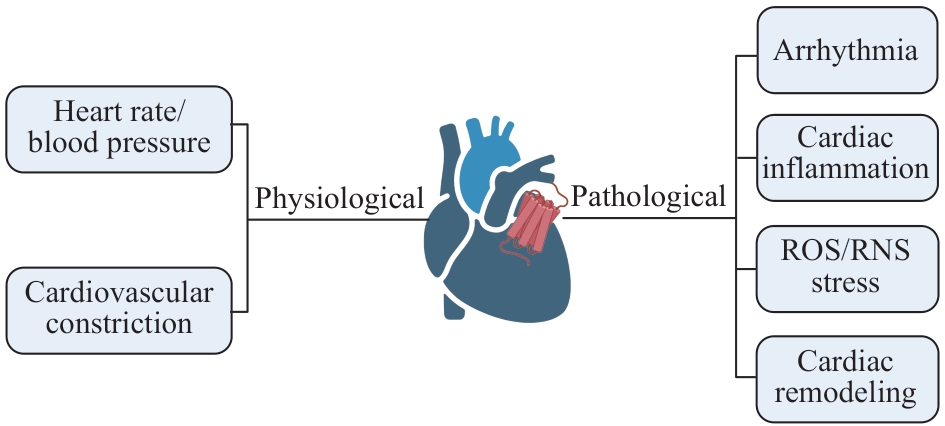
图1 CB1R在心脏生理及病理中的作用
Fig 1 Effects of CB1R on cardiac physiology and pathology
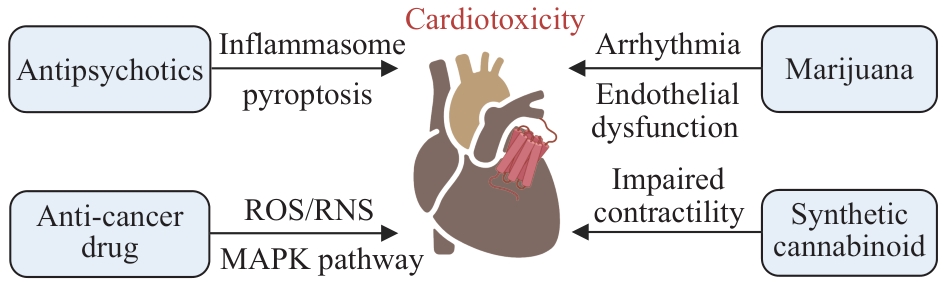
图2 CB1R在药物心脏毒性中的作用
Fig 2 Effects of CB1R on drug-induced cardiotoxicity
| [1] | KUNDNANI N R, PASSINI V, STEFANIA CARLOGEA I, et al. Overview of oncology: drug-induced cardiac toxicity[J]. Medicina (Kaunas), 2025, 61(4): 709. |
| [2] | MAMOSHINA P, RODRIGUEZ B, BUENO-OROVIO A. Toward a broader view of mechanisms of drug cardiotoxicity[J]. Cell Rep Med, 2021, 2(3): 100216. |
| [3] | HOWELL S, YAROVOVA E, KHWANDA A, et al. Cardiovascular effects of psychotic illnesses and antipsychotic therapy[J]. Heart, 2019, 105(24): 1852-1859. |
| [4] | LI X Q, TANG X R, LI L L. Antipsychotics cardiotoxicity: what's known and what's next[J]. World J Psychiatry, 2021, 11(10): 736-753. |
| [5] | DEMPKE W C M, ZIELINSKI R, WINKLER C, et al. Anthracycline-induced cardiotoxicity: are we about to clear this hurdle?[J]. Eur J Cancer, 2023, 185: 94-104. |
| [6] | NIELSEN R E, BANNER J, JENSEN S E. Cardiovascular disease in patients with severe mental illness[J]. Nat Rev Cardiol, 2021, 18(2): 136-145. |
| [7] | COPPOLA C, RIENZO A, PISCOPO G, et al. Management of QT prolongation induced by anti-cancer drugs: target therapy and old agents. Different algorithms for different drugs[J]. Cancer Treat Rev, 2018, 63: 135-143. |
| [8] | HERRMANN J. Adverse cardiac effects of cancer therapies: cardiotoxicity and arrhythmia[J]. Nat Rev Cardiol, 2020, 17(8): 474-502. |
| [9] | CROCQ M A. History of cannabis and the endocannabinoid system[J]. Dialogues Clin Neurosci, 2020, 22(3): 223-228. |
| [10] | AN D C, PEIGNEUR S, HENDRICKX L A, et al. Targeting cannabinoid receptors: current status and prospects of natural products[J]. Int J Mol Sci, 2020, 21(14): 5064. |
| [11] | WEI F M, ZHAO L, JING Y H. Signaling molecules targeting cannabinoid receptors: hemopressin and related peptides[J]. Neuropeptides, 2020, 79: 101998. |
| [12] | REN S Y, WANG Z Z, ZHANG Y, et al. Potential application of endocannabinoid system agents in neuropsychiatric and neurodegenerative diseases-focusing on FAAH/MAGL inhibitors[J]. Acta Pharmacol Sin, 2020, 41(10): 1263-1271. |
| [13] | HOWLETT A C, ABOOD M E. CB1 and CB2 receptor pharmacology[J]. Adv Pharmacol, 2017, 80: 169-206. |
| [14] | TIAN N, YANG C, DU Y, et al. Cannabinoid receptor 2 selective agonist ameliorates adjuvant-induced arthritis by modulating the balance between Treg and Th17 cells[J]. Front Pharmacol, 2025, 16: 1532518. |
| [15] | YE L Y, CAO Z, WANG W W, et al. New insights in cannabinoid receptor structure and signaling[J]. Curr Mol Pharmacol, 2019, 12(3): 239-248. |
| [16] | NIEDERHOFFER N, SCHMID K, SZABO B. The peripheral sympathetic nervous system is the major target of cannabinoids in eliciting cardiovascular depression[J]. Naunyn Schmiedebergs Arch Pharmacol, 2003, 367(5): 434-443. |
| [17] | IBRAHIM B M, ABDEL-RAHMAN A A. Role of brainstem GABAergic signaling in central cannabinoid receptor evoked sympathoexcitation and pressor responses in conscious rats[J]. Brain Res, 2011, 1414: 1-9. |
| [18] | YAO F R, ABDEL-RAHMAN A A. Estrogen dampens central cannabinoid receptor 1-mediated neuroexcitation and pressor response in conscious female rats[J]. Biochem Pharmacol, 2022, 201: 115102. |
| [19] | LAGATTA D C, FASSINI A, TERZIAN A L, et al. The medial prefrontal cortex and the cardiac baroreflex activity: physiological and pathological implications[J]. Pflugers Arch, 2023, 475(3): 291-307. |
| [20] | PACHER P, NAGAYAMA T, MUKHOPADHYAY P, et al. Measurement of cardiac function using pressure-volume conductance catheter technique in mice and rats[J]. Nat Protoc, 2008, 3(9): 1422-1434. |
| [21] | AL KURY L T, VOITYCHUK O I, YANG K S, et al. Effects of the endogenous cannabinoid anandamide on voltage-dependent sodium and calcium channels in rat ventricular myocytes[J]. Br J Pharmacol, 2014, 171(14): 3485-3498. |
| [22] | WANG L N, XING M D, QU W T, et al. Impaired vessel relaxation response and increased infarct size in smooth muscle cannabinoid receptor 1 knockout mice[J]. Microvasc Res, 2022, 139: 104263. |
| [23] | SCHAICH C L, SHALTOUT H A, BROSNIHAN K B, et al. Acute and chronic systemic CB1 cannabinoid receptor blockade improves blood pressure regulation and metabolic profile in hypertensive (mRen2)27 rats[J]. Physiol Rep, 2014, 2(8): e12108. |
| [24] | BLADEN C, MIRLOHI S, SANTIAGO M, et al. Modulation of human T-type calcium channels by synthetic cannabinoid receptor agonists in vitro[J]. Neuropharmacology, 2021, 187: 108478. |
| [25] | WERESA J, PĘDZIŃSKA-BETIUK A, MIŃCZUK K, et al. Why do marijuana and synthetic cannabimimetics induce acute myocardial infarction in healthy young people?[J]. Cells, 2022, 11(7): 1142. |
| [26] | RICHARDS J R. Mechanisms for the risk of acute coronary syndrome and arrhythmia associated with phytogenic and synthetic cannabinoid use[J]. J Cardiovasc Pharmacol Ther, 2020, 25(6): 508-522. |
| [27] | MAGGO S, ASHTON J C. Effect of cannabinoid receptor agonists on isolated rat atria[J]. J Cardiovasc Pharmacol, 2018, 72(4): 191-194. |
| [28] | DOL-GLEIZES F, PAUMELLE R, VISENTIN V, et al. Rimonabant, a selective cannabinoid CB1 receptor antagonist, inhibits atherosclerosis in LDL receptor-deficient mice[J]. Arterioscler Thromb Vasc Biol, 2009, 29(1): 12-18. |
| [29] | RAJESH M, BÁTKAI S, KECHRID M, et al. Cannabinoid 1 receptor promotes cardiac dysfunction, oxidative stress, inflammation, and fibrosis in diabetic cardiomyopathy[J]. Diabetes, 2012, 61(3): 716-727. |
| [30] | HOHMANN A G, SUPLITA R L, BOLTON N M, et al. An endocannabinoid mechanism for stress-induced analgesia[J]. Nature, 2005, 435(7045): 1108-1112. |
| [31] | WANG F L, YUAN Q H, CHEN F Y, et al. Fundamental mechanisms of the cell death caused by nitrosative stress[J]. Front Cell Dev Biol, 2021, 9: 742483. |
| [32] | MUKHOPADHYAY P, RAJESH M, BÁTKAI S, et al. CB1 cannabinoid receptors promote oxidative stress and cell death in murine models of doxorubicin-induced cardiomyopathy and in human cardiomyocytes[J]. Cardiovasc Res, 2010, 85(4): 773-784. |
| [33] | LI L L, GAO P, TANG X R, et al. CB1R-stabilized NLRP3 inflammasome drives antipsychotics cardiotoxicity[J]. Signal Transduct Target Ther, 2022, 7(1): 190. |
| [34] | SLAVIC S, LAUER D, SOMMERFELD M, et al. Cannabinoid receptor 1 inhibition improves cardiac function and remodelling after myocardial infarction and in experimental metabolic syndrome[J]. J Mol Med (Berl), 2013, 91(7): 811-823. |
| [35] | WAGNER J A, HU K, KARCHER J, et al. CB1 cannabinoid receptor antagonism promotes remodeling and cannabinoid treatment prevents endothelial dysfunction and hypotension in rats with myocardial infarction[J]. Br J Pharmacol, 2003, 138(7): 1251-1258. |
| [36] | LU Y, AKINWUMI B C, SHAO Z J, et al. Ligand activation of cannabinoid receptors attenuates hypertrophy of neonatal rat cardiomyocytes[J]. J Cardiovasc Pharmacol, 2014, 64(5): 420-430. |
| [37] | RAY W A, CHUNG C P, MURRAY K T, et al. Atypical antipsychotic drugs and the risk of sudden cardiac death[J]. N Engl J Med, 2009, 360(3): 225-235. |
| [38] | SUN D M, LI L L, ZHANG X, et al. Causes of sudden unexpected death in schizophrenia patients: a forensic autopsy population study[J]. Am J Forensic Med Pathol, 2019, 40(4): 312-317. |
| [39] | HE L Y, YU Y M, WEI Y M, et al. Characteristics and spectrum of cardiotoxicity induced by various antipsychotics: a real-world study from 2015 to 2020 based on FAERS[J]. Front Pharmacol, 2022, 12: 815151. |
| [40] | ARZUK E, KARAKUŞ F, ORHAN H. Bioactivation of clozapine by mitochondria of the murine heart: possible cause of cardiotoxicity[J]. Toxicology, 2021, 447: 152628. |
| [41] | PATEL J J, LISI P A, LATHARA Z, et al. Clozapine-induced peripheral and pleural fluid eosinophilia[J]. Ann Pharmacother, 2012, 46(2): e4. |
| [42] | WANG J F, MIN J Y, HAMPTON T G, et al. Clozapine-induced myocarditis: role of catecholamines in a murine model[J]. Eur J Pharmacol, 2008, 592(1/2/3): 123-127. |
| [43] | LI L L, DONG X R, TU C Y, et al. Opposite effects of cannabinoid CB1 and CB2 receptors on antipsychotic clozapine-induced cardiotoxicity[J]. Br J Pharmacol, 2019, 176(7): 890-905. |
| [44] | LI X Q, PENG Z, ZHOU Y L, et al. Quetiapine induces myocardial necroptotic cell death through bidirectional regulation of cannabinoid receptors[J]. Toxicol Lett, 2019, 313: 77-90. |
| [45] | IJAZ S, BOLEA B, DAVIES S, et al. Antipsychotic polypharmacy and metabolic syndrome in schizophrenia: a review of systematic reviews[J]. BMC Psychiatry, 2018, 18(1): 275. |
| [46] | RAWAT P S, JAISWAL A, KHURANA A, et al. Doxorubicin-induced cardiotoxicity: an update on the molecular mechanism and novel therapeutic strategies for effective management[J]. Biomed Pharmacother, 2021, 139: 111708. |
| [47] | ZHANG S, LIU X B, BAWA-KHALFE T, et al. Identification of the molecular basis of doxorubicin-induced cardiotoxicity[J]. Nat Med, 2012, 18(11): 1639-1642. |
| [48] | MUKHOPADHYAY P, BÁTKAI S, RAJESH M, et al. Pharmacological inhibition of CB1 cannabinoid receptor protects against doxorubicin-induced cardiotoxicity[J]. Am Coll Cardiol, 2007, 50(6): 528-536. |
| [49] | MUKHOPADHYAY P, HORVÁTH B, RAJESH M, et al. Fatty acid amide hydrolase is a key regulator of endocannabinoid-induced myocardial tissue injury[J]. Free Radic Biol Med, 2011, 50(1): 179-195. |
| [50] | HALL W. What has research over the past two decades revealed about the adverse health effects of recreational cannabis use?[J]. Addiction, 2015, 110(1): 19-35. |
| [51] | HOCH E, VOLKOW N D, FRIEMEL C M, et al. Cannabis, cannabinoids and health: a review of evidence on risks and medical benefits[J]. Eur Arch Psychiatry Clin Neurosci, 2025, 275(2): 281-292. |
| [52] | COTIER P, MAYER C, ETTING I, et al. Evaluation of the cardiovascular risk induced by cannabis use from a series of 43 autopsy cases[J]. Int J Legal Med, 2023, 137(6): 1725-1733. |
| [53] | GORELICK D A, HEISHMAN S J, PRESTON K L, et al. The cannabinoid CB1 receptor antagonist rimonabant attenuates the hypotensive effect of smoked marijuana in male smokers[J]. Am Heart J, 2006, 151(3): 754.e1-754.e5. |
| [54] | CHANDY M, NISHIGA M, WEI T T, et al. Adverse impact of cannabis on human health[J]. Annu Rev Med, 2024, 75: 353-367. |
| [55] | WEI T T, CHANDY M, NISHIGA M, et al. Cannabinoid receptor 1 antagonist genistein attenuates marijuana-induced vascular inflammation[J]. Cell, 2022, 185(10): 1676-1693.e23. |
| [56] | SHETE V, MAHAJAN N M, SHIVHARE R, et al. Genistein: a promising phytoconstituent with reference to its bioactivities[J]. Phytother Res, 2024, 38(8): 3935-3953. |
| [57] | FENG X J, XU S W, WENG J P. Marijuana and endothelial dysfunction: new mechanism and therapy[J]. Trends Mol Med, 2022, 28(8): 613-615. |
| [58] | OLIVEIRA N M C, MACHADO D A, DA SILVA T L, et al. Treatment with cannabidiol results in an antioxidant and cardioprotective effect in several pathophysiologies[J]. Curr Hypertens Rev, 2022, 18(2): 125-129. |
| [59] | GIOÉ-GALLO C, ORTIGUEIRA S, BREA J, et al. Pharmacological insights emerging from the characterization of a large collection of synthetic cannabinoid receptor agonists designer drugs[J]. Biomed Pharmacother, 2023, 164: 114934. |
| [60] | MASLOV L N, LASUKOVA O V, KRYLATOV A V, et al. Selective cannabinoid receptor agonist HU-210 decreases pump function of isolated perfused heart: role of cAMP and cGMP[J]. Bull Exp Biol Med, 2004, 138(6): 550-553. |
| [1] | 马秀珍, 周妮, 郭思琪, 王源媛, 麦平. 大麻素受体1通过Gαi/o/RhoA信号通路促进急性肺损伤小鼠巨噬细胞M1极化[J]. 上海交通大学学报(医学版), 2025, 45(2): 161-168. |
| [2] | 边姝, 于倩, 张钰婷, 李玎嘉, 张乔婷, 刘亮明. 羧酸酯酶1f基因活体肝转染对急性肝衰竭影响的研究[J]. 上海交通大学学报(医学版), 2025, 45(11): 1480-1489. |
| [3] | 边姝, 于倩, 刘亮明. 内源性大麻素系统在肝脏病中作用的研究进展[J]. 上海交通大学学报(医学版), 2024, 44(10): 1299-1306. |
| [4] | 梅艳青, 韩雨洁, 翁文筠, 张蕾, 唐玉杰. 靶向抑制CDK12/13在高级别胶质瘤中的体外治疗效果和作用分子机制探究[J]. 上海交通大学学报(医学版), 2023, 43(5): 545-559. |
| [5] | 轩红艳, 王丽华, 李华芳. 精神分裂症患者骨代谢影响因素的研究进展[J]. 上海交通大学学报(医学版), 2021, 41(7): 972-976. |
| [6] | 李睿, 曾端, 和申, 沈一峰, 李华芳. HRAS基因单核苷酸多态性与精神分裂症及非典型抗精神病药物疗效的关联研究[J]. 上海交通大学学报(医学版), 2021, 41(12): 1613-1617. |
| [7] | 周绍宇1,冯振晓1,姚晓萍2,王 万1,赵 静3#,易正辉4#. 典型与非典型抗精神病药对精神分裂症患者认知症状的影响[J]. 上海交通大学学报(医学版), 2020, 40(8): 1075-1080. |
| [8] | 王丹丹,汪也微,方新宇,陈 艳,余玲芳,张 晨. 托吡酯改善非典型抗精神病药所致体质量增加的meta分析[J]. 上海交通大学学报(医学版), 2020, 40(2): 200-. |
| [9] | 项思莹,李宁宁,徐一峰#,陈剑华#. 抗精神病药物诱发代谢综合征的DNA甲基化研究进展[J]. 上海交通大学学报(医学版), 2020, 40(12): 1656-1659. |
| [10] | 王颖婵,王继军. 抗精神病药对精神分裂症患者静息态脑功能影响的研究进展[J]. 上海交通大学学报(医学版), 2020, 40(11): 1515-1518. |
| [11] | 任延燕,王振. 强迫症增效治疗机制的研究进展[J]. 上海交通大学学报(医学版), 2019, 39(8): 919-. |
| [12] | 王丹丹,张晨. 精神分裂症患者认知功能的神经免疫机制及非典型抗精神病 药物对其影响的研究进展[J]. 上海交通大学学报(医学版), 2019, 39(7): 795-. |
| [13] | 姚亚民,方贻儒. 氯胺酮及内源性大麻素系统在快速抗抑郁中的作用研究进展[J]. 上海交通大学学报(医学版), 2019, 39(4): 428-. |
| [14] | 邓頔,赵敏. 肠道微生物与物质依赖关系的研究进展[J]. 上海交通大学学报(医学版), 2019, 39(3): 322-. |
| [15] | 陈艳,张晨. Pi3k/Akt信号通路与非典型抗精神病药物作用机制的研究进展[J]. 上海交通大学学报(医学版), 2018, 38(8): 948-. |
| 阅读次数 | ||||||
|
全文 |
|
|||||
|
摘要 |
|
|||||
