
上海交通大学学报(医学版) ›› 2026, Vol. 46 ›› Issue (11): 1455-1466.doi: 10.3969/j.issn.1674-8115.2026.11.001
• 创新团队成果专栏 • 下一篇
曹思瑶1, 张听雨2, 张小妍1, 唐艺嘉3, 马晨欢1, 刘洁琼1,2,4( ), 王广海1,2,4()
收稿日期:2026-02-27
接受日期:2026-05-25
出版日期:2026-11-28
发布日期:2026-11-27
通讯作者:
王广海,研究员,博士;电子信箱:wang-guanghai@163.com基金资助:
Cao Siyao1, Zhang Tingyu2, Zhang Xiaoyan1, Tang Yijia3, Ma Chenhuan1, Liu Jieqiong1,2,4(), Wang Guanghai1,2,4()
Received:2026-02-27
Accepted:2026-05-25
Online:2026-11-28
Published:2026-11-27
Contact:
Wang Guanghai, E-mail: wang-guanghai@163.comSupported by:摘要:
目的·利用机器学习模型,考察融合睡眠紊乱与情绪面孔加工神经活动的多模态特征对儿童孤独症谱系障碍(autism spectrum disorder,ASD)预测的准确性和稳定性,为儿童ASD的综合评估和跨诊断干预提供参考。方法·纳入性别、年龄匹配的3~7岁ASD儿童60名和健康对照儿童56名。采用儿童睡眠习惯问卷(Children′s Sleep Habits Questionnaire,CSHQ)、睡眠活动记录仪评估儿童睡眠状况;结合孤独症诊断观察量表第二版(Autism Diagnostic Observation Schedule.Second Edition,ADOS-2)等综合评估并明确ASD诊断;使用功能性近红外光谱成像(functional near-infrared spectroscopy,fNIRS)技术测量儿童在情绪面孔识别任务中的前额叶血氧活动。基于LASSO逻辑回归模型、支持向量机(support vector machine,SVM)以及核Fisher判别分析(kernel Fisher discriminant analysis,KFDA),构建并筛选最优预测模型。结果·ASD组客观夜间睡眠时间更短,并在愤怒面孔、快乐面孔条件下,额中回通道(CH1)呈现显著负激活(CH1angry:t=-3.02,FDR P=0.044,Cohen′s d=0.56;CH1happy:t=-2.94,FDR P=0.047,Cohen′s d=0.55)。采用不同特征组合训练3种机器学习模型,结果显示CH1angry、CH4angry、CH8angry、CH10angry的KFDA模型表现最佳,其受试者工作特征曲线下面积(area under the receiver operating characteristic curve,AUC)为0.67,准确率为0.59,灵敏度为0.33,特异度为0.88。进一步融合组间存在显著差异的7项睡眠与神经活动特征(异态睡眠、客观夜间睡眠时间、愤怒及快乐面孔识别时的脑激活值等)进行模型比较,显示KFDA模型性能最优且较前有所提升,其AUC为0.76,准确率为0.68,灵敏度为0.62,特异度为0.73。结论·融合主客观睡眠与情绪面孔识别神经活动特征对ASD诊断具有一定预测价值。
中图分类号:
曹思瑶, 张听雨, 张小妍, 唐艺嘉, 马晨欢, 刘洁琼, 王广海. 融合睡眠与情绪面孔识别神经活动特征的儿童孤独症预测模型构建[J]. 上海交通大学学报(医学版), 2026, 46(11): 1455-1466.
Cao Siyao, Zhang Tingyu, Zhang Xiaoyan, Tang Yijia, Ma Chenhuan, Liu Jieqiong, Wang Guanghai. Development of a predictive model for childhood autism based on the integration of sleep features and neural activity features during facial emotion recognition[J]. Journal of Shanghai Jiao Tong University (Medical Science), 2026,(11): 1455-1466.
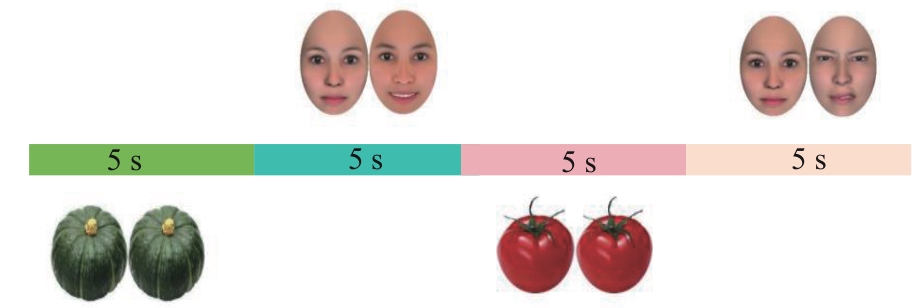
图1 情绪面孔识别任务流程
Fig 1 Flowchart of the facial emotion recognition task
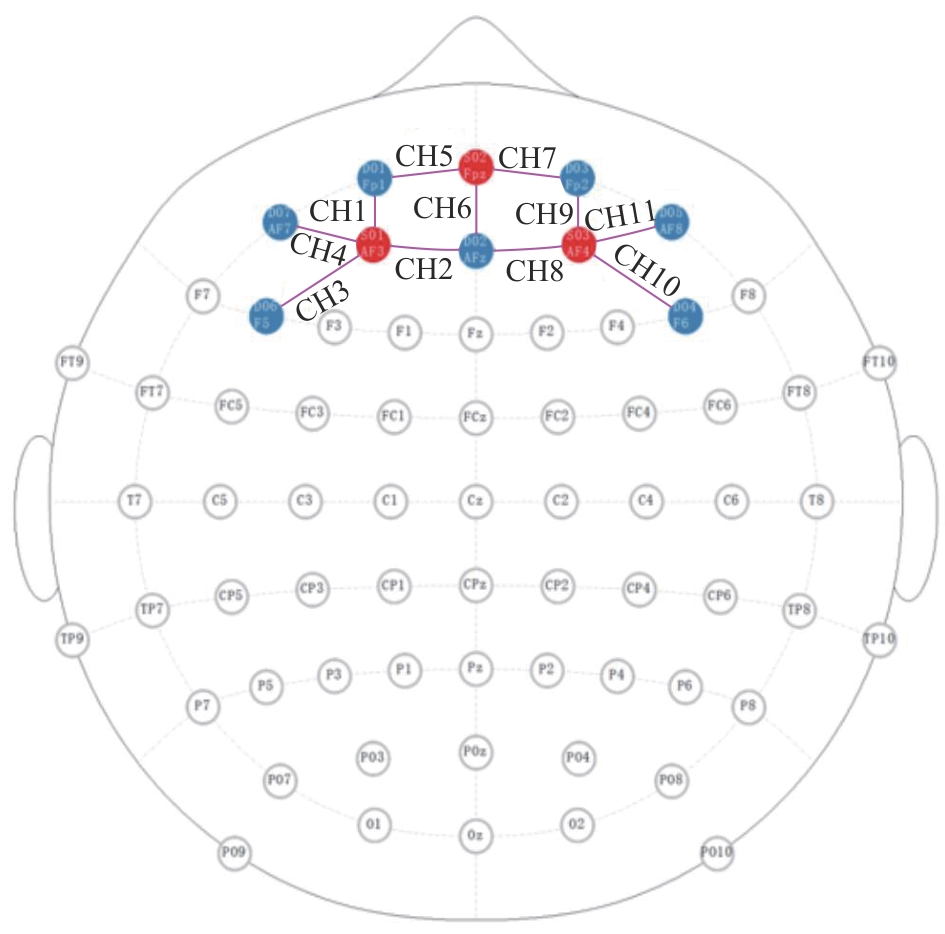
图2 通道空间分布示意
Fig 2 Spatial distribution of fNIRS channels
| Brain region | Channel (CH) | 10‒20 system electrode position | X/mm | Y/mm | Z/mm |
|---|---|---|---|---|---|
| Middle frontal gyrus | 1 | AF3-Fp1 | -31.82 | 82.02 | 0.59 |
| 3 | AF3-F5 | -52.11 | 65.74 | 13.05 | |
| 4 | AF3-AF7 | -45.39 | 73.74 | -0.04 | |
| 5 | Fpz-Fp1 | -14.89 | 88.69 | -10.57 | |
| 7 | Fpz-Fp2 | 15.35 | 88.52 | -10.52 | |
| 9 | AF4-Fp2 | 32.69 | 81.59 | 0.63 | |
| 10 | AF4-F6 | 51.37 | 66.12 | 14.44 | |
| 11 | AF4-AF8 | 44.70 | 74.26 | 0.09 | |
| Superior frontal gyrus | 2 | AF3-AFz | -18.35 | 83.52 | 24.19 |
| 6 | Fpz-AFz | 0.08 | 87.75 | 11.95 | |
| 8 | AF4-AFz | 18.29 | 83.47 | 24.41 |
表1 每个通道的脑区及位置图
Tab 1 Brodmann area and location of the channel
| Brain region | Channel (CH) | 10‒20 system electrode position | X/mm | Y/mm | Z/mm |
|---|---|---|---|---|---|
| Middle frontal gyrus | 1 | AF3-Fp1 | -31.82 | 82.02 | 0.59 |
| 3 | AF3-F5 | -52.11 | 65.74 | 13.05 | |
| 4 | AF3-AF7 | -45.39 | 73.74 | -0.04 | |
| 5 | Fpz-Fp1 | -14.89 | 88.69 | -10.57 | |
| 7 | Fpz-Fp2 | 15.35 | 88.52 | -10.52 | |
| 9 | AF4-Fp2 | 32.69 | 81.59 | 0.63 | |
| 10 | AF4-F6 | 51.37 | 66.12 | 14.44 | |
| 11 | AF4-AF8 | 44.70 | 74.26 | 0.09 | |
| Superior frontal gyrus | 2 | AF3-AFz | -18.35 | 83.52 | 24.19 |
| 6 | Fpz-AFz | 0.08 | 87.75 | 11.95 | |
| 8 | AF4-AFz | 18.29 | 83.47 | 24.41 |
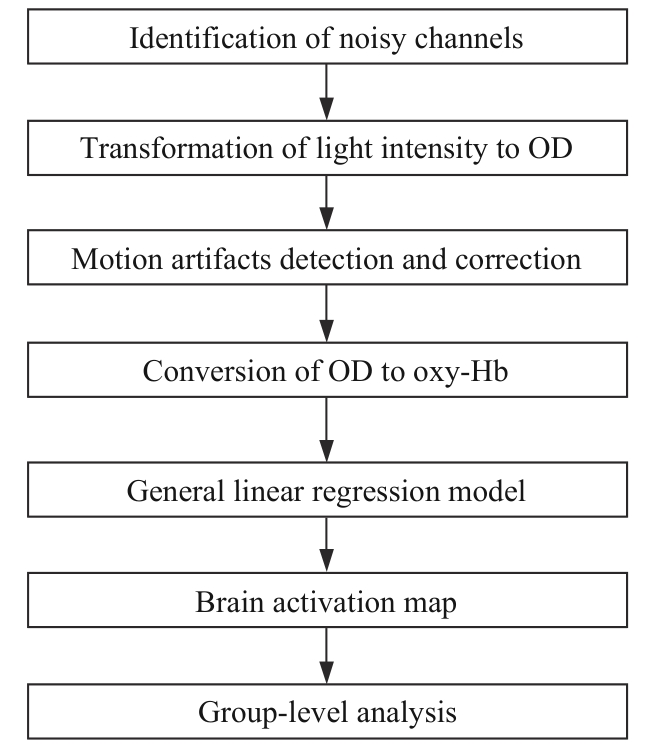
图3 fNIRS数据预处理流程Note: First, the HOMER2 function enPruneChannels was used to identify noisy channels[30]. Next, light intensity was converted to optical density (OD) using the HOMER2 function hmIntensity2OD. Subsequently, motion artifacts were detected using the hmrR_MotionArtifactByChannel function with the following parameters: tMotion=1.0, tMask=1.5,STDEVthresh=75, and AMPthresh=0.25. Motion correction was then performed using the hmrMotionCorrectSpline function. Finally, OD was converted to HbO concentration using the modified Beer-Lambert law implemented in the HOMER2 function hmrOD2c, with age correction [32,34].
Fig 3 Workflow of fNIRS data preprocessing
| Index | ASD (n=60) | TD (n=56) | t/χ2 | P |
|---|---|---|---|---|
| Age/year | 5.42±1.16 | 5.05±1.19 | 1.630 | 0.106 |
| Gender/n(%) | 0.177 | 0.674 | ||
| Male | 48 (80.00) | 43 (76.79) | ||
| Female | 12 (20.00) | 13 (23.21) | ||
| Maternal education level/n(%) | 15.916 | 0.001 | ||
| Associate degree or lower | 26 (43.33) | 6 (10.71) | ||
| Bachelor′s degree | 21 (35.00) | 32 (57.14) | ||
| Master′s degree or higher | 12 (20.00 ) | 18 (32.14) | ||
| Refused to answer or did not know | 1 (1.67) | 0 (0) | ||
| Family income/×10 000 yuan/n(%) | 26.098 | <0.001 | ||
| <15 | 23 (38.33 ) | 2 (3.57) | ||
| 15~30 | 13 (21.67) | 11 (19.67) | ||
| >30 | 16 (26.67) | 37 (66.07) | ||
| Refused to answer or did not know/n(%) | 8 (13.33) | 6 (10.71) |
表2 样本的人口学特征
Tab 2 Demographic characteristics of the sample
| Index | ASD (n=60) | TD (n=56) | t/χ2 | P |
|---|---|---|---|---|
| Age/year | 5.42±1.16 | 5.05±1.19 | 1.630 | 0.106 |
| Gender/n(%) | 0.177 | 0.674 | ||
| Male | 48 (80.00) | 43 (76.79) | ||
| Female | 12 (20.00) | 13 (23.21) | ||
| Maternal education level/n(%) | 15.916 | 0.001 | ||
| Associate degree or lower | 26 (43.33) | 6 (10.71) | ||
| Bachelor′s degree | 21 (35.00) | 32 (57.14) | ||
| Master′s degree or higher | 12 (20.00 ) | 18 (32.14) | ||
| Refused to answer or did not know | 1 (1.67) | 0 (0) | ||
| Family income/×10 000 yuan/n(%) | 26.098 | <0.001 | ||
| <15 | 23 (38.33 ) | 2 (3.57) | ||
| 15~30 | 13 (21.67) | 11 (19.67) | ||
| >30 | 16 (26.67) | 37 (66.07) | ||
| Refused to answer or did not know/n(%) | 8 (13.33) | 6 (10.71) |
| Index | ASD (n=60) | TD (n=56) | P |
|---|---|---|---|
| CSHQ/score | |||
| Total CSHQ score | 48.92±6.39 | 49.60±6.73 | 0.572t |
| Bedtime resistance | 11.87±2.73 | 11.91±2.64 | 0.905m |
| Sleep anxiety | 7.28±2.03 | 7.71±1.59 | 0.216 m |
| Daytime sleepiness | 12.43±2.81 | 12.26±3.04 | 0.761 t |
| Parasomnias | 8.16±1.25 | 9.03±1.81 | 0.005 m |
| Night wakings | 3.88±0.95 | 4.03±1.17 | 0.661 m |
| Sleep-disordered breathing | 3.83±0.64 | 3.71±1.07 | 0.171 m |
| Sleep duration | 4.61±1.49 | 4.21±1.36 | 0.138 m |
| Sleep onset delay | 1.73±0.76 | 1.67±0.74 | 0.696 m |
| ADOS-2/score | |||
| ADOS -2 comparison score | 6.03±1.60 | ||
| Social affect | 11.36±3.75 | ||
| Restricted repetitive behavior | 3.03±3.00 | ||
| Mean developmental age (GDS)/year | 44.71±14.05 | 68.76±14.92 | <0.001 t |
| Actigraphy ASD (n=44)/TD (n=51)/score | |||
| Total sleep time | 520.39±54.88 | 542.25±35.53 | 0.022 t |
| Sleep efficiency | 90.48±5.15 | 90.62±4.47 | 0.886 m |
| Sleep onset latency | 31.61±27.03 | 29.10±15.64 | 0.348 m |
| Wake after sleep onset | 51.25±29.53 | 50.27±24.59 | 0.794 m |
表3 ASD组与TD组的行为学特征比较
Tab 3 Comparison of behavioral characteristics between the ASD and TD groups
| Index | ASD (n=60) | TD (n=56) | P |
|---|---|---|---|
| CSHQ/score | |||
| Total CSHQ score | 48.92±6.39 | 49.60±6.73 | 0.572t |
| Bedtime resistance | 11.87±2.73 | 11.91±2.64 | 0.905m |
| Sleep anxiety | 7.28±2.03 | 7.71±1.59 | 0.216 m |
| Daytime sleepiness | 12.43±2.81 | 12.26±3.04 | 0.761 t |
| Parasomnias | 8.16±1.25 | 9.03±1.81 | 0.005 m |
| Night wakings | 3.88±0.95 | 4.03±1.17 | 0.661 m |
| Sleep-disordered breathing | 3.83±0.64 | 3.71±1.07 | 0.171 m |
| Sleep duration | 4.61±1.49 | 4.21±1.36 | 0.138 m |
| Sleep onset delay | 1.73±0.76 | 1.67±0.74 | 0.696 m |
| ADOS-2/score | |||
| ADOS -2 comparison score | 6.03±1.60 | ||
| Social affect | 11.36±3.75 | ||
| Restricted repetitive behavior | 3.03±3.00 | ||
| Mean developmental age (GDS)/year | 44.71±14.05 | 68.76±14.92 | <0.001 t |
| Actigraphy ASD (n=44)/TD (n=51)/score | |||
| Total sleep time | 520.39±54.88 | 542.25±35.53 | 0.022 t |
| Sleep efficiency | 90.48±5.15 | 90.62±4.47 | 0.886 m |
| Sleep onset latency | 31.61±27.03 | 29.10±15.64 | 0.348 m |
| Wake after sleep onset | 51.25±29.53 | 50.27±24.59 | 0.794 m |
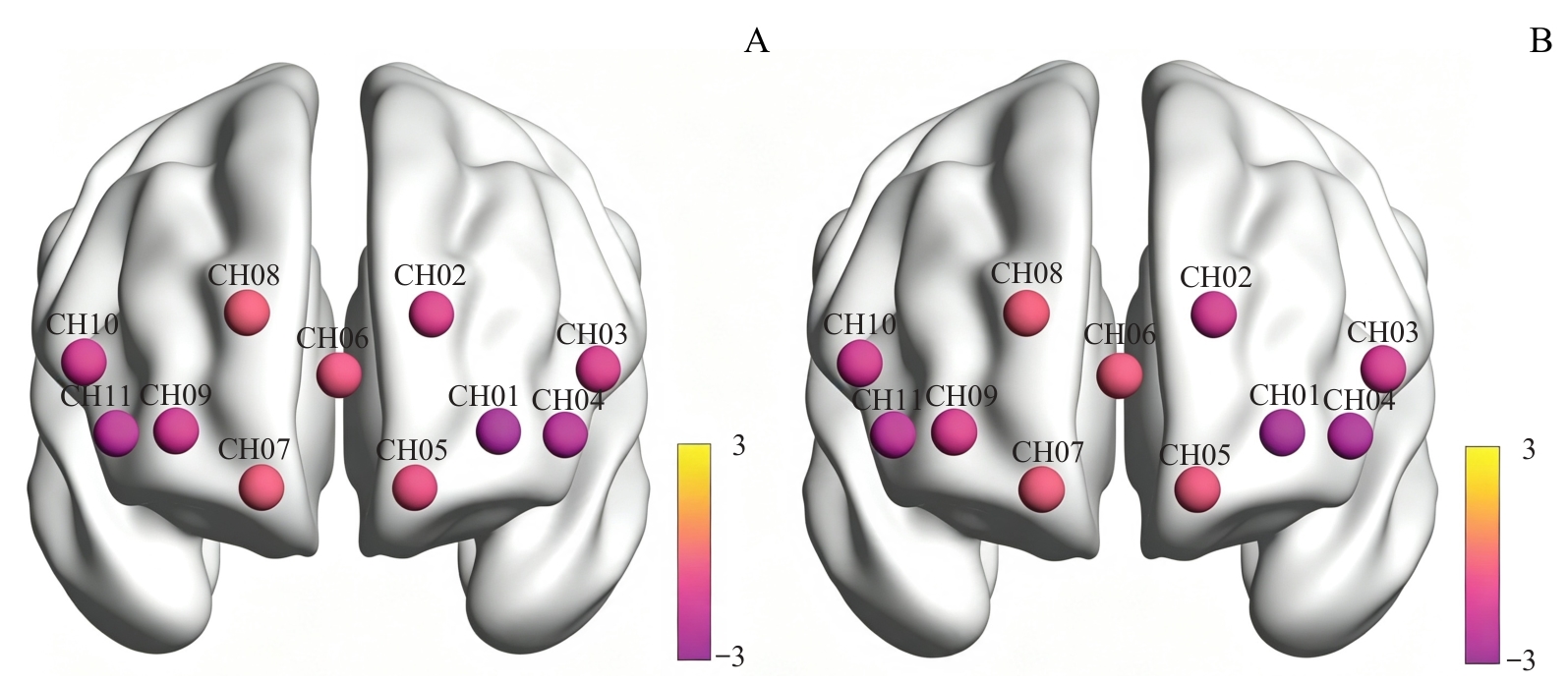
图4 ASD组与TD组在情绪面孔识别任务中的通道激活情况Note: A. Angry face condition. B. Happy face condition.
Fig 4 Channel activation patterns during facial emotion recognition in the ASD and TD groups
| CH1angry | β | SE | t | P | 95% CI |
|---|---|---|---|---|---|
| Group | -1.59 | 0.76 | -2.11 | 0.035 | -3.07‒-0.11 |
| Sleep problems | -0.73 | 0.52 | -1.40 | 0.161 | -1.74‒0.29 |
| Sex | -0.17 | 0.44 | -0.39 | 0.700 | -1.02‒0.69 |
| Average developmental age | 0.00 | 0.01 | 0.04 | 0.969 | 0.00‒0.02 |
| Maternal educational level | -0.33 | 0.32 | -1.06 | 0.291 | -0.95‒0.28 |
| Annual household income | -0.02 | 0.33 | -0.05 | 0.957 | -0.68‒0.64 |
| Group ×Sleep problems | 1.23 | 0.80 | 1.54 | 0.124 | -0.34‒2.80 |
表4 CH1通道在愤怒情绪加工条件下的混合线性模型分析
Tab 4 Linear mixed model analysis of CH1angry activation during facial emotion recognition task
| CH1angry | β | SE | t | P | 95% CI |
|---|---|---|---|---|---|
| Group | -1.59 | 0.76 | -2.11 | 0.035 | -3.07‒-0.11 |
| Sleep problems | -0.73 | 0.52 | -1.40 | 0.161 | -1.74‒0.29 |
| Sex | -0.17 | 0.44 | -0.39 | 0.700 | -1.02‒0.69 |
| Average developmental age | 0.00 | 0.01 | 0.04 | 0.969 | 0.00‒0.02 |
| Maternal educational level | -0.33 | 0.32 | -1.06 | 0.291 | -0.95‒0.28 |
| Annual household income | -0.02 | 0.33 | -0.05 | 0.957 | -0.68‒0.64 |
| Group ×Sleep problems | 1.23 | 0.80 | 1.54 | 0.124 | -0.34‒2.80 |
| CH1happy | β | SE | t | P | 95% CI |
|---|---|---|---|---|---|
| Group | -1.87 | 0.77 | -2.41 | 0.016 | -3.38‒-0.35 |
| Sleep problems | -1.01 | 0.53 | -1.89 | 0.058 | -2.05‒0.04 |
| Sex | -0.03 | 0.45 | -0.06 | 0.954 | -0.90‒0.85 |
| Average developmental age | -0.00 | 0.01 | -0.24 | 0.807 | -0.03‒0.02 |
| Maternal educational level | -0.38 | 0.32 | -1.18 | 0.238 | -1.01‒0.25 |
| Annual household income | -0.06 | 0.34 | -0.17 | 0.864 | -0.73‒0.62 |
| Group ×Sleep problems | 1.37 | 0.82 | 1.68 | 0.094 | -0.23‒2.98 |
表5 CH1通道在快乐情绪加工条件下的混合线性模型分析
Tab 5 Linear mixed model analysis of CH1happy activation during facial emotion recognition task
| CH1happy | β | SE | t | P | 95% CI |
|---|---|---|---|---|---|
| Group | -1.87 | 0.77 | -2.41 | 0.016 | -3.38‒-0.35 |
| Sleep problems | -1.01 | 0.53 | -1.89 | 0.058 | -2.05‒0.04 |
| Sex | -0.03 | 0.45 | -0.06 | 0.954 | -0.90‒0.85 |
| Average developmental age | -0.00 | 0.01 | -0.24 | 0.807 | -0.03‒0.02 |
| Maternal educational level | -0.38 | 0.32 | -1.18 | 0.238 | -1.01‒0.25 |
| Annual household income | -0.06 | 0.34 | -0.17 | 0.864 | -0.73‒0.62 |
| Group ×Sleep problems | 1.37 | 0.82 | 1.68 | 0.094 | -0.23‒2.98 |
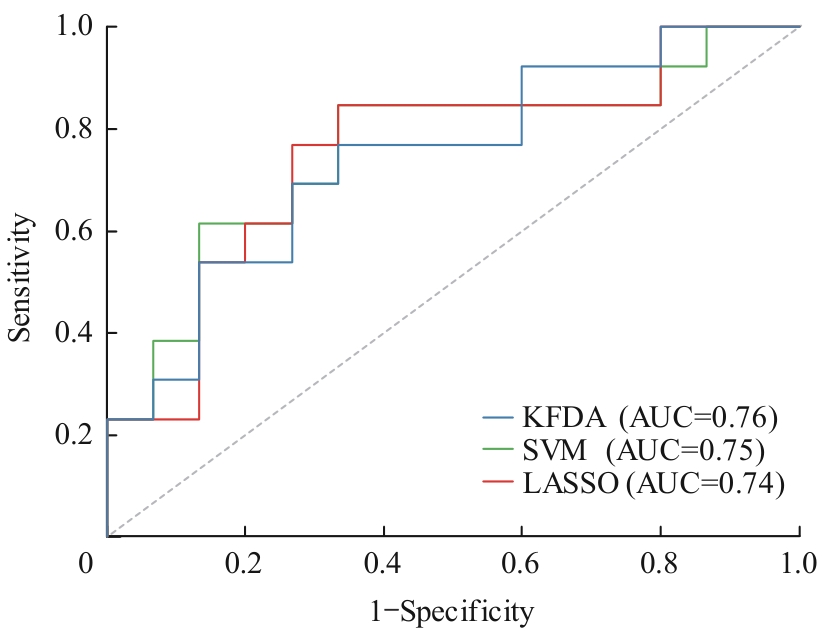
图5 基于fNIRS与睡眠特征的机器学习模型ROC曲线
Fig 5 ROC curves of machine learning models based on fNIRS and sleep-related features
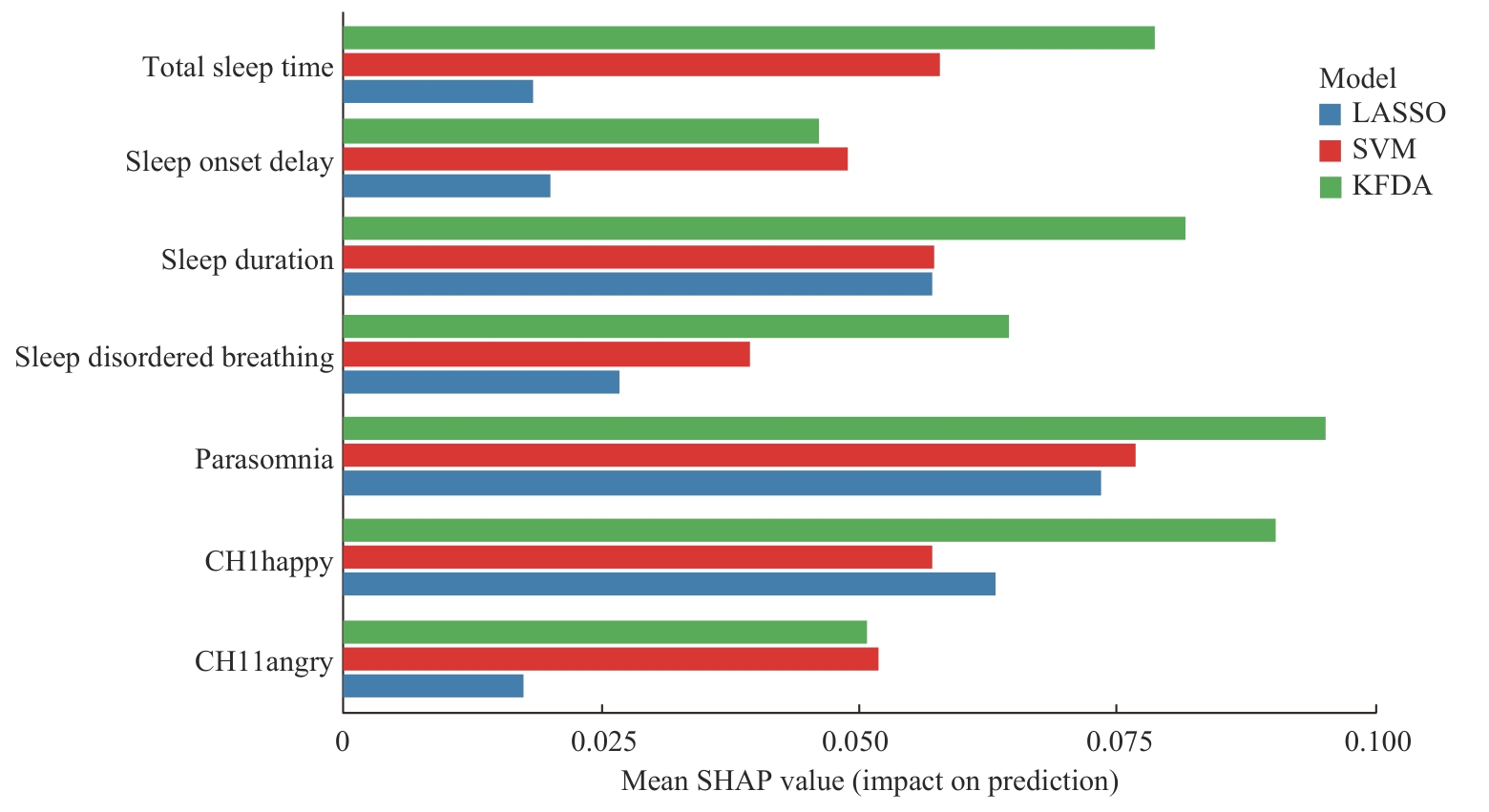
图6 最佳特征机器学习模型的SHAP图
Fig 6 SHAP plot of the best-performing machine learning model based on the selected features
| [1] | Hirota T, King B H. Autism spectrum disorder: a review[J]. Jama, 2023, 329(2): 157. |
| [2] | Vargas C, Paoletti D, De Stasio S, et al. Sleep disturbances in autistic children and adolescents: a systematic review and meta-analysis of randomized controlled trials[J]. Autism, 2025, 29(7): 1661-1673. |
| [3] | Owens J. Classification and epidemiology of childhood sleep disorders[J]. Prim Care, 2008, 35(3): 533-546, vii. |
| [4] | 唐艺嘉, 王紫惊, 姜艳蕊, 等. 孤独症谱系障碍儿童睡眠障碍临床实践相关指南解读[J]. 中国全科医学, 2022, 25(21): 2563-2568. |
| Tang Y J, Wang Z J, Jiang Y R, et al. Interpretation of clinical practice guidelines for sleep disorders in children with autism spectrum disorder[J]. Chinese General Practice, 2022, 25(21): 2563-2568. | |
| [5] | Veatch O J, Sutcliffe J S, Warren Z E, et al. Shorter sleep duration is associated with social impairment and comorbidities in ASD[J]. Autism Res, 2017, 10(7): 1221-1238. |
| [6] | Pattison E, Papadopoulos N, Fuller-Tyszkiewicz M, et al. Randomised controlled trial of a behavioural sleep intervention, ‘sleeping sound’, for autistic children: 12-month outcomes and moderators of treatment[J]. J Autism Dev Disord, 2024, 54(2): 442-457. |
| [7] | Contestabile A, Kojovic N, Casarotto G, et al. Translational research approach to social orienting deficits in autism: the role of superior Colliculus-ventral tegmental pathway[J]. Mol Psychiatry, 2025, 30(8): 3729-3739. |
| [8] | Clements C C, Zoltowski A R, Yankowitz L D, et al. Evaluation of the social motivation hypothesis of autism: a systematic review and meta-analysis[J]. JAMA Psychiatry, 2018, 75(8): 797-808. |
| [9] | Leung R C, Pang E W, Cassel D, et al. Early neural activation during facial affect processing in adolescents with Autism Spectrum Disorder[J]. Neuroimage Clin, 2015, 7: 203-212. |
| [10] | Yang M Y, Zhang L, Wei Z J, et al. Neural and gaze pattern responses to happy faces in autism: predictors of adaptive difficulties and re-evaluation of the social motivation hypothesis[J]. Int J Clin Health Psychol, 2024, 24(4): 100527. |
| [11] | Aquino G, Benz F, Dressle R J, et al. Towards the neurobiology of insomnia: a systematic review of neuroimaging studies[J]. Sleep Med Rev, 2024, 73: 101878. |
| [12] | 徐岩, 张亚旭, 周晓林. 面孔加工的认知神经科学研究: 回顾与展望[J]. 心理科学进展, 2003, 11(1): 35-43. |
| Xu Y, Zhang Y X, Zhou X L. The cognitive neuroscience of face processing: a review[J]. Advances in Psychological Science, 2003, 11(1): 35-43. | |
| [13] | Eken A, Nassehi F, Eroğul O. Diagnostic machine learning applications on clinical populations using functional near infrared spectroscopy: a review[J]. Rev Neurosci, 2024, 35(4): 421-449. |
| [14] | Xu L Y, Sun Z Y, Xie J, et al. Identification of autism spectrum disorder based on short-term spontaneous hemodynamic fluctuations using deep learning in a multi-layer neural network[J]. Clin Neurophysiol, 2021, 132(2): 457-468. |
| [15] | Li K Y, Zheng C Y, Yang Y, et al. The intentional and spontaneous social motor synchrony of pre-school autistic children: evidence from fNIRS hyperscanning and machine learning[J]. J Child Psychol Psychiatry, 2026, 67(6): 881-895. |
| [16] | Mohamed Z, Ponsonby A L, Wakhlu A, et al. Infant sleep characteristics in children with autism spectrum disorder: a population-derived Australian birth cohort study[J]. Arch Dis Child, 2025, 110(6): 471-479. |
| [17] | Shuffrey L C, Rennie B, Li X H, et al. Combining developmental and sleep health measures for autism spectrum disorder screening: an ECHO study[J]. Pediatr Res, 2025, 97(1): 411-421. |
| [18] | Yoo G E, Lee E Y, Lee E. Neural correlates of social motor coordination in autism: a systematic review and meta-analysis of fNIRS studies[J]. Neurosci Biobehav Rev, 2025, 177: 106347. |
| [19] | Owens J A, Spirito A, McGuinn M. The Children′s Sleep Habits Questionnaire (CSHQ): psychometric properties of a survey instrument for school-aged children[J]. Sleep, 2000, 23(8): 1043-1051. |
| [20] | 李生慧, 金星明, 沈晓明, 等. 儿童睡眠习惯问卷中文版制定及测量性能考核[J]. 中华儿科杂志, 2007, 45(3): 176-180. |
| Li S H, Jin X M, Shen X M, et al. Development and psychometric properties of the Chinese version of Children′s Sleep Habits Questionnaire[J]. Chinese Journal of Pediatrics, 2007, 45(3): 176-180. | |
| [21] | Reynolds A M, Soke G N, Sabourin K R, et al. Sleep problems in 2- to 5-year-olds with autism spectrum disorder and other developmental delays[J]. Pediatrics, 2019, 143(3): e20180492. |
| [22] | Ishii R, Obara H, Nagamitsu S, et al. The Japanese version of the Children′s Sleep Habits Questionnaire (CSHQ-J): a validation study and influencing factors[J]. Brain Dev, 2022, 44(9): 595-604. |
| [23] | Hong J S, Singh V, Kalb L, et al. Replication study for ADOS-2 cut-offs to assist evaluation of autism spectrum disorder[J]. Autism Res, 2022, 15(11): 2181-2191. |
| [24] | Wang G, Chen J, Zhang K, et al. The mediating role of gaze patterns in the association of child sleep disturbances and core symptoms of autism spectrum disorder. Autism Res. 2022, 15(9): 1719-1731. |
| [25] | Friedman N P, Robbins T W. The role of prefrontal cortex in cognitive control and executive function[J]. Neuropsychopharmacology, 2022, 47(1): 72-89. |
| [26] | Cui X, Bray S, Bryant D M, et al. A quantitative comparison of NIRS and fMRI across multiple cognitive tasks[J]. Neuroimage, 2011, 54(4): 2808-2821. |
| [27] | Steinbrink J, Villringer A, Kempf F, et al. Illuminating the BOLD signal: combined fMRI-fNIRS studies[J]. Magn Reson Imaging, 2006, 24(4): 495-505. |
| [28] | Skau S, Jonsdottir I H, Sjörs Dahlman A, et al. Exhaustion disorder and altered brain activity in frontal cortex detected with fNIRS[J]. Stress, 2021, 24(1): 64-75. |
| [29] | Sato H, Yahata N, Funane T, et al. A NIRS-fMRI investigation of prefrontal cortex activity during a working memory task[J]. Neuroimage, 2013, 83: 158-173. |
| [30] | von Lühmann A, Ortega-Martinez A, Boas D A, et al. Using the general linear model to improve performance in fNIRS single trial analysis and classification: a perspective[J]. Front Hum Neurosci, 2020, 14: 30. |
| [31] | Hoshino K, Zhang J X J. Optical transducers: Optical molecular sensing and spectroscopy [M]. New York: Elsevier Science & Technology, 2018. |
| [32] | Cope M, Delpy D T. System for long-term measurement of cerebral blood and tissue oxygenation on newborn infants by near infra-red transillumination[J]. Med Biol Eng Comput, 1988, 26(3): 289-294. |
| [33] | Pinti, Dina L M, Smith T J. Ecological functional near-infrared spectroscopy in mobile children: using short separation channels to correct for systemic contamination during naturalistic neuroimaging[J]. Neurophotonics, 2024, 11(4): 045004. |
| [34] | Nguyen T, Hoehl S, Vrtička P. A guide to parent-child fNIRS hyperscanning data processing and analysis[J]. Sensors (Basel), 2021, 21(12): 4075. |
| [35] | Hastie T, Tibshirani R, Friedman J. The elements of statistical learning: data mining, inference, and prediction[M]. 2nd ed. New York: Springer, 2009. |
| [36] | Zhou S L. Sparse SVM for sufficient data reduction[J]. IEEE Trans Pattern Anal Mach Intell, 2022, 44(9): 5560-5571. |
| [37] | Zheng W M, Lin Z C, Wang H X. L1-norm kernel discriminant analysis via Bayes error bound optimization for robust feature extraction[J]. IEEE Trans Neural Netw Learn Syst, 2014, 25(4): 793-805. |
| [38] | Rajagopalan S S, Zhang Y L, Yahia A, et al. Machine learning prediction of autism spectrum disorder from a minimal set of medical and background information[J]. JAMA Netw Open, 2024, 7(8): e2429229. |
| [39] | Gemke R J B J, Burger P, Steur L M H. Sleep disorders in children: classification, evaluation, and management. A review[J]. Eur J Pediatr, 2024, 184(1): 39. |
| [40] | 朱丽雅, 莫凡, 张志豪, 等. 同步与否: 婴儿基本面部表情识别的发展特点[J]. 心理科学进展, 2023, 31(9): 1688-1697. |
| Zhu L Y, Mo F, Zhang Z H, et al. Synchronized or not: developmental characteristics of basic facial expression recognition in infants[J]. Advances in Psychological Science, 2023, 31(9): 1688-1697. | |
| [41] | Fan X Z, Bi X B, Xie Y, et al. Attention bias toward threatening emotional faces in individuals with high-functioning autism[J]. Adv Psychol Sci, 2020, 28(7): 1172-1186. |
| [42] | BOISVERT M, PILON F, MOTTRON L, et al. Distinct neural alterations in schizophrenia and autism: a meta-analysis of social cognition and emotion processing [J]. medRxiv, 2024: 2024. 10.11.24315338. |
| [43] | Hosokawa M, Nakadoi Y, Watanabe Y, et al. Association of autism tendency and hemodynamic changes in the prefrontal cortex during facial expression stimuli measured by multi-channel near-infrared spectroscopy[J]. Psychiatry Clin Neurosci, 2015, 69(3): 145-152. |
| [44] | van der Donck S, Dzhelyova M, Vettori S, et al. Rapid neural categorization of angry and fearful faces is specifically impaired in boys with autism spectrum disorder[J]. J Child Psychol Psychiatry, 2020, 61(9): 1019-1029. |
| [45] | 全琰, 罗荔, 陈玲, 等. 发育迟缓儿童的功能性近红外光谱研究[J]. 中国儿童保健杂志, 2021, 29(7): 772-774, 786. |
| Quan Y, Luo L, Chen L, et al. Functional near-infrared spectroscopy study in children with developmental delay[J]. Chinese Journal of Child Health Care, 2021, 29(7): 772-774, 786. | |
| [46] | Bi F L, Jia Z T, Lv L, et al. Analysis of brain functional connectivity in children with autism spectrum disorder and sleep disorders: a fNIRS observational study[J]. Front Psychol, 2025, 16: 1544798. |
| [47] | [Reidy B L, Hamann S, Inman C, et al. Decreased sleep duration is associated with increased fMRI responses to emotional faces in children[J]. Neuropsychologia, 2016, 84: 54-62. |
| [48] | Qi L P, Ni J W, Dong G J, et al. Cortical hemodynamic responses and deep learning models of emotional face processing in preschool children with autism spectrum disorder: a fNIRS study[J]. Front Psychiatry, 2025, 16: 1703302. |
| [49] | Floris D L, Llera A, Zabihi M, et al. A multimodal neural signature of face processing in autism within the fusiform gyrus[J]. Nat Ment Health, 2025, 3(1): 31-45. |
| [50] | Wang J, Zou Z, Huang H Y, et al. The functional near infrared spectroscopy applications in children with developmental diseases: a review[J]. Front Neurol, 2025, 16: 1495138. |
| [51] | Tremblay J, Martínez-Montes E, Hüsser A, et al. LIONirs: flexible Matlab toolbox for fNIRS data analysis[J]. J Neurosci Methods, 2022, 370: 109487. |
| [52] | Rahimi M M, Phillips C L, Marshall NS, et al. Moderately strong intraclass correlations between actigraphic and polysomnographic total sleep time and sleep efficiency in older adults with sleep disturbance[J]. Sleep Breath. 2025; 29(2): 161. |
| [53] | Griffin J W, Bauer R, Scherf K S. A quantitative meta-analysis of face recognition deficits in autism: 40 years of research[J]. Psychol Bull, 2021, 147(3): 268-292. |
| [54] | Yeung M K. A systematic review and meta-analysis of facial emotion recognition in autism spectrum disorder: the specificity of deficits and the role of task characteristics[J]. Neurosci Biobehav Rev, 2022, 133: 104518. |
| [1] | 诸梦琳, 刘骁, 徐晓丹, 王甘红, 夏开建, 陈健. 多模态模型预测结肠息肉切除术后迟发性出血[J]. 上海交通大学学报(医学版), 2026, 46(4): 509-520. |
| [2] | 方雯, 张浩楠, 杨涛, 陈俊, 方贻儒. 非典型抑郁症患者睡眠紊乱的研究进展[J]. 上海交通大学学报(医学版), 2026, 46(2): 241-247. |
| [3] | 阮顺毅, 孙宜, 王琼, 常玉洁, 顾一峰, 徐永明, 王智煜, 赵晖. 转移性骨肿瘤患者静脉血栓栓塞危险因素分析及机器学习预测模型的建立与验证[J]. 上海交通大学学报(医学版), 2026, 46(10): 1383-1391. |
| [4] | 吴迪, 马骏. 孤独症谱系障碍儿童的线粒体病理机制与靶向治疗研究进展[J]. 上海交通大学学报(医学版), 2026, 46(1): 115-122. |
| [5] | 黄昕, 刘家辉, 叶敬文, 钱文莉, 许万星, 王琳. 基于机器学习的小细胞肺癌代谢分子诊断模型的建立和临床应用[J]. 上海交通大学学报(医学版), 2025, 45(8): 1009-1016. |
| [6] | 曹思瑶, 刘洁琼, 王广帅, 王广海. 孤独症谱系障碍婴儿期超早筛查和干预的研究进展[J]. 上海交通大学学报(医学版), 2025, 45(2): 222-227. |
| [7] | 阮青青, 苏树智, 李延婷, 任渊, 戴勇, 乔增勇. 急性心肌梗死介入治疗并发症风险预测模型构建[J]. 上海交通大学学报(医学版), 2025, 45(12): 1589-1597. |
| [8] | 禹志远, 董海平, 高楠, 马柯. 背根神经节吗啡耐受核心基因筛选与机制研究:加权基因共表达网络分析和机器学习的转录组学整合策略[J]. 上海交通大学学报(医学版), 2025, 45(10): 1308-1319. |
| [9] | 吴其蓁, 刘启明, 柴烨子, 陶政宇, 王依楠, 郭欣宁, 姜萌, 卜军. 机器学习预测乳腺癌新辅助治疗后炎症代谢状态改变的模型评价[J]. 上海交通大学学报(医学版), 2024, 44(9): 1169-1181. |
| [10] | 许万星, 王琳, 郭巧梅, 王薛庆, 娄加陶. 多模态肺结节诊断模型的临床验证及应用价值探索[J]. 上海交通大学学报(医学版), 2024, 44(8): 1030-1036. |
| [11] | 吕娜, 章玲丽, 任芳, 杨涵舒, 李斐, 徐明玉. 孤独症谱系障碍RUBI-PT方案的改编及适应性调查[J]. 上海交通大学学报(医学版), 2024, 44(3): 291-300. |
| [12] | 马奔, 赵成, 束翌俊, 董平. CT影像组学在胃肠道间质瘤中的应用进展[J]. 上海交通大学学报(医学版), 2023, 43(7): 923-930. |
| [13] | 吴丹萍, 任芳, 沈理笑, 薛敏波, 王俊丽, 李斐, 徐明玉. 孤独症谱系障碍ImPACT干预方案的改编及适应性调查[J]. 上海交通大学学报(医学版), 2022, 42(9): 1239-1246. |
| [14] | 马嘉吟, 邬钰玮, 吴佳佳, 唐琳, 单春雷, 徐建光. 静息状态皮肤电活动在孤独症谱系障碍群体应用的研究进展[J]. 上海交通大学学报(医学版), 2022, 42(11): 1598-1604. |
| [15] | 李欣, 范青. 机器学习在抑郁症患者面部特征研究中的应用进展[J]. 上海交通大学学报(医学版), 2022, 42(1): 124-129. |
| 阅读次数 | ||||||
|
全文 |
|
|||||
|
摘要 |
|
|||||
