
上海交通大学学报(医学版) ›› 2026, Vol. 46 ›› Issue (9): 1179-1187.doi: 10.3969/j.issn.1674-8115.2026.09.003
• 前沿述评 • 上一篇
张鑫1,2, 李丹1,3, 杨菊1,3, 邓科蕾4, 曹宏1,2,3,5( )
收稿日期:2025-12-04
接受日期:2026-02-02
出版日期:2026-09-28
发布日期:2026-09-28
通讯作者:
曹 宏,教授,博士;电子信箱:hongcao@jiangnan.edu.cn。基金资助:
Zhang Xin1,2, Li Dan1,3, Yang Ju1,3, Deng Kelei4, Cao Hong1,2,3,5()
Received:2025-12-04
Accepted:2026-02-02
Online:2026-09-28
Published:2026-09-28
Contact:
Cao Hong, E-mail: hongcao@jiangnan.edu.cn.Supported by:摘要:
骨质疏松症以骨量丢失和微结构破坏为特征,已成为降低全球中老年人生活质量并加剧社会经济负担的系统性骨病。细胞外囊泡(extracellular vesicles,EVs)是细胞间信息传递的重要载体,内含蛋白质、脂质及核酸等多种活性分子,在骨重塑平衡中发挥关键作用。EVs既能推动成骨细胞分化,又能抑制破骨细胞活性,并刺激血管新生,因而在骨质疏松治疗中显示出潜力。然而,天然EVs在体内清除快、靶向弱等固有缺陷限制了其临床转化。为突破上述瓶颈,多种功能化策略相继出现。该文梳理EVs的基本特性与生物学行为,解析其在骨微环境中的多重调控机制;聚焦骨质疏松治疗新思路,探讨如何通过细胞预处理提升天然EVs活性,借助内容物工程和表面修饰增强工程化EVs的效能和靶向性,以及将后者与水凝胶或3D打印支架等智能材料耦合,构建可局部滞留、可控释放并协同促修复的递送体系;总结该领域面临的挑战,展望EVs用于骨质疏松精准治疗的前景,为开发高效、安全的无细胞骨再生疗法提供理论依据与研究视角。
中图分类号:
张鑫, 李丹, 杨菊, 邓科蕾, 曹宏. 细胞外囊泡在骨质疏松发生与治疗中的作用及其功能化递送策略[J]. 上海交通大学学报(医学版), 2026, 46(9): 1179-1187.
Zhang Xin, Li Dan, Yang Ju, Deng Kelei, Cao Hong. Roles of extracellular vesicles in pathogenesis and treatment of osteoporosis and their functionalized delivery strategies[J]. Journal of Shanghai Jiao Tong University (Medical Science), 2026,(9): 1179-1187.
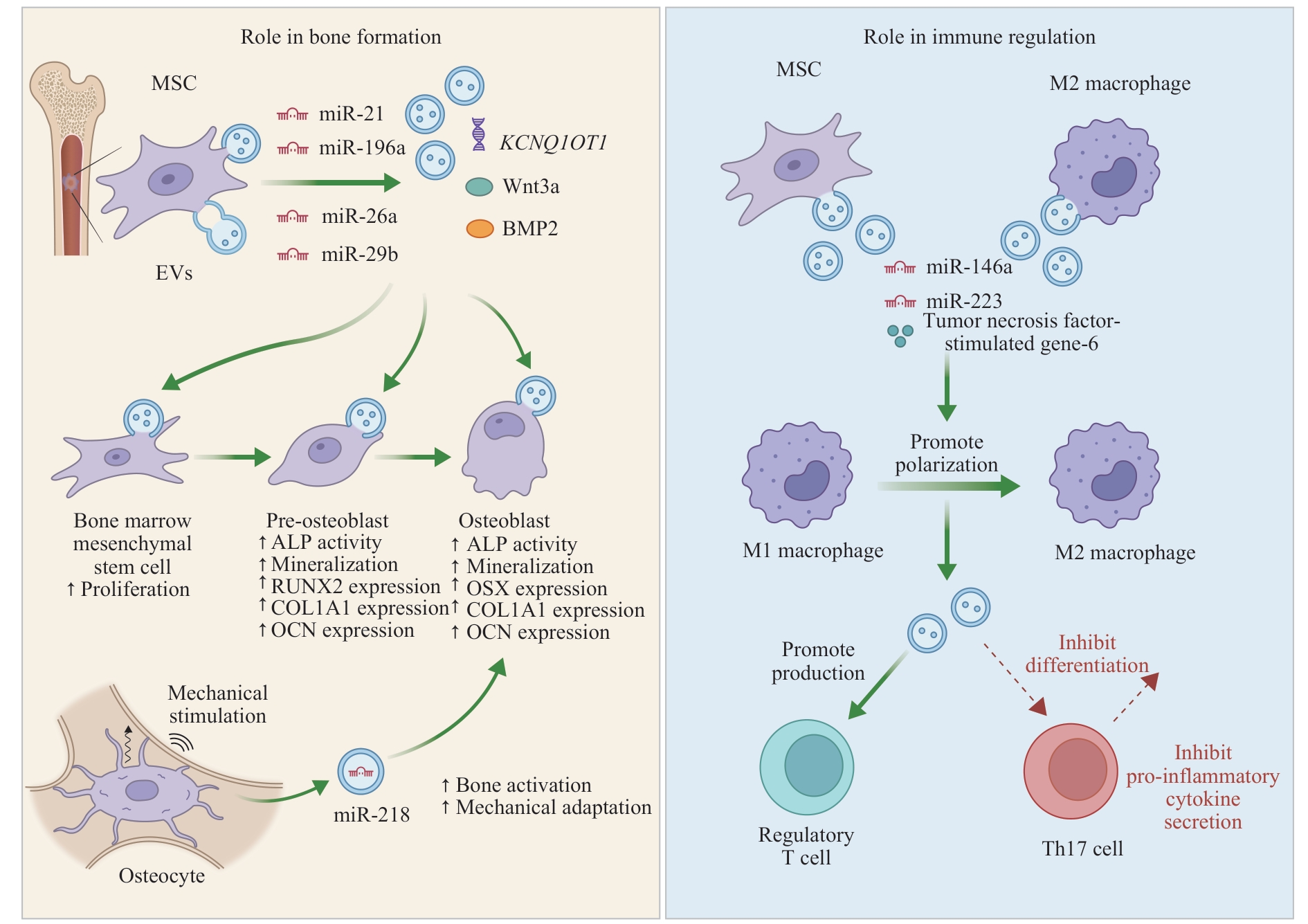
图1 EVs在骨微环境中的作用机制
Fig 1 Mechanism of EV action in the bone microenvironment
| [1] | 周云帆, 童铭豪, 张伟刚, 等. 芹菜素调控骨代谢治疗骨质疏松症的研究进展[J]. 现代药物与临床, 2025, 40(10): 2655-2659. |
| Zhou Y F, Tong M H, Zhang W G, et al. Research progress on apigenin in regulating bone metabolism for the treatment of osteoporosis[J]. Modern Drugs and Clinical, 2025, 40(10): 2655-2659. | |
| [2] | Williams S A, Daigle S G, Weiss R, et al. Economic burden of osteoporosis-related fractures in the US medicare population[J]. Ann Pharmacother, 2021, 55(7): 821-829. |
| [3] | Wang L J, You X L, Zhang L L, et al. Mechanical regulation of bone remodeling[J]. Bone Res, 2022, 10(1): 16. |
| [4] | 姚玉红, 何姣, 单琳, 等. 老年骨质疏松症患者双膦酸盐类药物治疗用药依从性研究进展[J]. 护理与康复, 2024, 23(7): 94-98. |
| Yao Y H, He J, Shan L, et al. Research progress on medication adherence to bisphosphonate therapy in elderly patients with osteoporosis [J]. Nursing and Rehabilitation, 2024, 23(7): 94-98. | |
| [5] | 王瑞. 选择性雌激素受体调节剂治疗绝经后女性骨质疏松症的效果及骨代谢指标研究[J]. 医学理论与实践, 2025, 38(15): 2603-2605. |
| Wang R. Effects of selective estrogen receptor modulators in the treatment of postmenopausal osteoporosis and related bone metabolism indicators [J]. Medical Theory and Practice, 2025, 38(15): 2603-2605. | |
| [6] | 姚娟娟, 石春霞, 张乐媛, 等. 甲状旁腺激素类似物与双膦酸盐序贯治疗骨质疏松症有效性与安全性的Meta分析[J]. 中国药房, 2024, 35(24): 3059-3064. |
| Yao J J, Shi C X, Zhang L Y, et al. Efficacy and safety of sequential therapy with parathyroid hormone analogs and bisphosphonates for osteoporosis: a meta-analysis [J]. China Pharmacy, 2024, 35(24): 3059-3064. | |
| [7] | Leder B Z, Tsai J N, Uihlein A V, et al. Denosumab and teriparatide transitions in postmenopausal osteoporosis (the DATA-Switch study): extension of a randomised controlled trial[J]. Lancet, 2015, 386(9999): 1147-1155. |
| [8] | 柳忠豪, 董凯. 骨质疏松症患者口腔种植治疗的风险与对策[J]. 中国口腔种植学杂志, 2024, 29(4): 303-310. |
| Liu Z H, Dong K. Risks and countermeasures of oral implant therapy in patients with osteoporosis [J]. Chinese Journal of Oral Implantology, 2024, 29(4): 303-310. | |
| [9] | 张格, 朱涵, 张婧雯, 等. 诱导胚胎干细胞分化为视网膜色素上皮细胞的培养方法[J]. 国际眼科杂志, 2020, 20(12): 2079-2082. |
| Zhang G, Zhu H, Zhang J W, et al. Culture methods for inducing embryonic stem cells to differentiate into retinal pigment epithelial cells [J]. International Journal of Ophthalmology, 2020, 20(12): 2079-2082. | |
| [10] | Matsuzaka Y, Yashiro R. Therapeutic strategy of mesenchymal-stem-cell-derived extracellular vesicles as regenerative medicine[J]. Int J Mol Sci, 2022, 23(12): 6480. |
| [11] | van Griensven M, Balmayor E R. Extracellular vesicles are key players in mesenchymal stem cells' dual potential to regenerate and modulate the immune system[J]. Adv Drug Deliv Rev, 2024, 207: 115203. |
| [12] | Karoichan A, Li L, Agnes C J, et al. Mesenchymal stem cells-derived extracellular vesicles mimetics as osteoinductive mediators for bone healing[J]. Adv Funct Mater, 2025, 35(29): 2419562. |
| [13] | Tartaglia N R, Martin-Jaular L, Joliot A, et al. Extracellular vesicles: a complex array of particles involved in cell-to-cell communication for tissue homeostasis[J]. Cells Dev, 2026, 185: 204054. |
| [14] | Xiang H Y, Bao C X, Chen Q Q, et al. Extracellular vesicles (EVs)′ journey in recipient cells: from recognition to cargo release[J]. J Zhejiang Univ Sci B, 2024, 25(8): 633-655. |
| [15] | Manai F, Smedowski A, Kaarniranta K, et al. Extracellular vesicles in degenerative retinal diseases: a new therapeutic paradigm[J]. J Control Release, 2024, 365: 448-468. |
| [16] | Chen H Y, Sun T, Jiang C. Extracellular vesicle-based macromolecule delivery systems in cancer immunotherapy[J]. J Control Release, 2022, 348: 572-589. |
| [17] | Padinharayil H, Varghese J, Wilson C, et al. Mesenchymal stem cell-derived exosomes: characteristics and applications in disease pathology and management[J]. Life Sci, 2024, 342: 122542. |
| [18] | Zhu S L, Li S Y, Yi M, et al. Roles of microvesicles in tumor progression and clinical applications[J]. Int J Nanomed, 2021, 16: 7071-7090. |
| [19] | Song S S, Guo Y Y, Yang Y H, et al. Advances in pathogenesis and therapeutic strategies for osteoporosis[J]. Pharmacol Ther, 2022, 237: 108168. |
| [20] | Batsali A K, Georgopoulou A, Mavroudi I, et al. The role of bone marrow mesenchymal stem cell derived extracellular vesicles (MSC-EVs) in normal and abnormal hematopoiesis and their therapeutic potential[J]. J Clin Med, 2020, 9(3): 856. |
| [21] | Luo K Y, Jin Y F, Liu B Y, et al. Harnessing bone marrow mesenchymal stem cell-derived extracellular vesicles and biomimetic peptide WKYMVm in self-healing hydrogel for enhanced bone repair in femoral defects[J]. J Tissue Eng, 2024, 15: 20417314241306681. |
| [22] | Zou J X, Yang W N, Cui W S, et al. Therapeutic potential and mechanisms of mesenchymal stem cell-derived exosomes as bioactive materials in tendon-bone healing[J]. J Nanobiotechnology, 2023, 21(1): 14. |
| [23] | Chen B K, Zhang Y X, Liu O S. microRNAs in maxillofacial bone modeling and remodeling: implications for malocclusion development and orthodontic treatment[J]. Front Cell Dev Biol, 2024, 12: 1355312. |
| [24] | Las Heras K, Garcia-Orue I, Rancan F, et al. Modulating the immune system towards a functional chronic wound healing: a biomaterials and Nanomedicine perspective[J]. Adv Drug Deliv Rev, 2024, 210: 115342. |
| [25] | Nakao Y, Fukuda T, Zhang Q Z, et al. Exosomes from TNF-α-treated human gingiva-derived MSCs enhance M2 macrophage polarization and inhibit periodontal bone loss[J]. Acta Biomater, 2021, 122: 306-324. |
| [26] | Longo A, Manganelli V, Misasi R, et al. Extracellular vesicles in the crosstalk of autophagy and apoptosis: a role for lipid rafts[J]. Cells, 2025, 14(10): 749. |
| [27] | Cheng P Z, Cao T Q, Zhao X Y, et al. Nidogen1-enriched extracellular vesicles accelerate angiogenesis and bone regeneration by targeting Myosin-10 to regulate endothelial cell adhesion[J]. Bioact Mater, 2022, 12: 185-197. |
| [28] | Liam-Or R, Faruqu F N, Walters A, et al. Cellular uptake and in vivo distribution of mesenchymal-stem-cell-derived extracellular vesicles are protein corona dependent[J]. Nat Nanotechnol, 2024, 19(6): 846-855. |
| [29] | Liu N, Ma Y Z, Gong W, et al. Osteocyte-derived extracellular vesicles mediate the bone-to-cartilage crosstalk and promote osteoarthritis progression[J]. Nat Commun, 2025, 16(1): 4746. |
| [30] | Dave K M, Pinky P P, S Manickam D. Molecular engineering of extracellular vesicles for drug delivery: strategies, challenges, and perspectives[J]. J Control Release, 2025, 386: 114068. |
| [31] | Duan J X, Li H, Wang C Y, et al. BMSC-derived extracellular vesicles promoted osteogenesis via Axin2 inhibition by delivering miR-16-5p[J]. Int Immunopharmacol, 2023, 120: 110319. |
| [32] | Liu Y, Sun L, Li Y, et al. Mesenchymal stromal/stem cell tissue source and in vitro expansion impact extracellular vesicle protein and miRNA compositions as well as angiogenic and immunomodulatory capacities[J]. J Extracell Vesicles, 2024, 13(8): e12472. |
| [33] | Shahid H, Morya V K, Oh J U, et al. Hypoxia-inducible factor and oxidative stress in tendon degeneration: a molecular perspective[J]. Antioxidants (Basel), 2024, 13(1): 86. |
| [34] | Tan Y L, Al-Masawa M E, Eng S P, et al. Therapeutic efficacy of interferon-gamma and hypoxia-primed mesenchymal stromal cells and their extracellular vesicles: underlying mechanisms and potentials in clinical translation[J]. Biomedicines, 2024, 12(6): 1369. |
| [35] | Terriaca S, Fiorelli E, Scioli M G, et al. Endothelial progenitor cell-derived extracellular vesicles: potential therapeutic application in tissue repair and regeneration[J]. Int J Mol Sci, 2021, 22(12): 6375. |
| [36] | Eichholz K F, Woods I, Riffault M, et al. Human bone marrow stem/stromal cell osteogenesis is regulated via mechanically activated osteocyte-derived extracellular vesicles[J]. Stem Cells Transl Med, 2020, 9(11): 1431-1447. |
| [37] | Zuppone S, Zarovni N, Noguchi K, et al. Novel loading protocol combines highly efficient encapsulation of exogenous therapeutic toxin with preservation of extracellular vesicles properties, uptake and cargo activity[J]. Discov Nano, 2024, 19(1): 76. |
| [38] | Cao Z L, Wu Y F, Yu L L, et al. Exosomal miR-335 derived from mature dendritic cells enhanced mesenchymal stem cell-mediated bone regeneration of bone defects in athymic rats[J]. Mol Med, 2021, 27(1): 20. |
| [39] | Hu H F, Wang D, Li L H, et al. Role of microRNA-335 carried by bone marrow mesenchymal stem cells-derived extracellular vesicles in bone fracture recovery[J]. Cell Death Dis, 2021, 12(2): 156. |
| [40] | Tang J D, Wang X Y, Lin X, et al. Mesenchymal stem cell-derived extracellular vesicles: a regulator and carrier for targeting bone-related diseases[J]. Cell Death Discov, 2024, 10(1): 212. |
| [41] | Venslauskas M S, Šatkauskas S. Mechanisms of transfer of bioactive molecules through the cell membrane by electroporation[J]. Eur Biophys J, 2015, 44(5): 277-289. |
| [42] | Li S, Li W Q, Wu X G, et al. Immune cell-derived extracellular vesicles for precision therapy of inflammatory-related diseases[J]. J Control Release, 2024, 368: 533-547. |
| [43] | Zhao S, Di Y F, Fan H L, et al. Targeted delivery of extracellular vesicles: the mechanisms, techniques and therapeutic applications[J]. Mol Biomed, 2024, 5(1): 60. |
| [44] | Liu H M, Li M T, Xiang B, et al. An integrated “Engage & Evasion” approach for mononuclear phagocyte system escape and efficient extracellular vesicle therapy[J]. J Nanobiotechnol, 2024, 22(1): 770. |
| [45] | Hao Y, Zhou X X, Li Y L, et al. The CD47-SIRPα axis is a promising target for cancer immunotherapies[J]. Int Immunopharmacol, 2023, 120: 110255. |
| [46] | Adelnia H, Sirous F, Blakey I, et al. Metal ion chelation of poly(aspartic acid): from scale inhibition to therapeutic potentials[J]. Int J Biol Macromol, 2023, 229: 974-993. |
| [47] | Liu Q S, Li D F, Pan X H, et al. Targeted therapy using engineered extracellular vesicles: principles and strategies for membrane modification[J]. J Nanobiotechnology, 2023, 21(1): 334. |
| [48] | Murali V P, Holmes C A. Biomaterial-based extracellular vesicle delivery for therapeutic applications[J]. Acta Biomater, 2021, 124: 88-107. |
| [49] | Peng Z Y, Wang C Q, Liu C, et al. 3D printed polycaprolactone/beta-tricalcium phosphate/magnesium peroxide oxygen releasing scaffold enhances osteogenesis and implanted BMSCs survival in repairing the large bone defect[J]. J Mater Chem B, 2021, 9(28): 5698-5710. |
| [50] | Uman S, Weingarten N, Helmers M, et al. Engineering and monitoring the sustained release of extracellular vesicles from hydrogels for in vivo therapeutic applications[J]. Adv Nanobiomed Res, 2024, 4(11): 2400073. |
| [51] | Anggelia M R, Cheng H Y, Lin C H. Thermosensitive hydrogels as targeted and controlled drug delivery systems: potential applications in transplantation[J]. Macromol Biosci, 2024: 2400064. |
| [52] | Liu S C, Wang Z R, Li Y H, et al. Erythropoietin-stimulated macrophage-derived extracellular vesicles in chitosan hydrogel rescue BMSCs fate by targeting EGFR to alleviate inflammatory bone loss in periodontitis[J]. Adv Sci (Weinh), 2025, 12(23): e2500554. |
| [53] | Lu W, Zeng M, Liu W B, et al. Human urine-derived stem cell exosomes delivered via injectable GelMA templated hydrogel accelerate bone regeneration[J]. Mater Today Bio, 2023, 19: 100569. |
| [54] | Zhou Y J, Liu S Y, Zhao M, et al. Injectable extracellular vesicle-released self-assembling peptide nanofiber hydrogel as an enhanced cell-free therapy for tissue regeneration[J]. J Control Release, 2019, 316: 93-104. |
| [55] | Lin C, He J L, Li J C, et al. Metal coordination-based double-network microsphere scaffolds facilitate bone regeneration via oxygen-driven mitochondrial oxidative phosphorylation[J]. Chem Eng J, 2025, 512: 162233. |
| [56] | Qin T W, Lian X J, Ullah A, et al. The multi-scale porous and hydrophilic 3D printed polycaprolactone/silk fibroin/β-tricalcium phosphate bone scaffolds effect on femoral defect repair[J]. Int J Biol Macromol, 2025, 330(Pt 4): 148230. |
| [57] | Hariprasad B, Eslamian M, Patel N, et al. A process optimization and release modeling of coaxial electrospun aligned core-shell poly (ethylene oxide-poly(l-lactide-co-glycolide)) nanofibers encapsulating nerve growth factor[J]. J Appl Polym Sci, 2025, 142(32): 57292. |
| [58] | Cai Y J, Zhang H J, Fan X N, et al. Hit the bull's eye: engineered extracellular vesicles for targeted therapy[J]. Bioact Mater, 2026, 64: 324-358. |
| [59] | Wang D R, Pan J. Extracellular vesicles: emerged as a promising strategy for regenerative medicine[J]. World J Stem Cells, 2023, 15(4): 165-181. |
| [60] | Xu G L, Jin J, Fu Z H, et al. Extracellular vesicle-based drug overview: research landscape, quality control and nonclinical evaluation strategies[J]. Signal Transduct Target Ther, 2025, 10(1): 255. |
| [61] | Jin S L, Lv Z Y, Kang L, et al. Next generation of neurological therapeutics: native and bioengineered extracellular vesicles derived from stem cells[J]. Asian J Pharm Sci, 2022, 17(6): 779-797. |
| [62] | Carney R P, Mizenko R R, Bozkurt B T, et al. Harnessing extracellular vesicle heterogeneity for diagnostic and therapeutic applications[J]. Nat Nanotechnol, 2025, 20(1): 14-25. |
| [1] | 林超, 邹青松, 钱名扬, 程千. 基于氧微环境调控的水凝胶体系促进骨再生的研究进展[J]. 上海交通大学学报(医学版), 2026, 46(2): 248-255. |
| [2] | 黄紫晗, 黄心智. 单细胞RNA测序在骨再生研究中的应用[J]. 上海交通大学学报(医学版), 2025, 45(8): 1053-1058. |
| [3] | 鲁佳艺, 刘锦喆, 郭尚春, 陶诗聪. 纳米材料通过降低活性氧水平促进骨组织再生的研究进展[J]. 上海交通大学学报(医学版), 2025, 45(4): 487-492. |
| [4] | 王北辰, 杨耀琦, 鲍其远, 温竣翔, 张伟滨, 万荣. 术后早期应用唑来膦酸对骨质疏松性股骨转子间骨折高龄患者预后的影响[J]. 上海交通大学学报(医学版), 2024, 44(7): 891-898. |
| [5] | 何姝航, 郭尚春, 陶诗聪. 神经血管耦合在骨修复中作用的研究进展[J]. 上海交通大学学报(医学版), 2024, 44(3): 373-378. |
| [6] | 王千懿, 冉欣悦, 张沛灵, 慈政, 雷东, 周广东. 软骨脱细胞基质/丝素蛋白活性支架的构建及其软骨组织工程研究[J]. 上海交通大学学报(医学版), 2023, 43(7): 795-803. |
| [7] | 金芳全, 樊成虎, 唐晓栋, 陈彦同, 齐兵献. 线粒体功能障碍与骨质疏松症相关性研究进展[J]. 上海交通大学学报(医学版), 2023, 43(6): 761-767. |
| [8] | 李旭冉, 陶诗聪, 郭尚春. 骨髓间充质干细胞来源小细胞外囊泡对骨质疏松症的改善作用[J]. 上海交通大学学报(医学版), 2023, 43(4): 406-416. |
| [9] | 刘辰骏, 尹博浩, 孙辉, 张伟. 非侵入性影像学技术在骨质疏松症中的应用[J]. 上海交通大学学报(医学版), 2023, 43(3): 385-390. |
| [10] | 禹茜, 孙俊楠, 张姣姣, 高月, 王虎, 于洋, 王海嵘, 洪雯. 成人胸部CT胸骨皮质比例对骨量低下及骨质疏松诊断效能的探究[J]. 上海交通大学学报(医学版), 2023, 43(10): 1274-1281. |
| [11] | 刘宏强, 陆艳青, 高宇轩, 王一云, 王传东, 张晓玲. 构建高效载体OPEI沉默TRAF6促进骨关节炎软骨再生的研究[J]. 上海交通大学学报(医学版), 2022, 42(7): 846-857. |
| [12] | 吴靖, 赵正宜, 邹多宏, 杨驰, 张志愿. 帐篷钉技术在牙槽骨重度缺损修复重建中的应用:30例临床病例回顾性分析与总结[J]. 上海交通大学学报(医学版), 2022, 42(6): 768-777. |
| [13] | 轩红艳, 王丽华, 李华芳. 精神分裂症患者骨代谢影响因素的研究进展[J]. 上海交通大学学报(医学版), 2021, 41(7): 972-976. |
| [14] | 王青, 王伟, 姜达君, 贾伟涛. 钙磷涂层的JDBM镁合金多孔支架促进血管新生及骨缺损修复的效果评估[J]. 上海交通大学学报(医学版), 2021, 41(6): 732-740. |
| [15] | 蔡苗苗, 高艳虹. 肌少-骨质疏松症的研究进展[J]. 上海交通大学学报(医学版), 2021, 41(5): 678-683. |
| 阅读次数 | ||||||
|
全文 |
|
|||||
|
摘要 |
|
|||||
