


随着细胞测序技术的快速发展和广泛应用,大量的公共生物数据库相继建立,为系统地发现新的分子靶点提供了方便[4]。本研究采用GEO数据库对NSCLC组织数据集GSE33532进行差异表达基因分析,结合GEPIA、UALCAN、KM Plotter等在线分析网站,筛选出与NSCLC患者生存、预后及淋巴结转移密切相关的候选基因G蛋白偶联受体87(G protein-coupled receptor 87,GPR87)。
本研究拟探究GPR87的表达与SK-MES-1和A549细胞的侵袭和转移、基质金属蛋白酶(matrix metalloproteinases,MMPs)表达、上皮间质转化(epithelial-mesenchymal transition,EMT)和RHO/ROCK信号通路的关系,阐明GPR87在NSCLC侵袭中的作用机制,为抑制NSCLC的侵袭转移治疗提供新的靶点。
1 资料与方法
1.1 生物信息学分析
选择GEO数据库的数据集GSE33532筛选与NSCLC侵袭及转移相关的差异表达基因,使用KM plotter网站进行差异基因与患者的生存分析、GEPIA数据库分析候选基因在NSCLC中的表达、UALCANA网站分析候选基因与NSCLC的临床相关性。通过CCLE网站对已知的NSCLC细胞系的候选基因表达进行预测。
1.2 临床样本分析
收集2018年1月—2020年8月湖北省宜昌市中心人民医院病理科的NSCLC临床样本80例及对应的临床病理资料。对80例肿瘤石蜡样本及癌旁正常组织使用GPR87抗体(1∶500;Abcam,美国)进行免疫组化分析,采用二氨基联苯胺(diaminobenzidine,DAB)显色,苏木精复染。评分标准由阳性染色的肿瘤细胞数量和染色强度决定。阳性细胞染色比例:≤5%为0分,6%~25%为1分,26%~50%为2分,51%~75%为3分,76%~100%为4分。染色强度:0分为无着色,1分为淡黄色,2分为棕黄色,3分为黄褐色。两者乘积等于0为阴性,1~4分为弱阳性,5~8分为中等阳性,9~12分为强阳性。结合免疫组化的结果及患者的临床病理资料(病理分型、年龄、性别、吸烟情况、分化程度、临床分期、淋巴结转移情况),分析GPR87与NSCLC的临床相关性。
1.3 细胞培养及建模处理
人腺癌细胞系A549和人鳞癌细胞系SK-MES-1购自武汉大学中国典型培养物保藏中心。A549用高糖DMEM(Gibco,美国)培养,SK-MES-1用MEM(Gibco,美国)培养,培养基中添加10%胎牛血清(Hyclone,美国)、100 U/mL青霉素/链霉素(Gibco,美国)和2 mmol/L的L-谷氨酰胺(索莱宝,北京),培养箱条件设置为37 ℃、5% CO2。
当细胞汇合到80%后,按每孔2×10⁵个细胞接种到6孔板中,用siRNA或质粒处理。siRNA序列如表1所示。质粒pCMV-Vector-his和pCMV-GPR87-his(义翘神州,北京)。按照转染试剂(Thermo Fisher,美国)的操作说明进行转染。细胞转染4~6 h,用完全培养基培养适当时间后进行后续检测。
表1 siRNA序列
Tab 1
| Name | Forward (5'→3') | Reverse (5'→3') |
|---|---|---|
| siRNA-GPR87-1 | GACCUUAGUUUCAAAGCUUdTdT | AAGCUUUGAAACUAAGGUCdTdT |
| siRNA-GPR87-2 | GCAUCUUGCUGAAUGGUUUdTdT | AAACCAUUCAGCAAGAUGCdTdT |
| NC-siRNA | UUCUCCGAACGUGUCACGUTT | ACGUGACACGUUCGGAGAATT |
1.4 Transwell检测迁移和侵袭
为评估细胞的迁移活性,经siRNA或质粒处理的细胞培养24 h后,用不含血清的培养基按每孔4×10⁵个细胞接种到Transwell小室中,小室的孔径为8 μm,下室添加完全培养基。孵育24 h后,取出小室,清除未穿孔的细胞,用多聚甲醛固定、结晶紫溶液染色,拍照,用Image J软件扫描紫色面积,重复3次,统计结果。
为评估细胞的侵袭活性,将经siRNA或质粒处理的细胞培养24 h,用不含血清的培养基按8×10⁵个/孔细胞接种到Transwell小室中,小室提前24 h铺好Matrigel基质胶(BD Biosciences,美国),小室的孔径为8 μm,下室添加完全培养基。孵育24 h后,取出小室,清除未穿孔的细胞,用多聚甲醛固定、结晶紫溶液染色,拍照,用Image J软件扫描紫色面积,重复3次,统计结果。
1.5 ELISA
经siRNA或质粒处理的细胞继续培养48 h,取1 mL培养上清液,使用ELISA试剂盒(博士德,武汉)检测细胞MMP7的分泌量。重复实验3次后进行数据分析。
1.6 RT-qPCR
经siRNA或质粒处理的细胞继续培养48 h,收集细胞,用Trizol(Takara,日本)提取RNA。取2 μg RNA按照反转录试剂盒(诺唯赞,南京)的操作说明反转录为40 μL cDNA,再以cDNA为模板使用SYBR qPCR Master Mix(诺唯赞,南京)进行qPCR。GPR87、MMP2、MMP7、MMP9、E-cadherin、N-cadherin、vimentin、snail、twist、RHOA、RHOC、ROCK1、β-actin的引物序列(生工,上海)如表2所示。以β-actin为内参基因,用2‑ΔΔCt法计算目的基因的mRNA表达量。
表2 RT-qPCR引物序列
Tab 2
| Gene | Forward (5'→3') | Reverse (5'→3') |
|---|---|---|
| GPR87 | GGAGGCGACATCAATGCAG | AAATGAAAGTAAAGAACGATTTTGTGT |
| MMP2 | GCTGGAGACAAATTCTGGAGATACA | GTATCGAAGGCAGTGGAGAGGA |
| MMP7 | GAGTGAGCTACAGTGGGAACA | CTATGACGCGGGAGTTTAACAT |
| MMP9 | GCCACTACTGTGCCTTTGAGTC | CCCTCAGAGAATCGCCAGTACT |
| E-cadherin | GCCTCCTGAAAAGAGAGTGGAAG | TGGCAGTGTCTCTCCAAATCCG |
| N-cadherin | CCTCCAGAGTTTACTGCCATGAC | GTAGGATCTCCGCCACTGATTC |
| vimentin | AGGCAAAGCAGGAGTCCACTGA | ATCTGGCGTTCCAGGGACTCAT |
| snail | TGCCCTCAAGATGCACATCCGA | GGGACAGGAGAAGGGCTTCTC |
| twist | GCCAGGTACATCGACTTCCTCT | TCCATCCTCCAGACCGAGAAGG |
| RHOA | GCAGGTAGAGTTGGCTTTATGG | CTTGTGTGCTCATCATTCCGA |
| RHOC | AAGACGAGCACACCAGGAGAGA | TTGGCTGAGCACTCAAGGTAGC |
| ROCK1 | GAAACAGTGTTCCATGCTAGACG | GCCGCTTATTTGATTCCTGCTCC |
| β-actin | CTGGAACGGTGAAGGTGACA | AAGGGACTTCCTGTAACAACGCA |
1.7 Western blotting
经siRNA或质粒处理的细胞培养48 h,收集细胞,用含有PMSF(博士德,武汉)的RIPA(博士德,武汉)提取总蛋白,使用BCA试剂盒(Thermo Fisher,美国)进行蛋白质定量。使用SDS-PAGE分离蛋白,接着把蛋白转移至PVDF膜(GE Amersham,美国)。用5%的脱脂牛奶(碧云天,上海)封闭PVDF膜,在4 ℃孵育一抗过夜:MMP9抗体(1∶1 000;三鹰,武汉)、vimentin抗体(1∶1 000;三鹰,武汉)、RHOA抗体(1∶1 000;三鹰,武汉)、ROCK1抗体(1∶1 000;三鹰,武汉)、β-actin抗体(1∶1 000;三鹰,武汉)、GPR87抗体(1∶1 000;Abcam,美国)、E-cadherin抗体(1∶500,Abcam,美国)。室温孵育二抗(1∶3 000;三鹰,武汉)1 h,用ECL试剂盒(Thermo Fisher,美国)进行蛋白检测,利用Image J软件对结果进行灰度扫描。
1.8 统计学分析
实验数据均采用SPSS 22.0统计学软件进行分析处理,每组数据均进行3次独立重复试验,用x±s表示;2组样本比较采用t检验。P<0.05表示结果具有统计学意义。
2 结果
2.1 生物信息学分析结果
表3 与NSCLC转移及预后相关的差异表达基因
Tab 3
| ID | Padj | P value | logFC | Gene symbol |
|---|---|---|---|---|
| 219936_s_at | 3.47×10⁻⁵ | 2.32×10⁻⁷ | 2.43 | GPR87 |
| 212094_at | 1.24×10⁻⁵ | 4.70×10⁻⁸ | 2.36 | PEG10 |
| 209278_s_at | 1.63×10⁻² | 1.53×10⁻³ | 2.22 | TFPI2 |
| 227506_at | 1.25×10⁻⁵ | 5.17×10⁻⁸ | 2.14 | SLC16A9 |
| 206023_at | 3.69×10⁻⁴ | 6.62×10⁻⁶ | 2.12 | NMU |
| 205048_s_at | 3.22×10⁻³ | 1.44×10⁻⁴ | 2.02 | PSPH |
| 220393_at | 7.91×10⁻³ | 5.37×10⁻⁴ | -2.05 | LGSN |
| 213432_at | 1.33×10⁻³ | 3.96×10⁻⁵ | -2.17 | MUC5B |
| 225728_at | 2.93×10⁻⁴ | 4.65×10⁻⁶ | -2.23 | SORBS2 |
| 203824_at | 1.38×10⁻³ | 4.19×10⁻⁵ | -2.25 | TSPAN8 |
图1
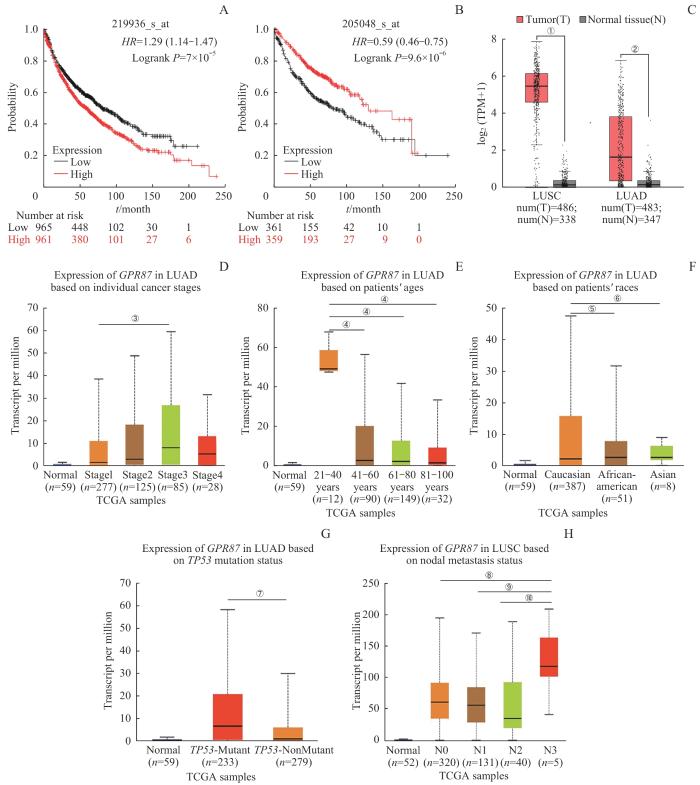
图1
GPR87 与 NSCLC的生物信息学分析
Note: GPR87 (A) and PSPH (B) were found to correlate with poor survival in NSCLC population with KM plotter. GPR87 mRNA levels in LUAD and LUSC (C) were both overexpressed, according to the GEPIA database. High expression of GPR87 was associated with poor clinical stage (D), age (E), race (F) and TP53 mutation status (G) in patients with LUAD, and with lymph node metastasis in patients with LUSC (H) in UALCAN database. Error bars represent the x±s. ①P=0.032, ②P=0.026, compared with the adjacent normal tissues. ③P=0.006, compared with stage1 LUAD patients. ④P<0.001, compared with the 21‒40 year-old patients. ⑤P=0.005, ⑥P<0.001, compared with Caucasian patients. ⑦P<0.001, compared with the TP53-mutant group. ⑧P=0.007, ⑨P=0.005, ⑩P=0.004, compared with the N3-lymph node metastasis patients.
Fig 1
Bioinformatics analysis of GPR87 and NSCLC
2.2 临床样本分析结果
图2
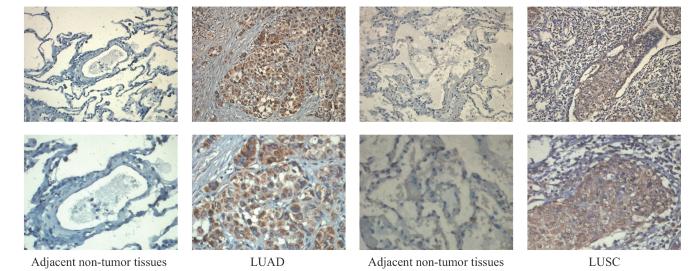
图2
GPR87蛋白在NSCLC临床样本中的表达
Note: Protein expression of GPR87 in 80 NSCLC samples was upregulated compared to adjacent non-tumor tissues, as shown by IHC staining. LUAD—lung adenocarcinoma; LUSC—lung squamous cell carcinoma. Line 1, ×200; line 2, ×400.
Fig 2
Expression of GPR87 protein in NSCLC samples
表4 GPR87在NSCLC肿瘤组织及癌旁正常组织中的蛋白表达量
Tab 4
| Group | Case/n | Expression of GPR87/n | χ2 | P value | |
|---|---|---|---|---|---|
| High | Low | ||||
| Tissue of NSCLC | 80 | 51 | 29 | 74.862 | <0.001 |
| Adjacent non-tumor tissues | 80 | 0 | 80 | ||
为了进一步揭示GPR87与NSCLC患者临床病理特征之间的关系,我们分析了上述80例临床样本的临床病理数据(病理类型、年龄、性别、吸烟状况、分化程度、临床分期、淋巴结转移情况),如表5所示。GPR87的表达在不同临床分期(P=0.001)和淋巴结转移状态(P=0.019)之间差异有统计学意义,但在不同病理类型、年龄、性别、吸烟状况以及分化程度之间差异无统计学意义。结果表明,与低表达GPR87的患者相比,高表达GPR87的NSCLC患者临床分期更晚、更易发生淋巴结转移。
表5 GPR87与NSCLC患者的临床相关性分析
Tab 5
| Factor | Case/n | Expression of GPR87/n | χ2 | P value | |
|---|---|---|---|---|---|
| High | Low | ||||
| Subgroup | 1.524 | 0.217 | |||
| LUAD | 48 | 28 | 20 | ||
| LUSC | 32 | 23 | 9 | ||
| Age/year | 0.197 | 0.657 | |||
| ≥65 | 36 | 22 | 14 | ||
| <65 | 44 | 29 | 15 | ||
| Gender | 0.442 | 0.506 | |||
| Male | 48 | 32 | 16 | ||
| Female | 32 | 19 | 13 | ||
| Smoking | 0.548 | 0.459 | |||
| Yes/ever | 43 | 29 | 14 | ||
| No | 37 | 22 | 15 | ||
| Differentiation | 1.847 | 0.174 | |||
| Good | 11 | 5 | 6 | ||
| Middle/poor | 69 | 46 | 23 | ||
| Stage | 10.498 | 0.001 | |||
| Ⅰ/Ⅱ | 65 | 36 | 29 | ||
| Ⅲ/Ⅳ | 15 | 15 | 0 | ||
| Lymphatic metastasis | 5.485 | 0.019 | |||
| No | 50 | 27 | 23 | ||
| Yes | 30 | 24 | 6 | ||
2.3 不同NSCLC细胞模型中 GPR87 mRNA和蛋白的表达分析
图3
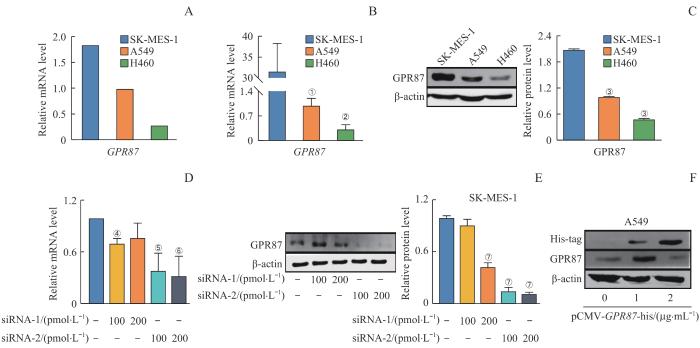
图3
GPR87 mRNA和蛋白在不同NSCLC细胞模型中的表达分析
Note: Relative mRNA expression of GPR87 in SK-MES-1 and A549 cells, as predicted by CCLE (A), analyzed by RT-qPCR analysis (B), and relative protein expression of GPR87 by Western blotting analysis (C). Relative mRNA expression of GPR87 by RT-qPCR analysis (D) and relative protein expression of GPR87 by Western blotting analysis (E) in SK-MES-1 cells treated with siRNA-GPR87. GPR87 protein expression in A549 cells treated with pCMV-GPR87-his by Western blotting analysis (F). Error bars represent the x±s. ①P=0.037, ②P=0.008, compared with SK-MES-1. ③P<0.001, compared with SK-MES-1. ④P=0.008, ⑤P=0.005, ⑥P=0.006, compared with control group. ⑦P<0.001, compared with control group.
Fig 3
Analysis of GPR87 mRNA and protein expression in NSCLC cell models
用不同剂量(100、200 pmol/L)的siRNA-GPR87-1和siRNA-GPR87-2转染SK-MES-1,培养48 h后检测GPR87 mRNA和蛋白的表达水平,发现100 pmol/L siRNA-GPR87-2处理组的敲低效果最好(图3D、E),故选择该处理建立敲减模型。
将pCMV-GPR87-his以不同剂量(1 μg/mL、2 μg/mL)转染A549 48 h,检测GPR87的表达水平,结果显示,1 μg/mL处理组GPR87过表达效果优于2 μg/mL处理组(图3F),故选择1 μg/mL pCMV-GPR87-his处理细胞建立过表达模型。
2.4 Transwell检测 GPR87 对NSCLC细胞迁移和侵袭的影响
图4
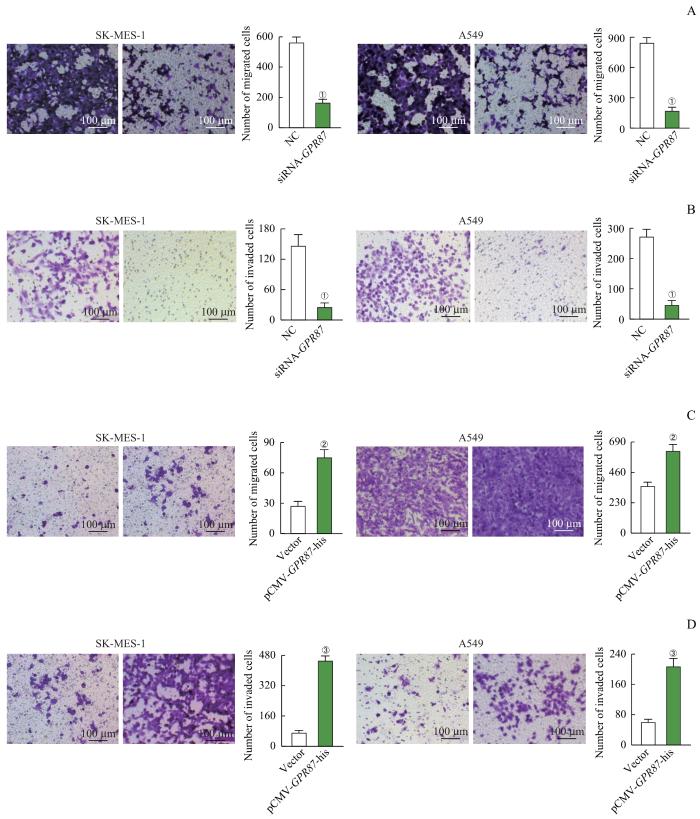
图4
Transwell检测 GPR87 对NSCLC细胞迁移和侵袭的影响
Note: Representative images (×200) and quantification of migrated (A) and invaded (B) cells, analyzed by using the Transwell matrix penetration assay in SK-MES-1 and A549 cells treated with siRNA-GPR87. Representative images (×200) and quantification of migrated (C) and invaded (D) cells, analyzed by Transwell matrix penetration assay in SK-MES-1 and A549 cells treated with pCMV-GPR87-his. Error bars represent the x±s. ①P<0.001, compared with the NC group. ②P=0.008, compared with the Vector group. ③P<0.001, compared with the Vector group.
Fig 4
Effect of GPR87 on migration and invasion in NSCLC cell lines by the Transwell assay
2.5 ELISA、RT-qPCR、Western blotting检测 GPR87 对NSCLC细胞MMPs表达的影响
图5
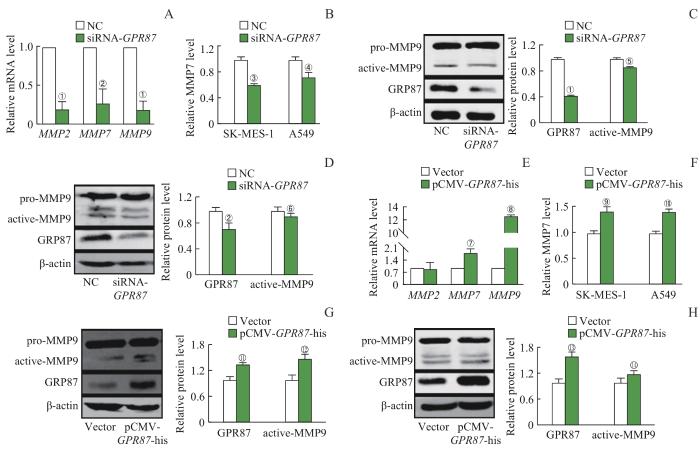
图5
GPR87 对NSCLC细胞MMPs表达的影响
Note: A. The mRNA expression of MMP2, MMP7 and MMP9 in SK-MES-1 cells treated with siRNA-GPR87 was decreased, as detected by RT-qPCR. B. The protein expression of MMP7 in the supernatant of SK-MES-1 and A549 cells treated with siRNA-GPR87 was decreased, as detected by ELISA. The protein expression of active-MMP9 and GPR87 was decreased in SK-MES-1 (C) and A549 cells (D) treated with siRNA-GPR87, as detected by Western blotting. E. The mRNA expression of MMP2, MMP7 and MMP9 was increased in A549 cells treated with pCMV-GPR87-his, as detected by RT-qPCR. F. The protein expression of MMP7 in the supernatant of SK-MES-1 and A549 cells treated with pCMV-GPR87-his was increased, as detected by ELISA. The protein expression of active-MMP9 and GPR87 was increased in A549 (G) and SK-MES-1 cells (H) treated with pCMV-GPR87-his, as detected by Western blotting. Error bars represent the x±s. ①P<0.001, ②P=0.008, ③P=0.013,④P=0.041, ⑤P=0.009, ⑥P=0.043, compared with the NC group. ⑦P=0.007, ⑧P<0.001, ⑨P=0.003, ⑩P=0.002, 11P=0.005, 12P=0.008, 13P=0.001, 14P=0.021, compared with the Vector group.
Fig 5
Effect of GPR87 on the expression of MMPs in NSCLC cell lines
2.6 RT-qPCR、Western blotting检测 GPR87 对NSCLC细胞EMT的影响
图6
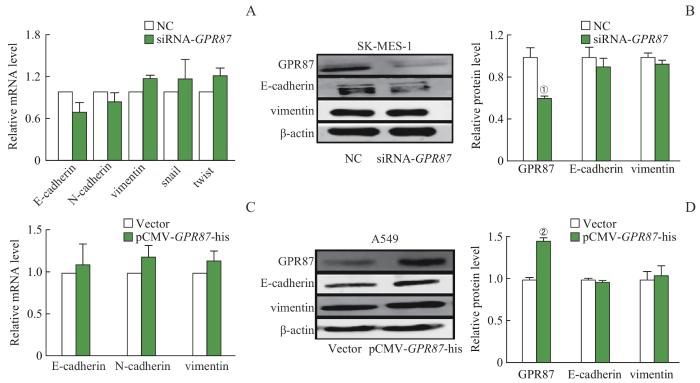
图6
GRP87 对NSCLC细胞EMT的影响
Note: The mRNA expression (A) of E-cadherin, N-cadherin, vimentin, snail, and twist, and the protein expression (B) of E-cadherin and vimentin did not change in SK-MES-1 cells treated with siRNA-GPR87. The mRNA expression of E-cadherin, N-cadherin, and vimentin (C), and the protein expression of E-cadherin and vimentin (D) did not change in A549 cells treated with pCMV-GPR87-his. Error bars represent the x±s. ①P<0.001, compared with the NC group. ②P=0.008, compared with the Vector group.
Fig 6
Effect of GPR87 on EMT in NSCLC cell lines
2.7 RT-qPCR、Western blotting检测 GPR87 对NSCLC细胞RHO/ROCK通路的影响
图7
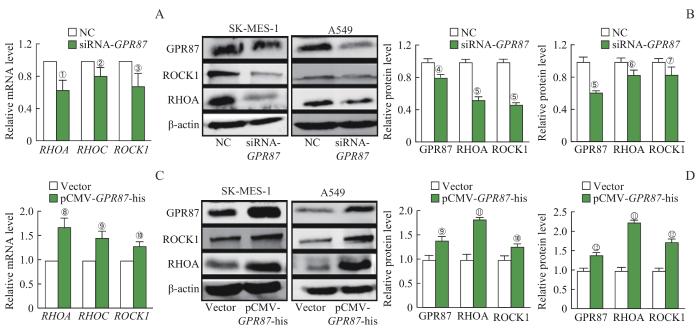
图7
GPR87 对NSCLC细胞RHO/ROCK通路的影响
Note: A. The mRNA expression of RHOA, RHOC and ROCK1 was decreased in SK-MES-1 cells treated with siRNA-GPR87. B. The protein expression of RHOA and ROCK1 in SK-MES-1 and A549 cells treated with siRNA-GPR87 was decreased, as detected by Western blotting. C. The mRNA expression of RHOA, RHOC and ROCK1 in A549 cells treated with pCMV-GPR87-his was increased. D. The protein expression of RHOA and ROCK1 was increased in SK-MES-1 and A549 cells treated with pCMV-GPR87-his, as detected by Western blotting. Error bars represent the x±s. ①P=0.008, ②P=0.035, ③P=0.041, ④P=0.005, ⑤P<0.001, ⑥P=0.019, ⑦P=0.026, compared with the NC group.⑧P=0.003, ⑨P=0.002, ⑩P=0.007, 11P<0.001, 12P=0.008, compared with the Vector group.
Fig 7
Effect of GPR87 on the RHO/ROCK signaling pathway in NSCLC cell lines
3 讨论
MMPs是一类蛋白水解酶,在肿瘤侵袭转移过程中发挥重要作用[11]。MMP2和MMP9是降解细胞外基质中的层粘连蛋白的明胶酶之一。MMP7也被称为基质溶解素,主要降解细胞外基质和基底膜蛋白。文献[12]报道,在NSCLC中MMP2、MMP7和MMP9的高表达可促进转移,提示患者预后不良。本文研究了GPR87与A549和SK-MES-1中MMPs表达的关系,结果显示,敲低GPR87表达可下调细胞内MMP2、MMP7和MMP9的mRNA和MMP7、MMP9的蛋白水平,而在高表达GPR87的细胞中观察到这些指标均上调。本研究结果表明,GPR87可通过促进MMPs的表达,溶解细胞基质,增强NSCLC的侵袭能力。
RHO/ROCK信号通路在细胞增殖与凋亡、细胞骨架重组与收缩、细胞变形、运动及黏附中发挥重要作用[17]。RHOA和RHOC主要调控肌动蛋白聚合、基底膜分解和皮质收缩,ROCK1通过调节肌球蛋白磷酸化来重构肌动蛋白细胞骨架,通过迁移细胞的前缘和后缘调节细胞迁移[18]。本研究的结果显示,当GPR87在SK-MES-1和A549中低表达时,RHOA、RHOC和ROCK1的表达量相应地降低;当GPR87高表达时,RHOA、RHOC和ROCK1的表达也相应上调。这些结果与GPR87诱导Gα12/13-RHO/ROCK依赖性细胞迁移的报道一致[19]。该结果提示,GPR87可通过激活RHOA/ROCK1信号通路促进NSCLC细胞的迁移能力。
综上,本研究发现:GPR87的高表达与NSCLC的侵袭和转移密切相关;在SK-MES-1和A549细胞中,GPR87可通过激活RHOA/ROCK1信号通路,促进MMPs的表达,最终促进NSCLC的侵袭与转移。
作者贡献声明
刘亚云、盛德乔参与实验设计;刘晨茜、韩林、周韩、杨轶参与实验操作;刘晨茜、韩林、周韩、杨轶参与数据采集及数据分析;刘晨茜、刘亚云、盛德乔参与论文的写作和修改。所有作者均阅读并同意最终稿件的提交。
AUTHOR's CONTRIBUTIONS
The study was designed by LIU Yayun and SHENG Deqiao. The experiments were conducted by LIU Chenxi, HAN Lin, ZHOU Han and YANG Yi. The data were collected and analyzed by LIU Chenxi, HAN Lin, ZHOU Han and YANG Yi. The manuscript was drafted and revised by LIU Chenxi, LIU Yayun and SHENG Deqiao. All the authors have read the last version of paper and consented for submission.
利益冲突声明
所有作者声明不存在利益冲突。
COMPETING INTERESTS
All authors disclose no relevant conflict of interests.
参考文献


