
上海交通大学学报(医学版) ›› 2026, Vol. 46 ›› Issue (4): 537-544.doi: 10.3969/j.issn.1674-8115.2026.04.014
• 综述 • 上一篇
杜鑫1, 李雪冰2, 李永伟1,2( )
)
收稿日期:2025-07-29
接受日期:2025-10-23
出版日期:2026-04-10
发布日期:2026-04-10
通讯作者:
李永伟,主任技师,博士;电子信箱:lyw@hactcm.edu.cn。基金资助:
Du Xin1, Li Xuebing2, Li Yongwei1,2()
Received:2025-07-29
Accepted:2025-10-23
Online:2026-04-10
Published:2026-04-10
Contact:
Li Yongwei, E-mail: lyw@hactcm.edu.cn.Supported by:摘要:
复发性流产发病过程复杂,涉及多种免疫和代谢因素,具体机制尚不清楚。近年来,巨噬细胞通过代谢途径影响胚胎着床和维持妊娠稳定性的作用逐渐受到关注。巨噬细胞代谢主要包括糖代谢、脂代谢和氨基酸代谢。糖代谢主要通过影响糖酵解导致M1巨噬细胞极化,脂肪酸氧化减少与巨噬细胞抗炎功能受损相关,胆固醇积累加剧局部炎症反应,脂类代谢失衡也可影响蜕膜血管生成及胎盘发育。目前,研究已证实蜕膜局部微环境的代谢紊乱如缺氧和氧化应激,可直接诱导巨噬细胞发生代谢重编程,进而影响其促炎或抗炎作用转换;但巨噬细胞代谢关键节点在妊娠免疫调控中的具体作用机制,以及靶向代谢途径干预的可行性,仍需深入探讨。该文总结巨噬细胞在复发性流产中的作用,并聚焦于代谢重编程这一核心调控节点,深入探讨糖代谢、脂代谢及氨基酸代谢失衡如何驱动巨噬细胞功能紊乱,进而影响母胎界面免疫耐受微环境的建立与维持,为复发性流产的防治研究提供新的视角。
中图分类号:
杜鑫, 李雪冰, 李永伟. 巨噬细胞代谢重编程在复发性流产中的作用综述[J]. 上海交通大学学报(医学版), 2026, 46(4): 537-544.
Du Xin, Li Xuebing, Li Yongwei. Research progress of macrophage metabolic reprogramming in recurrent spontaneous abortion[J]. Journal of Shanghai Jiao Tong University (Medical Science), 2026, 46(4): 537-544.
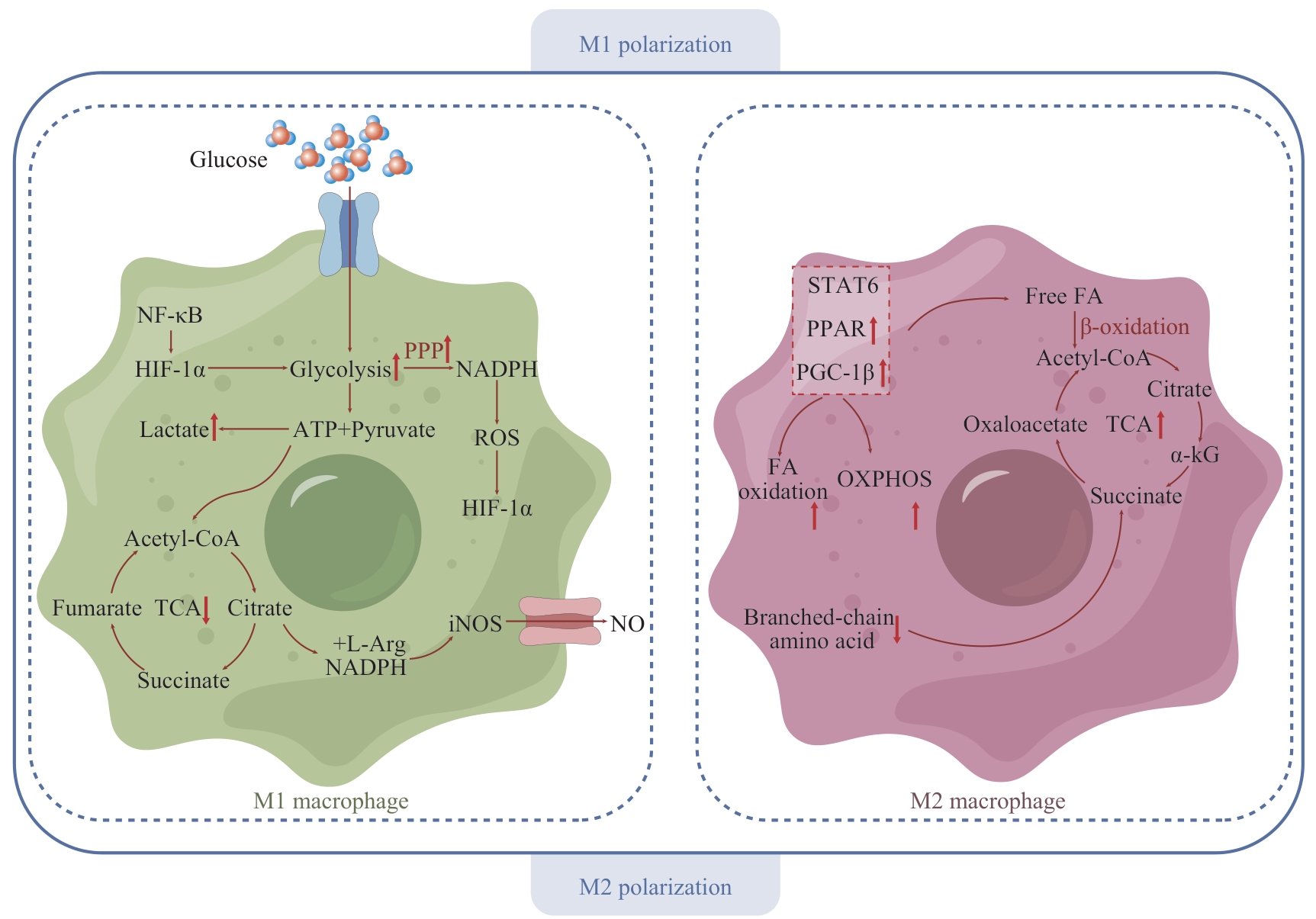
图1 M1和M2巨噬细胞的代谢重编程
Fig 1 Metabolic reprogramming of M1 and M2 macrophages
| [1] | 中华医学会妇产科学分会产科学组,复发性流产诊治专家共识编写组.复发性流产诊治专家共识(2022)[J].中华妇产科杂志,2022,57(9):653-667. |
| The Reproductive Medicine Group of the Obstetrics and Gynecology Branch of the Chinese Medical Association, the Expert Consensus Writing Group for the Diagnosis and Treatment of Recurrent Miscarriage. Expert consensus on the diagnosis and treatment of recurrent miscarriage (2022) [J]. Chinese Journal of Obstetrics and Gynecology, 2022, 57(9): 653-667. | |
| [2] | Deng T Q, Liao X Y, Zhu S M. Recent advances in treatment of recurrent spontaneous abortion[J]. Obstet Gynecol Surv, 2022, 77(6): 355-366. |
| [3] | Guo H Y, Gao H Y, Li J H, et al. Impacts of medroxyprogesterone acetate on oocytes and embryos: matched case-control study in women with stage III-IV ovarian endometriosis undergoing controlled ovarian hyperstimulation for in vitro fertilization[J]. Ann Transl Med, 2020, 8(6): 377. |
| [4] | Sheng Y R, Hu W T, Wei C Y, et al. Insights of efferocytosis in normal and pathological pregnancy[J]. Am J Reprod Immunol, 2019, 82(2): e13088. |
| [5] | Pan Y, Yang L, Chen D Y, et al. Decidual macrophage derived MMP3 contributes to extracellular matrix breakdown in spiral artery remodeling in early human pregnancy[J]. J Reprod Immunol, 2022, 150: 103494. |
| [6] | Zhang W R, Wang M M, Ji C H, et al. Macrophage polarization in the tumor microenvironment: emerging roles and therapeutic potentials[J]. Biomedecine Pharmacother, 2024, 177: 116930. |
| [7] | Wang N, Liang H W, Zen K. Molecular mechanisms that influence the macrophage m1-m2 polarization balance[J]. Front Immunol, 2014, 5: 614. |
| [8] | Jena M K, Nayak N, Chen K, et al. Role of macrophages in pregnancy and related complications[J]. Arch Immunol Ther Exp, 2019, 67(5): 295-309. |
| [9] | Houser B L, Tilburgs T, Hill J, et al. Two unique human decidual macrophage populations[J]. J Immunol, 2011, 186(4): 2633-2642. |
| [10] | Jiang X X, Du M R, Li M, et al. Three macrophage subsets are identified in the uterus during early human pregnancy[J]. Cell Mol Immunol, 2018, 15(12): 1027-1037. |
| [11] | Vassiliou E, Farias-Pereira R. Impact of lipid metabolism on macrophage polarization: implications for inflammation and tumor immunity[J]. Int J Mol Sci, 2023, 24(15): 12032. |
| [12] | Li M Y, Yang Y H, Xiong L T, et al. Metabolism, metabolites, and macrophages in cancer[J]. J Hematol Oncol, 2023, 16(1): 80. |
| [13] | Wang F L, Zhang S, Vuckovic I, et al. Glycolytic stimulation is not a requirement for M2 macrophage differentiation[J]. Cell Metab, 2018, 28(3): 463-475.e4. |
| [14] | Zheng Y X, Wei K, Jiang P, et al. Macrophage polarization in rheumatoid arthritis: signaling pathways, metabolic reprogramming, and crosstalk with synovial fibroblasts[J]. Front Immunol, 2024, 15: 1394108. |
| [15] | van den Bossche J, Baardman J, Otto N A, et al. Mitochondrial dysfunction prevents repolarization of inflammatory macrophages[J]. Cell Rep, 2016, 17(3): 684-696. |
| [16] | Ahangari F, Price N L, Malik S, et al. microRNA-33 deficiency in macrophages enhances autophagy, improves mitochondrial homeostasis, and protects against lung fibrosis[J]. JCI Insight, 2023, 8(4): e158100. |
| [17] | Rodríguez J P, Casas J, Balboa M A, et al. Bioactive lipid signaling and lipidomics in macrophage polarization: impact on inflammation and immune regulation[J]. Front Immunol, 2025, 16: 1550500. |
| [18] | Goossens P, Rodriguez-Vita J, Etzerodt A, et al. Membrane cholesterol efflux drives tumor-associated macrophage reprogramming and tumor progression[J]. Cell Metab, 2019, 29(6): 1376-1389.e4. |
| [19] | de la Aleja A G, Herrero C, Torres-Torresano M, et al. Inhibition of LXR controls the polarization of human inflammatory macrophages through upregulation of MAFB[J]. Cell Mol Life Sci, 2023, 80(4): 96. |
| [20] | Santos Silva L, Poschet G, Nonnenmacher Y, et al. Branched‐chain ketoacids secreted by glioblastoma cells via MCT1 modulate macrophage phenotype[J]. EMBO Rep, 2017, 18(12): 2172-2185. |
| [21] | Zhang K L, Mishra A, Jagannath C. New insight into arginine and tryptophan metabolism in macrophage activation during tuberculosis[J]. Front Immunol, 2024, 15: 1363938. |
| [22] | Rodriguez A E, Ducker G S, Billingham L K, et al. Serine metabolism supports macrophage IL-1β production[J]. Cell Metab, 2019, 29(4): 1003-1011.e4. |
| [23] | Singh K, Coburn L A, Asim M, et al. Ornithine decarboxylase in macrophages exacerbates colitis and promotes colitis-associated colon carcinogenesis by impairing M1 immune responses[J]. Cancer Res, 2018, 78(15): 4303-4315. |
| [24] | Yang H, Kim C, Zou W P. Metabolism and macrophages in the tumor microenvironment[J]. Curr Opin Immunol, 2024, 91: 102491. |
| [25] | Hu T Y, Liu C H, Lei M, et al. Metabolic regulation of the immune system in health and diseases: mechanisms and interventions[J]. Signal Transduct Target Ther, 2024, 9(1): 268. |
| [26] | Auger J P, Zimmermann M, Faas M, et al. Metabolic rewiring promotes anti-inflammatory effects of glucocorticoids[J]. Nature, 2024, 629(8010): 184-192. |
| [27] | Wong A, Sun Q Y, Latif I I, et al. Macrophage energy metabolism in cardiometabolic disease[J]. Mol Cell Biochem, 2025, 480(3): 1763-1783. |
| [28] | Zhou H C, Yu W W, Yan X Y, et al. Lactate-driven macrophage polarization in the inflammatory microenvironment alleviates intestinal inflammation[J]. Front Immunol, 2022, 13: 1013686. |
| [29] | Lin Z J, Dong X, He H, et al. A simplified herbal decoction attenuates myocardial infarction by regulating macrophage metabolic reprogramming and phenotypic differentiation via modulation of the HIF-1α/PDK1 axis[J]. Chin Med, 2024, 19(1): 75. |
| [30] | Shang M, Cappellesso F, Amorim R, et al. Macrophage-derived glutamine boosts satellite cells and muscle regeneration[J]. Nature, 2020, 587(7835): 626-631. |
| [31] | Gong N, Wang W J, Fu Y F, et al. The crucial role of metabolic reprogramming in driving macrophage conversion in kidney disease[J]. Cell Mol Biol Lett, 2025, 30(1): 72. |
| [32] | Dussold C, Zilinger K, Turunen J, et al. Modulation of macrophage metabolism as an emerging immunotherapy strategy for cancer[J]. J Clin Invest, 2024, 134(2): e175445. |
| [33] | O'Neill L A, Kishton R J, Rathmell J. A guide to immunometabolism for immunologists[J]. Nat Rev Immunol, 2016, 16(9): 553-565. |
| [34] | Zhu Y Y, Wu F, Hu J N, et al. LDHA deficiency inhibits trophoblast proliferation via the PI3K/AKT/FOXO1/CyclinD1 signaling pathway in unexplained recurrent spontaneous abortion[J]. FASEB J, 2023, 37(2): e22744. |
| [35] | Tang L C, Xu X H, Xu S, et al. Dysregulated Gln-Glu-α-ketoglutarate axis impairs maternal decidualization and increases the risk of recurrent spontaneous miscarriage[J]. Cell Rep Med, 2023, 4(5): 101026. |
| [36] | Chen Y H, Zhao X M, Gan B, et al. Metabolomics and proteomics analyses reveal the role of the glycerophospholipid metabolism pathway in unexplained recurrent spontaneous abortion[J]. PeerJ, 2025, 13: e19317. |
| [37] | Cargnin S, Agnusdei F, Shin J I, et al. Maternal ApoE genotype and risk of recurrent pregnancy loss: an updated systematic review and meta-analysis[J]. J Gene Med, 2023, 25(3): e3467. |
| [38] | Wang L L, Wang H, Luo J, et al. Decorin promotes decidual M1-like macrophage polarization via mitochondrial dysfunction resulting in recurrent pregnancy loss[J]. Theranostics, 2022, 12(17): 7216-7236. |
| [39] | Zhou W J, Yang H L, Mei J, et al. Fructose-1, 6-bisphosphate prevents pregnancy loss by inducing decidual COX-2+ macrophage differentiation[J]. Sci Adv, 2022, 8(8): eabj2488. |
| [40] | Bao S H, Chen Z C, Qin D K, et al. Single-cell profiling reveals mechanisms of uncontrolled inflammation and glycolysis in decidual stromal cell subtypes in recurrent miscarriage[J]. Hum Reprod, 2023, 38(1): 57-74. |
| [41] | Wu S J, Han L, Zhou M Q, et al. LncRNA AOC4P recruits TRAF6 to regulate EZH2 ubiquitination and participates in trophoblast glycolysis and M2 macrophage polarization which is associated with recurrent spontaneous abortion[J]. Int Immunopharmacol, 2023, 125(Pt B): 111201. |
| [42] | Chen X, Song Q L, Ji R, et al. JPT2 affects trophoblast functions and macrophage polarization and metabolism, and acts as a potential therapeutic target for recurrent spontaneous abortion[J]. Adv Sci (Weinh), 2024, 11(16): e2306359. |
| [43] | Wang B Y, Yang Y, Ye J W, et al. GRIM-19 deficiency promotes macrophage polarization to the M1 phenotype partly through glycolysis in unexplained recurrent spontaneous abortion[J]. Biol Reprod, 2024, 110(4): 739-749. |
| [44] | Yan S S, Ding J L, Wang Z H, et al. CTRP6 regulates M1 macrophage polarization via the PPAR-γ/NF-κB pathway and reprogramming glycolysis in recurrent spontaneous abortion[J]. Int Immunopharmacol, 2023, 124: 110840. |
| [45] | Liu H, Chen H J, Han T, et al. Lipid imbalance and inflammatory oxylipin cascade at the maternal-fetal interface in recurrent spontaneous abortion[J]. Heliyon, 2024, 10(24): e40515. |
| [46] | Yang D Y, Dai F F, Wang L L, et al. HSP70 regulates lipid metabolism of decidual macrophages to maintain normal pregnancy[J]. J Reprod Immunol, 2023, 156: 103829. |
| [47] | Zhu X X, Liu H P, Zhang Z, et al. miR-103 protects from recurrent spontaneous abortion via inhibiting STAT1 mediated M1 macrophage polarization[J]. Int J Biol Sci, 2020, 16(12): 2248-2264. |
| [48] | Ding J L, Zhang Y, Cai X P, et al. Extracellular vesicles derived from M1 macrophages deliver miR-146a-5p and miR-146b-5p to suppress trophoblast migration and invasion by targeting TRAF6 in recurrent spontaneous abortion[J]. Theranostics, 2021, 11(12): 5813-5830. |
| [49] | Ye H X, Liao G N, Dong Y J, et al. miR-146a-5p enhances embryo survival in unexplained recurrent spontaneous abortion by promoting M2 polarization of decidual macrophages[J]. Int Immunopharmacol, 2022, 110: 108930. |
| [50] | Qi X, Ding Y P, Zheng J D, et al. Hsa-miR-194-5p regulates TRAF6-mediated M1 macrophage apoptosis in recurrent spontaneous abortion[J]. J Mol Histol, 2025, 56(3): 166. |
| [51] | Zhang Y H, Wang H Y, Qiu P P, et al. Decidual macrophages derived NO downregulates PD-L1 in trophoblasts leading to decreased Treg cells in recurrent miscarriage[J]. Front Immunol, 2023, 14: 1180154. |
| [52] | Morley L C, Tang T, Yasmin E, et al. Insulin-sensitising drugs (metformin, rosiglitazone, pioglitazone, D-chiro-inositol) for women with polycystic ovary syndrome, oligo amenorrhoea and subfertility[J]. Cochrane Database Syst Rev, 2017, 11(11): CD003053. |
| [53] | Tamblyn J A, Pilarski N S P, Markland A D, et al. Vitamin D and miscarriage: a systematic review and meta-analysis[J]. Fertil Steril, 2022, 118(1): 111-122. |
| [54] | Nie X Y, Dong X R, Hu Y G, et al. Coenzyme Q10 stimulate reproductive vitality[J]. Drug Des Devel Ther, 2023, 17: 2623-2637. |
| [55] | Canella P R B C, Barini R, Carvalho P O, et al. Lipid emulsion therapy in women with recurrent pregnancy loss and repeated implantation failure: the role of abnormal natural killer cell activity[J]. J Cell Mol Med, 2021, 25(5): 2290-2296. |
| [56] | Chen S A, Zhang J H, Chen J, et al. Compromised C3b-VSIG4 axis between decidual NK cells and macrophages contributes to recurrent spontaneous abortion[J]. J Transl Med, 2024, 22(1): 1017. |
| [57] | Sayama S, Nagamatsu T, Schust D J, et al. Human decidual macrophages suppress IFN-γ production by T cells through costimulatory B7-H1: PD-1 signaling in early pregnancy[J]. J Reprod Immunol, 2013, 100(2): 109-117. |
| [58] | Michelet X, Dyck L, Hogan A, et al. Metabolic reprogramming of natural killer cells in obesity limits antitumor responses[J]. Nat Immunol, 2018, 19(12): 1330-1340. |
| [59] | Wei Y Q, Ding J L, Li J N, et al. Metabolic reprogramming of immune cells at the maternal-fetal interface and the development of techniques for immunometabolism[J]. Front Immunol, 2021, 12: 717014. |
| [1] | 钱亦乐, 姚赛, 陈思锋, 李全富, 赵猛. 巨噬细胞介导心肌纤维化的分子机制及靶向干预研究进展[J]. 上海交通大学学报(医学版), 2026, 46(3): 348-357. |
| [2] | 姜芊羽, 姚程程, 季萍, 王颖. HAMA水凝胶促进皮肤创面愈合的组织局部微环境特征[J]. 上海交通大学学报(医学版), 2025, 45(8): 969-980. |
| [3] | 王琳, 徐萍, 张乔婷, 田军, 娄晓丽, 王静. 胱天蛋白酶募集域蛋白9在重症急性胰腺炎巨噬细胞M1极化中的作用[J]. 上海交通大学学报(医学版), 2025, 45(8): 981-989. |
| [4] | 韩龙传, 李悦, 邹智慧, 罗静, 李若伊, 张颖婷, 唐欣欣, 田丽红, 陆宇恒, 黄莺, 贺明, 付寅坤. 磷脂酰乙醇胺引起内质网应激促进巨噬细胞衰老及肝损伤[J]. 上海交通大学学报(医学版), 2025, 45(6): 693-704. |
| [5] | 黄英荷, 招冠钰, 孙阳, 侯鉴基, 左勇. 2型糖尿病创面愈合中巨噬细胞代谢调控的研究进展[J]. 上海交通大学学报(医学版), 2025, 45(6): 792-799. |
| [6] | 汤开然, 冯成领, 韩邦旻. 基于单细胞测序与转录组测序构建M2巨噬细胞基因相关的前列腺癌预后模型[J]. 上海交通大学学报(医学版), 2025, 45(5): 549-561. |
| [7] | 倪书奕, 姜钊, 汪中涛, 何树梅. 红景天苷对卡介苗感染的巨噬细胞免疫功能的影响[J]. 上海交通大学学报(医学版), 2025, 45(4): 426-433. |
| [8] | 马秀珍, 周妮, 郭思琪, 王源媛, 麦平. 大麻素受体1通过Gαi/o/RhoA信号通路促进急性肺损伤小鼠巨噬细胞M1极化[J]. 上海交通大学学报(医学版), 2025, 45(2): 161-168. |
| [9] | 李广慧, 冯晓玲. 复发性流产中胎盘细胞铁死亡的研究进展[J]. 上海交通大学学报(医学版), 2025, 45(10): 1383-1389. |
| [10] | 张烨晟, 杨易静, 黄依雯, 施珑玙, 王曼媛, 陈思思. 肿瘤微环境免疫细胞调节肿瘤细胞耐药性的研究进展[J]. 上海交通大学学报(医学版), 2024, 44(7): 830-838. |
| [11] | 牛媛媛, 汪龙德, 胥文娟, 李正菊, 张瑞婷, 吴毓谦. 巨噬细胞M1/M2型极化在不同肝病中的作用研究进展[J]. 上海交通大学学报(医学版), 2024, 44(4): 509-517. |
| [12] | 张羽桐, 侯国俊, 沈南. 单细胞基因组学比较人诱导多能干细胞来源巨噬细胞与外周血来源巨噬细胞的异质性[J]. 上海交通大学学报(医学版), 2024, 44(12): 1477-1489. |
| [13] | 宋文汀, 陶悦, 潘艺, 莫茜, 曹清. SIRT2通过组蛋白H4K8去乳酸化修饰调控巨噬细胞趋化功能[J]. 上海交通大学学报(医学版), 2023, 43(8): 1008-1016. |
| [14] | 吴淇琦, 汪豪, 林砺, 晏博, 张舒林. miR-185-5p通过抑制巨噬细胞自噬促进胞内分枝杆菌生长[J]. 上海交通大学学报(医学版), 2023, 43(6): 699-708. |
| [15] | 魏兰懿, 薛晓川, 陈君君, 杨全军, 王梦月, 韩永龙. 骨肉瘤免疫微环境中肿瘤相关巨噬细胞及其靶向治疗的研究进展[J]. 上海交通大学学报(医学版), 2023, 43(5): 624-630. |
| 阅读次数 | ||||||
|
全文 |
|
|||||
|
摘要 |
|
|||||
